
Image: Saphir Hops – Technical Brewing Specifications Chart
Published: October 25, 2026 at 4:07:21 PM UTC
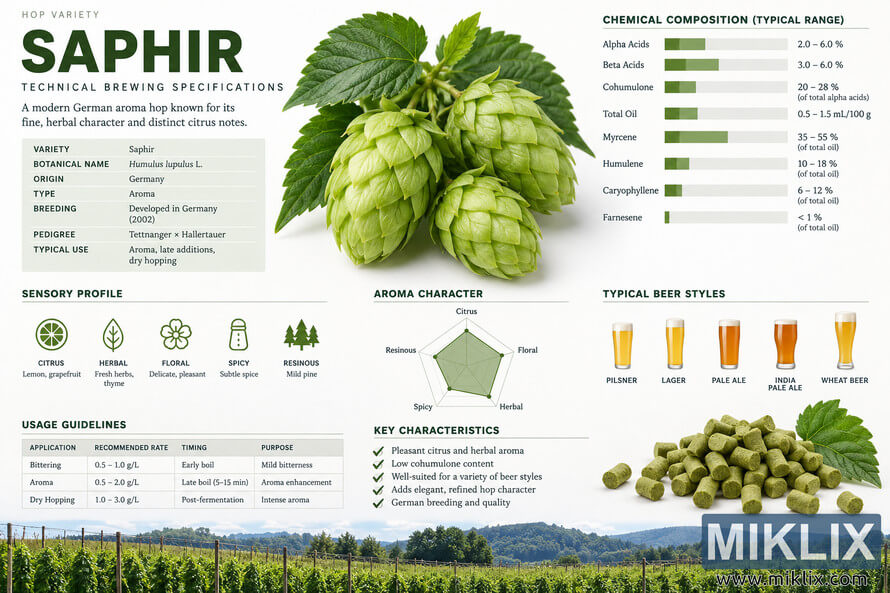
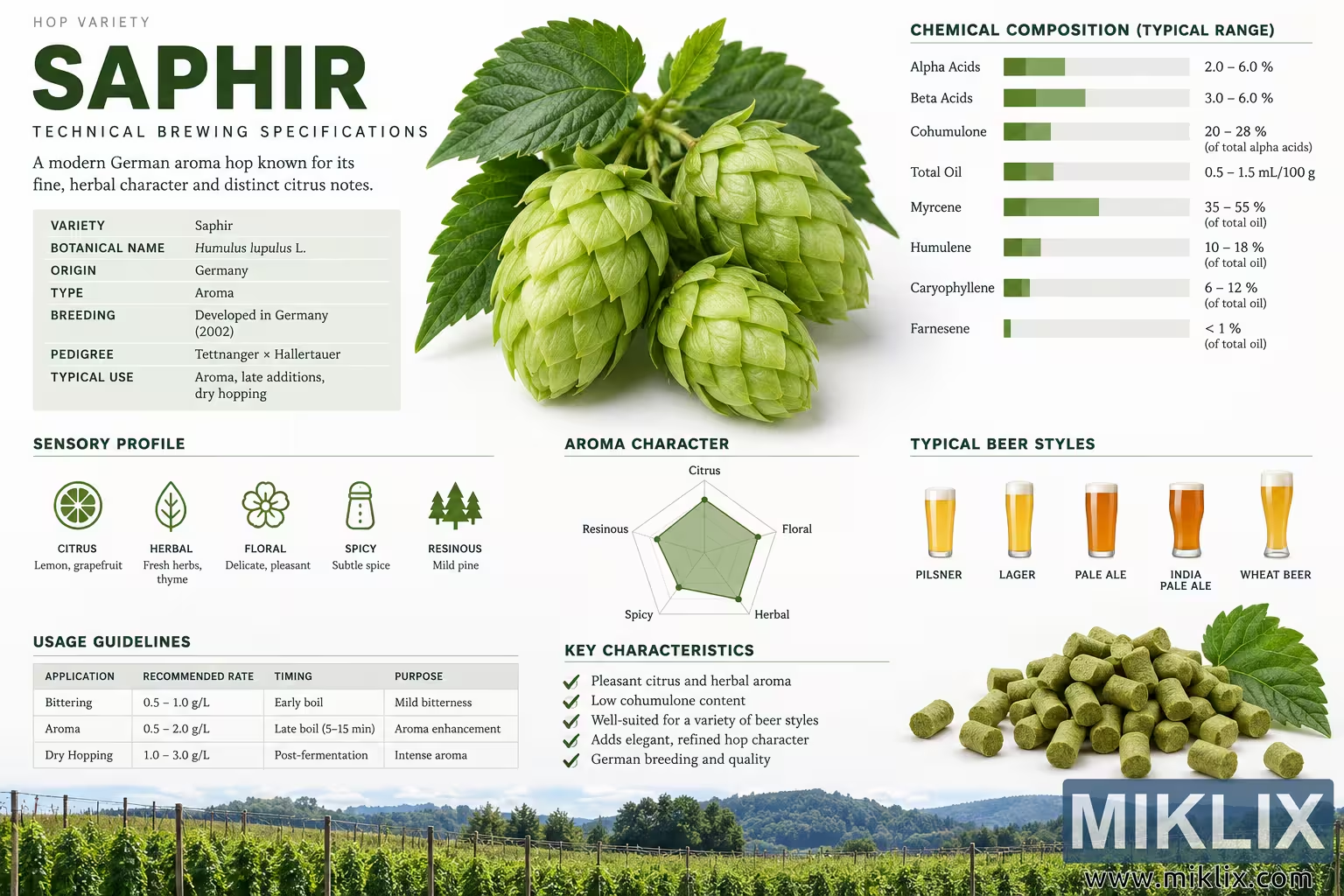
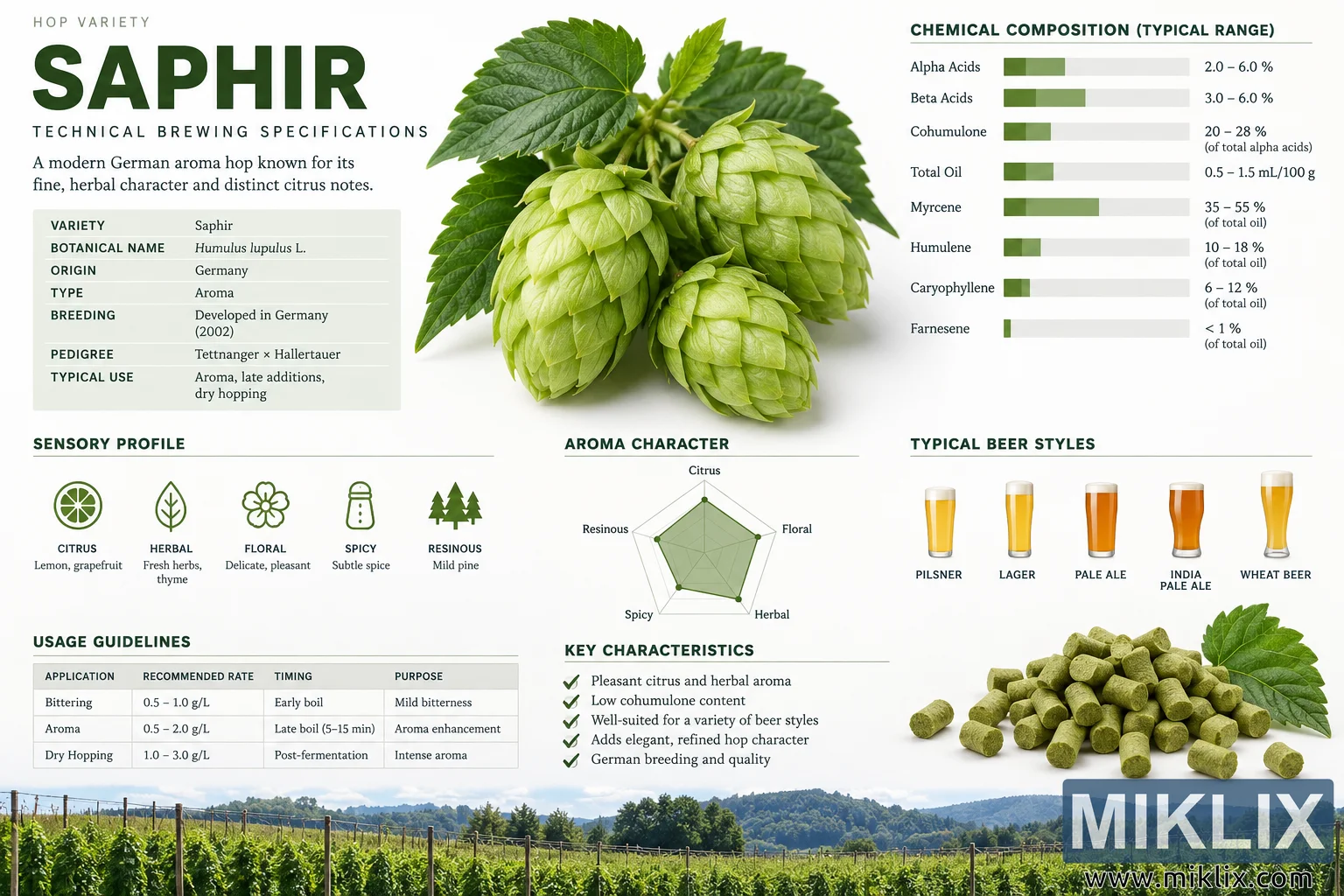
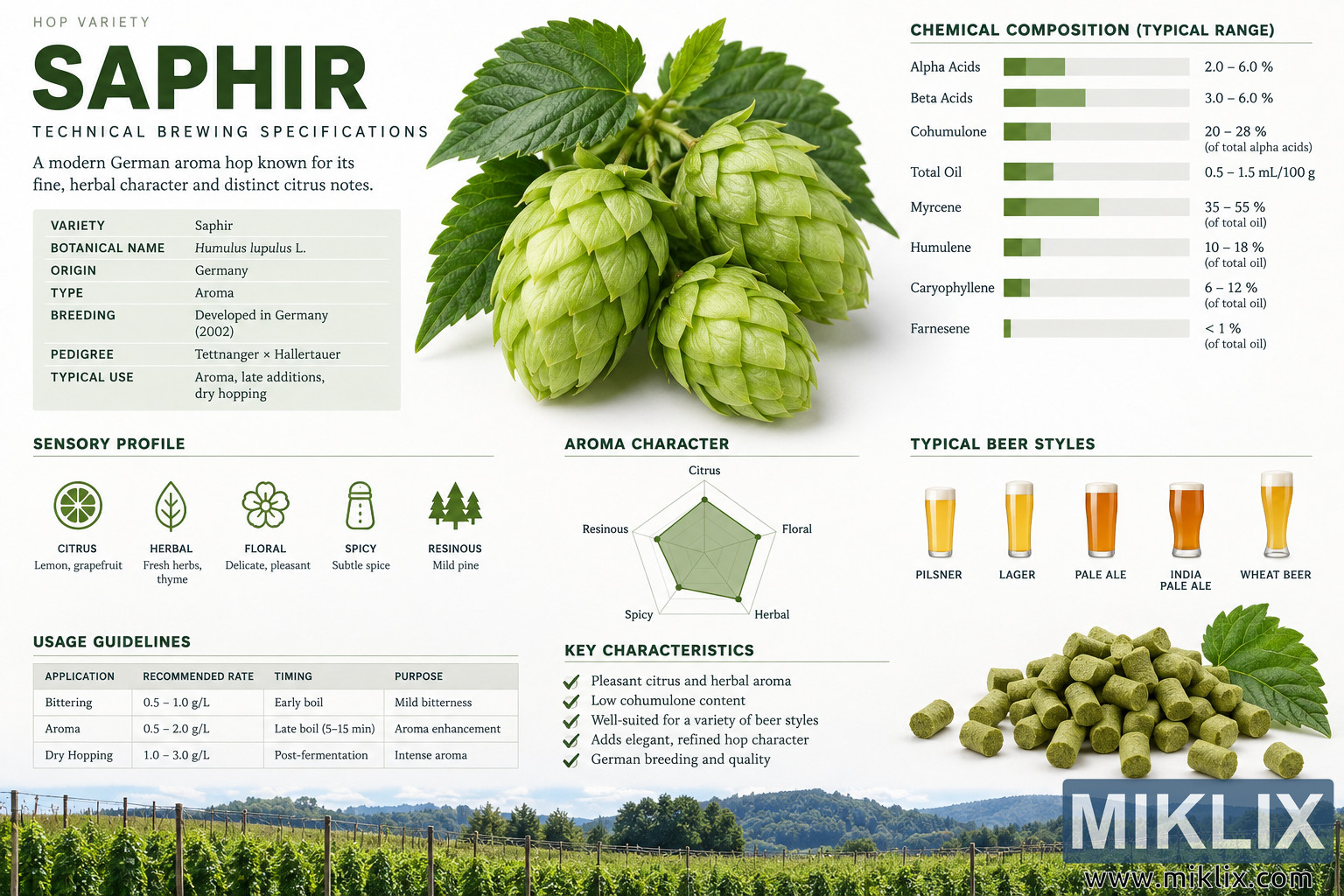
Technical Saphir hops infographic with brewing specifications, chemical ranges, aroma and sensory profile, usage guidelines, beer styles, hop pellets and botanical imagery.
Available versions of this image
The image files available for download below are less compressed and higher resolution - and as a result of that, higher quality - than the images embedded in articles and pages on this website, which are more optimized for file size in order to reduce bandwidth consumption.
Regular size (1,536 x 1,024)
Large size (3,072 x 2,048)
Very large size (4,608 x 3,072)
Extra large size (6,144 x 4,096)
Comically large size (1,048,576 x 699,051)
- Still uploading... ;-)
Image description
A wide, landscape-format technical brewing infographic presents the Saphir hop variety against a bright white background with restrained green accents and a clean, professional reference-chart aesthetic. The composition is divided into clearly organized informational zones combining botanical photography, brewing data, diagrams, icons, and product-style imagery. At the upper left, a small heading reading “HOP VARIETY” sits above the dominant title “SAPHIR,” rendered in very large, bold, dark-green uppercase lettering. Immediately beneath it is the subtitle “TECHNICAL BREWING SPECIFICATIONS.” A short introductory paragraph describes Saphir as a modern German aroma hop associated with fine herbal character and distinct citrus notes. Below this introduction is a pale, subtly tinted specification panel arranged like a compact technical table. It identifies the variety as Saphir, gives the botanical name Humulus lupulus L., lists Germany as the origin, categorizes the hop as an aroma variety, notes German development in 2002, provides pedigree information, and indicates typical use for aroma additions, late additions, and dry hopping.
The central upper portion of the image is dominated by a highly detailed photographic rendering of fresh hop cones. Several plump, pale-green cones overlap one another, surrounded by broad, richly textured green hop leaves. Fine veins, serrated leaf edges, layered cone bracts, natural highlights, and soft shadows give the botanical subject a realistic studio-photography appearance. The cones are positioned partly over the surrounding information areas, creating a visual focal point while preserving the structured technical character of the poster. No commercial packaging, company logos, trademarks, or actual product brands are visible anywhere in the composition.
At the upper right, a section titled “CHEMICAL COMPOSITION (TYPICAL RANGE)” displays brewing-related analytical values using horizontal indicator bars. Each measurement is labeled on the left, while a green segment against a light gray bar provides a visual indication of its typical range. The displayed categories include alpha acids, beta acids, cohumulone, total oil, myrcene, humulene, caryophyllene, and farnesene. Numeric ranges appear alongside the bars, with percentage or oil-volume units where appropriate. The section resembles a laboratory specification sheet or professional brewing ingredient reference, using aligned rows, understated rules, and compact typography for efficient scanning.
Across the lower half, the infographic separates sensory information, aroma characterization, beer-style applications, usage guidance, and key traits into distinct modules. On the left, the “SENSORY PROFILE” section contains five simple green line icons with labels and short descriptors. Citrus is represented by a sliced citrus-fruit symbol and is associated with lemon and grapefruit. Herbal is represented by a leaf and is described with fresh herbs and thyme. Floral uses a flower icon and suggests a delicate, pleasant quality. Spicy is represented by a shaker-like symbol and described as subtle spice. Resinous uses stylized evergreen trees and is associated with mild pine. The iconography is minimal and consistent, functioning as an at-a-glance sensory vocabulary for brewers.
Near the center is an “AROMA CHARACTER” radar chart. A translucent green polygon is plotted over a five-axis grid with the axes labeled Citrus, Floral, Herbal, Spicy, and Resinous. The polygon visually emphasizes the relative sensory profile, with citrus, floral, and herbal characteristics appearing prominent while spicy and resinous characteristics remain present but less dominant. This chart complements the icon-based sensory section by translating the descriptive attributes into a more technical visual format.
On the right, a “TYPICAL BEER STYLES” section displays five generic, unbranded glasses of beer in different shapes and shades of gold to amber. The labels beneath them identify Pilsner, Lager, Pale Ale, India Pale Ale, and Wheat Beer. The glasses contain realistic-looking beer with pale foam heads but contain no logos, branded glassware, packaging, or recognizable commercial marks. Below and beside this section is a pile of green hop pellets photographed against the white background. The pellets vary slightly in orientation and size, creating a natural loose pile, and a fresh green hop leaf extends behind them. This imagery visually connects whole-cone hops with the processed pellet form commonly encountered in brewing.
At the lower left, the “USAGE GUIDELINES” section is formatted as a small technical table with columns for application, recommended rate, timing, and purpose. Rows cover bittering, aroma use, and dry hopping, with rates expressed in grams per liter and timing references such as early boil, late boil, and post-fermentation. The table uses fine borders, muted gray-green shading, and compact typography, reinforcing the appearance of a professional brewer’s reference sheet rather than an advertising poster.
The lower center contains a “KEY CHARACTERISTICS” section marked by green check symbols. The statements summarize qualities such as pleasant citrus and herbal aroma, relatively low cohumulone content, suitability for multiple beer styles, an elegant or refined hop character, and German breeding heritage. These concise statements provide a quick-reference summary after the more detailed numerical and sensory sections above.
Along the entire bottom edge, a panoramic photograph of a hop-growing landscape forms a narrow visual footer. Rows of vigorous green hop plants extend across agricultural trellises and posts, with rolling wooded hills visible in the distance beneath a lightly clouded blue sky. The landscape adds geographic and agricultural context while also grounding the otherwise clinical white infographic in the natural origin of the ingredient. Overall, the image combines botanical realism with the visual language of a technical brewing datasheet: generous white space, dark-green headings, pale neutral panels, fine divider lines, precise charts, practical brewing information, and realistic hop imagery. The design is landscape oriented, highly detailed, informational rather than promotional, and entirely generic in branding. Its overall impression is that of a polished educational reference chart intended for brewers, brewing students, hop enthusiasts, or anyone comparing the sensory, chemical, and practical characteristics of the Saphir hop variety.
The image is related to: Hops in Beer Brewing: Saphir