
Hops in Beer Brewing: Sladek
Published: February 19, 2026 at 5:29:37 PM UTC
Sladek is a Czech aroma hop, bred in Czechia. It has a clear pedigree and is a practical choice for brewers. Known internationally as SLD, it was developed from VÚCH-71 cultivar. The goal was to combine noble European traits with more fruit and vigor.
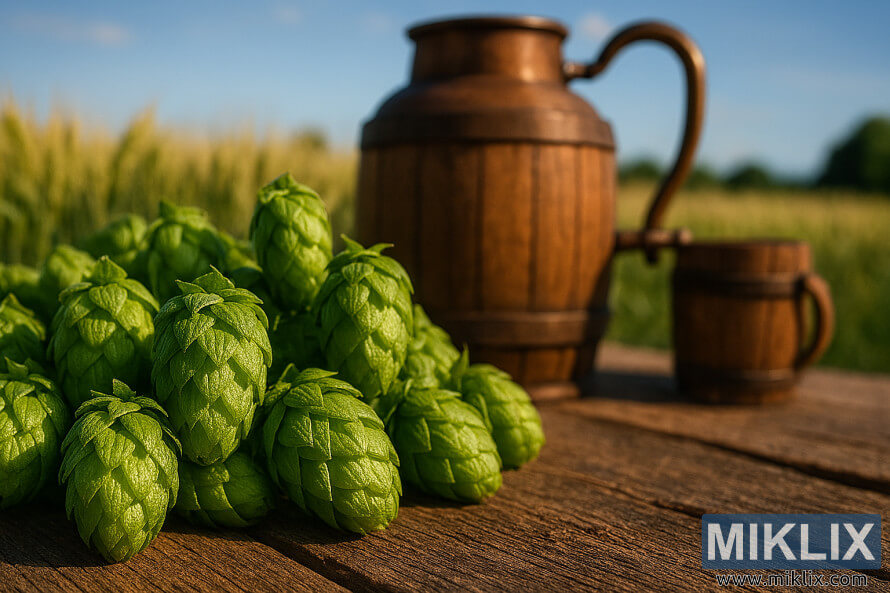
Click or tap the image for more information and higher resolutions.
The name Sladek comes from the Czech word for “brewer.” It's a cross between Saaz and Northern Brewer, registered as VÚCH 71 in 1987. Later, in 1994, it was renamed Sladek. This background explains its balanced aroma and reliable brewing performance.
Readers will find detailed information on Sladek's origin, flavor, and aroma. There's also a focus on brewing uses, chemical profile, and agronomy. Additionally, substitutes, availability, recipe guidance, commercial examples, storage, and its sensory impact are covered. The article also explores its role in current craft trends.
Key Takeaways
- Sladek hops are a Czech aroma hop with floral and herbal character.
- The variety is a Saaz × Northern Brewer cross, registered as VÚCH 71 in 1987.
- Sladek works well in lagers, pilsners, and certain ales for subtle aroma lift.
- U.S. brewers will find Sladek versatile for both late additions and dry hopping.
- This guide covers chemistry, growing traits, substitutes, recipes, and storage.
What Are Sladek Hops and Their Origin
Sladek is a Czech aroma hop, bred in Czechia. It has a clear pedigree and is a practical choice for brewers. Known internationally as SLD, it was developed from VÚCH-71 cultivar. The goal was to combine noble European traits with more fruit and vigor.
Genetically, Sladek is a mix of Saaz and Northern Brewer. This blend gives it a Saaz-type profile but with a firmer backbone. The VÚCH-71 designation marks its registration and wider adoption.
Registration started in 1987, when it was listed as VÚCH 71. Growers and brewers widely adopted it after it was renamed Sladek in 1994. The name Sladek, meaning "brewer" in Czech, honors its intended use and cultural roots.
It's also known as Czech Sladek, Sládek with the diacritic, and VÚCH‑71. Sladek's history shows ongoing interest from European and North American craft brewers. They seek a noble hop with a fruity twist.
As an aroma hop, Sladek shines in late boil additions, whirlpool additions, or dry hopping. Brewers appreciate its balance of classic Saaz spice and the brighter notes from Northern Brewer. This versatility makes Sladek suitable for lagers and lighter ales.
Flavor and Aroma Profile of Sladek Hops
Sladek flavor is rooted in a noble, floral base with a spicy edge. It's known for its delicate, old-world charm. This makes it a perfect match for lighter lagers and pilsners.
Fruity notes also emerge, with many describing it as peach passionfruit grapefruit. These elements add a bright, tropical quality. They enhance the beer without overpowering it.
The presence of floral spicy hops is noticeable in late additions and dry hopping. Used late in the kettle, Sladek preserves volatile oils. This results in a soft perfume and a peppery nuance.
Blending Sladek with Saaz showcases its strengths. The Saaz-like noble background smooths out the spicy tones. Meanwhile, the fruit components stay prominent, creating a balanced hop character for lagers and hybrid ales.
- Best use: late-boil additions to protect aroma
- Dry hopping: enhances peach and passionfruit highlights
- Pairing: Saaz for a refined, noble finish
For those seeking subtle complexity, Sladek offers elegance. The combination of peach passionfruit grapefruit with floral spicy hops provides brewers with options for aroma-forward beers.
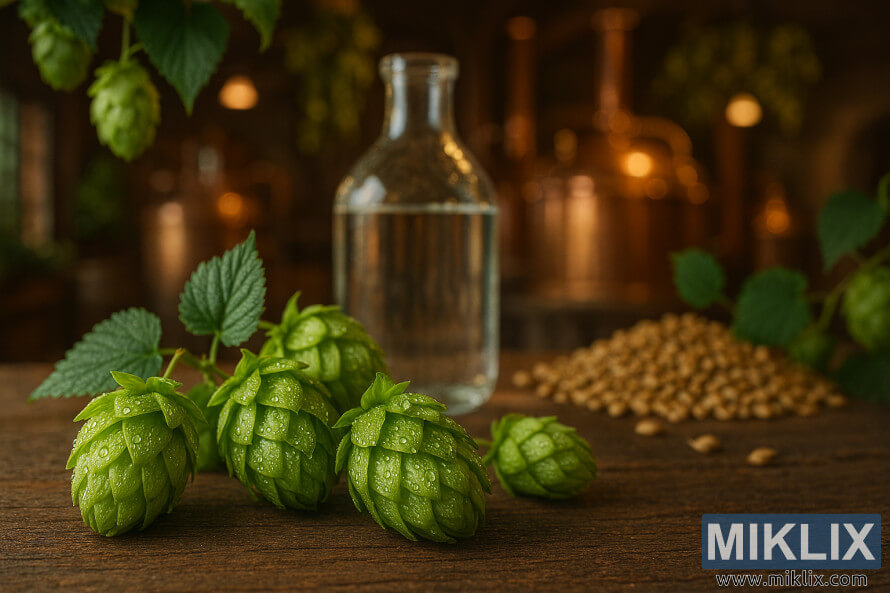
Click or tap the image for more information and higher resolutions.
Brewing Characteristics and Purpose
Sladek is highly valued as an aroma hop. It's used during late additions to preserve delicate oils and enhance floral and fruit notes. Its role is to impact the senses, not just bitter the beer. Therefore, timing is more critical than alpha acid content.
It's commonly used in whirlpool, flameout, or dry hopping phases of fermentation. These methods help retain volatile compounds, showcasing Sladek's aromatic qualities. As a late addition, it adds a brighter, fresher character to the beer.
In Pilsners and classic lagers, Sladek is often paired with Saaz. This combination complements noble hop profiles and adds subtle fruit complexity to balanced styles. Its purpose is to enhance the aroma without dominating the base hop character.
While Sladek has some alpha acid, it's rarely chosen as a primary bittering hop. Its true purpose lies in finishing and conditioning the beer. Dry hopping amplifies its aromatic qualities, contributing to a well-rounded, aromatic finish.
- Addition points: whirlpool, flameout, fermentation/dry hop.
- Main goal: aroma enhancement and fruit/floral lift.
- Common pairing: Saaz and other noble varieties for balance.
Chemical Composition and Oil Breakdown
Sladek alpha acids typically range from about 4.5% to 9%, with many sources clustering near 6.8% on average. This range indicates Sladek's limited bittering potential compared with high-alpha bittering hops.
Sladek beta acids sit roughly between 4% and 11%, averaging near 7.5% in some analyses. Beta acids do not add classic boil bitterness but can influence aroma stability and the beer's aging profile.
Co-humulone makes up a notable portion of the alpha fraction, commonly from 23% to 40% and averaging about 31.5%. This moderate co-humulone level can shape perceived harshness when hops are used early in the boil.
Total essential oils in Sladek usually fall between 0.8 and 2.0 mL per 100 g, with many reports near 1.4 mL/100 g. This oil load supports the hop's aromatic contribution when used late or in dry hopping.
- Myrcene: about 35%–50% (avg ~42.5%). Provides resinous, citrus, and fruity top notes.
- Humulene: roughly 20%–40% (avg ~30%). Brings woody, noble, and spicy character.
- Caryophyllene: near 9%–14% (avg ~11.5%). Adds peppery, woody, and herbal tones.
- Farnesene: commonly 0%–1% (avg ~0.5%). Contributes fresh, green, floral hints.
- Other minor oils (β-pinene, linalool, geraniol, selinene) can reach up to 36% combined, enhancing floral and citrus nuance.
Examining hop oil composition reveals why Sladek favors floral and fruity expressions. A high myrcene fraction drives bright citrus and resin notes. Meanwhile, humulene and caryophyllene layer in noble spice and herbal depth.
Because many of these volatiles evaporate when boiled, late additions or dry hopping best preserve myrcene, humulene, caryophyllene, farnesene, and the minor terpenes. Brewers seeking aromatic impact should plan timing around that volatility.
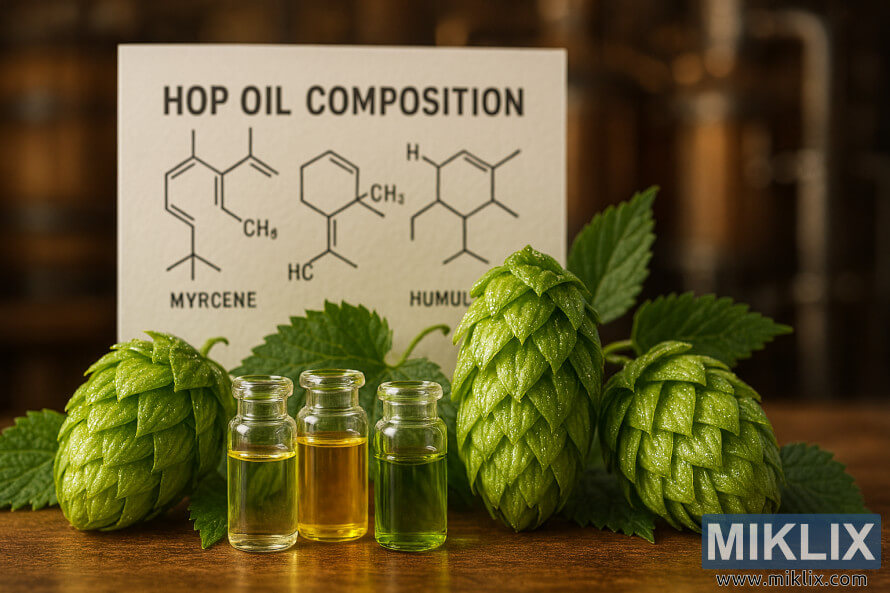
Click or tap the image for more information and higher resolutions.
Growing Regions and Agronomic Traits
Sladek was bred in the Czech Republic and remains most common across Czech hop farms. Growers in Bohemia and Moravia list Sladek as a regional aroma variety that fits local soils and climate. Interest in VÚCH-71 cultivation spreads through Czech hop networks and catalogs.
Public agronomic notes for Sladek agronomy describe medium to large cone size and good cone density. Reports vary on exact numbers for yield and maturation time. Some producers call Sladek a high-yielding aroma hop under well-managed conditions.
Field records show a steady growth rate with predictable seasonal maturity in Central European climates. Disease resistance and susceptibility are reported inconsistently. Farmers are advised to confirm specific resistance ratings with seed-stock suppliers or Czech hop farms before planting.
Harvesting and storability traits are favorable for craft and regional producers. Storability appears acceptable for an aroma hop, and mechanical harvest adapts well to standard equipment used on Czech hop farms. Practical choices for irrigation and pruning depend on local microclimate and management goals.
Key considerations for VÚCH-71 cultivation include matching site soil, monitoring for regional pests, and consulting local agronomy guides. Trial plots and consultation with established Czech hop farms help refine expectations for yield and post-harvest handling in Sladek growing regions.
Common Beer Styles Using Sladek Hops
Sladek hops are a perfect match for Czech and German lager traditions. They blend well with Saaz and noble hops in light, crisp recipes. This combination enhances floral and soft fruit notes without increasing bitterness. In pilsner recipes, Sladek adds a refreshing peach or floral note to the finish.
For optimal results, brewers prefer late additions, whirlpool, and dry hopping. These methods help preserve delicate esters and emphasize the hop's aroma. In lager brewing, Sladek is used to achieve a bright, clean character, avoiding aggressive resinous flavors.
Craft brewers also use Sladek in IPAs for a unique twist. Added late or during dry hopping, it brings out stone-fruit and tropical hints like passionfruit and grapefruit. This aroma complements citrusy or pine-forward American varieties well.
Sladek's versatility extends to hybrid and modern beer styles. It excels in both classic Czech lagers and hazy pale ales. Its use in these styles is marked by restrained bitterness and a focus on aroma. Even small additions can significantly enhance a recipe without upsetting the balance.
- Traditional: Czech pilsners and lagers — floral lift, subtle fruit
- Modern: IPAs and pale ales — late/aroma use for tropical and stone-fruit notes
- Hybrid: Session beers and craft lagers — aroma-driven, low bitterness
Typically, brewers favor aroma-focused timing with Sladek. The best results come from flameout, whirlpool rests, and dry hopping. This approach ensures Sladek complements pilsners and lagers effectively in many recipes.
Substitutes and Comparable Varieties
Brewers often look for Sladek substitutes, turning to Saaz and Northern Brewer. Saaz, from the Czech Republic or its US-grown counterpart, offers a noble, mild spice and floral profile. This is similar to Sladek's contribution to lagers and pilsners. Northern Brewer, with its genetic link to Sladek, provides a resinous-citrus backbone. It's suitable when more bite is desired.
These hop substitutions are best used in late-kettle additions or for dry hopping. This method captures aroma and delicate fruit notes. Adjust amounts based on differing alpha acids and essential oil totals. Begin with a one-to-one swap, then adjust by 10–30% after tasting trial batches.
Consider the role you need filled. For a subtle noble character, choose Saaz alternative hops. For a greener, bolder edge, opt for a Northern Brewer replacement. Each variety adds distinct esters and herbal nuances, affecting the beer's balance.
Concentrated lupulin products like Cryo, Lupomax, or LupuLN2 are scarce for Sladek. Major suppliers such as Yakima Chief Hops, Barth-Haas, and Hopsteiner offer limited lupulin options. This limits direct lupulin-based hop substitutions for brewers preferring powder or high-impact extracts.
When planning recipes, consider oil composition differences and aroma intensity. Keep records of substitution trials and sensory notes. This helps refine future batches and ensures consistent results when using alternative hops for aroma and flavor.
Buying Sladek Hops and Availability
Sladek availability changes with the season and location. Suppliers in Europe and North America offer whole cones and pellets. U.S. buyers should verify the harvest year and lot notes before making a purchase.
Online hop merchants and marketplaces often have Sladek. For quick searches, ask about Sladek availability on craft brewing forums and check major hop retailers. Amazon listings occasionally appear, but availability can change with the harvest cycle.
- Purchase formats: whole cones and pellets are most common.
- Unavailable formats: lupulin powder and cryo forms are not generally offered for Sladek.
- Shipping: most suppliers ship within their home country; international shipping depends on customs and carrier rules.
When buying Sladek hops, review the alpha and beta acid data for the specific lot. Late-season crops may show more variability in oil composition. Request a lab certificate from Sladek suppliers if consistency in your recipe is crucial.
To secure supply, compare prices across merchants and confirm Sladek availability before planning a brew. For imports from Czech or other European growers, verify shipping policies and estimated transit times to avoid freshness loss.
Simple buying tips: request harvest year, request lab analysis, and choose pellets for longer shelf life when immediate use is unlikely. These steps make it easier to find where to buy Sladek and ensure the hops match your brewing goals.
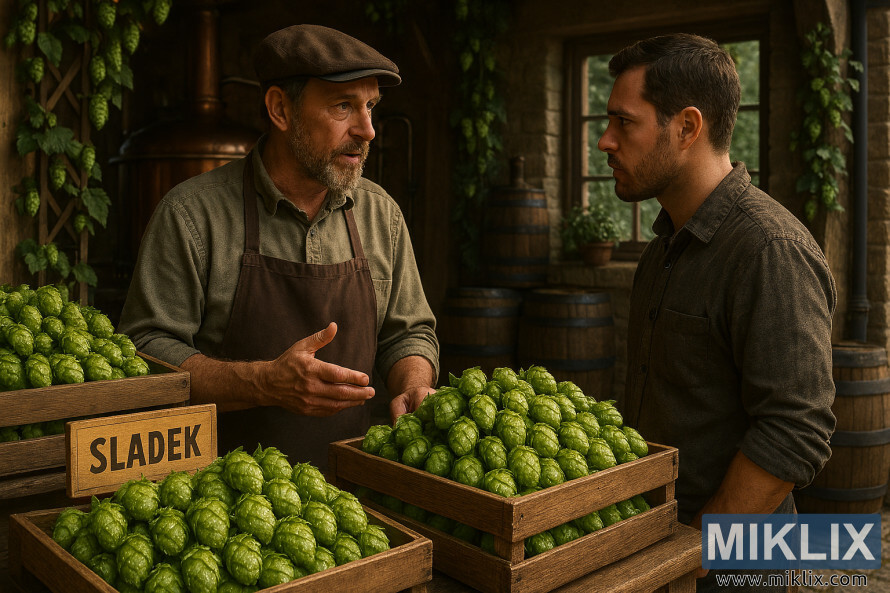
Click or tap the image for more information and higher resolutions.
Using Sladek Hops in Homebrewing Recipes
Sladek homebrew benefits from late-boil, whirlpool, and dry hop additions. These methods capture delicate peach, passionfruit, and grapefruit notes. For aroma focus, add small late-boil amounts and a gentle whirlpool at cooler temps. This protects volatile oils.
Treat Sladek like other aroma hops when crafting a Sladek recipe. Use modest late additions—grams per pound of grain or per batch volume. This depends on batch size. Plan multi-day Sladek dry hop contact to lift fruity character without vegetal harshness.
Recommended approach:
- Add a small late-boil charge at 5–10 minutes for flavor lift.
- Whirlpool at 160–175°F for 15–30 minutes to extract oils while avoiding heavy isomerization.
- Dry hop for 3–7 days, splitting additions if you want a layered aroma.
Style pairings work well when Sladek is subtle. Use it in Czech-style pilsners and lagers to add noble-laced fruitiness. Or blend into pale ales and IPAs for a soft tropical lift. Combining Sladek with Saaz creates a classic Czech profile with a brighter fruit edge.
When substituting, account for alpha acid and oil differences if replacing Saaz or Northern Brewer. Adjust late-addition quantities to match perceived aroma intensity rather than weight alone.
Handling tips: choose pellets for ease of dosing and extraction. Avoid extended high-heat exposure to preserve delicate oils. Consider adding hops during active fermentation for biotransformation that enhances ester-like notes.
Commercial Brewer Use Cases and Examples
Professional breweries often choose Sladek for lager and pilsner recipes. They seek a refined noble aroma with a gentle fruit lift. Many Sladek breweries use it to introduce peach, passionfruit, or grapefruit accents without overpowering the malt profile.
Pairing strategies help maintain a classic Czech character while expanding aroma complexity. Brewers commonly blend Sladek with Saaz or Žatec. This adds subtle tropical top notes. This approach suits flagship lagers and seasonal releases alike.
Large-scale sourcing depends on crop-year reports and tight supplier coordination. Brewers who rely on Sladek in production beer usually work with Czech suppliers such as Bohemia Hop. They secure consistent lots and plan around harvest variation.
- Core lineup use: gentle dry-hop additions to brighten a pilsner.
- Special batches: single-hop trials and limited editions that spotlight aroma nuance.
- Blending: paired with noble varieties to balance classic and modern profiles.
Some commercial brewers market small-run beers that highlight Sladek’s unique aromatics. These limited releases help breweries differentiate their portfolios. They test consumer response to lighter, fruit-tinged noble hops.
Availability in varietal catalogs makes Sladek accessible to many operations. Still, procurement teams at Sladek breweries track yearly yield and alpha variation. They keep Sladek in production beer consistent across batches.

Click or tap the image for more information and higher resolutions.
Storage, Shelf Life, and Storability
Proper handling is key for Sladek storage, especially for aroma hops. The shelf life of hops depends on their packaging and storage temperature. A sealed lot kept cold will retain aroma better than one exposed to room air.
To store Sladek hops effectively, vacuum-seal them in oxygen-barrier bags and refrigerate or freeze. This method slows down the degradation of alpha acids and volatile oils like myrcene. By limiting oxygen exposure and avoiding temperature fluctuations, you preserve the hop's aroma for late additions.
Over time, volatile oils like myrcene decrease, reducing floral and fruity notes. The total oil content, typically between 0.8–2.0 mL/100g for Sladek, also diminishes with age. This decline impacts the perceived hop freshness in the beer.
- Store vacuum-sealed and chilled to extend hop shelf life.
- Rotate stock by harvest year and use the newest hops for late additions.
- Request analysis and harvest date from suppliers to assess lot quality.
For homebrewers and craft brewers, storing Sladek hops in a dedicated freezer section is crucial. Use the most recent harvest for dry hopping or late kettle additions to maximize character. Proper inventory control and attention to Sladek storage ensure consistent results and preserve hop freshness.
Impact of Sladek Hops on Final Beer Sensory Profile
Sladek hops introduce a delicate blend of floral and noble spice, enhancing a beer's profile without dominating it. When added late in the boil or as a dry hop, they impart distinct fruity notes like peach, passionfruit, and grapefruit.
The timing of hop addition significantly influences the outcome. Late additions and dry hopping help preserve myrcene and other volatile oils, resulting in the characteristic beer aroma associated with Sladek. Early boil additions, however, lose these volatile compounds, limiting the aroma's contribution.
The bitterness level of a beer can also be affected by Sladek's use. With moderate alpha acids around 6.8% and co-humulone near 31.5%, it can introduce a subtle bitterness if added early. Yet, most brewers prefer it for its aromatic qualities, enhancing the beer's flavor.
The interaction between Sladek hops, malt, and yeast is crucial. In lagers and pilsners, the noble and fruity aspects add depth without overpowering the delicate malts. In ales and IPAs, the peach and passionfruit notes complement yeast esters, amplifying the beer's hop-forward character.
- Floral backbone: supports traditional styles.
- Fruity lift: most vivid with late or dry-hop use.
- Moderate bitterness: present if added early in the boil.
Brewers aiming for a balance between classic noble character and modern fruit-forward aroma find Sladek invaluable. Its subtle flavor contribution and distinct aroma can elevate a simple recipe into a more complex and enjoyable pint.
Sladek Hops in Craft Trends and Brewing Innovation
Sladek craft beer trends are shifting towards more subtle, fruit-forward hop profiles. Small breweries are incorporating Sladek into both lagers and ales. This adds delicate apricot and floral notes, enhancing the beer without overpowering the malt.
Innovative hop use in brewing often involves pellets or whole cones for aroma. The absence of lupulin or cryo forms means traditional extraction methods are preferred. This influences recipe choices and timing for dry hopping and whirlpool additions.
Sladek is particularly effective in hybrid beers that combine Czech lager techniques with modern aromatics. Limited releases and small-batch runs allow brewers to experiment with unique blends. These highlight the hop's nuance over aggressive bitterness.
- Blend-focused recipes that soften IPA intensity and add rounded fruit tones.
- Session lagers benefiting from noble-like softness and aromatic lift.
- Barrel-aged experiments where Sladek’s subtle profile complements oak and yeast esters.
Hop innovation with Sladek is practical. Brewers stick to traditional processing while exploring new flavor combinations with yeast strains and malt bases. This approach caters to craft drinkers who prefer complexity without sharp citrus or pine.
Sladek's market positioning targets consumers who appreciate refined aromatic hops. Its wider adoption in the U.S. hinges on supply networks and the development of concentrated hop products. These would make Sladek more accessible for larger-scale craft operations.
Conclusion
Sladek conclusion: Sladek (VÚCH‑71) is a Czech-bred aroma hop, a cross between Saaz and Northern Brewer, registered in 1987 and renamed in 1994. It boasts a floral, noble profile with delicate fruity notes, including peach, passionfruit, and grapefruit. This makes it a unique choice for brewers seeking subtle complexity without the intense tropical flavors.
Brewing takeaway: Sladek is best used as a late-addition aroma hop and for dry hopping in lagers, pilsners, and select pale ales or IPAs. This preserves its volatile oils. With alpha acids ranging from 4.5%–9% and oil content near 0.8–2.0 mL/100g, it's ideal for adding aroma, not bitterness. It's important to note that lupulin or cryo forms are rare, so opt for whole-cone or pellet forms from trusted suppliers. Choose recent harvests for the best aroma retention.
Practical summary: Sladek summary highlights the importance of proper storage and supplier verification. For U.S. brewers looking for a refined alternative to classic noble varieties like Saaz or Hallertauer, Sladek offers a layered floral and fruity character. This complements traditional profiles well. Sladek hops final thoughts: always check lab data, store in cold, dark conditions, and plan for late additions to fully capture its aromatic potential in your beer.
Further Reading
If you enjoyed this post, you may also like these suggestions: