
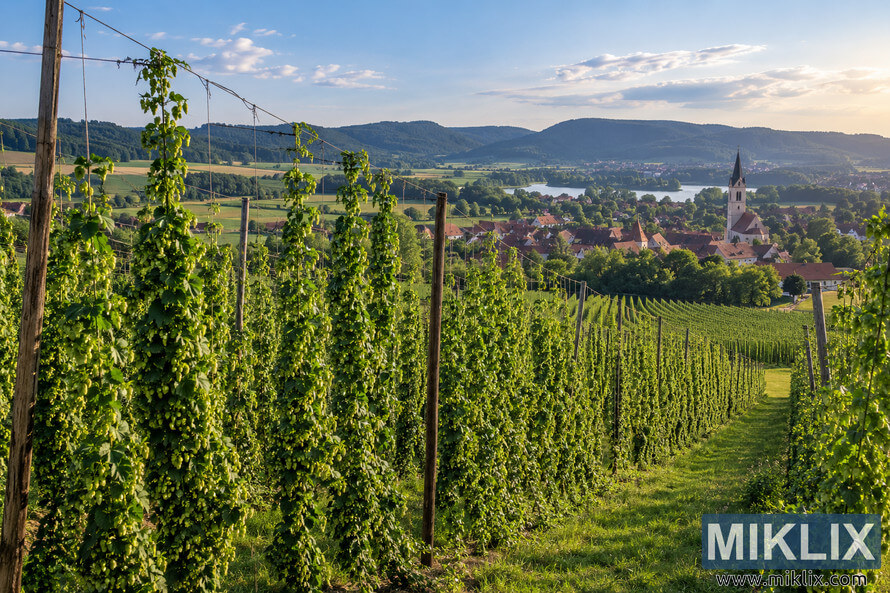
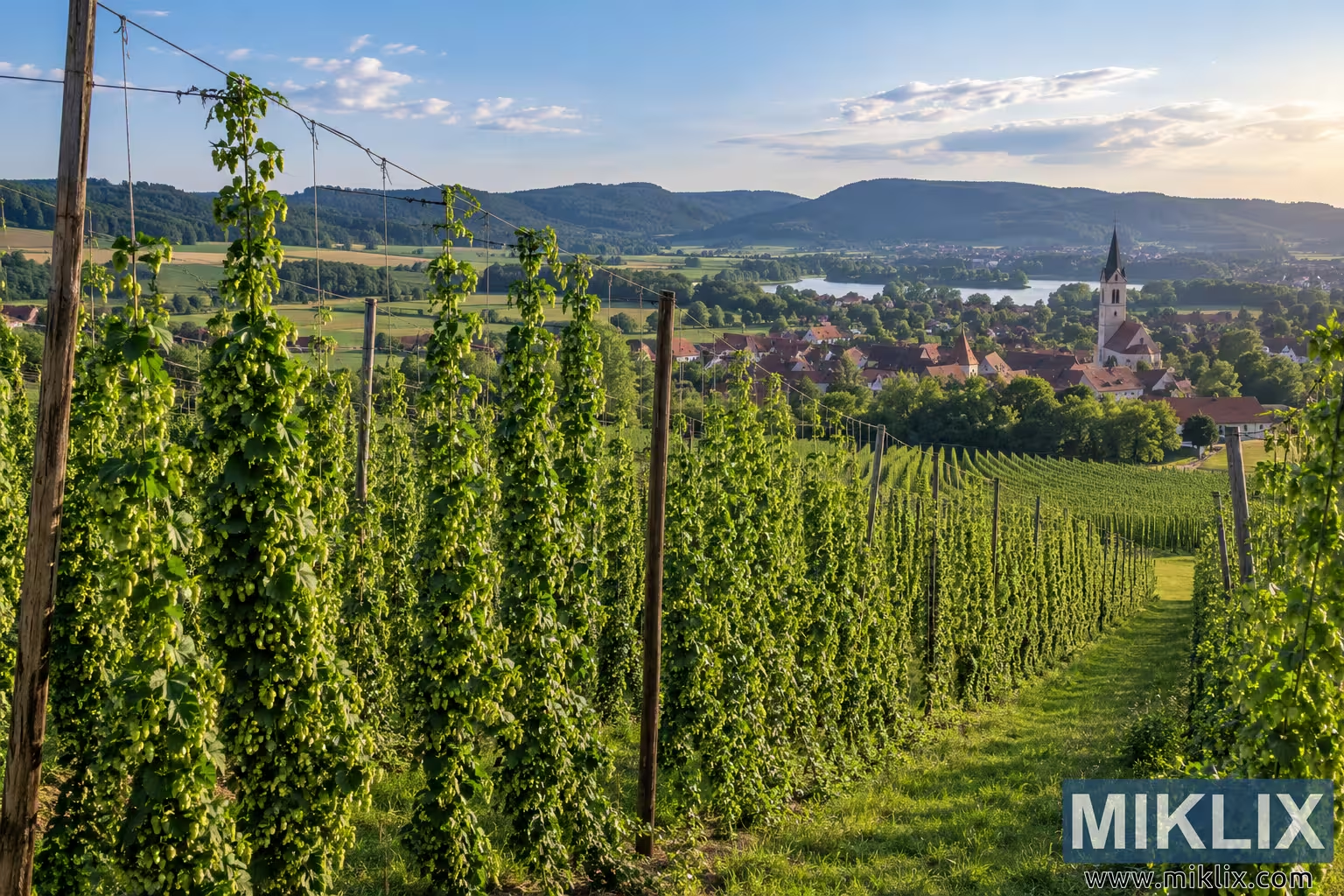
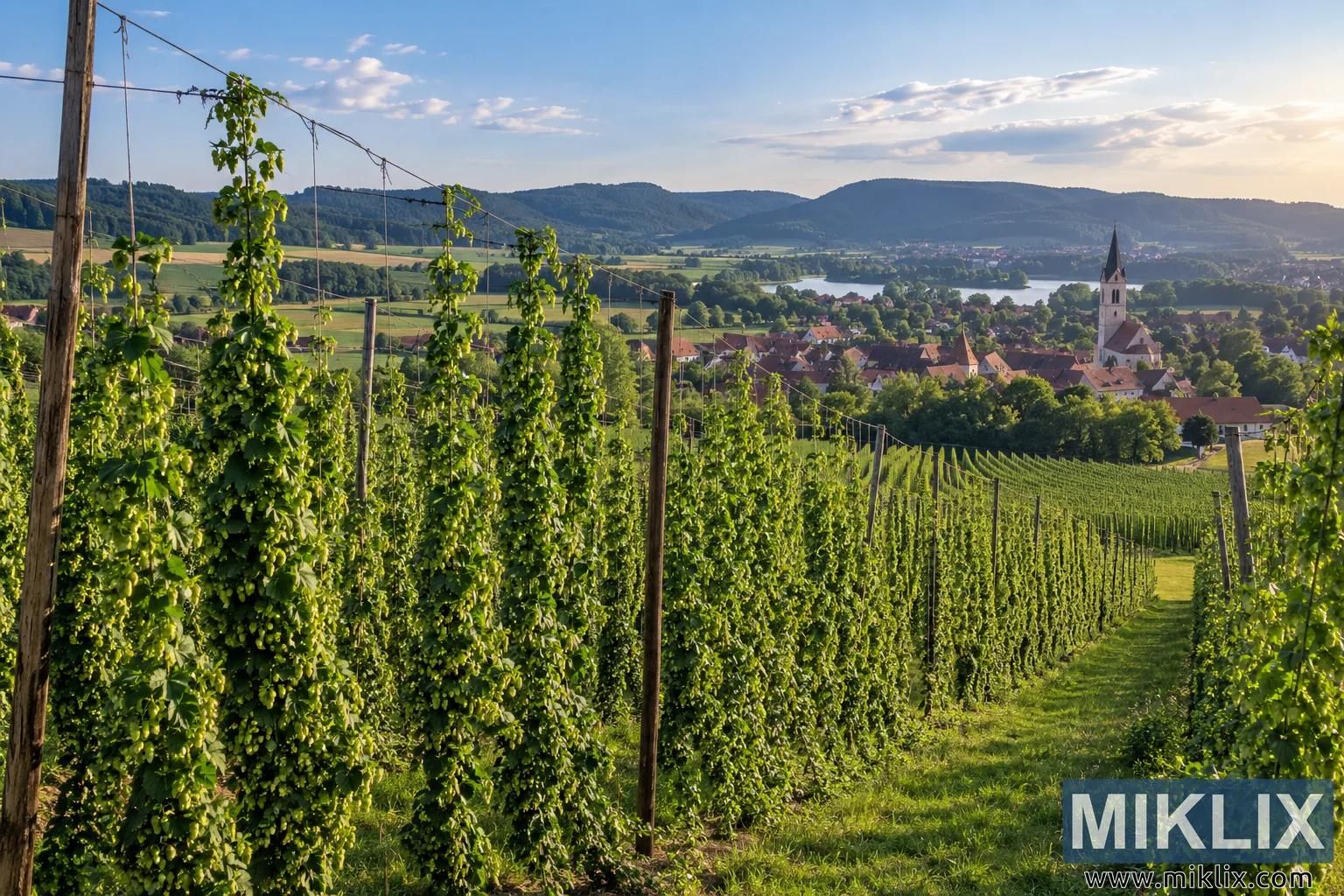
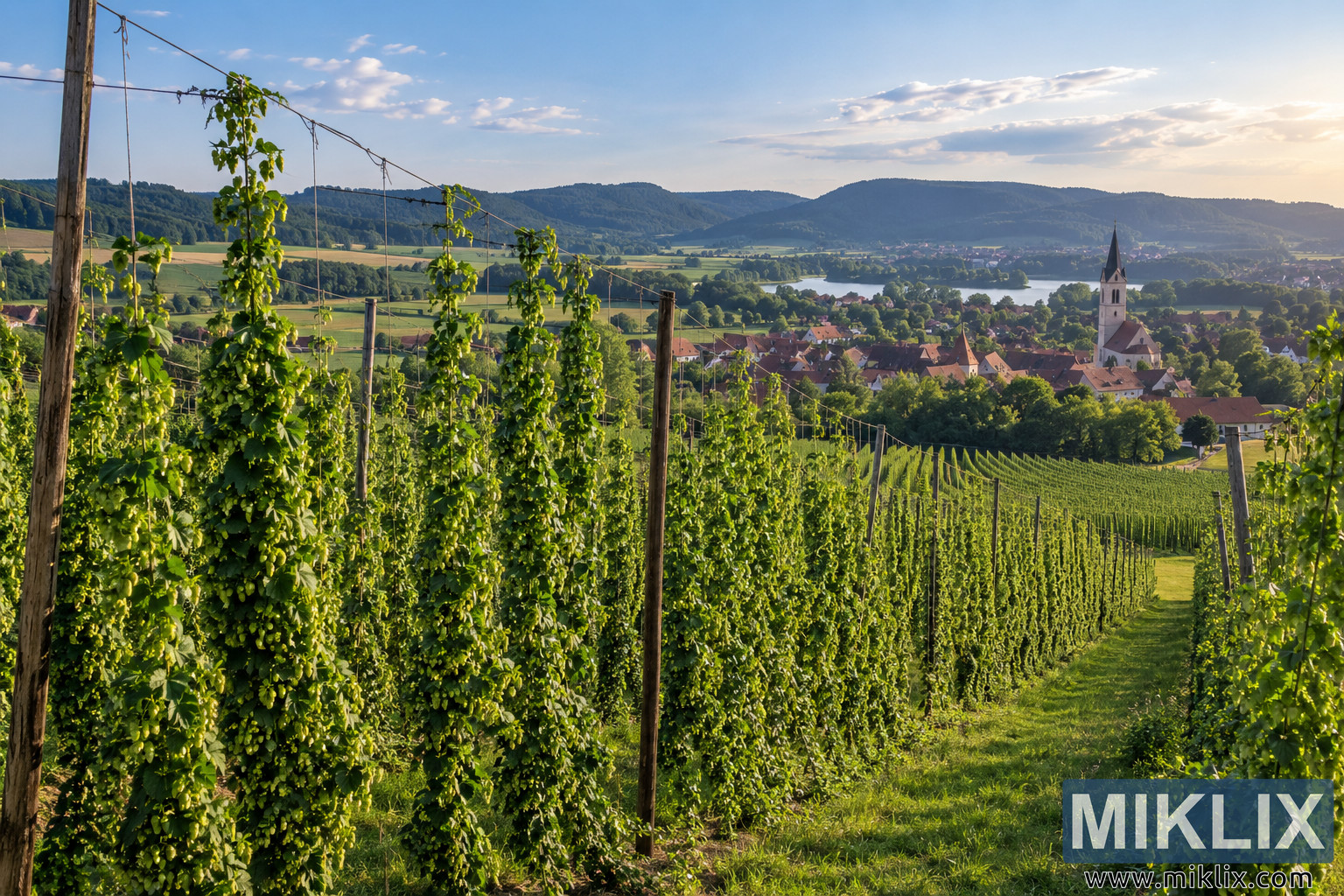
Image: Traditional Hop Gardens in the Historic Spalt Growing Region
Published: October 26, 2026 at 6:11:59 PM UTC
Historic Spalt hop-growing landscape in Germany featuring traditional hop gardens, wooden trellises and training wires, a rural village, rolling farmland, and warm golden-hour scenery.
Available versions of this image
The image files available for download below are less compressed and higher resolution - and as a result of that, higher quality - than the images embedded in articles and pages on this website, which are more optimized for file size in order to reduce bandwidth consumption.
Regular size (1,536 x 1,024)
Large size (3,072 x 2,048)
Very large size (4,608 x 3,072)
Extra large size (6,144 x 4,096)
Comically large size (1,048,576 x 699,051)
- Still uploading... ;-)
Image description
A wide, high-resolution landscape photograph depicts a traditional hop-growing area in southern Germany, presented in warm late-afternoon or early-evening sunlight. The foreground is dominated by an extensive hop garden arranged in long, carefully organized rows that descend gently across a hillside toward a historic rural settlement. Tall wooden poles rise vertically throughout the field and support an intricate network of horizontal and diagonal training wires. From these wires, vigorous hop plants climb upward in dense green columns. Their abundant foliage creates a rich pattern of leaves, stems, and hanging hop cones, clearly communicating the agricultural purpose of the landscape. The mature plants are particularly prominent on the left and along the right edge of the composition, where individual leaves and clusters of pale green hop cones can be distinguished in the warm directional light. Between the rows, narrow strips of grass form natural pathways and emphasize the depth and orderly geometry of the cultivated field. One especially visible grassy lane begins near the lower right portion of the image and leads the eye downhill toward the village, creating a strong sense of perspective. The hop-training infrastructure is an important visual feature: weathered wooden posts stand at regular intervals, while thin wires stretch between them above the plants. A large wooden pole close to the left edge extends beyond the top of the frame, and additional poles recede toward the horizon, demonstrating the traditional tall trellis system associated with commercial hop cultivation. The sunlight comes from the right side of the scene and gives the vegetation a luminous yellow-green appearance. Highlights illuminate the edges of leaves and hop cones, while shaded areas within the dense plants remain deeper green, producing substantial texture and dimensionality. Beyond the hop gardens lies a compact historic village surrounded by mature trees. Numerous houses and agricultural buildings have steeply pitched roofs in muted red, terracotta, and brown tones. Their clustered arrangement contrasts with the regular linear structure of the hop fields. Rising above the village on the right side is a prominent church with a pale exterior and a tall, slender tower topped by a dark pointed spire. The church acts as a clear architectural landmark and reinforces the traditional Central European character of the setting. No visible commercial signs, logos, advertisements, or recognizable brands appear anywhere in the scene. Behind the village, the landscape opens into a broad patchwork of agricultural fields and meadows in varying shades of green and gold. Hedgerows, groups of trees, and darker woodland areas divide the cultivated land into irregular parcels. A calm body of water is visible in the middle distance, reflecting portions of the bright sky and forming a horizontal visual break between the settlement and the more distant countryside. Small wooded islands or tree-covered banks interrupt the surface of the water. Farther away, a sequence of gently rounded, forested hills stretches across the horizon. The hills appear progressively softer and more bluish with distance, adding atmospheric depth to the panorama. Above them is a broad blue sky occupying roughly the upper third of the composition. Scattered white and pale gray clouds extend across the sky, particularly toward the upper center and right, where they catch the warm illumination of the low sun. The brightest portion of the sky is near the right edge, suggesting that the sun is positioned just outside or close to the frame. The overall lighting has the clarity and warmth associated with the golden hour, giving the rural scene a tranquil, productive, and historically rooted atmosphere. The composition combines close agricultural detail with an expansive regional panorama: the viewer can study the characteristic hop bines, cones, wooden poles, and training wires in the foreground while simultaneously looking across the village, water, fields, forests, and distant hills. Strong converging lines created by the hop rows and wires guide attention from the immediate foreground into the center of the landscape. The photograph therefore communicates both the practical structure of traditional hop cultivation and the broader cultural landscape in which it developed. Its visual emphasis is on agriculture, heritage, landscape, and the relationship between a historic settlement and the surrounding cultivated countryside. The lush hop garden, traditional trellis construction, church-centered village, rolling farmland, wooded hills, and warm natural light together evoke the historic hop-growing regions of Bavaria and, specifically, the character associated with the Spalt area of Germany. The scene is entirely naturalistic and photographic in appearance, with detailed vegetation, realistic rural architecture, convincing depth, and crisp environmental textures throughout the panoramic frame.
The image is related to: Hops in Beer Brewing: Spalt