
Image: Star Hops Aroma Wheel: Flavor Compounds and Sensory Descriptors
Published: October 29, 2026 at 8:06:39 PM UTC
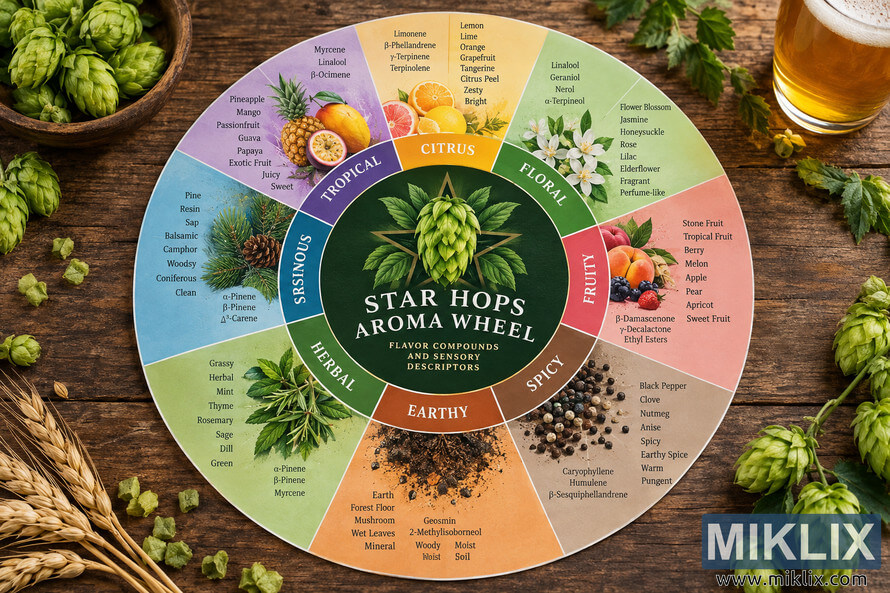
Detailed Star Hops Aroma Wheel infographic showing hop flavor compounds and sensory descriptors across citrus, floral, fruity, spicy, earthy, herbal, resinous, and tropical aroma families.
Available versions of this image
The image files available for download below are less compressed and higher resolution - and as a result of that, higher quality - than the images embedded in articles and pages on this website, which are more optimized for file size in order to reduce bandwidth consumption.
Regular size (1,536 x 1,024)
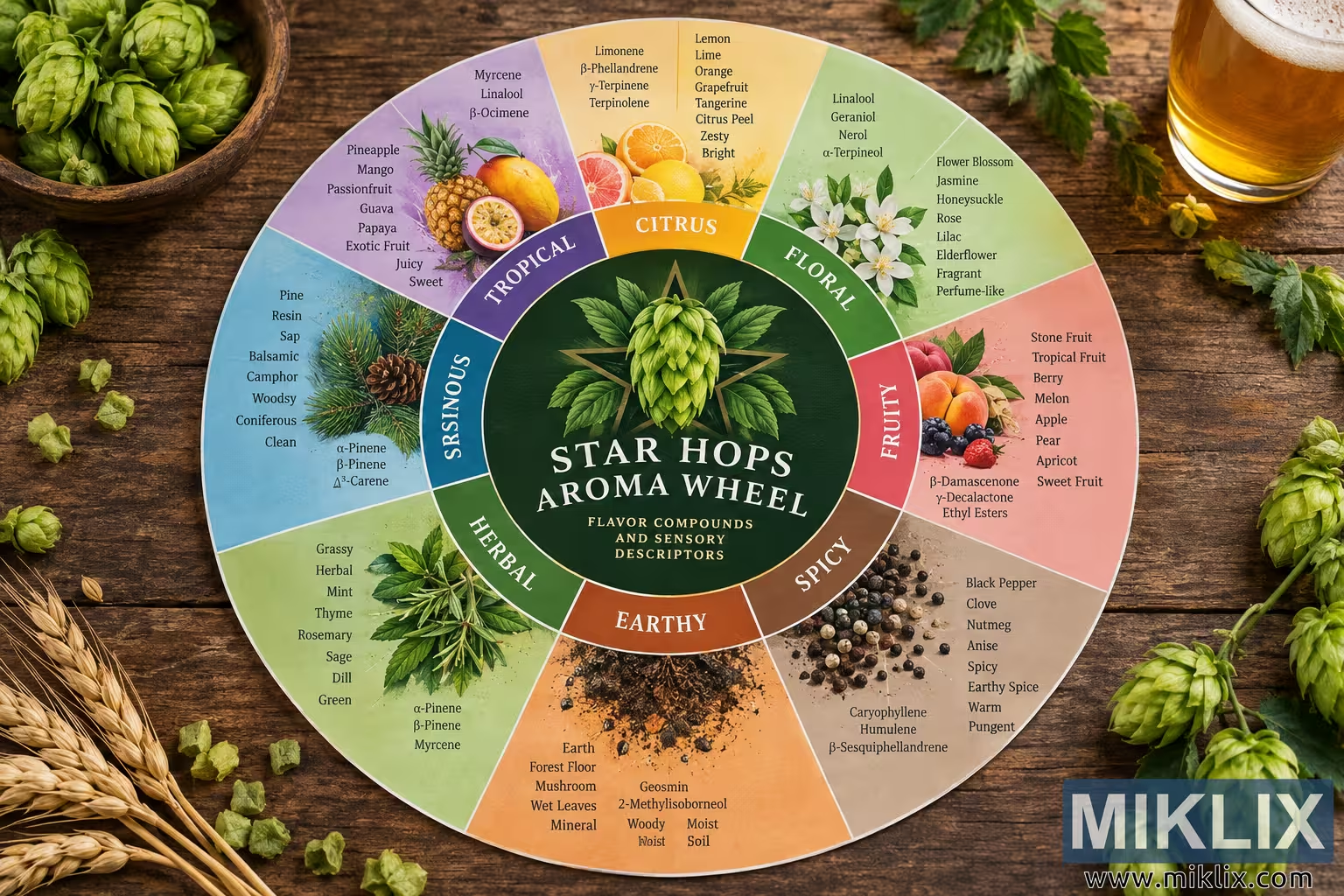
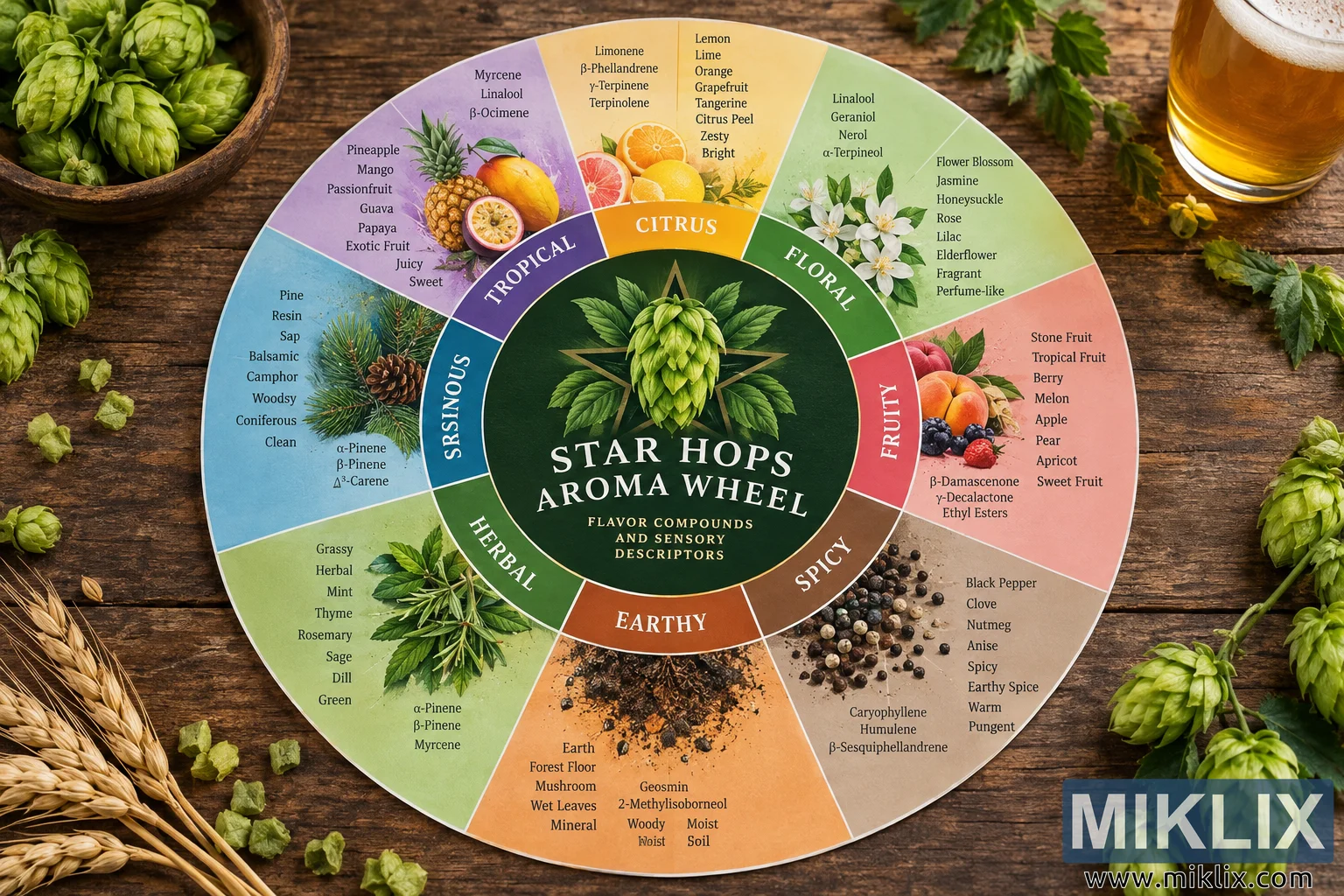
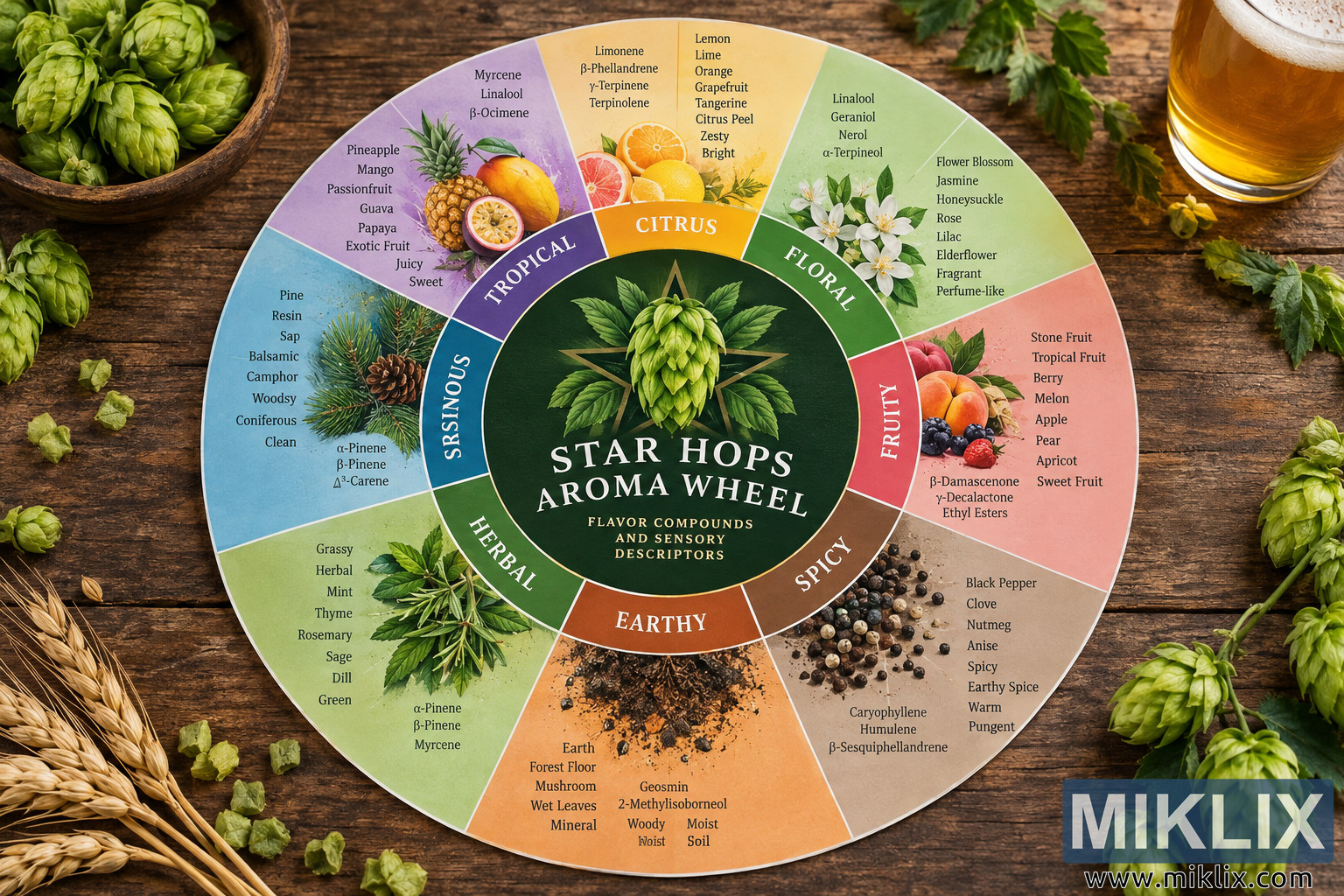
Large size (3,072 x 2,048)
Very large size (4,608 x 3,072)
Extra large size (6,144 x 4,096)
Comically large size (1,048,576 x 699,051)
- Still uploading... ;-)
Image description
A high-resolution, landscape-oriented photograph presents a large circular infographic titled “STAR HOPS AROMA WHEEL” arranged prominently at the center of a rustic wooden tabletop. The composition combines the visual language of a professional sensory-analysis chart with natural brewing ingredients, giving the image the appearance of an educational reference photographed in a craft brewery or tasting environment. The aroma wheel occupies most of the frame and is viewed from a slightly elevated, nearly overhead perspective, making its segmented structure and printed terminology easy to inspect. Around the wheel are fresh green hop cones and hop vines, a wooden bowl filled with hops in the upper-left corner, golden barley or wheat stalks in the lower-left corner, scattered dried hop pieces, leafy herbs, and a partially visible glass of clear golden beer with a foamy white head in the upper-right corner. No commercial branding or recognizable brand marks are visible.
At the center of the wheel is a dark green circular field containing a botanical illustration of a fresh green hop cone surrounded by hop leaves and a subtle star-shaped graphic. Beneath the hop illustration, large white serif lettering reads “STAR HOPS AROMA WHEEL,” followed by the smaller gold-colored subtitle “FLAVOR COMPOUNDS AND SENSORY DESCRIPTORS.” An inner ring divides the sensory profile into eight major aroma families: Citrus, Floral, Fruity, Spicy, Earthy, Herbal, Resinous, and Tropical. Each family is distinguished by its own color and extends outward into a larger wedge containing representative aroma compounds, descriptive tasting vocabulary, and small illustrations of ingredients or natural references associated with that sensory family.
The Citrus section appears in warm yellow and orange tones near the top of the wheel. It references compounds including limonene, beta-phellandrene, gamma-terpinene, and terpinolene, while its sensory vocabulary includes lemon, lime, orange, grapefruit, tangerine, citrus peel, zest, and bright. Illustrations of sliced and whole citrus fruits visually reinforce the fresh, acidic, zesty character of this category. Adjacent to it, the pale green Floral section lists compounds such as linalool, geraniol, nerol, and alpha-terpineol. Its descriptors include flower blossom, jasmine, honeysuckle, rose, lilac, elderflower, fragrant, and perfume-like, accompanied by delicate white blossoms and green foliage.
The Fruity category is rendered in pink and coral tones. Its visual elements include peaches or apricots and assorted berries, while the descriptors cover stone fruit, tropical fruit, berry, melon, apple, pear, apricot, and sweet fruit. Compounds printed within this region include beta-damascenone, gamma-decalactone, and ethyl esters. Moving clockwise, the Spicy section uses muted beige and brown tones and is illustrated with scattered peppercorns. Its chemical references include caryophyllene, humulene, and beta-sesquiphellandrene, while the sensory descriptors include black pepper, clove, nutmeg, anise, spicy, earthy spice, warm, and pungent.
At the bottom of the wheel, the orange-brown Earthy segment evokes soil and forest-floor aromas with an illustration of dark earth and organic material. Compounds such as geosmin and 2-methylisoborneol are associated with descriptors including earth, forest floor, mushroom, wet leaves, mineral, woody, moist, and soil. The neighboring Herbal category is light green and features an illustration of fresh leafy herbs. Its descriptors include grassy, herbal, mint, thyme, rosemary, sage, dill, and green, while compounds including alpha-pinene, beta-pinene, and myrcene appear in the chemical portion of the segment.
The blue Resinous section emphasizes forest and conifer associations. Pine needles and a pine cone provide the principal illustration, and the sensory vocabulary includes pine, resin, sap, balsamic, camphor, woody, coniferous, and clean. Compounds shown in this area include alpha-pinene, beta-pinene, and delta-3-carene. Finally, the purple Tropical section contains illustrations of pineapple, mango, passionfruit, and other exotic fruits. Its descriptors include pineapple, mango, passionfruit, guava, papaya, exotic fruit, juicy, and sweet, with compounds such as myrcene, linalool, and beta-ocimene presented as associated aromatic components.
The wheel uses a harmonious palette of yellow, green, pink, brown, orange, blue, and purple, allowing the individual aroma families to be recognized quickly while retaining a cohesive botanical aesthetic. Fine cream-colored borders separate the wedges, and a combination of serif typography, botanical illustrations, chemical names, and sensory terminology gives the design the feel of a detailed professional tasting aid. The surrounding wooden surface has visible grain, knots, scratches, and warm brown tones that contrast with the clean geometry of the wheel. Fresh hop cones positioned around several edges connect the scientific and sensory information to the plant itself, while the grain stalks and glass of beer subtly establish a brewing context. Overall, the image functions as an attractive educational visualization of hop aroma: it links chemical compounds to recognizable sensory impressions and organizes those impressions into eight intuitive families, while the natural ingredients and rustic tabletop create a warm, artisanal presentation suitable for brewing education, hop evaluation, beer tasting, or general flavor and aroma reference.
The image is related to: Hops in Beer Brewing: Star