
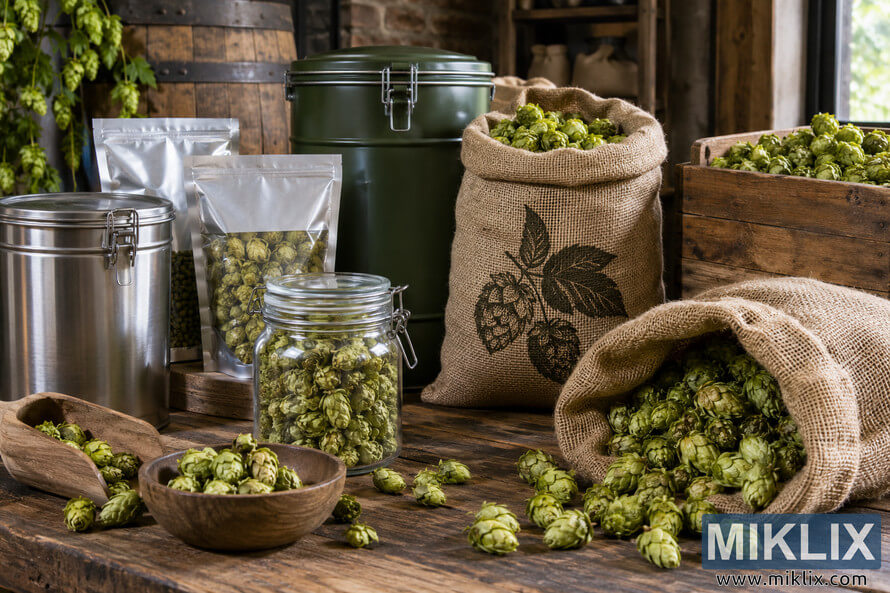
Image: Various Hop Storage Containers and Bags in a Rustic Brewery Setting
Published: October 29, 2026 at 8:06:39 PM UTC
High-resolution rustic still life showing green hops in various unbranded storage containers, including burlap sacks, sealed bags, glass jars, metal canisters, and a wooden crate.
Available versions of this image
The image files available for download below are less compressed and higher resolution - and as a result of that, higher quality - than the images embedded in articles and pages on this website, which are more optimized for file size in order to reduce bandwidth consumption.
Regular size (1,536 x 1,024)
Large size (3,072 x 2,048)
Very large size (4,608 x 3,072)
Extra large size (6,144 x 4,096)
Comically large size (1,048,576 x 699,051)
- Still uploading... ;-)
Image description
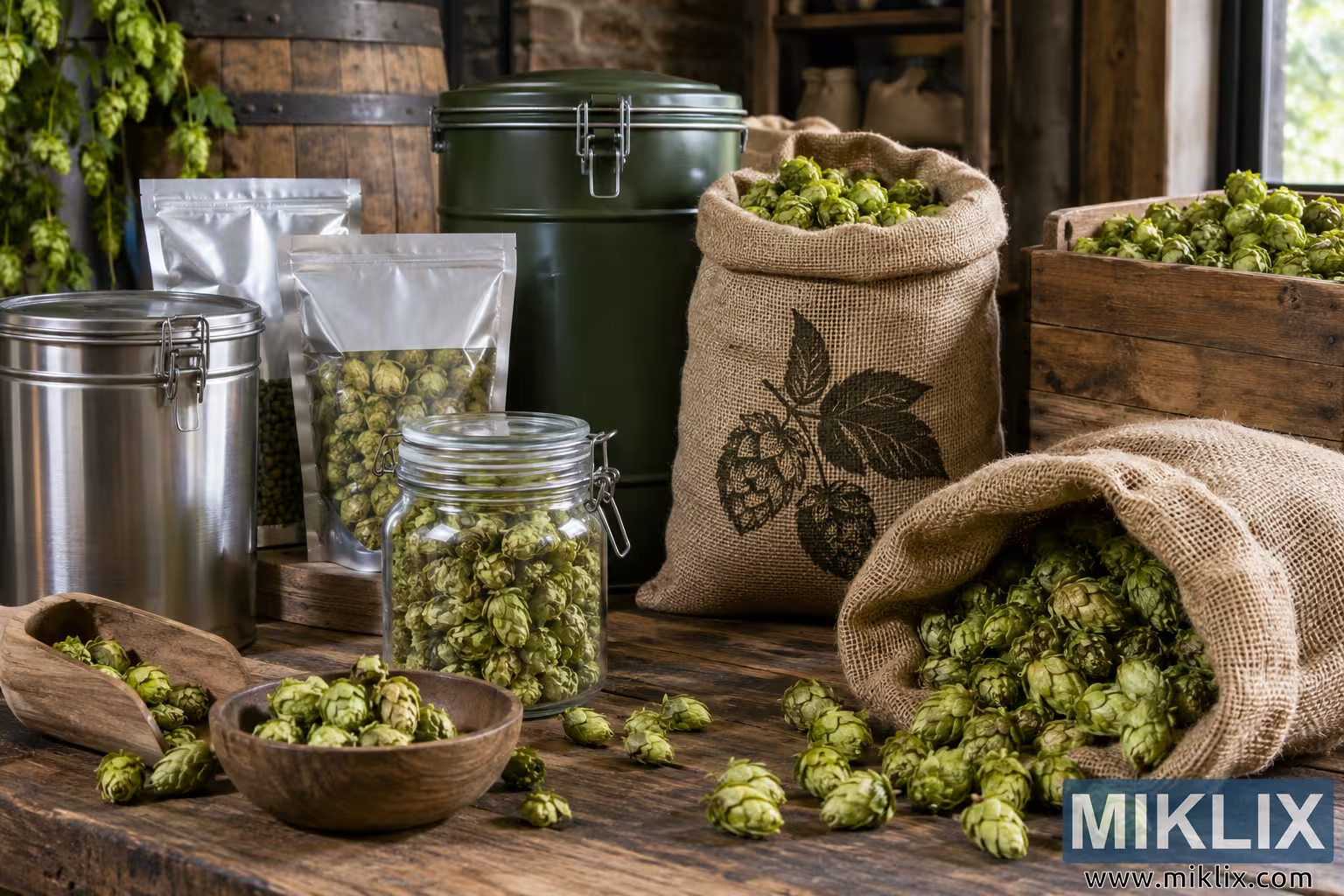
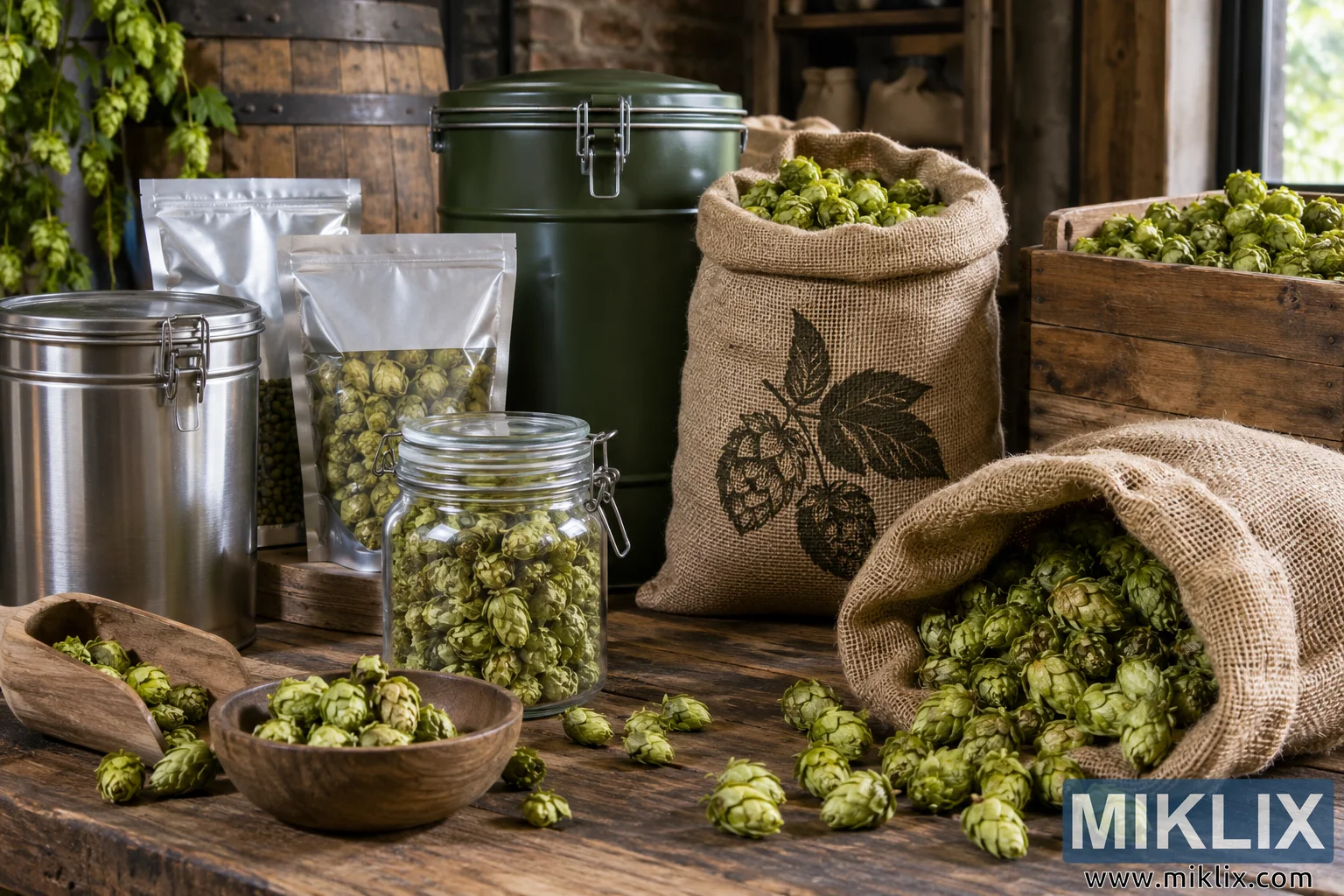
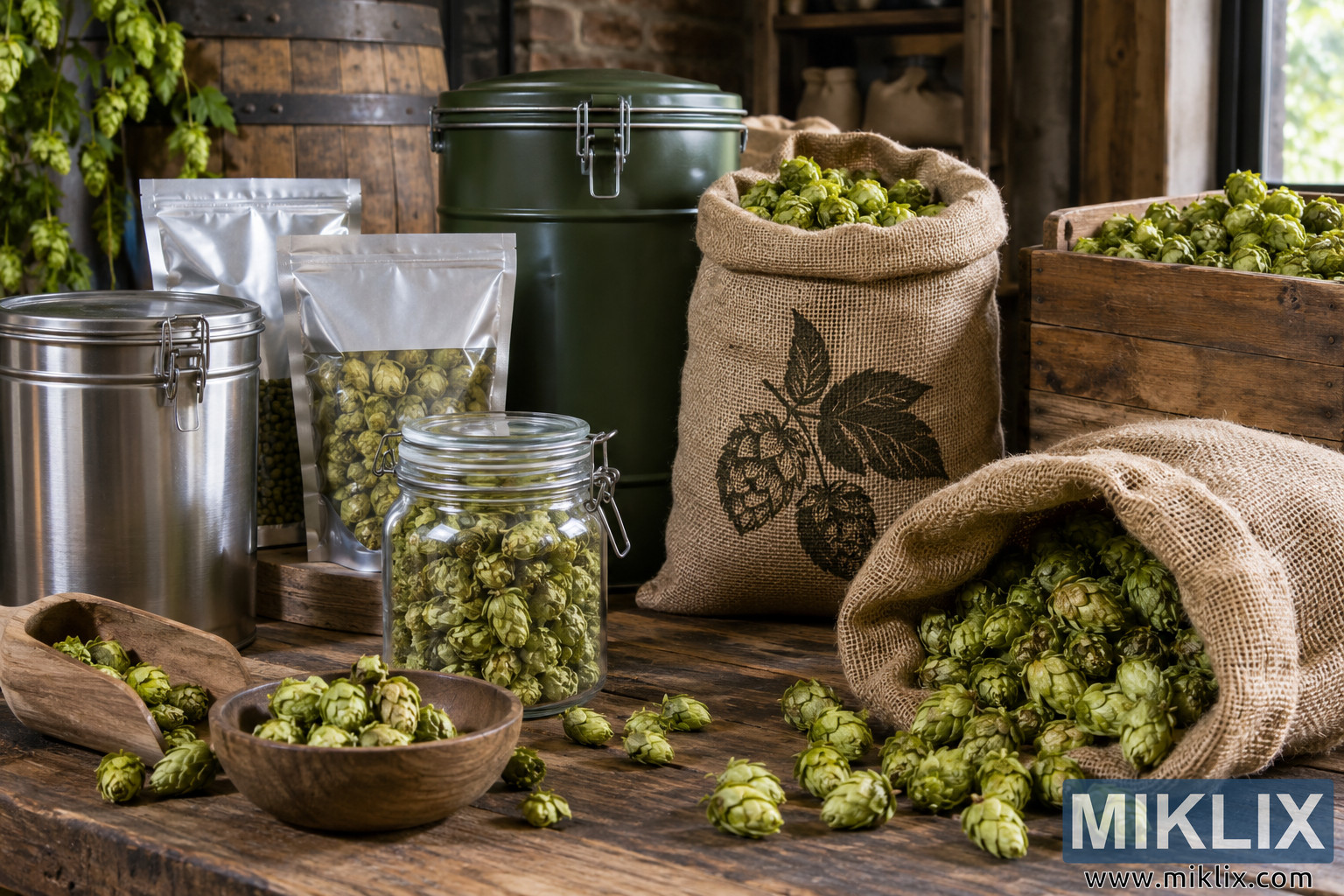
A high-resolution landscape-oriented photograph presents a carefully arranged collection of hop storage containers and bags in a warm, rustic setting reminiscent of a traditional craft brewery, hop farm storehouse, or agricultural processing room. The scene is viewed straight on at approximately tabletop height, allowing the different storage methods and the fresh green hop cones to become the primary visual focus. A broad, heavily textured wooden worktable stretches across the entire foreground. Its dark brown boards show pronounced grain, knots, scratches, and natural variations that reinforce the practical, handcrafted character of the environment. Numerous pale to medium green hop cones are scattered loosely over the tabletop, creating an organic connection between the individual containers and suggesting that the hops have recently been sorted, handled, or prepared for storage. On the right side of the composition, a large natural burlap sack lies partly on its side with its opening facing toward the viewer. The coarse woven fabric is folded and wrinkled around a generous quantity of hop cones, which spill from the mouth of the sack onto the table. Individual cones display layered, overlapping bracts and subtle variations in green, ranging from muted olive tones to brighter yellow-green highlights. Behind this sack stands another large upright burlap bag filled almost to the top with hops. Its upper edge is rolled outward to create a thick, textured rim. A simple dark botanical illustration depicting a hop plant, including leaves and hop cones, is printed on the front of the sack. The illustration is decorative rather than a commercial logo, and there are no visible brand names or identifiable trademarks anywhere in the scene. To the right and slightly behind the upright sack is a sturdy wooden crate filled with additional green hop cones. The crate is made from dark, weathered boards whose worn surfaces and visible grain complement the worktable. Near the center-left stands a large cylindrical dark green metal storage container with a fitted lid and prominent metal latch hardware. Its smooth painted surface contrasts with the rough burlap and aged timber surrounding it. In front of this container is a clear glass preserving jar with a hinged clamp lid and metal closure. The jar is densely packed with dried or partially dried hop cones, making their detailed forms visible through the transparent glass. Soft reflections along the curved glass and metal hardware add realistic highlights without obscuring the contents. Behind and to the left of the jar are several upright resealable storage pouches. These bags have reflective silver surfaces and simple, unbranded construction. One pouch includes a transparent section through which stored hop cones can be seen. The metallic material catches the ambient light, producing gentle gradients and highlights that distinguish the modern airtight packaging from the more traditional sacks and wooden containers. At the far left foreground is a tall cylindrical stainless-steel canister with a tightly fitted lid and clamp-style fasteners. Its brushed metal surface reflects the surrounding warm tones in a subdued way. A second partially visible metallic pouch stands behind it. Together, these objects illustrate a variety of possible hop storage approaches, ranging from breathable natural-fiber sacks and wooden crates to glass jars, sealed metallic bags, and robust metal containers. In the lower-left foreground, a rustic wooden scoop rests diagonally on the tabletop and contains several hop cones. Next to it sits a shallow round wooden bowl filled with more hops. Additional loose cones are distributed across the front edge and center of the table, some isolated and others gathered into small groups. Their irregular placement keeps the arrangement from appearing overly staged while adding depth and visual rhythm. The background continues the rustic agricultural atmosphere. On the far left, hanging hop vines descend into the frame, their green leaves and clusters of cones providing a natural reference to the plant from which the stored material originates. A large wooden barrel with dark metal hoops stands behind the storage containers. Farther back, a rough brick or stone wall and dark wooden shelving contribute texture while remaining softly subdued so that they do not compete with the foreground. Neutral ceramic or fabric storage vessels can be seen on the shelves, but they carry no labels or branding. On the right, a tall window admits soft natural daylight and offers a blurred glimpse of green foliage outside. The window light creates gentle directional illumination across the hops, sacks, jars, metal containers, and wooden surfaces. Highlights are strongest along the right-facing edges of the objects, while soft shadows help separate the layers of the composition and emphasize the three-dimensional forms. The overall color palette is dominated by earthy browns, natural beige burlap, muted silver, dark forest green, and the lively yellow-green shades of the hop cones. The lighting is realistic and inviting rather than dramatic, giving the image the appearance of a professionally photographed editorial still life. Fine material details are clearly rendered: individual fibers are visible in the burlap, wood grain and wear marks can be distinguished on the table and crate, reflections define the glass and stainless steel, and the delicate overlapping scales of the hop cones remain crisp throughout the main focal area. The composition communicates storage, preservation, agriculture, brewing ingredients, and traditional craftsmanship without depicting a particular company or product brand. It balances modern storage solutions with traditional containers, showing hops held in airtight metal canisters, resealable barrier bags, transparent glass, burlap sacks, wooden vessels, and an open crate. Despite the number of objects, the scene remains visually coherent because the containers are arranged at different heights and depths around the central upright sack and green metal container. The foreground spill of hops leads the eye naturally through the image, while the barrel, shelving, hanging plants, and bright window provide environmental context. The final impression is that of an authentic, well-stocked hop storage workspace where freshly harvested or dried hops are being organized and preserved, presented with rich photographic detail, natural textures, warm rustic styling, and absolutely no actual commercial branding.
The image is related to: Hops in Beer Brewing: Star