
Image: Laboratory Analysis of Alpha Acid Content in Summer Hops
Published: November 2, 2026 at 5:50:58 PM UTC
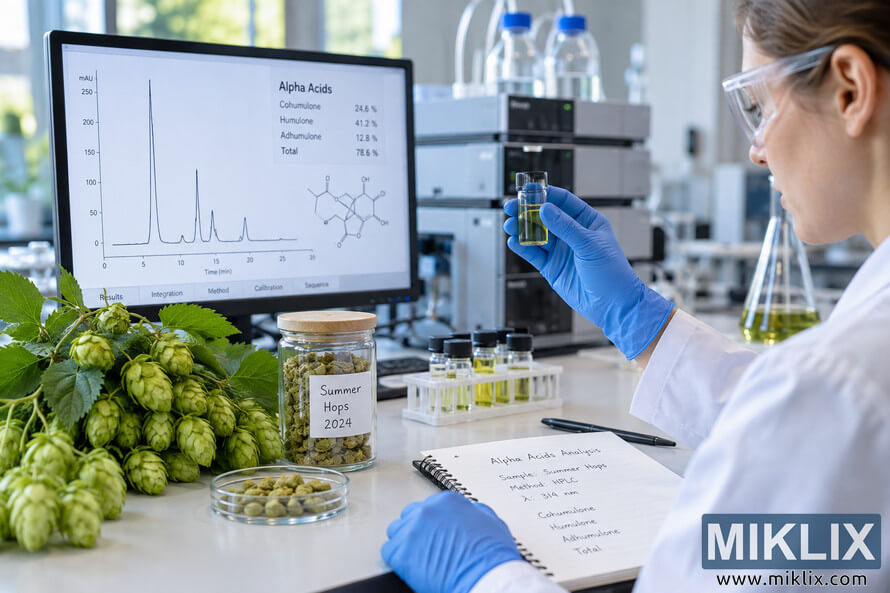
Laboratory analysis of summer hops showing fresh hop cones, prepared extracts, HPLC equipment, and chromatographic measurement of alpha acid content.
Available versions of this image
The image files available for download below are less compressed and higher resolution - and as a result of that, higher quality - than the images embedded in articles and pages on this website, which are more optimized for file size in order to reduce bandwidth consumption.
Regular size (1,536 x 1,024)
Large size (3,072 x 2,048)
Very large size (4,608 x 3,072)
Extra large size (6,144 x 4,096)
Comically large size (1,048,576 x 699,051)
- Still uploading... ;-)
Image description
A bright, professionally equipped analytical laboratory is shown in a wide landscape composition, focusing on the scientific analysis of alpha acids in freshly harvested summer hops. The scene combines recognizable hop plant material, laboratory glassware, analytical instrumentation, and a researcher actively examining a prepared sample. In the foreground on the left side of the laboratory bench is a generous cluster of fresh green hop cones still attached to leafy stems. The cones have the characteristic layered, overlapping bracts of mature hops and provide an immediate visual connection between the agricultural raw material and the chemical analysis taking place in the laboratory. Their vivid green appearance suggests freshly harvested summer hops. Beside the fresh plant material is a clear glass jar containing dried hop cones or processed hop material. A simple handwritten label on the jar identifies the contents as summer hops from 2024. In front of the jar, a shallow transparent laboratory dish contains additional pieces of dried hop material prepared for inspection or sampling.
On the right side of the image, a laboratory researcher wearing a clean white lab coat, transparent protective safety glasses, and blue disposable gloves is seated or positioned at the workbench. The researcher is shown primarily in profile and is concentrating on a small transparent sample vial held up at approximately eye level. The vial contains a clear yellow-green liquid, visually suggesting an extract prepared from hop material for chemical analysis. The researcher’s careful posture and direct attention to the vial convey a controlled analytical procedure rather than casual observation. One gloved hand holds the sample securely while the other rests near an open laboratory notebook on the bench.
The notebook is positioned prominently in the lower center of the scene and contains handwritten analytical notes related to alpha acid testing. The visible writing references an alpha acids analysis, a summer hops sample, an HPLC method, a wavelength of approximately 314 nanometers, and individual alpha acid components such as cohumulone, humulone, and adhumulone. These details reinforce the scientific context of the image and indicate that high-performance liquid chromatography is being used to characterize the chemical composition of the hop sample. A black laboratory pen lies nearby, suggesting that observations and analytical results are being documented as part of the workflow.
Behind the notebook is a white test-tube rack containing several small transparent vials or tubes filled with pale yellow to yellow-green solutions. The slight differences in liquid color and volume imply multiple samples, standards, extracts, or stages of sample preparation. Additional small capped laboratory containers are arranged around the rack. Farther to the right, a glass Erlenmeyer flask contains another yellow-green solution, visually connecting the sample preparation process with the vial being inspected by the researcher.
A large computer monitor dominates the left-center background and displays the results of an instrumental analysis. The screen shows a chromatogram with several distinct peaks plotted against retention time, resembling output from high-performance liquid chromatography. The vertical axis is labeled in milli-absorbance units, while the horizontal axis represents time in minutes. A particularly prominent early peak is followed by several smaller peaks, visually illustrating the separation of compounds present in the hop extract. On the right side of the displayed analytical interface is a section titled 'Alpha Acids' with entries for cohumulone, humulone, and adhumulone, accompanied by percentage values and a total. A simplified chemical structure is also visible on the screen, strengthening the association with laboratory chemistry and quantitative compound identification. The displayed interface is generic and contains no recognizable commercial branding.
Behind the monitor and researcher stands a substantial piece of chromatography equipment composed of stacked laboratory instrument modules. Tubing and clear solvent bottles are visible above the instrument, consistent with the appearance of an HPLC system used for liquid chromatography. The equipment is intentionally generic, with no actual manufacturer names, logos, or recognizable brands. Its placement in the scene connects the chromatogram displayed on the monitor to the physical analytical instrument performing the separation and measurement.
The laboratory itself is exceptionally clean, orderly, and brightly illuminated. Large windows in the background allow abundant natural daylight to enter, while the pale work surfaces, white laboratory coat, transparent glassware, and neutral-colored equipment create a clinical and precise atmosphere. Green foliage outside the windows is softly blurred, subtly reinforcing the summer agricultural theme without distracting from the laboratory activity. The shallow depth of field keeps the researcher, sample vial, hop cones, notebook, and analytical display visually prominent while allowing the more distant laboratory equipment to remain recognizable but slightly softened.
The composition tells a complete visual story of hops moving from agricultural material to quantitative chemical characterization. Fresh hop cones represent the original crop, dried material and prepared solutions illustrate sample processing, the researcher represents controlled laboratory handling, and the chromatography equipment and chromatogram communicate instrumental measurement. The central scientific subject is the determination of alpha acid content, an important chemical characteristic of hops. The image emphasizes precision, traceability, laboratory quality control, and the relationship between natural plant material and modern analytical chemistry. Overall, the photograph has the polished appearance of professional scientific and agricultural research photography, with realistic laboratory details, natural lighting, crisp foreground textures, and a balanced landscape composition suitable for illustrating hop quality analysis, brewing science, agricultural research, chromatography, or laboratory testing of summer hop samples.
The image is related to: Hops in Beer Brewing: Summer