
Image: Summer Hops Essential Oil Breakdown and Flavor Compounds
Published: November 2, 2026 at 5:50:58 PM UTC
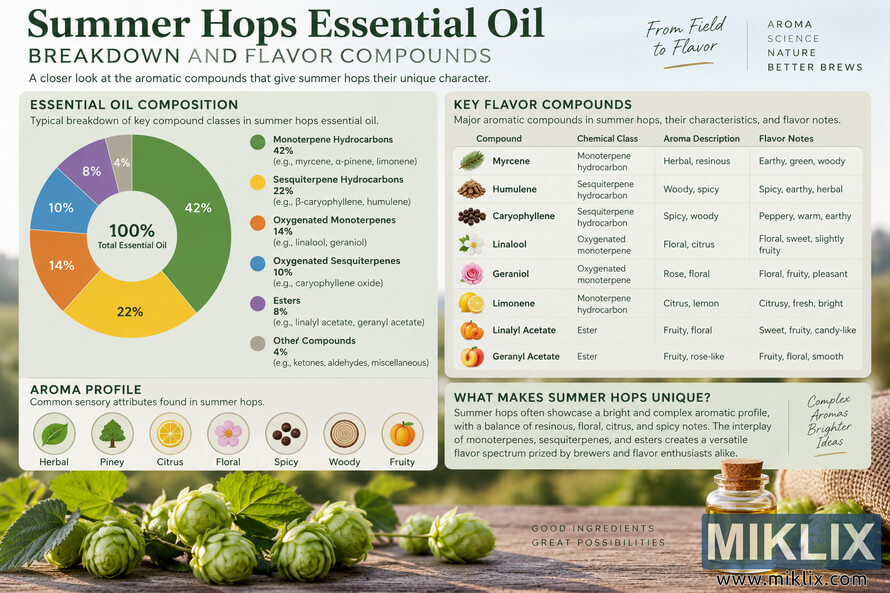
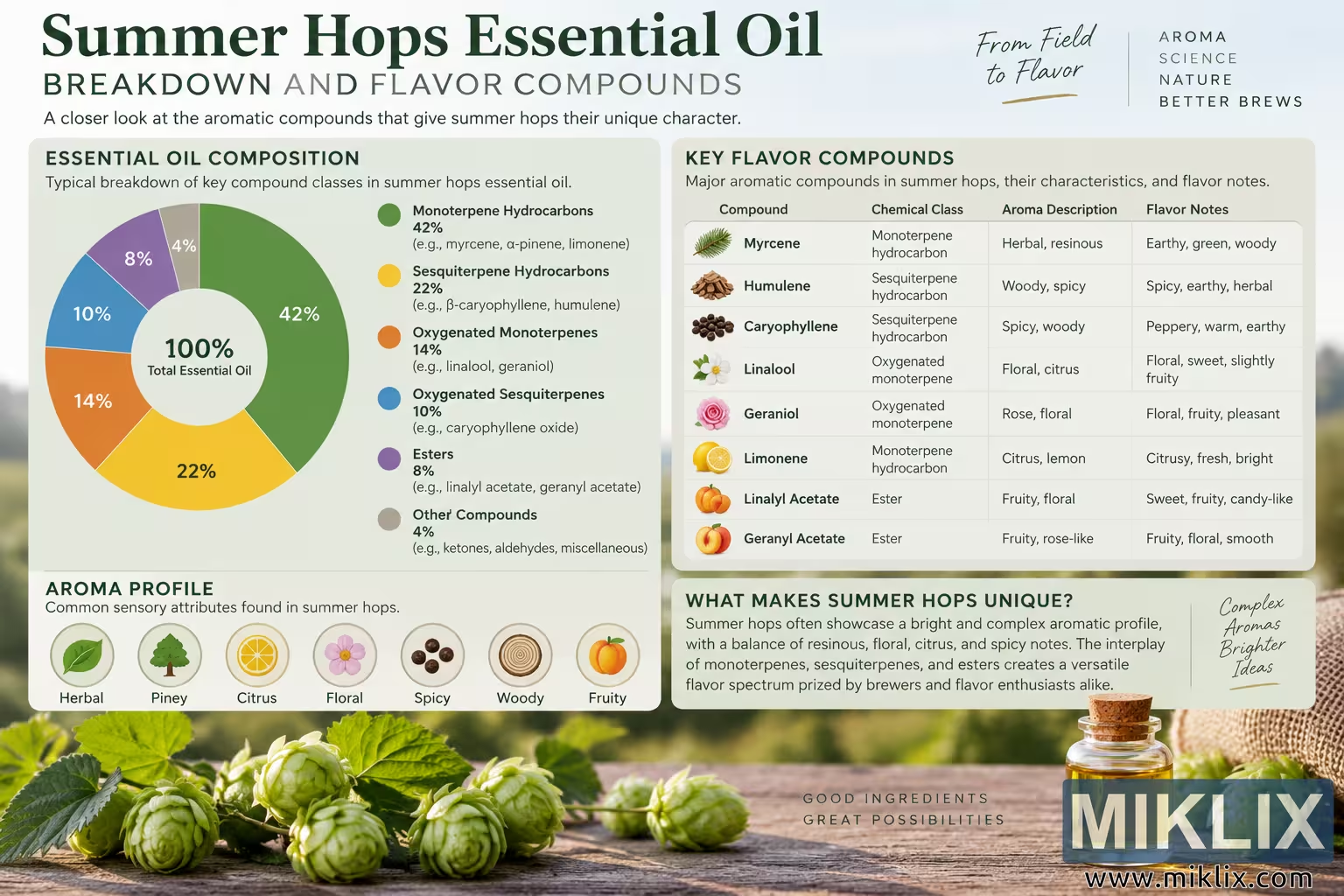
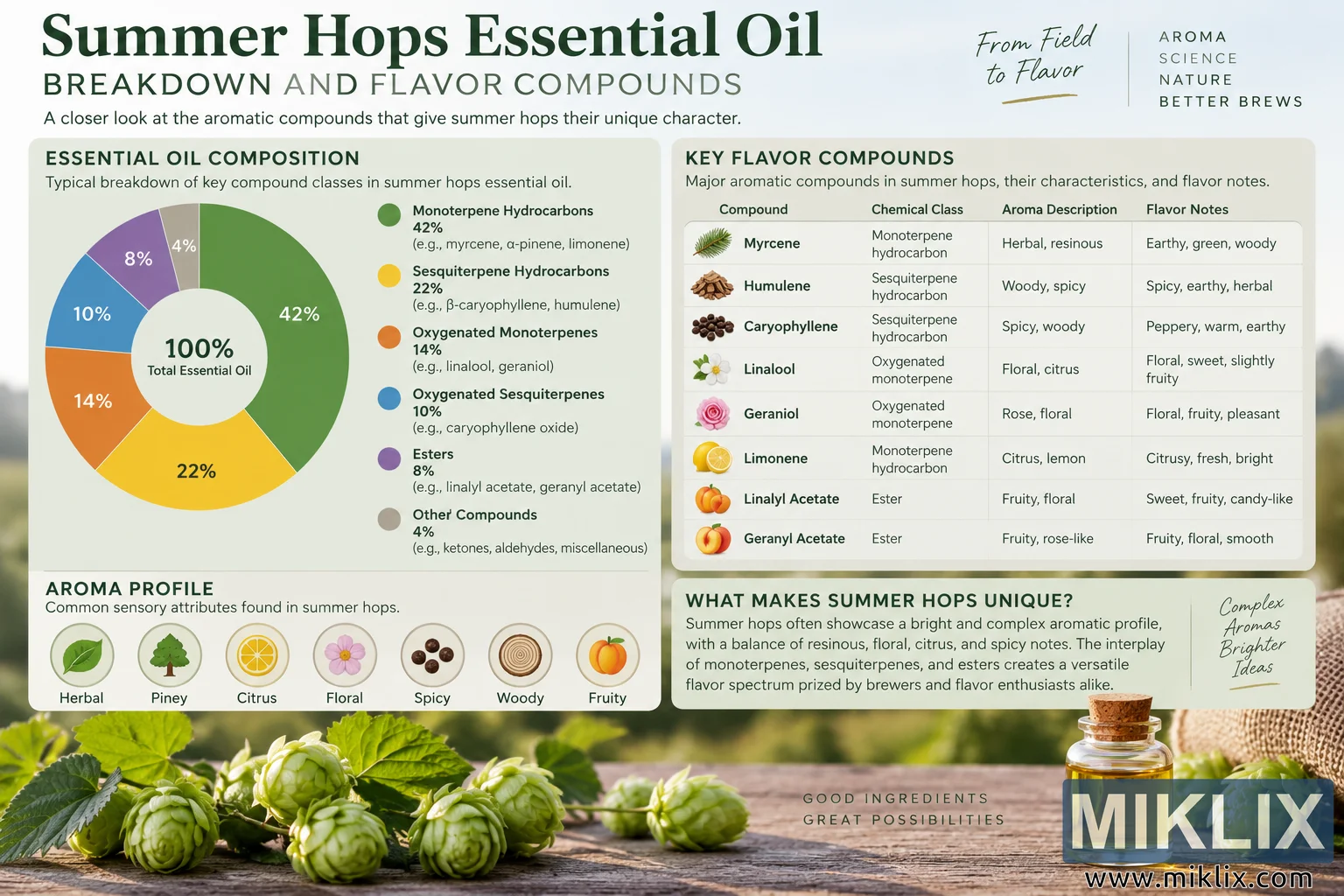
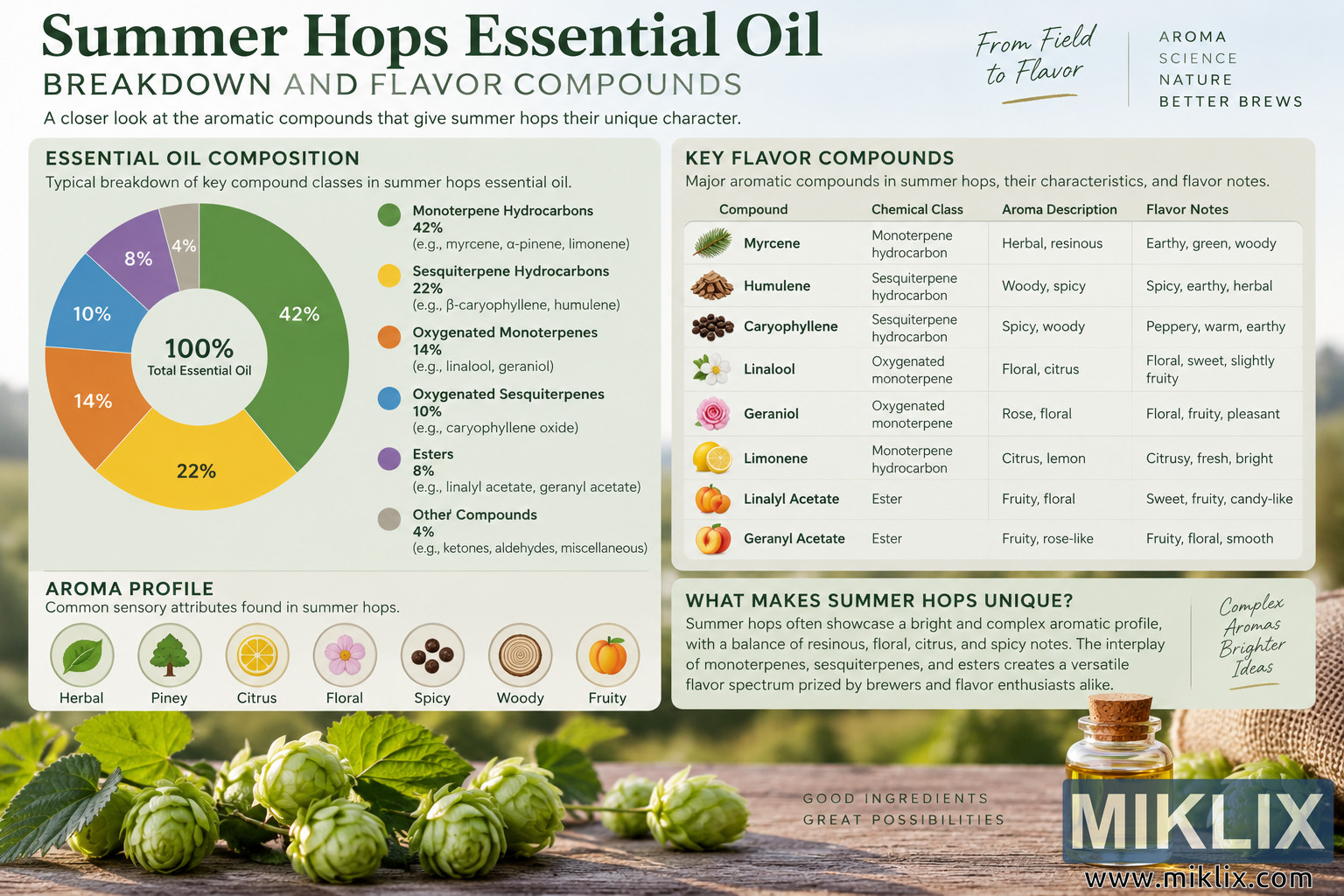
Educational botanical infographic exploring summer hops essential oil composition, key flavor compounds, aroma characteristics, and the balance of herbal, piney, citrus, floral, spicy, woody, and fruity notes.
Available versions of this image
The image files available for download below are less compressed and higher resolution - and as a result of that, higher quality - than the images embedded in articles and pages on this website, which are more optimized for file size in order to reduce bandwidth consumption.
Regular size (1,536 x 1,024)
Large size (3,072 x 2,048)
Very large size (4,608 x 3,072)
Extra large size (6,144 x 4,096)
Comically large size (1,048,576 x 699,051)
- Still uploading... ;-)
Image description
A wide, landscape-format educational infographic presents the aromatic chemistry and sensory characteristics of summer hops in a polished botanical style. The composition combines scientific information with natural photographic elements, using a restrained palette of deep forest green, leafy green, warm yellow, orange, blue, purple, cream, and earthy neutral tones. The background is softly blurred and suggests a sunny agricultural field or hop-growing landscape, while the foreground rests on a weathered wooden tabletop. Fresh green hop cones and leafy hop vines are arranged prominently along the lower left and center edge, and a small clear glass bottle containing golden-colored oil sits near the lower right. The bottle has a simple cork closure and carries no visible branding, logo, or commercial label.
Across the top, a large dark-green serif headline reads “Summer Hops Essential Oil,” followed by the uppercase subtitle “BREAKDOWN AND FLAVOR COMPOUNDS.” Beneath this is a short introductory line explaining that the graphic takes a closer look at the aromatic compounds that give summer hops their distinctive character. Toward the upper right is a handwritten-style phrase, “From Field to Flavor,” accompanied by a small decorative underline. Nearby, understated uppercase words reference aroma, science, nature, and better brews, reinforcing the educational and ingredient-focused theme without identifying any real brand.
The main information area is divided into softly rounded, pale cream panels. The large panel on the left is headed “ESSENTIAL OIL COMPOSITION” and contains a prominent donut chart representing 100 percent of the essential oil. The center of the chart reads “100% Total Essential Oil.” Around the ring, six colored segments visualize the approximate compound-class breakdown. Monoterpene hydrocarbons form the largest portion at 42 percent and are represented in green, with examples such as myrcene, alpha-pinene, and limonene. Sesquiterpene hydrocarbons account for 22 percent and appear in yellow, with beta-caryophyllene and humulene given as examples. Oxygenated monoterpenes represent 14 percent in orange, including compounds such as linalool and geraniol. Oxygenated sesquiterpenes account for 10 percent in blue, with caryophyllene oxide given as an example. Esters comprise 8 percent in purple, including linalyl acetate and geranyl acetate, while other compounds make up the remaining 4 percent in a neutral gray-beige segment and encompass miscellaneous chemical groups such as ketones and aldehydes. A matching legend beside the donut chart repeats the percentages and provides representative compounds for each class.
Below the chart, a section titled “AROMA PROFILE” summarizes common sensory attributes associated with summer hops. Seven circular illustrated icons are arranged horizontally, each paired with a concise label. The sequence includes Herbal, represented by a green leaf; Piney, represented by an evergreen tree; Citrus, represented by a bright citrus slice; Floral, represented by a flower; Spicy, represented by dark spice-like seeds or berries; Woody, represented by a circular wood-grain motif; and Fruity, represented by warm orange fruit. This row translates the chemistry above into recognizable sensory language, making the scientific information easier to connect with flavor and aroma perception.
The large panel on the upper right is titled “KEY FLAVOR COMPOUNDS” and contains a structured table with the columns Compound, Chemical Class, Aroma Description, and Flavor Notes. Each row combines a compound name with a small illustrative botanical or flavor cue. Myrcene is identified as a monoterpene hydrocarbon and associated with herbal, resinous aromas and earthy, green, woody flavor impressions. Humulene is shown as a sesquiterpene hydrocarbon with woody and spicy aroma characteristics and spicy, earthy, herbal flavor notes. Caryophyllene is also categorized as a sesquiterpene hydrocarbon and is linked with spicy and woody aromas as well as peppery, warm, earthy flavor qualities. Linalool is listed as an oxygenated monoterpene with floral and citrus aromas and floral, sweet, slightly fruity flavor notes. Geraniol, another oxygenated monoterpene, is associated with rose-like and floral aromas and pleasant floral and fruity qualities. Limonene is presented as a monoterpene hydrocarbon characterized by citrus and lemon aromas with a fresh, bright, citrus-forward flavor impression. Linalyl acetate and geranyl acetate are shown as esters; both contribute fruity and floral qualities, with linalyl acetate described as sweet, fruity, and candy-like and geranyl acetate as fruity, floral, smooth, and somewhat rose-like.
A lower-right information panel carries the heading “WHAT MAKES SUMMER HOPS UNIQUE?” It explains that summer hops can display a bright, complex aromatic profile created by the interplay of resinous, floral, citrus, spicy, and related notes. The text emphasizes that the balance among monoterpenes, sesquiterpenes, oxygenated compounds, and esters can create a versatile flavor spectrum of interest in brewing and flavor applications. A handwritten-style annotation on the right side of this panel reads “Complex Aromas Brighter Ideas,” adding a casual field-notebook quality to the otherwise structured scientific layout.
The overall design blends the appearance of a modern scientific poster, ingredient guide, and botanical editorial photograph. Rounded information cards, generous spacing, legible typography, organized charts, and a clear visual hierarchy make the dense chemical information approachable. Natural hop cones, foliage, warm sunlight, shallow depth of field, wood texture, and the small bottle of golden oil provide an agricultural and artisanal context around the data. The result is a visually inviting educational chart that connects the chemical composition of hop essential oil with recognizable aroma and flavor descriptors while maintaining a clean, natural, unbranded presentation.
The image is related to: Hops in Beer Brewing: Summer