
Image: Homebrewing Equipment Setup for Hop-Forward Beer Production
Published: November 2, 2026 at 5:50:58 PM UTC
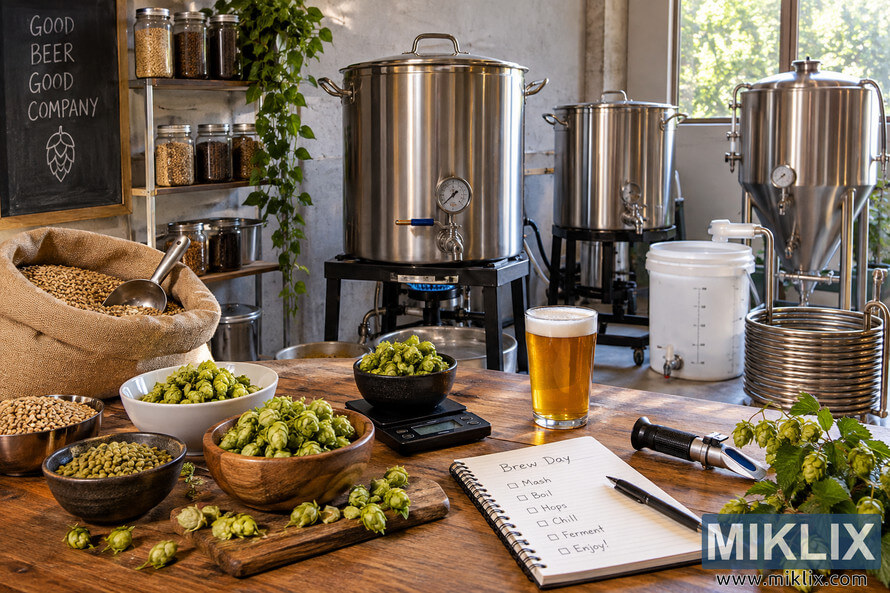
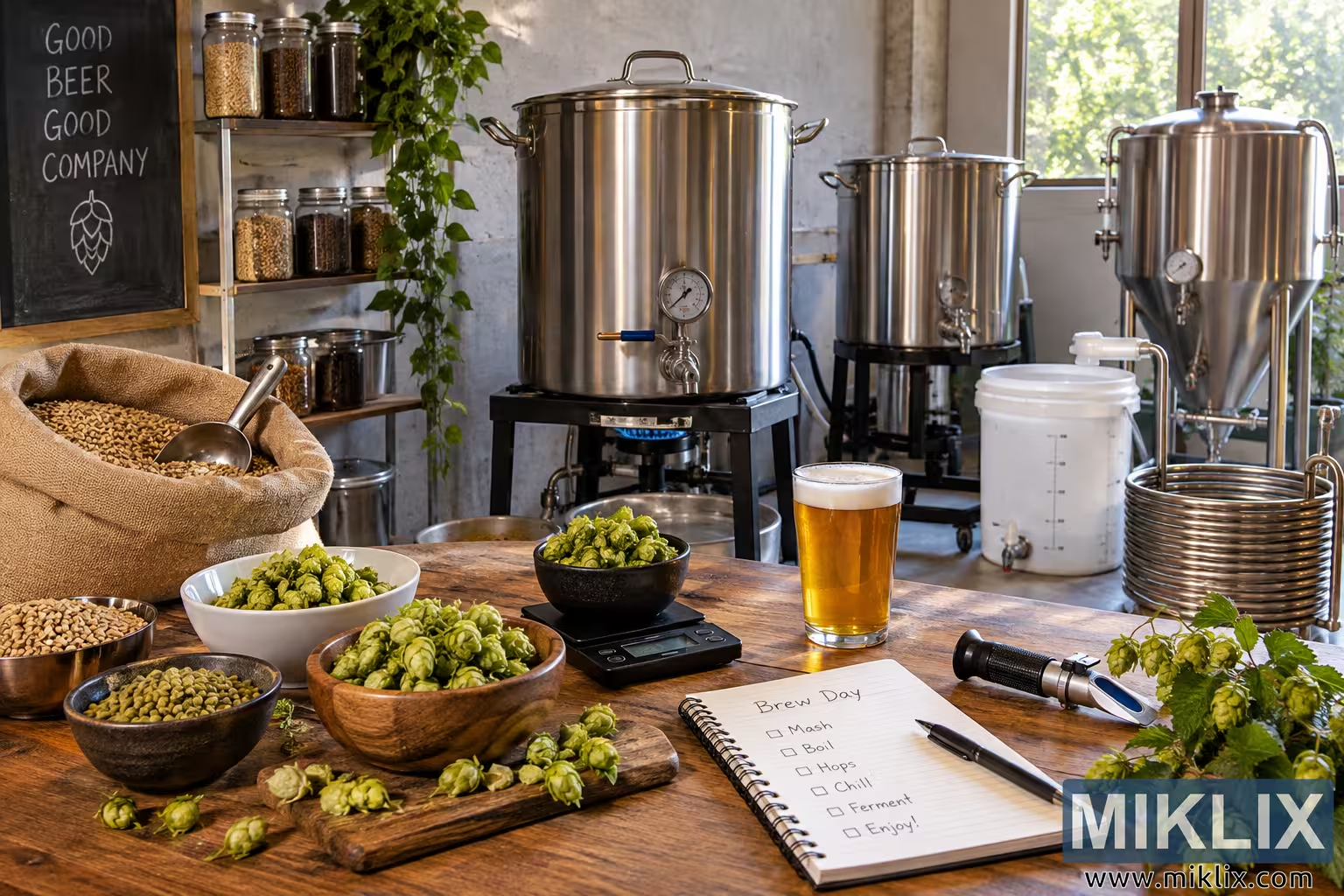
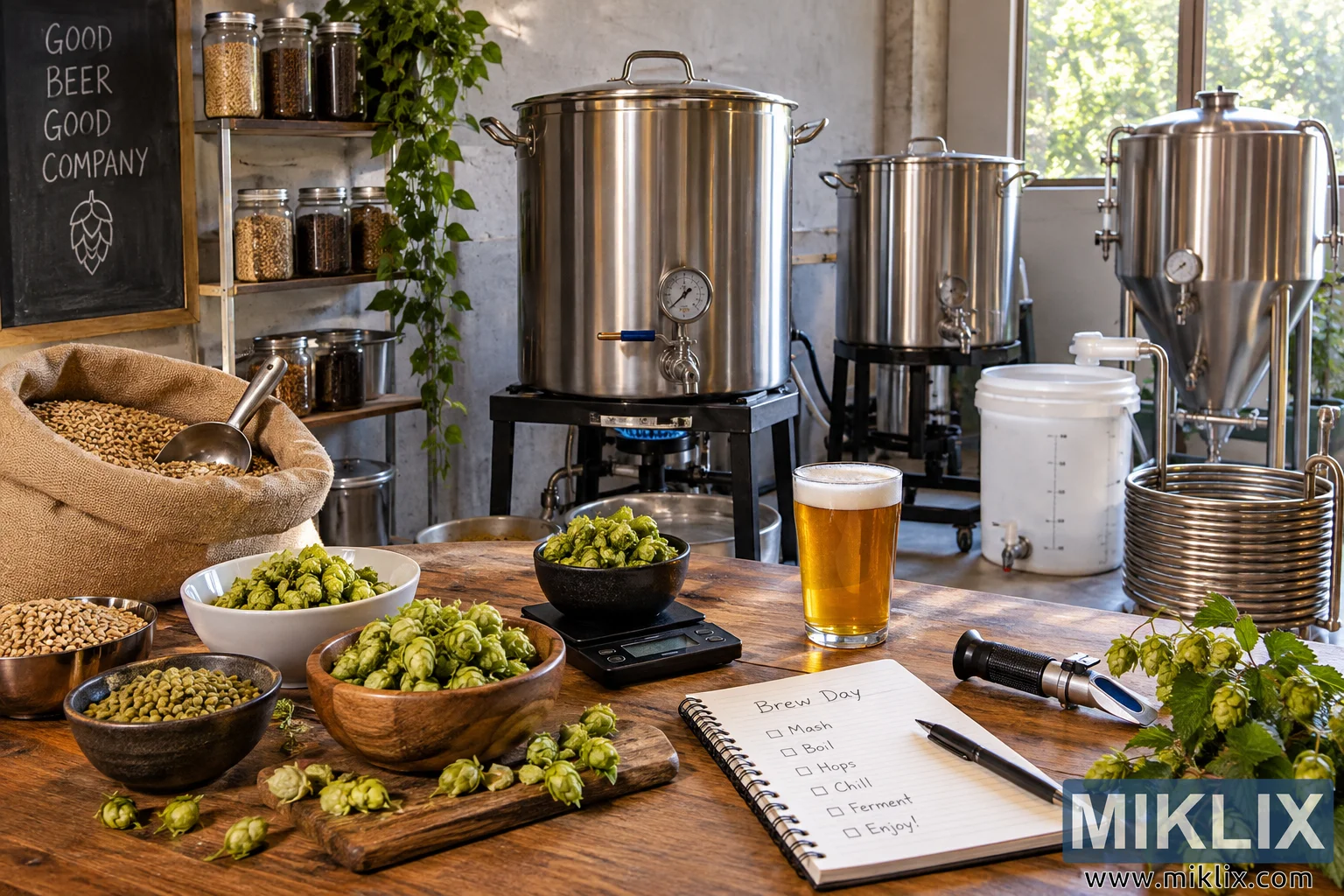
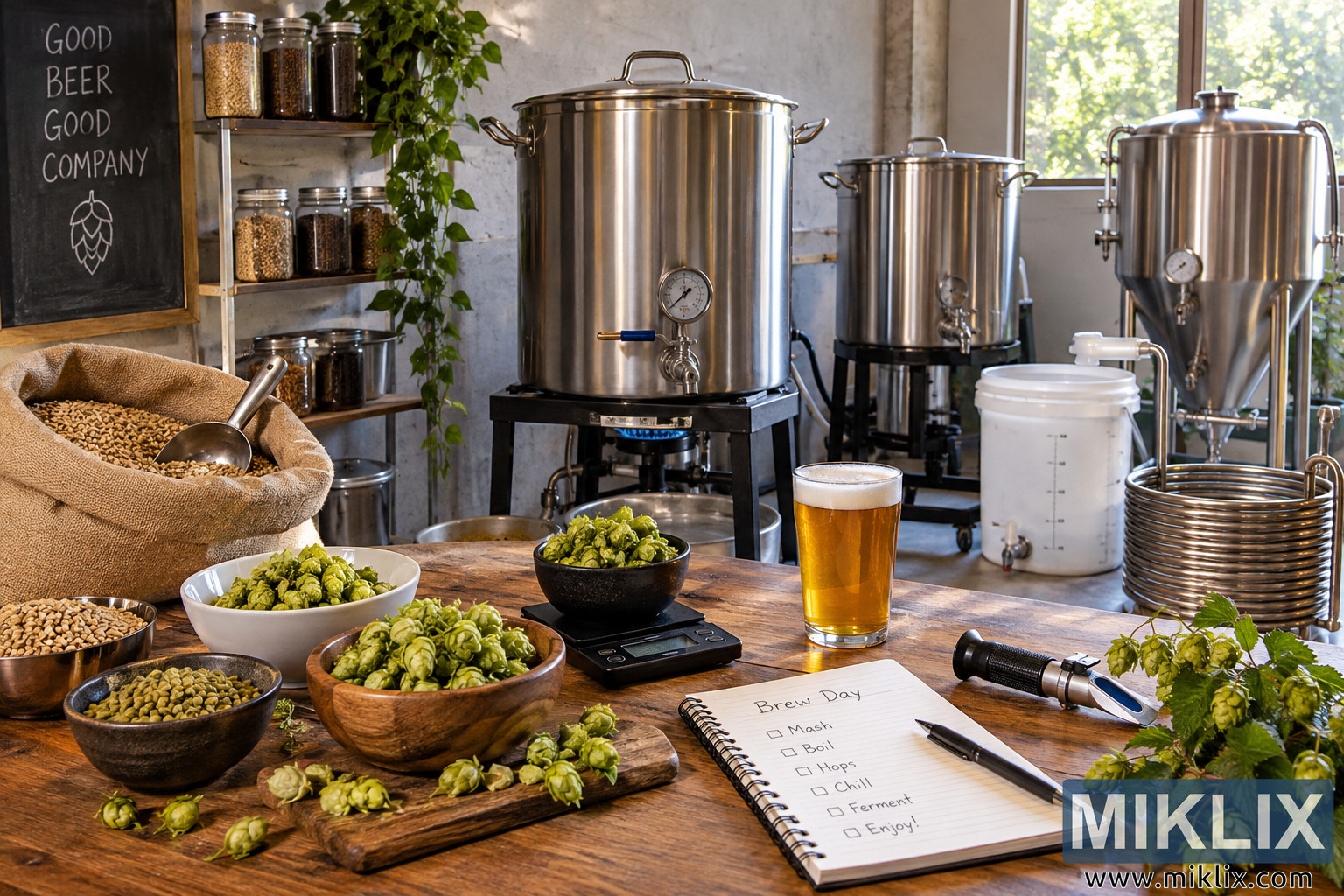
A detailed homebrewing setup for hop-forward beer, featuring stainless-steel kettles, fermentation equipment, fresh hops, malted grain, brewing tools, an immersion chiller, and a glass of golden beer.
Available versions of this image
The image files available for download below are less compressed and higher resolution - and as a result of that, higher quality - than the images embedded in articles and pages on this website, which are more optimized for file size in order to reduce bandwidth consumption.
Regular size (1,536 x 1,024)
Large size (3,072 x 2,048)
Very large size (4,608 x 3,072)
Extra large size (6,144 x 4,096)
Comically large size (1,048,576 x 699,051)
- Still uploading... ;-)
Image description
A wide, landscape-oriented photograph depicts a carefully arranged homebrewing workspace designed for producing hop-forward beer. The scene is set in a bright, rustic indoor brewing area that combines practical stainless-steel equipment with warm wooden surfaces and natural decorative elements. Daylight enters through a large window on the right side of the room, illuminating the polished metal vessels and creating soft reflections across the brewing equipment. The overall atmosphere suggests an enthusiastic and well-equipped home brewer preparing for a brew day focused heavily on hops.
The central feature is a large cylindrical stainless-steel brewing kettle positioned on a sturdy black metal burner stand. The kettle has two side handles, a fitted lid with a raised handle, a round analog gauge mounted near the lower front, and a metal outlet valve. A small blue-handled fitting is attached near the valve assembly. Beneath the kettle, the burner and associated metal components are visible. Behind and slightly to the right of the main kettle is a second stainless-steel vessel mounted on another dark stand. It has a similar cylindrical form, with a lid, side handles, a gauge, and a valve near its base. Farther to the right stands a tall conical stainless-steel fermenter. Its polished body narrows toward the bottom and is supported by several slender legs. Additional fittings, clamps, a gauge, and valves emphasize the functional brewing setup. No commercial branding or recognizable brand logos are visible on the equipment.
In the right foreground, a large stainless-steel immersion chiller is prominently displayed. Its tightly wound metal coil forms a substantial cylinder, with tubing extending upward from the coil. Behind it is a large white brewing bucket with measurement markings and a spigot near the bottom. Flexible tubing and various brewing connections can be seen around the vessels, reinforcing the impression of a complete small-scale brewing system capable of handling mashing, boiling, chilling, fermentation, and transfer.
The wooden worktable in the foreground is covered with ingredients and tools associated with hop-forward beer production. Several bowls contain fresh-looking green hop cones. A large wooden bowl near the center foreground is filled generously with hops, while a white bowl farther left contains another substantial portion. A dark bowl positioned on a digital scale holds an additional measured quantity of hop cones, suggesting that different hop additions are being weighed for specific stages of the brewing process. More individual hop cones are scattered naturally across a wooden cutting board and the tabletop. On the far right, leafy hop bines with clusters of green cones extend across the table, providing a fresh botanical element and visually emphasizing the hop-focused character of the brewing session.
Malted grain is also prominently represented. On the left side of the image, a large burlap sack is open and filled with pale malted barley. A stainless-steel scoop rests inside the grain. Nearby metal and dark-colored bowls contain additional portions of grain and small green hop pellets. These ingredients create a visual progression from malt to hops, illustrating the primary raw materials involved in brewing. Shelves against the back wall hold clear glass jars filled with different grains or malts in a range of golden, tan, brown, and dark shades. The jars are simple and unbranded.
Near the center-right of the worktable stands a clear pint glass filled with bright golden-amber beer. A dense white foam head sits on top, while light passing through the glass highlights the beer's warm color and clarity. The glass contains no logo, label, or other brand identification. Its placement among the brewing ingredients suggests the finished result of the process represented by the surrounding equipment.
A spiral-bound notebook lies open on the front-right portion of the table. The page is headed “Brew Day” and contains a handwritten checklist with brewing stages including mash, boil, hops, chill, ferment, and enjoy. A black pen rests diagonally across the notebook. Beside the notebook is a handheld optical brewing instrument resembling a refractometer, used for taking measurements during the brewing process. A compact digital scale under one of the bowls of hops further communicates the precision involved in recipe formulation and ingredient measurement.
The background gives the brewing room a warm workshop character. The wall has a light, slightly weathered finish, while simple wooden shelving holds grain jars and brewing supplies. Green trailing plants grow around the shelving, softening the industrial appearance of the stainless-steel vessels. On the far left is a vertical chalkboard framed in wood. Written in white chalk are the words “GOOD BEER GOOD COMPANY,” accompanied by a simple line drawing of a hop cone. The message is generic rather than commercial and does not represent an actual beer or equipment brand.
Natural light from the large window creates a bright highlight along the right side of the scene. Green foliage is visible outside, contributing to the fresh, craft-oriented atmosphere. The mix of reflective stainless steel, warm wood, burlap, glass, grain, and vivid green hops creates strong textural contrast throughout the photograph. The composition is dense with brewing details without appearing chaotic: major equipment occupies the middle and background, while ingredients, measuring tools, and the finished beer are arranged across the foreground.
Overall, the image presents an inviting, technically capable homebrewing setup centered on hop-forward beer production. The abundance of whole hop cones, hop pellets, fresh hop bines, measured hop additions, brewing vessels, fermentation equipment, grain, chilling coil, notebook, and measurement tools communicates both the craft and process of brewing. The photograph contains no people and no identifiable commercial brands, allowing the equipment and ingredients themselves to define the scene. Its wide composition, warm natural lighting, rustic workshop setting, and polished brewing hardware give it the appearance of a professional lifestyle photograph while retaining the approachable character of a serious home brewery.
The image is related to: Hops in Beer Brewing: Summer