
Image: Vacuum-Sealed Hops Stored in a Freezer
Published: November 2, 2026 at 5:50:58 PM UTC
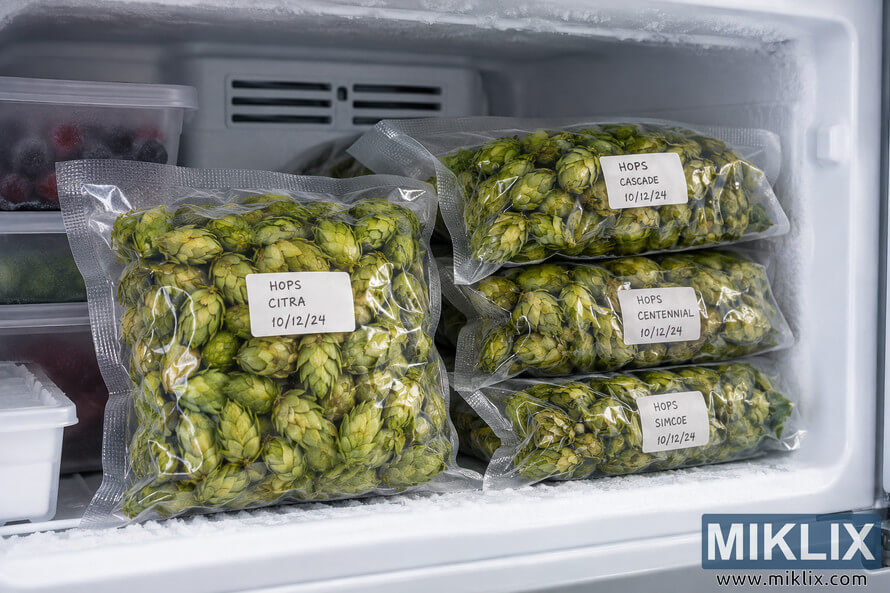
High-resolution photo illustrating hop storage with labeled, vacuum-sealed bags of whole green hop cones neatly organized inside a cold freezer.
Available versions of this image
The image files available for download below are less compressed and higher resolution - and as a result of that, higher quality - than the images embedded in articles and pages on this website, which are more optimized for file size in order to reduce bandwidth consumption.
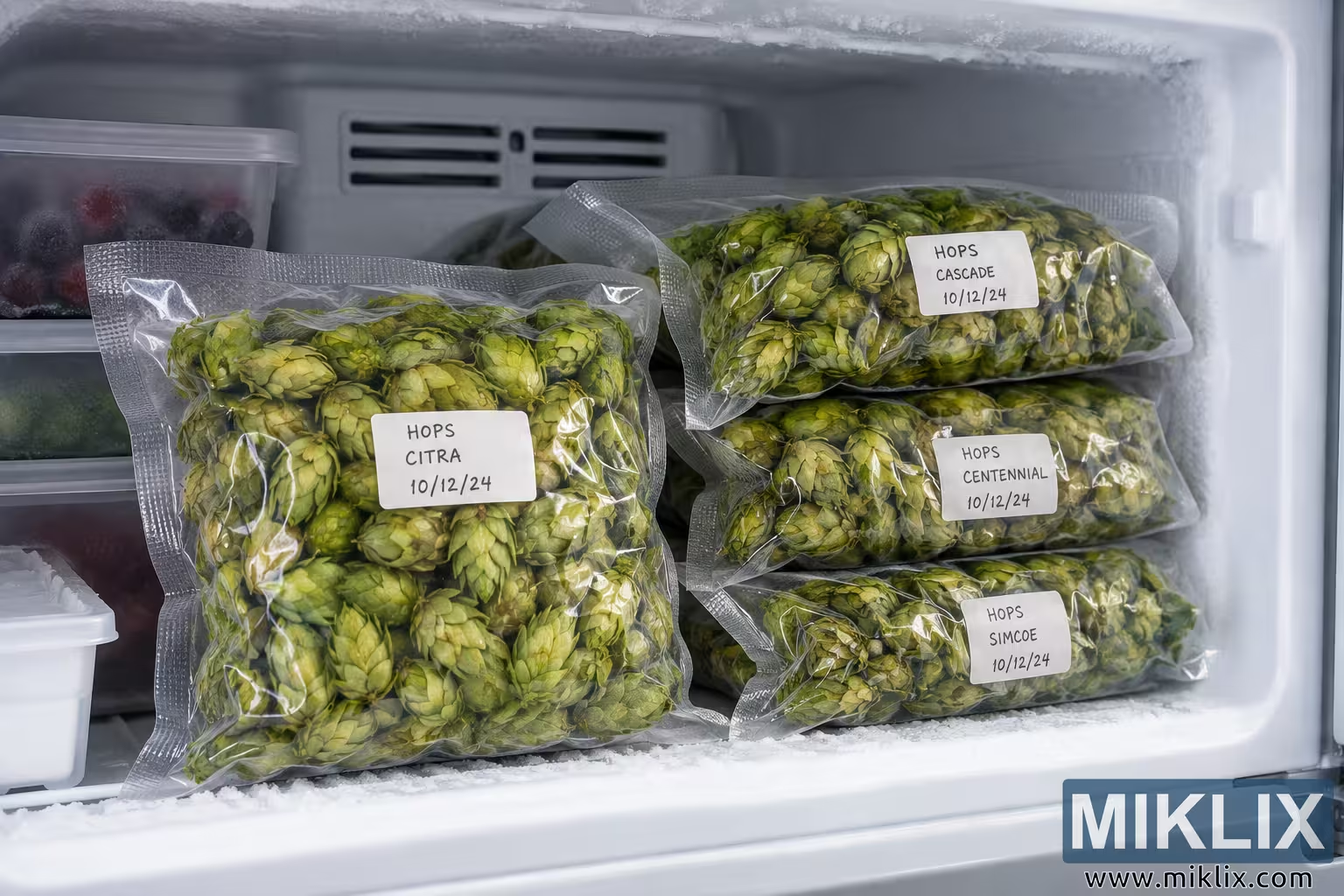
Regular size (1,536 x 1,024)
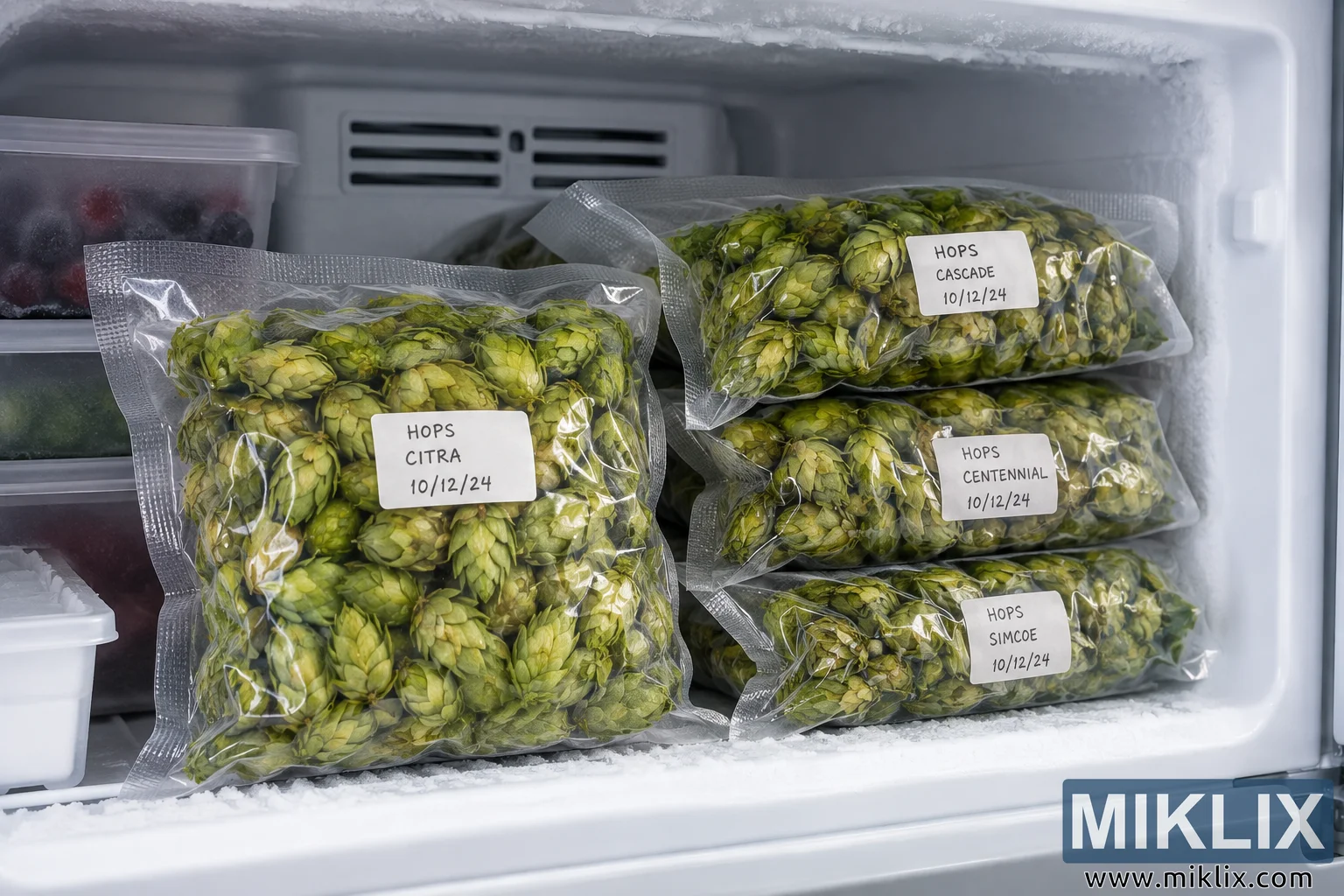
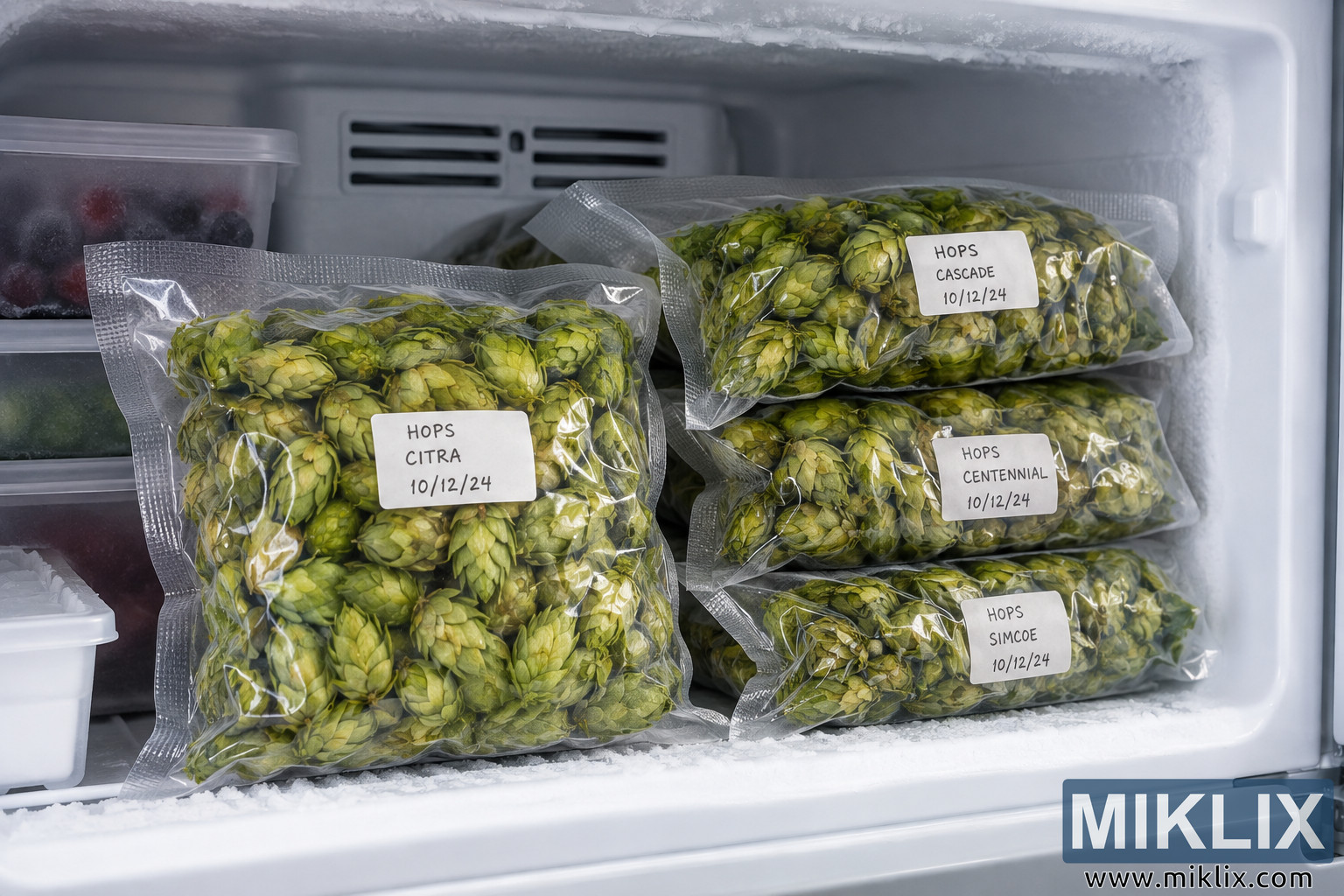
Large size (3,072 x 2,048)
Very large size (4,608 x 3,072)
Extra large size (6,144 x 4,096)
Comically large size (1,048,576 x 699,051)
- Still uploading... ;-)
Image description
A high-resolution, landscape-oriented photograph shows a carefully organized freezer interior being used for proper long-term hop storage. The camera looks directly into a clean white freezer compartment from a slightly elevated frontal angle, creating a clear view of several transparent vacuum-sealed bags filled with whole hop cones. The scene is brightly but softly illuminated by cool, neutral light, emphasizing cleanliness, cold storage, and careful ingredient preservation. The freezer walls and shelving are white, while a thin layer of frost and small ice crystals is visible along the upper interior edge and across the lower shelf. These frozen details immediately communicate the low-temperature environment and reinforce the idea that the hops are being protected from heat during storage.
The most prominent object is a large vacuum-sealed bag positioned in the left foreground. It contains numerous tightly packed hop cones in natural shades ranging from fresh yellow-green to deeper olive green. Individual cones remain clearly recognizable through the transparent packaging, with overlapping papery bracts and compact flower shapes creating a richly textured appearance. The vacuum process has drawn the clear plastic closely around the hops, producing wrinkles, glossy highlights, compressed contours, and small pockets where the film conforms to the ingredients. A plain rectangular white label is attached near the center of the bag. The label identifies the contents as hops and includes the variety name “CITRA” together with the date “10/12/24.” There are no commercial logos, branded package designs, promotional graphics, or manufacturer marks anywhere on the visible packaging.
To the right of the large foreground bag is a neat stack of three additional vacuum-sealed hop packages. Their orderly horizontal arrangement makes efficient use of the freezer space and visually communicates a practical storage system. The upper package contains densely packed green hop cones and has a simple white label reading “HOPS,” “CASCADE,” and “10/12/24.” Beneath it, another transparent bag is labeled “HOPS,” “CENTENNIAL,” and “10/12/24.” The lowest visible bag is labeled “HOPS,” “SIMCOE,” and “10/12/24.” All three packages have the same functional, unbranded presentation: transparent vacuum-sealed material, clearly visible hop cones, and straightforward white identification labels. The repeated labeling convention suggests an organized method in which hop varieties and storage dates can be identified quickly without opening the packages.
The composition demonstrates several important visual aspects of appropriate hop storage. The hops are sealed tightly rather than being exposed to the freezer atmosphere, which visually suggests an effort to minimize the air surrounding them. The transparent bags allow the contents to be inspected while remaining enclosed. Keeping the packages inside a freezer conveys protection from elevated temperatures, and the compact stacking arrangement suggests that the sealed bags can be stored efficiently until they are needed. The image therefore works as a practical visual representation of vacuum sealing and frozen storage rather than as an advertisement for a particular product or supplier.
Additional freezer contents appear around the hop packages but remain secondary to the main subject. On the far left, several translucent plastic food containers are stacked vertically. The upper container appears to hold dark red and purple frozen berries, while a lower container contains green food items. Their surfaces are slightly softened by condensation or frost, helping establish depth without distracting from the hops. A small portion of a white ice tray or freezer container is visible at the lower-left edge of the frame. Behind the hop bags, the freezer's rear ventilation grille can be seen near the upper center. Its dark horizontal openings contrast subtly with the white interior and add realistic appliance detail to the setting.
The freezer itself appears clean, modern, and well maintained. Frost along the ceiling edge and shelf lip has a granular, crystalline texture, while the smooth molded plastic surfaces reflect the cool illumination. The transparent vacuum bags introduce brighter specular reflections, especially where the plastic folds and stretches around the hop cones. These highlights make the packaging appear genuinely sealed and give the photograph a tactile quality. The combination of white freezer surfaces, transparent packaging, green hops, and restrained background colors produces a fresh, practical visual palette dominated by white, silver-gray, and botanical green.
Depth is created through overlapping packages and a gradual reduction in sharpness toward the rear and left edges. The large Citra bag occupies much of the foreground and acts as the primary focal point, while the three stacked bags on the right create a second strong visual grouping. Together they form a balanced composition that fills most of the horizontal frame. The freezer walls naturally frame the stored ingredients, while the ventilation grille and background containers provide enough contextual information to make the setting immediately recognizable. There are no people, hands, brewing vessels, tools, or decorative props in the scene, allowing attention to remain firmly focused on storage technique.
Overall, the photograph presents a realistic and easy-to-understand example of hops prepared for frozen storage. Whole hop cones have been separated by variety, placed in individual transparent vacuum-sealed bags, labeled with identifying information and dates, and arranged neatly inside a freezer. The visible compression of the bags, clearly frozen environment, simple labeling system, and absence of commercial branding give the scene an instructional and practical character. The landscape format provides enough room to show both the prominent foreground package and the organized stack beside it, making the image suitable for educational material, brewing guides, articles about ingredient preservation, or general explanations of how hops can be packaged for freezer storage.
The image is related to: Hops in Beer Brewing: Summer