
Image: Fresh vs. Degraded Summer Hops: Visual Comparison
Published: November 2, 2026 at 5:50:58 PM UTC
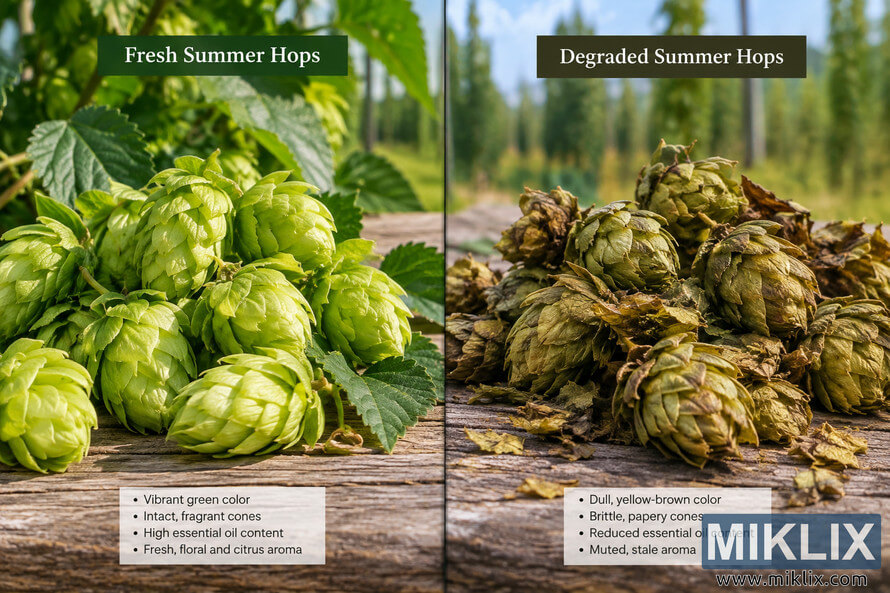
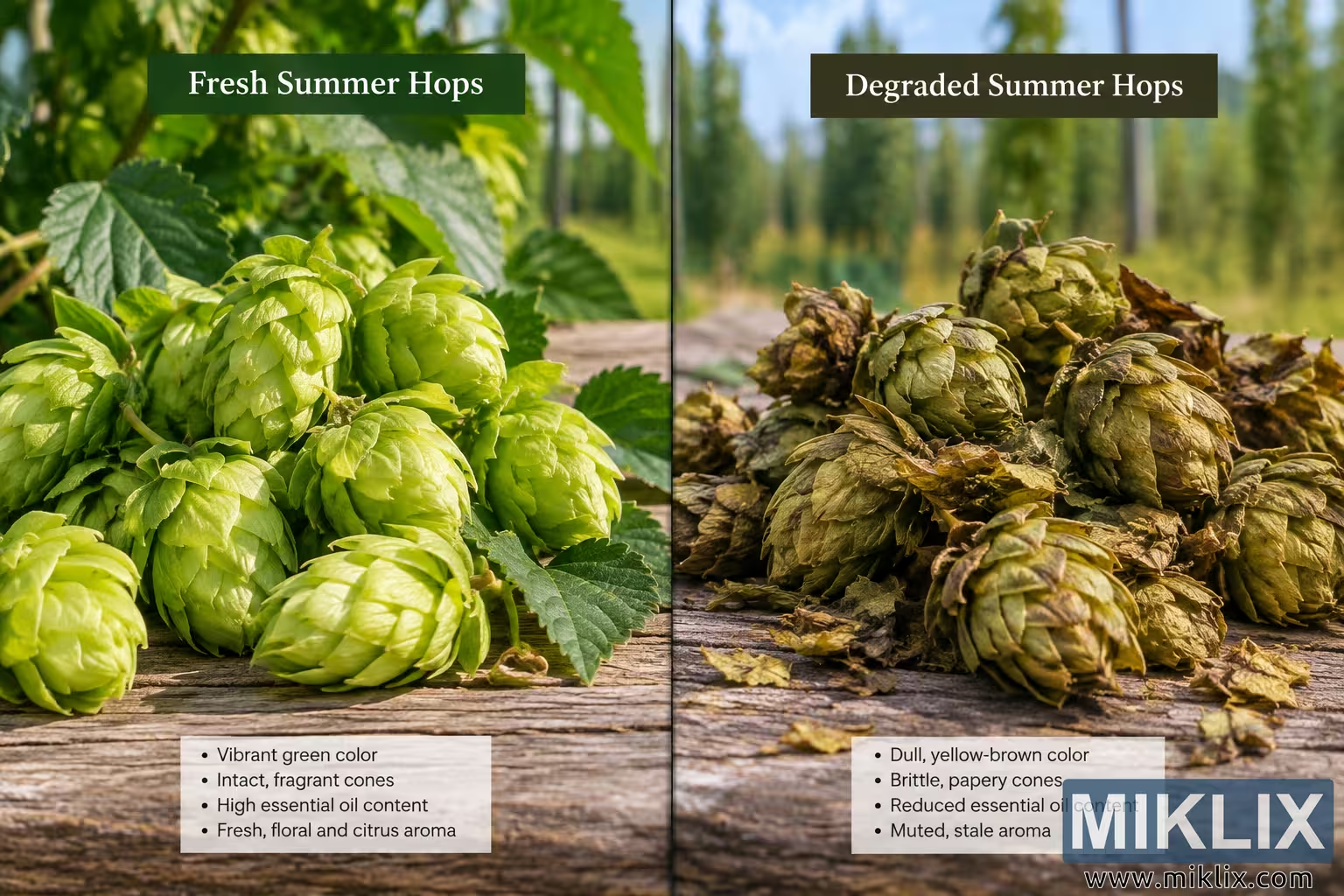
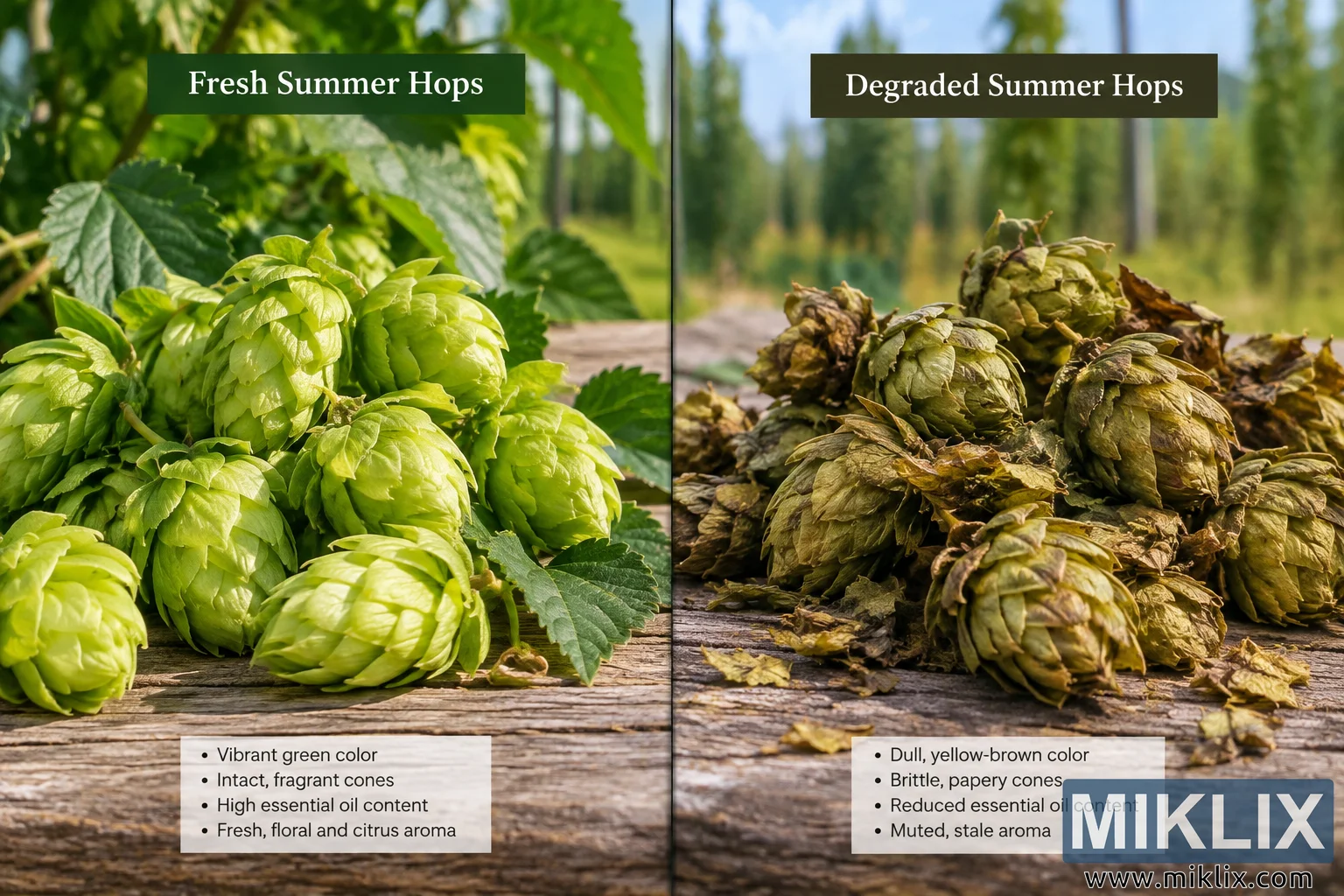
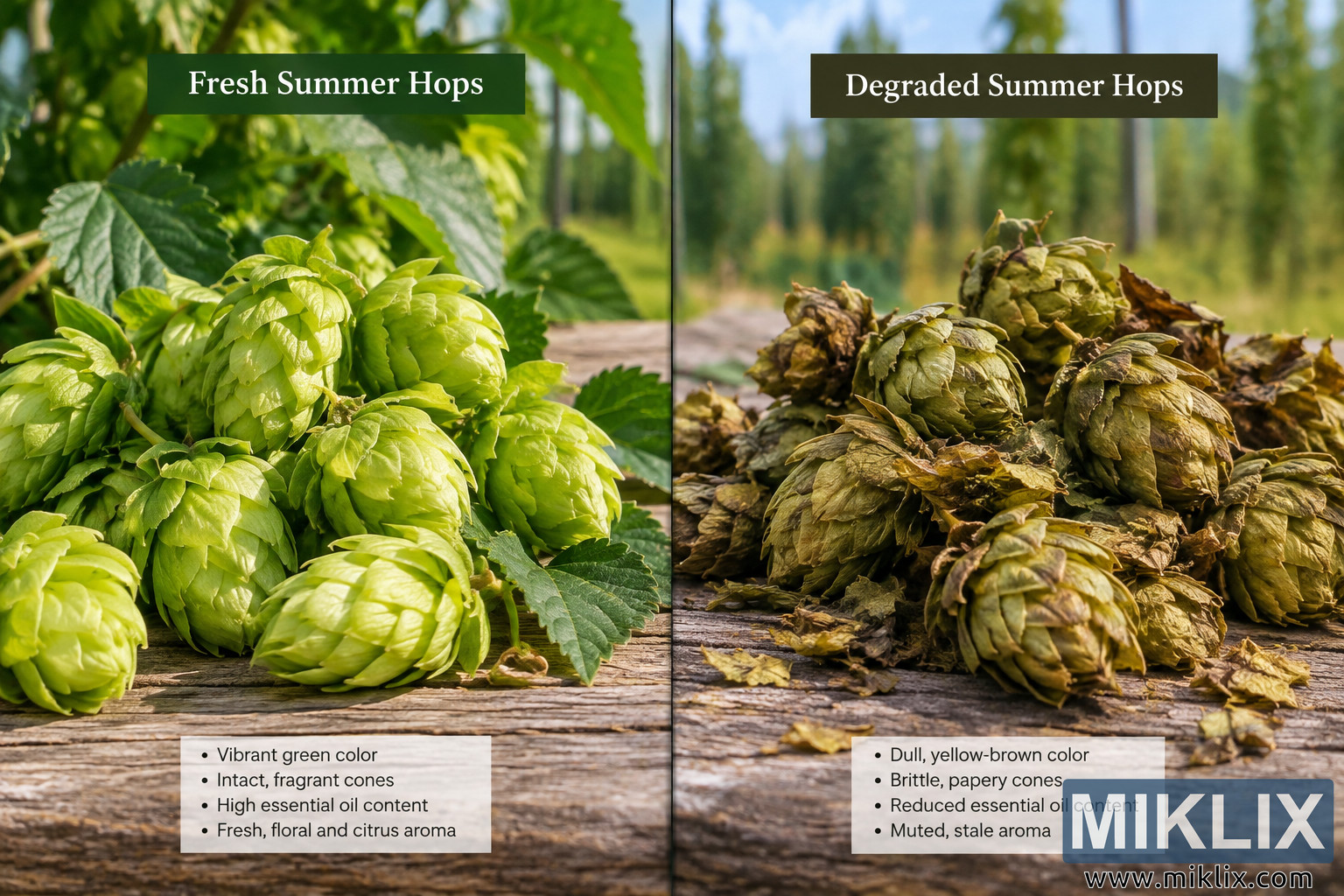
Visual comparison of fresh and degraded summer hops, showing differences in green color, cone structure, dryness, essential oil content, and signs of deterioration.
Available versions of this image
The image files available for download below are less compressed and higher resolution - and as a result of that, higher quality - than the images embedded in articles and pages on this website, which are more optimized for file size in order to reduce bandwidth consumption.
Regular size (1,536 x 1,024)
Large size (3,072 x 2,048)
Very large size (4,608 x 3,072)
Extra large size (6,144 x 4,096)
Comically large size (1,048,576 x 699,051)
- Still uploading... ;-)
Image description
The image is a landscape-oriented, side-by-side photographic comparison designed to illustrate the visual difference between fresh summer hops and degraded summer hops. The composition is divided almost exactly down the center by a thin, dark vertical line, creating two clearly separated halves while maintaining a consistent outdoor setting. Both groups of hop cones rest on a rustic, weathered wooden surface, and a softly blurred natural background suggests a sunny hop-growing environment or rural field. The overall presentation combines realistic agricultural photography with simple informational labels, making the contrast immediately understandable.
On the left side, the heading “Fresh Summer Hops” appears near the top in large white serif lettering inside a dark green rectangular banner. Beneath the heading is a generous cluster of fresh hop cones. The cones are vivid green to yellow-green, with plump, tightly layered bracts and a healthy, resilient appearance. Sunlight catches the overlapping surfaces of the cones, producing bright highlights that emphasize their freshness and three-dimensional texture. Several cones are positioned prominently in the foreground, while additional cones and lush green foliage fill the middle ground. The surrounding leaves are deep green, broad, and healthy-looking, reinforcing the impression of recently harvested or still-fresh plant material. The combination of saturated green coloration, firm-looking structure, and bright natural illumination conveys vitality and freshness.
The fresh hops occupy much of the lower and central portion of the left half. Their individual bracts remain clearly defined and generally intact, with smooth edges and very little visible discoloration. The cones vary slightly in size and orientation, which gives the arrangement a natural rather than artificially uniform appearance. Some cones face the viewer directly, while others angle sideways or downward. Behind them, green leaves rise into the upper portion of the image, partially framing the title. The background becomes progressively softer and less detailed with distance, helping the foreground hops remain the primary visual focus. Warm summer sunlight contributes to the impression that these cones are aromatic, recently harvested, and rich in desirable plant oils.
Near the bottom of the left half is a pale, semi-opaque rectangular information panel containing four bullet points in dark text. The listed characteristics are “Vibrant green color,” “Intact, fragrant cones,” “High essential oil content,” and “Fresh, floral and citrus aroma.” These statements reinforce the visual cues already communicated by the photograph. The panel sits over the wooden tabletop without completely obscuring its texture, and its neutral light background ensures that the explanatory text remains legible against the detailed photographic scene.
The right side provides a deliberate visual contrast. At the top, the heading “Degraded Summer Hops” appears in large white serif lettering within a dark brown to olive-brown rectangular banner. Below it lies a pile of aged or degraded hop cones and fragmented plant material. Instead of the luminous green seen on the left, these cones display muted olive, yellow-brown, tan, and dark brown tones. Their bracts look dry, curled, papery, and brittle. Several cones appear partially collapsed or misshapen, and loose dried fragments are scattered across the wooden surface around them. The deterioration is especially evident along the edges of the bracts, where browning, curling, and irregular textures suggest loss of moisture and freshness.
The degraded hops form a dense pile extending across much of the lower-right half of the image. A few larger cones remain recognizable as intact hop cones, but their coloration and texture differ strongly from the fresh examples. The cone in the lower foreground is predominantly dull olive green with brownish areas and visibly dry overlapping layers. Behind it, other cones are surrounded by crumbled leaves and flakes of dried plant matter. This scattered debris makes the right side appear less orderly and more fragile than the left. Highlights from the same warm outdoor light reveal coarse, desiccated surfaces rather than the smooth, lively sheen of the fresh cones.
The background on the right remains softly blurred and visually compatible with the left side, featuring green vegetation, vertical plant or tree forms, and a bright blue summer sky. Because both halves share similar lighting, environment, camera angle, and wooden foreground, the condition of the hops becomes the principal variable in the comparison. This consistency strengthens the educational nature of the image: viewers can directly compare color, shape, surface condition, and apparent moisture without unrelated differences in setting distracting from the subject.
Near the bottom of the right half is another pale, semi-opaque information panel with four bullet points. It identifies the degraded characteristics as “Dull, yellow-brown color,” “Brittle, papery cones,” “Reduced essential oil content,” and “Muted, stale aroma.” The text complements the visible signs of deterioration, particularly the faded coloration and brittle appearance of the plant material. The placement and styling mirror the information panel on the fresh side, reinforcing the balanced comparison.
The weathered wooden surface running continuously across the bottom of both halves provides visual unity. Its horizontal grain, cracks, warm brown tones, and rough texture create a natural agricultural context for the hops. The tabletop also offers a useful neutral reference against which the difference in hop coloration becomes especially noticeable: the fresh cones stand out through their bright greens, while the degraded cones blend more closely with the brown and ochre tones of the wood.
Overall, the image functions as an accessible visual guide to recognizing fresh versus degraded summer hops. The left half communicates freshness through vivid green color, full cone structure, healthy foliage, intact bracts, and an energetic sunlit appearance. The right half communicates deterioration through olive and brown discoloration, curled and brittle bracts, collapsed forms, loose fragments, and an overall dry, stale appearance. The centered split, matching photographic conditions, prominent headings, and concise explanatory panels allow viewers to understand the comparison quickly while still providing enough visual detail for closer inspection. No commercial branding, product packaging, logos, trademarks, or identifiable brand elements are visible; the presentation remains generic and focused entirely on the agricultural characteristics of the hop cones.
The image is related to: Hops in Beer Brewing: Summer