
Image: Microscopic Interaction of Yeast Cells and Hop Compounds
Published: November 2, 2026 at 5:50:58 PM UTC
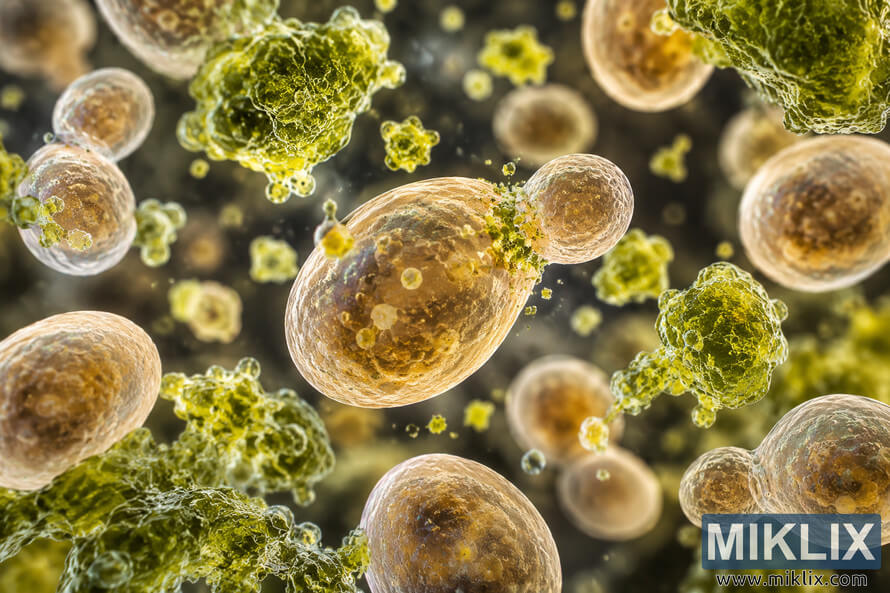
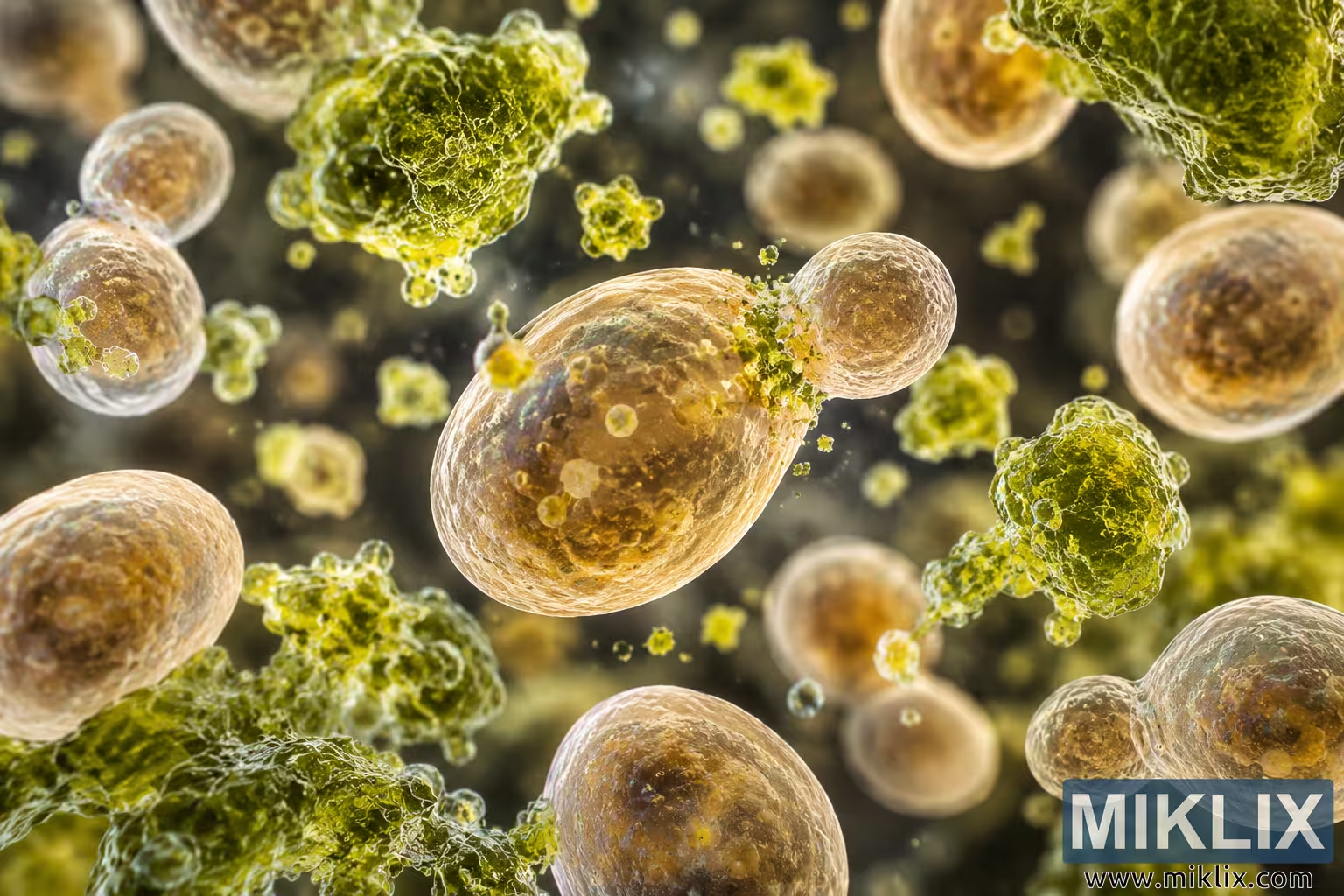
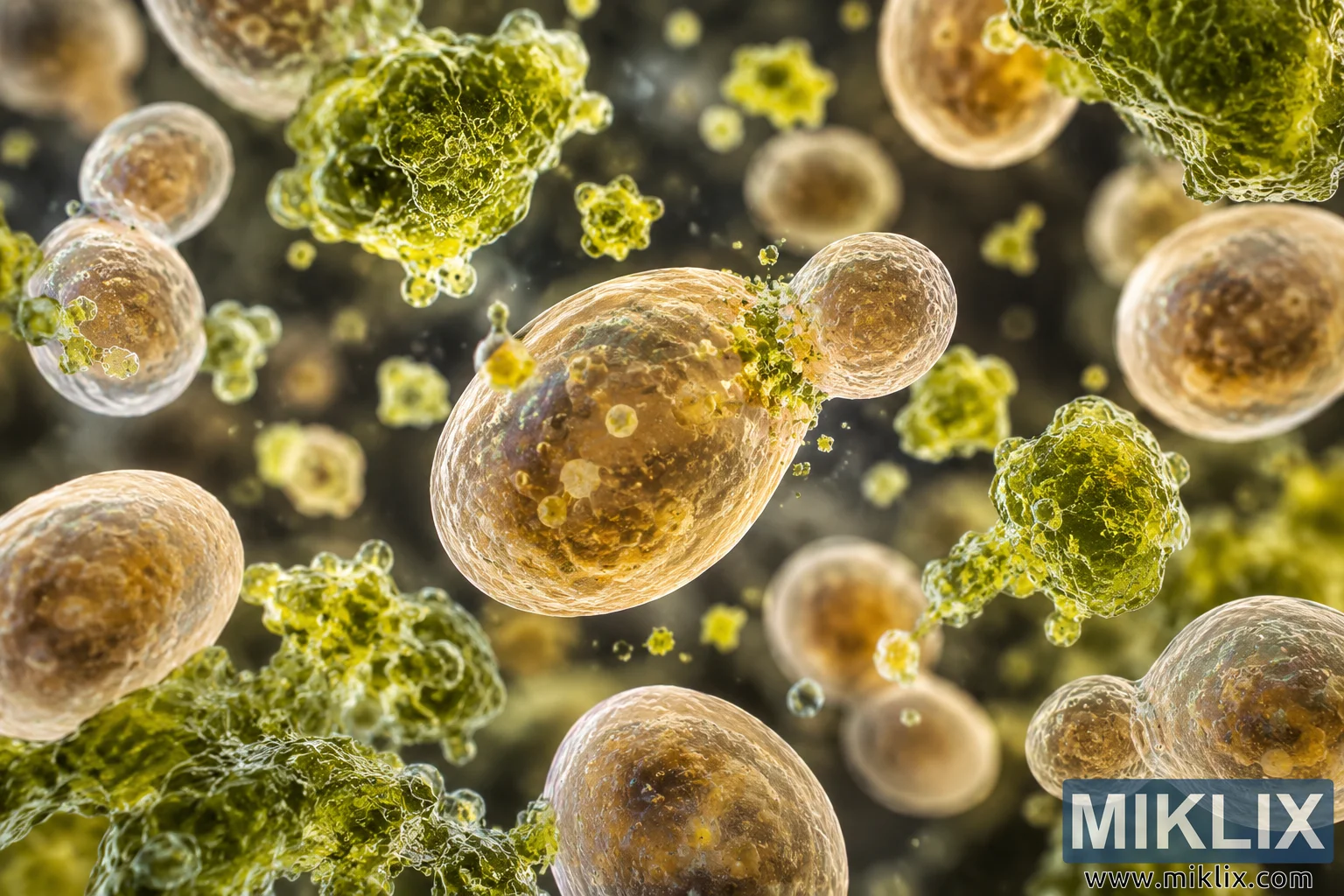
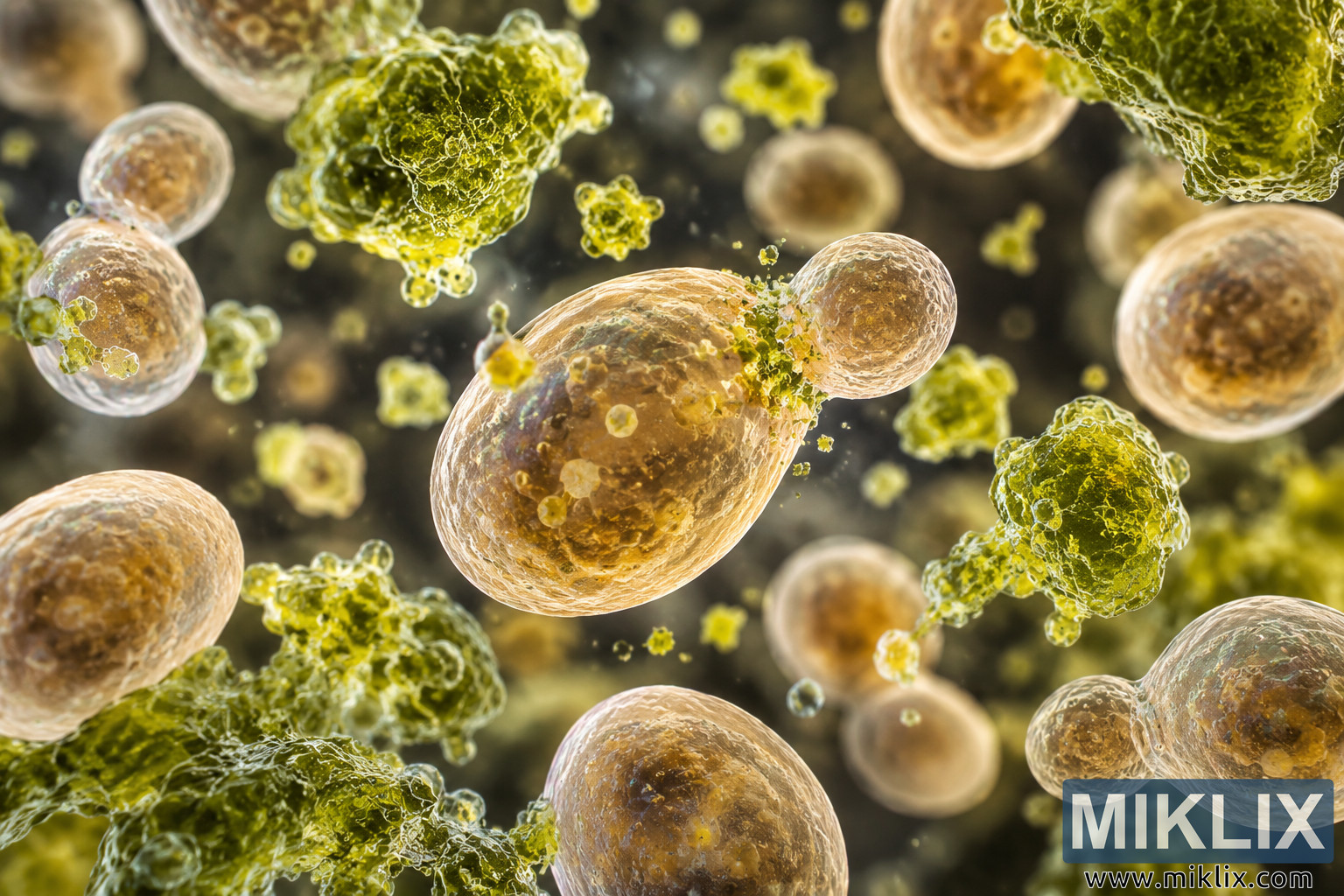
Detailed microscopic visualization of budding yeast cells interacting with yellow-green hop-derived compounds, illustrating a dynamic fermentation-related biochemical environment.
Available versions of this image
The image files available for download below are less compressed and higher resolution - and as a result of that, higher quality - than the images embedded in articles and pages on this website, which are more optimized for file size in order to reduce bandwidth consumption.
Regular size (1,536 x 1,024)
Large size (3,072 x 2,048)
Very large size (4,608 x 3,072)
Extra large size (6,144 x 4,096)
Comically large size (1,048,576 x 699,051)
- Still uploading... ;-)
Image description
A highly detailed microscopic-style visualization depicts yeast cells interacting with hop-derived compounds in a fluid biological environment. The scene is presented in landscape orientation and uses an immersive macro-photographic perspective, making the microscopic structures appear large, tangible, and three-dimensional. Numerous yeast cells are distributed throughout the composition at different depths. They have rounded to oval forms, translucent outer membranes, and warm amber, golden-brown, and honey-colored interiors. Their surfaces appear slightly textured and refractive, with bright highlights tracing portions of their cell walls. Several cells display the characteristic budding morphology associated with yeast reproduction, with smaller spherical or oval daughter cells attached to larger parent cells. The most prominent example occupies the center of the image, where a large oval yeast cell is connected to a smaller rounded bud near its upper-right edge. This central cell forms the primary focal point and is rendered with particularly sharp detail, revealing a complex internal appearance composed of softly defined granular structures, darker brown regions, tiny suspended particles, and luminous golden inclusions.
Surrounding and interacting with the yeast cells are irregular masses representing hop-derived compounds. These structures are predominantly yellow-green, olive green, and vivid chartreuse, providing a strong visual contrast with the warm amber tones of the yeast. Rather than appearing as recognizable whole hop flowers, the compounds are represented as microscopic resinous aggregates, molecular clusters, or fragmented botanical material. Their shapes are uneven and organic, with folded, craggy, porous, and occasionally web-like surfaces. Some clusters resemble translucent resin suspended in liquid, while others have a denser, fibrous appearance. Fine pale lines and filament-like details run across portions of the green structures, suggesting complex molecular networks or surface textures. Bright yellow highlights along their edges give the compounds a luminous, almost crystalline quality.
The interaction between the yeast and hop compounds is most clearly illustrated around the central budding yeast cell. Small green and yellow particles appear concentrated at the point where the smaller bud joins the larger parent cell. Tiny fragments surround the contact region, suggesting that hop-derived molecules are accumulating on, binding to, or otherwise interacting with the yeast cell membrane. Additional microscopic particles float freely through the surrounding medium, visually connecting the larger hop clusters and individual yeast cells. This distribution creates the impression of an active biochemical environment rather than a static collection of isolated objects. The visualization therefore communicates the concept of yeast and hop compounds existing together at the microscopic scale, with molecular-scale contact and exchange occurring throughout the scene.
The composition uses pronounced depth of field to reinforce the microscopic photographic aesthetic. Structures near the central focal plane are crisp and richly textured, while cells and hop compounds positioned farther toward the foreground or background become progressively softer and more blurred. Large yeast cells enter the frame from the left, right, upper, and lower edges, giving the impression that the visible scene represents only a small portion of a much larger microbial environment. A large amber yeast cell on the far right is partially cropped by the image boundary, while several other cells in the upper and lower areas are similarly truncated. Green hop-derived masses also extend beyond the frame, particularly in the upper-right and lower-left regions. These cropped elements create visual continuity beyond the image boundaries and contribute to the sensation of looking through a microscope into a densely populated suspension.
Lighting plays a major role in the image's appearance. The yeast membranes catch bright cream and white highlights, producing a glossy, semi-transparent effect similar to illuminated biological specimens or fluid-filled vesicles. Light appears to pass through portions of the cells, revealing layered internal textures while leaving other regions darker and more opaque. The hop compounds receive stronger yellow-green illumination, particularly along their ridges and irregular outer surfaces. Their brightest regions glow against the subdued background, making them immediately distinguishable from the yeast. Small suspended particles also catch points of light, appearing as tiny yellow or pale golden specks scattered between the larger structures.
The background is dark, diffuse, and heavily out of focus, consisting primarily of muted charcoal, olive, brown, and gray-green tones. This restrained backdrop increases the perceived brightness and dimensionality of the foreground organisms and compounds. Soft circular blur patterns from distant cells and particles create a natural microscopic bokeh effect. There is no text, labeling, interface, logo, packaging, trademark, or recognizable commercial branding anywhere in the image. The scene is purely illustrative and scientific in character.
Overall, the image combines realistic biological cues with polished scientific visualization. The budding shapes make the amber structures readily identifiable as yeast-like cells, while the green resinous material visually evokes hop-derived compounds without depicting a specific branded ingredient or product. The close interaction between the two types of structures is emphasized through direct surface contact, clusters of fine particles, and the concentration of green material around certain cell membranes. Warm amber cells and cool yellow-green compounds form a complementary palette, while translucent surfaces, granular interiors, shallow focus, and dramatic illumination create a sense of microscopic scale. The final result resembles a sophisticated conceptual micrograph or three-dimensional scientific rendering designed to communicate the interaction of yeast cells and hop compounds in a fermentation-related biochemical environment.
The image is related to: Hops in Beer Brewing: Summer