
Image: Macro Close-Up of Hop Cone with Golden Lupulin Glands
Published: November 12, 2026 at 9:33:54 PM UTC
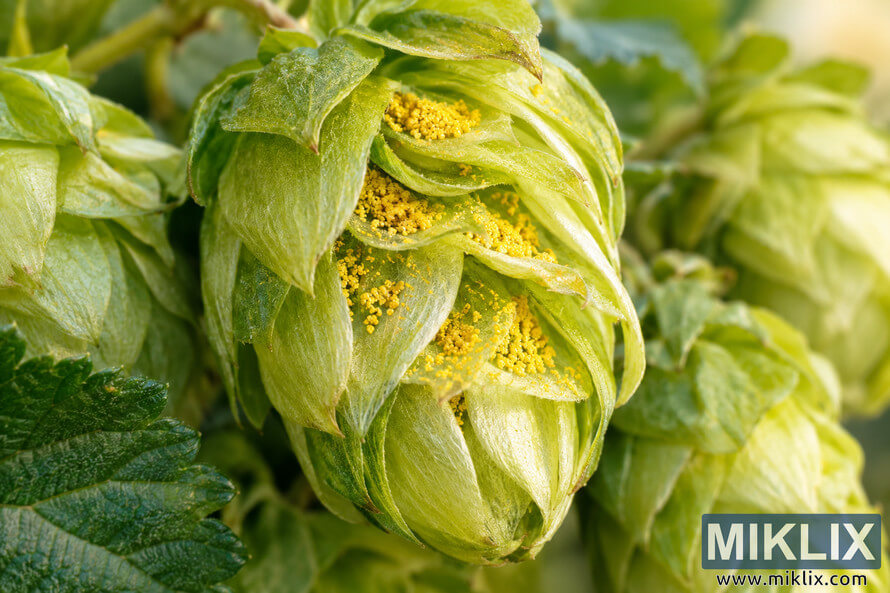
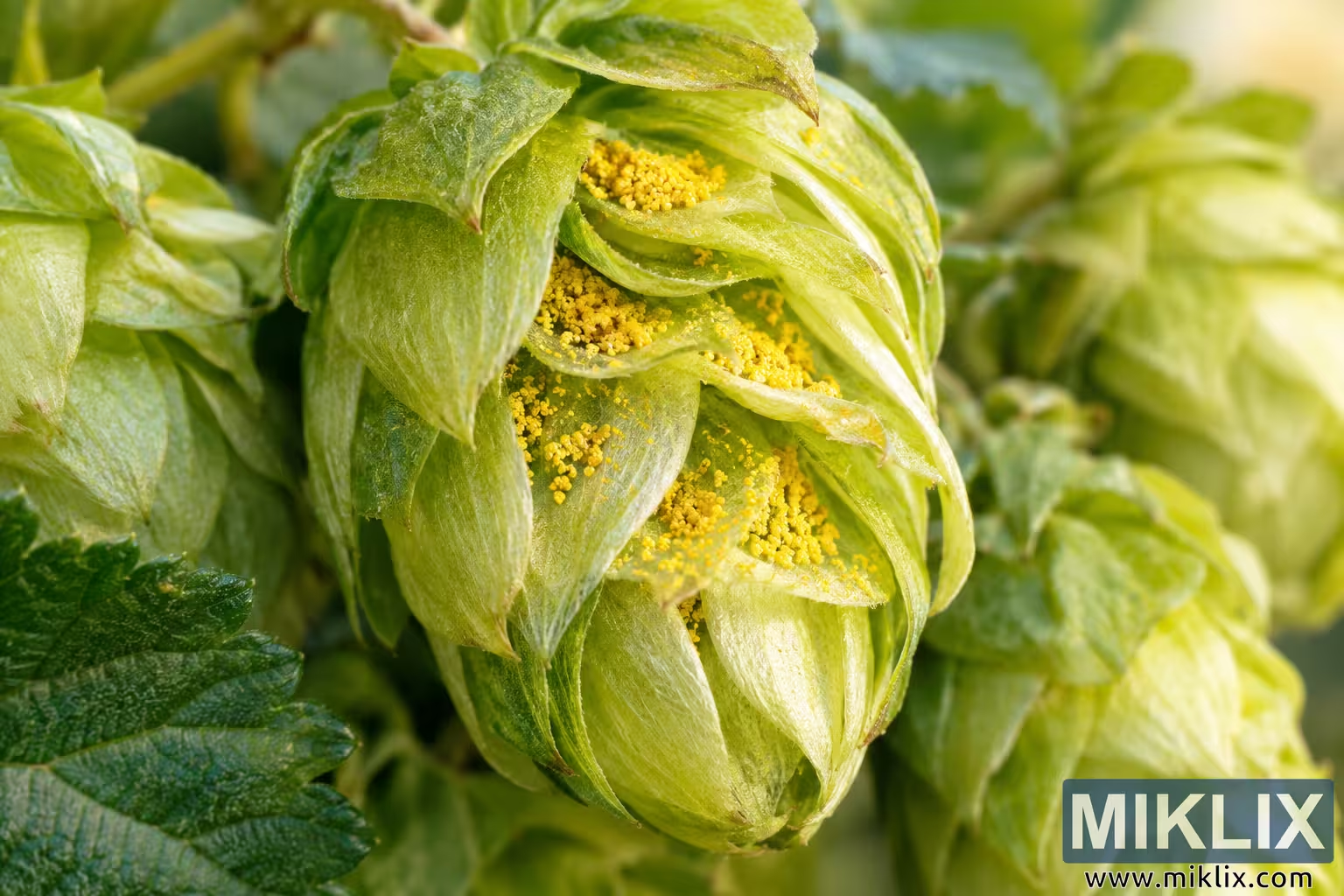
Photorealistic macro close-up of a fresh hop cone revealing golden lupulin glands beneath green bracts, surrounded by sunlit hops and soft botanical foliage.
Available versions of this image
The image files available for download below are less compressed and higher resolution - and as a result of that, higher quality - than the images embedded in articles and pages on this website, which are more optimized for file size in order to reduce bandwidth consumption.
Regular size (1,536 x 1,024)
Large size (3,072 x 2,048)
Very large size (4,608 x 3,072)
Extra large size (6,144 x 4,096)
Comically large size (1,048,576 x 699,051)
- Still uploading... ;-)
Image description
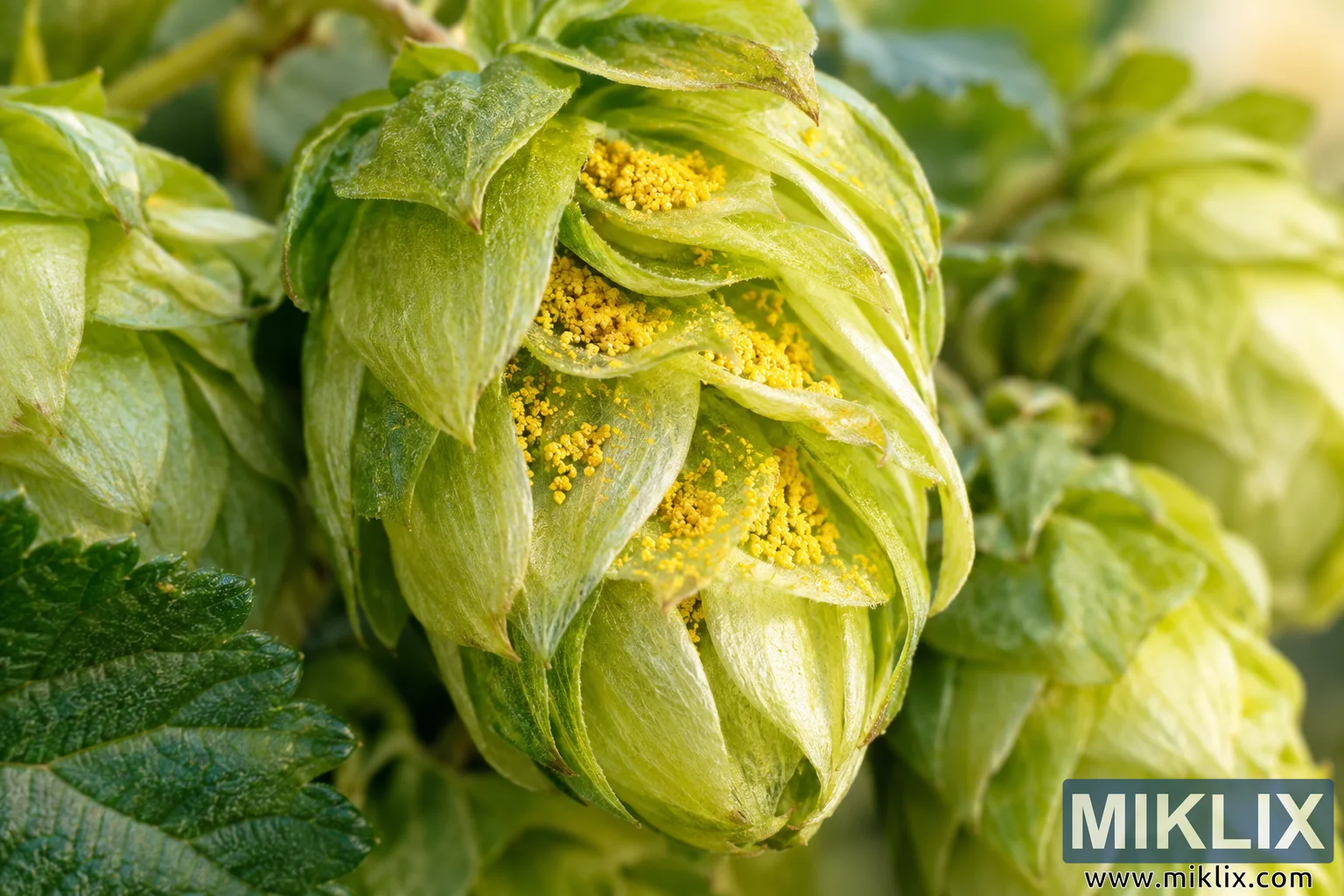
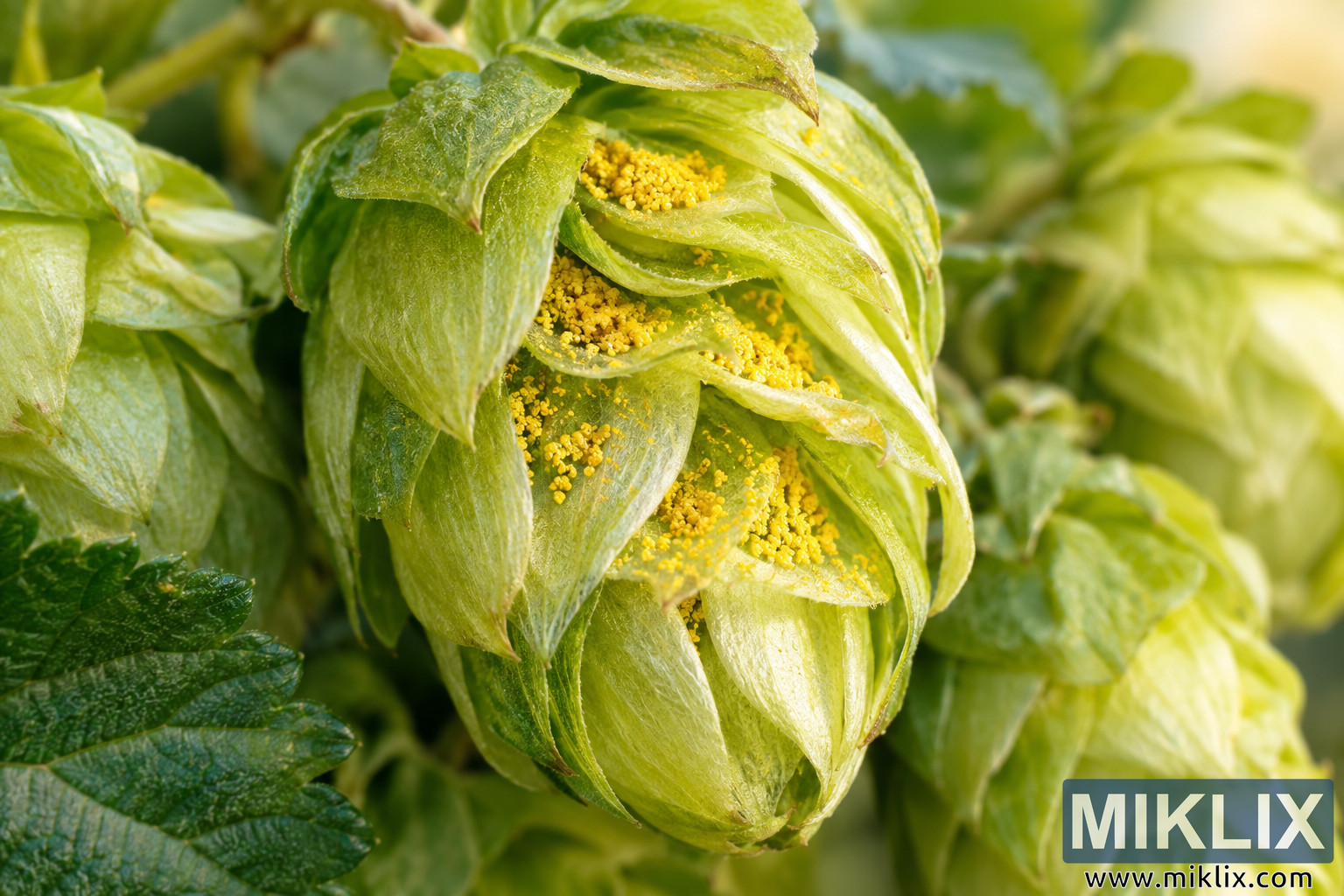
A highly detailed, photorealistic macro photograph presents a fresh hop cone at extremely close range, revealing the intricate botanical structure of the flower and, most importantly, the golden lupulin glands contained among its overlapping bracts. The principal hop cone dominates the center and left-center of the landscape-oriented composition. It is rendered with exceptional clarity, allowing the viewer to examine individual layers of pale green plant tissue, subtle veins, delicate surface textures, softly curled edges, and tiny natural imperfections. Several of the cone's bracts are partially separated or gently opened, exposing concentrated deposits of bright golden-yellow lupulin within the protected inner surfaces. These lupulin glands appear as numerous minute grains and clusters, creating a striking textural and chromatic contrast against the surrounding fresh green material.
The central hop cone has a substantial, three-dimensional presence. Its overlapping bracts form a complex pattern of pointed, leaf-like scales that curve around one another from the top toward the lower portion of the cone. The outer surfaces range from fresh yellow-green to deeper botanical green, while translucent areas illuminated by sunlight take on warmer lime and chartreuse tones. Fine veins can be seen running through many of the bracts, and the macro perspective makes their thin, slightly papery texture particularly apparent. Some edges show faint brownish or reddish natural discoloration, lending realism to the otherwise vibrant plant material. Minute specks and fine surface details further emphasize that this is an organic specimen rather than a stylized botanical illustration.
The lupulin is the strongest visual focal point. Golden glands are concentrated inside the partially opened central section of the hop cone and occur in multiple distinct patches. Near the upper interior, a dense pocket of yellow particles rests against a curved green bract. Additional deposits appear farther down the cone, including a broad area of golden material distributed across the inner surfaces. Individual particles vary subtly in size and shape, with some appearing as rounded granules and others merging into small irregular clusters. Their saturated yellow and ochre coloration stands out dramatically against the cooler green surroundings. Direct illumination creates tiny highlights on the glands, making them look resinous, granular, and richly textured. This detailed rendering visually communicates where lupulin occurs within a hop cone and gives the image an almost educational macro-photography quality while retaining a natural, attractive aesthetic.
Warm sunlight enters primarily from the upper right portion of the scene. It illuminates the exposed bracts and creates luminous highlights along their edges and curved surfaces. The right side of the principal cone is noticeably brighter, with some thin plant tissue appearing almost translucent where the light passes through it. In contrast, folds between the overlapping bracts contain soft shadows that enhance the cone's depth and sculptural form. The lighting is natural and warm rather than clinical, producing the impression of hops photographed outdoors during bright daylight or in a sunlit growing environment. The balance of highlights and shadows brings out the fine texture of both the green bracts and the yellow lupulin without flattening the subject.
Surrounding the main cone are additional hop flowers, leaves, stems, and vegetation. On the far left, part of another pale green hop cone enters the frame but remains secondary to the sharply focused central specimen. A dark green serrated leaf occupies the lower-left corner, providing a strong tonal counterpoint to the lighter central flower. Its pronounced veins and slightly textured surface are visible, although it receives less emphasis than the main cone. Toward the right side of the frame, several additional hop cones appear at varying distances. These background cones are progressively softer and more blurred, their shapes recognizable but without the microscopic detail of the foreground subject. One large, pale hop cone occupies much of the lower-right region, while another softly illuminated cone appears in the upper-right background.
The shallow depth of field is a major compositional feature. The central hop cone and its exposed lupulin glands are sharply resolved, while the surrounding vegetation transitions smoothly into a creamy botanical blur. This selective focus isolates the key subject and prevents the dense foliage from becoming visually distracting. The background consists primarily of soft greens, yellow-greens, and warm sunlit highlights, producing natural bokeh and a sense of depth. There are no buildings, tools, labels, packaging, people, typography, logos, or recognizable commercial branding anywhere in the image. Everything visible belongs to the natural hop plant environment.
The landscape framing gives the close-up room to breathe despite the large scale of the primary cone. The main flower sits slightly left of center, while softer secondary cones extend the composition toward the right. This arrangement guides the eye first toward the golden lupulin, then outward through the overlapping green bracts and finally into the softly blurred surrounding hops. The palette is dominated by fresh botanical greens, ranging from dark forest green in the leaf at lower left to luminous lime and yellow-green in the sunlit cones. Golden-yellow lupulin supplies the principal accent color. Overall, the image combines botanical accuracy, dramatic macro detail, warm natural illumination, and shallow-focus photography to emphasize the distinctive internal structure of a hop cone and the granular lupulin glands hidden beneath its bracts.
The image is related to: Hops in Beer Brewing: Sun