
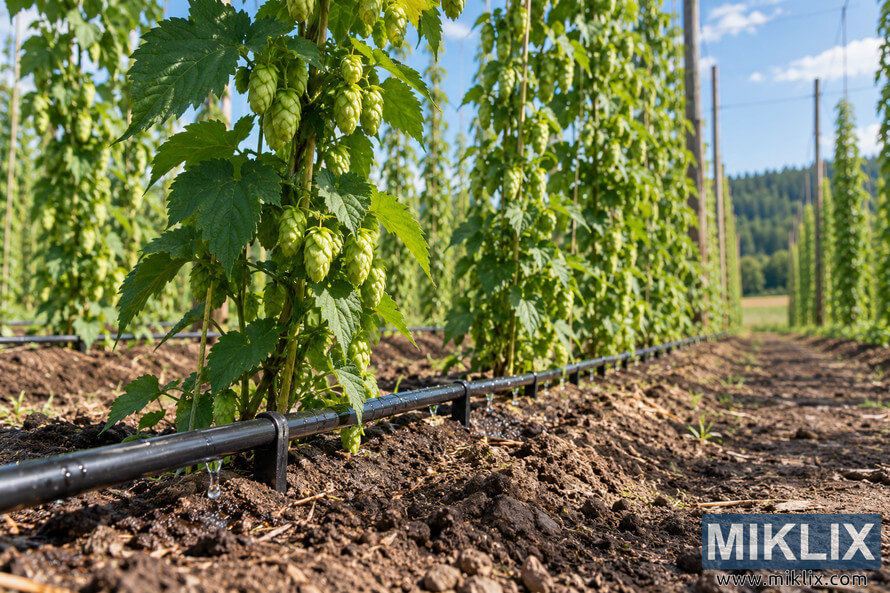
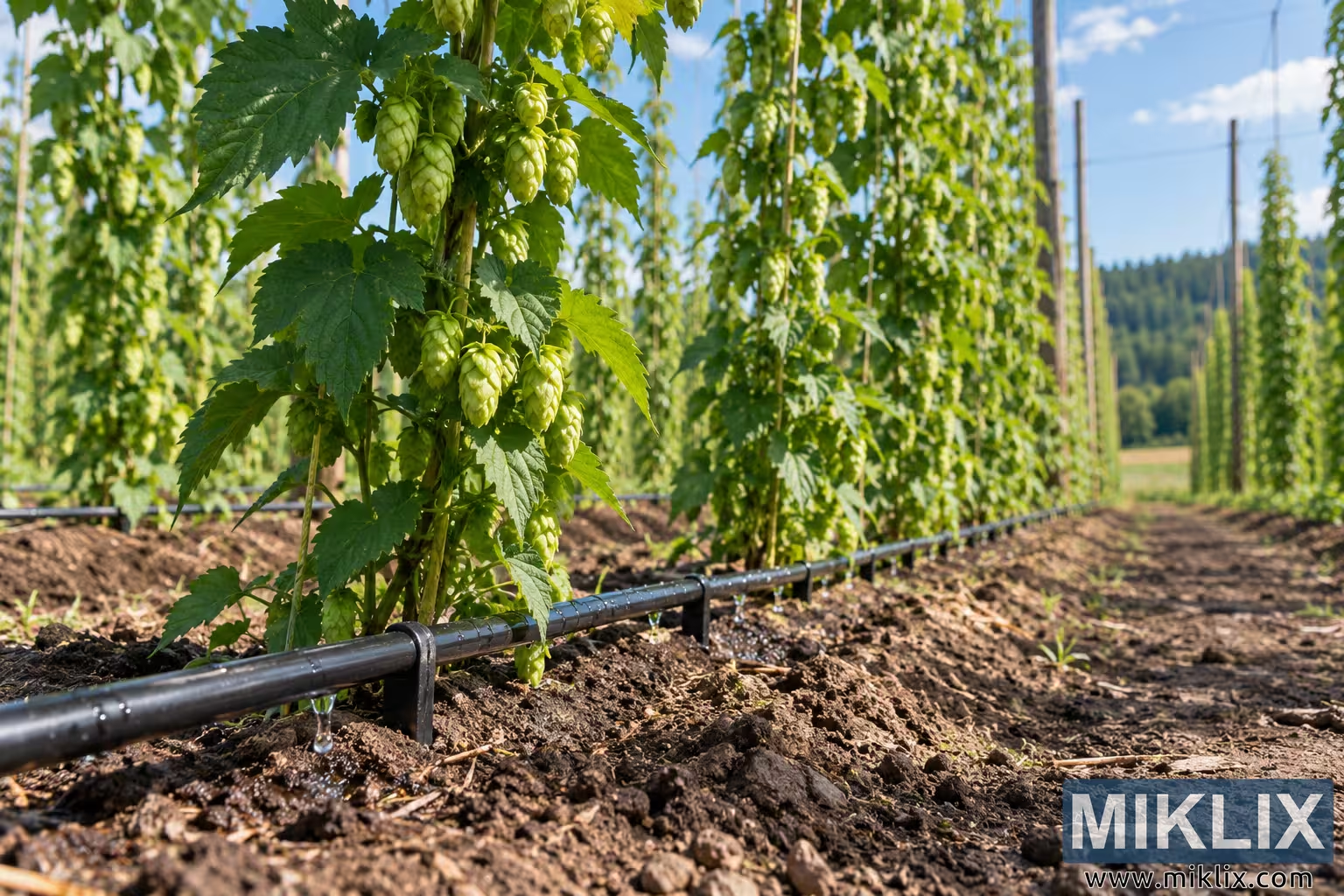
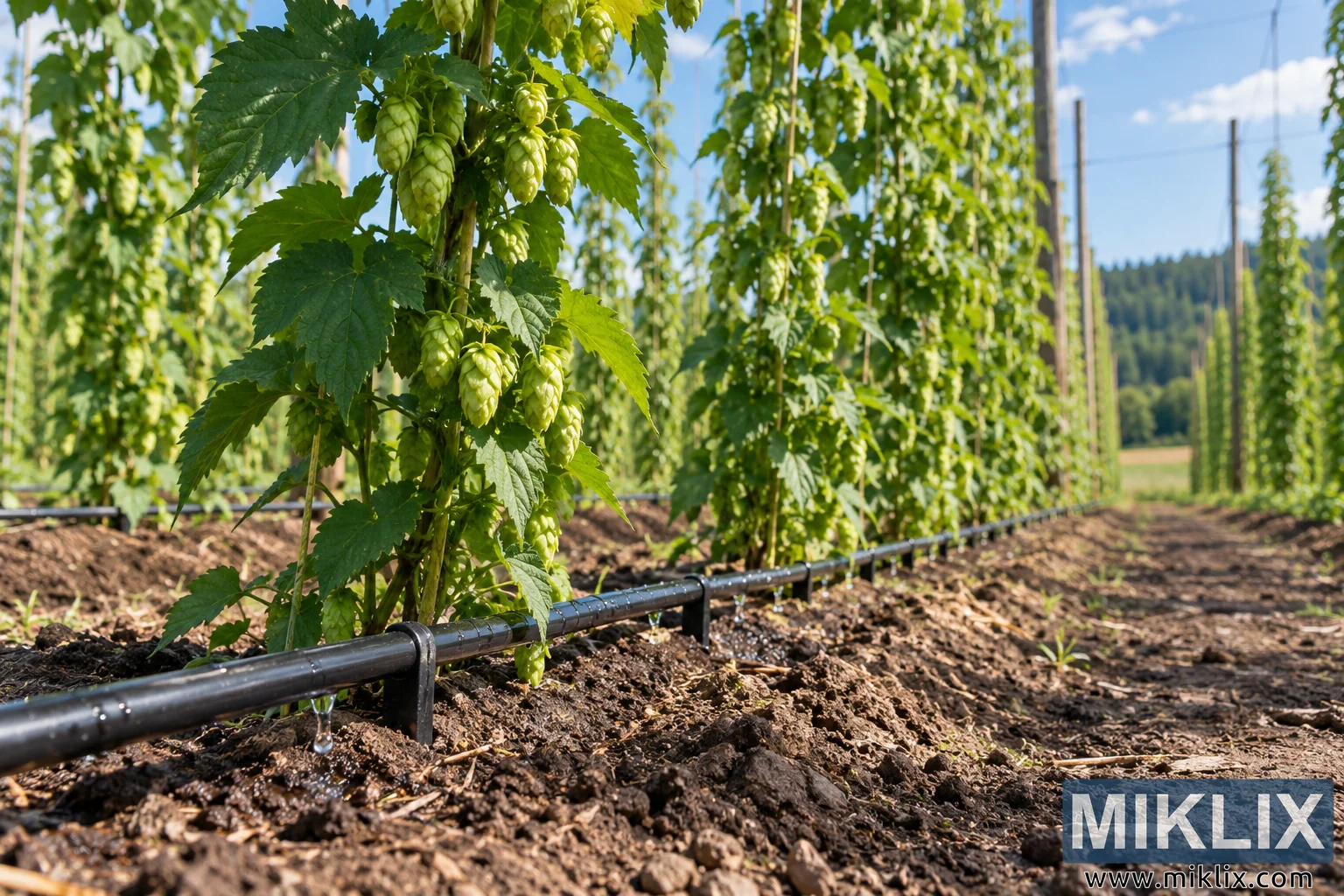
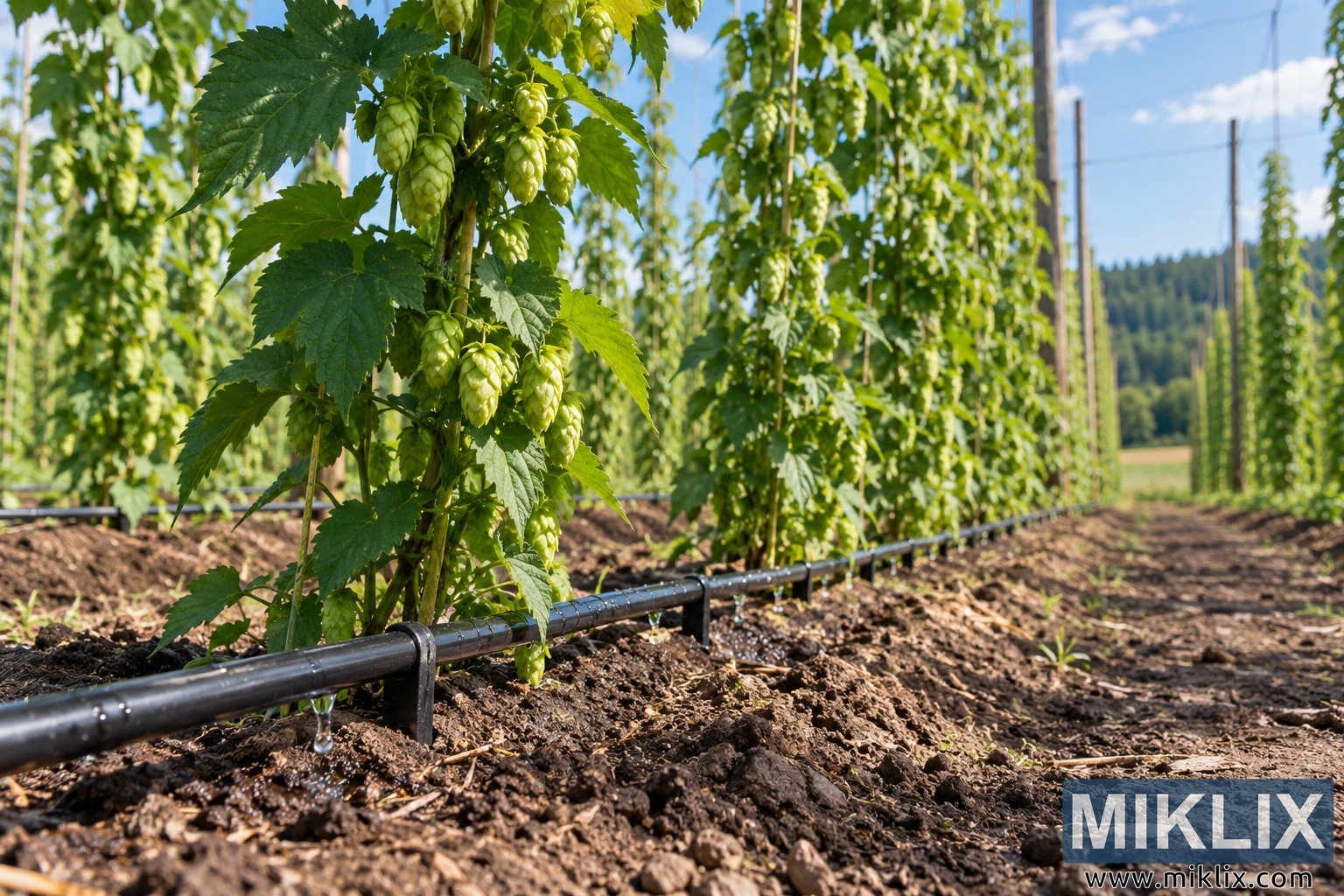
Image: Drip Irrigation System Installed Along a Row of Hop Plants
Published: November 12, 2026 at 9:33:54 PM UTC
Photorealistic agricultural scene of healthy hop plants growing on trellises with a drip irrigation system supplying water directly to the soil at the base of the crop.
Available versions of this image
The image files available for download below are less compressed and higher resolution - and as a result of that, higher quality - than the images embedded in articles and pages on this website, which are more optimized for file size in order to reduce bandwidth consumption.
Regular size (1,536 x 1,024)
Large size (3,072 x 2,048)
Very large size (4,608 x 3,072)
Extra large size (6,144 x 4,096)
Comically large size (1,048,576 x 699,051)
- Still uploading... ;-)
Image description
The image presents a detailed, photorealistic agricultural scene showing a drip irrigation system installed along a thriving row of hop plants. Photographed in a wide landscape orientation from a low, ground-level perspective, the composition places the irrigation equipment prominently in the foreground while allowing the viewer to look down the length of the cultivated hop field. A black irrigation tube runs diagonally from the lower-left foreground toward the center-right distance, closely following the base of the plants. The tube is slightly elevated above the soil by small black supports, making its construction and placement clearly visible. Small droplets of water can be seen emerging from the irrigation line at several points. Near the foreground, a particularly clear droplet hangs beneath the tubing, while the earth immediately below appears dark and moist. Additional wet patches along the row demonstrate how the system delivers water directly to the root zone of the crop rather than broadly spraying the surrounding area.
The nearest hop plant occupies much of the left and central foreground and is rendered with crisp botanical detail. It has vigorous green stems and large, textured leaves with strongly serrated edges and visible veins. Numerous mature hop cones hang in clusters among the foliage. These cones are pale yellow-green to fresh green in color and display the characteristic overlapping, scale-like bracts associated with hops. Sunlight illuminates portions of the cones and leaves, creating bright highlights and subtle translucent effects in the thinner plant tissue. Other leaves fall into partial shade, giving the plant a natural range of green tones and helping establish a strong sense of depth. The vegetation appears healthy, dense, and productive, suggesting a well-maintained agricultural planting during the active growing season.
Behind the foreground plant, additional hop plants continue in a long, orderly row. They grow vertically on a tall trellis system consisting of upright wooden poles, overhead support wires, and vertical training lines. The repeating poles and columns of foliage gradually become smaller toward the horizon, creating strong linear perspective. Parallel rows are also visible farther to the left and right, indicating that the scene is part of a larger commercial or professionally managed hop yard rather than a small garden planting. The tall structure emphasizes the distinctive cultivation method used for hops, whose climbing bines are trained upward to make efficient use of vertical space.
The soil beneath the plants is exposed and uneven, with a rich brown color and a visibly coarse agricultural texture. Small clods of earth, stones, bits of dried organic material, and occasional young weeds or shoots are scattered across the ground. Around the drip emitters, the soil is noticeably darker from recently applied water. This localized moisture provides a visual explanation of the purpose of the irrigation system: water is being supplied close to individual plants while much of the surrounding soil surface remains comparatively dry. The irrigation tubing itself is clean, simple, and functional, without visible writing, logos, trademarks, or identifiable branding.
To the right of the irrigated row is a narrow dirt access path extending into the distance. Its comparatively dry, compacted surface contrasts with the damp soil immediately beneath the drip line. The path forms another strong perspective line and visually guides the eye toward the background of the field. Beyond the hop rows, the landscape transitions into open agricultural land and a softly rendered forested hillside. Dense dark-green trees cover the distant slope, providing a natural backdrop and reinforcing the rural farming setting.
Above the field is a bright blue sky containing scattered soft white clouds. Strong, warm daylight suggests a clear and pleasant growing-season day. The light comes from a relatively high angle and produces defined yet natural shadows around the foliage, irrigation pipe, support stakes, and textured ground. Reflections on the wet black tubing and sparkling water droplets add small highlights to the foreground. The combination of vivid greenery, blue sky, warm sunlight, and dark fertile earth gives the image a fresh and productive agricultural atmosphere.
The photographic composition uses selective depth of field. The foreground hop plant, cones, irrigation line, water droplets, and nearby soil are sharply focused, allowing the viewer to inspect the irrigation installation and crop in considerable detail. Elements farther down the row become progressively softer, while the distant trees and landscape are gently blurred. This treatment keeps attention on the relationship between the hop plants and their water-delivery system while still providing enough environmental context to understand the scale and organization of the field.
Overall, the image communicates modern, targeted crop irrigation in a hop-growing environment. The most important visual relationship is between the black drip line in the lower portion of the frame and the tall, productive hop plants directly above it. Visible droplets and damp soil make the irrigation process immediately understandable without requiring diagrams, labels, or text. The orderly rows, trellis infrastructure, healthy hop cones, cultivated soil, and rural background collectively portray a practical agricultural system designed to supply water efficiently at plant level. No people, vehicles, buildings, signs, labels, packaging, or recognizable commercial brands are visible, keeping the visual emphasis entirely on the hop crop, irrigation equipment, field structure, and surrounding landscape.
The image is related to: Hops in Beer Brewing: Sun