
Image: Brewing Recipe Notebook with Sun Hops Notes and Calculations
Published: November 12, 2026 at 9:33:54 PM UTC
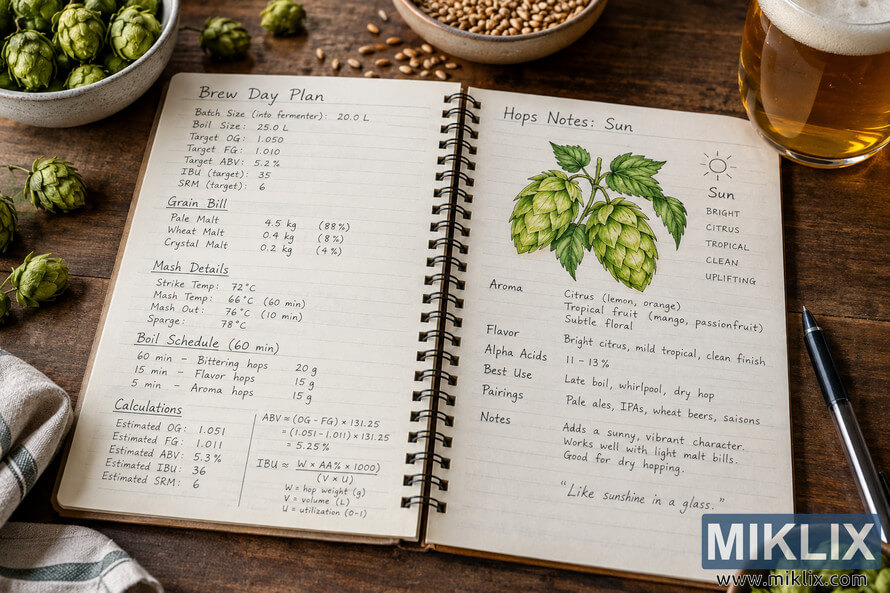
Warm overhead still life of a brewing recipe notebook featuring beer calculations, mash and grain notes, illustrated Sun hops tasting notes, fresh hops, malt grains, and a glass of golden beer on a rustic wooden table.
Available versions of this image
The image files available for download below are less compressed and higher resolution - and as a result of that, higher quality - than the images embedded in articles and pages on this website, which are more optimized for file size in order to reduce bandwidth consumption.
Regular size (1,536 x 1,024)
Large size (3,072 x 2,048)
Very large size (4,608 x 3,072)
Extra large size (6,144 x 4,096)
Comically large size (1,048,576 x 699,051)
- Still uploading... ;-)
Image description
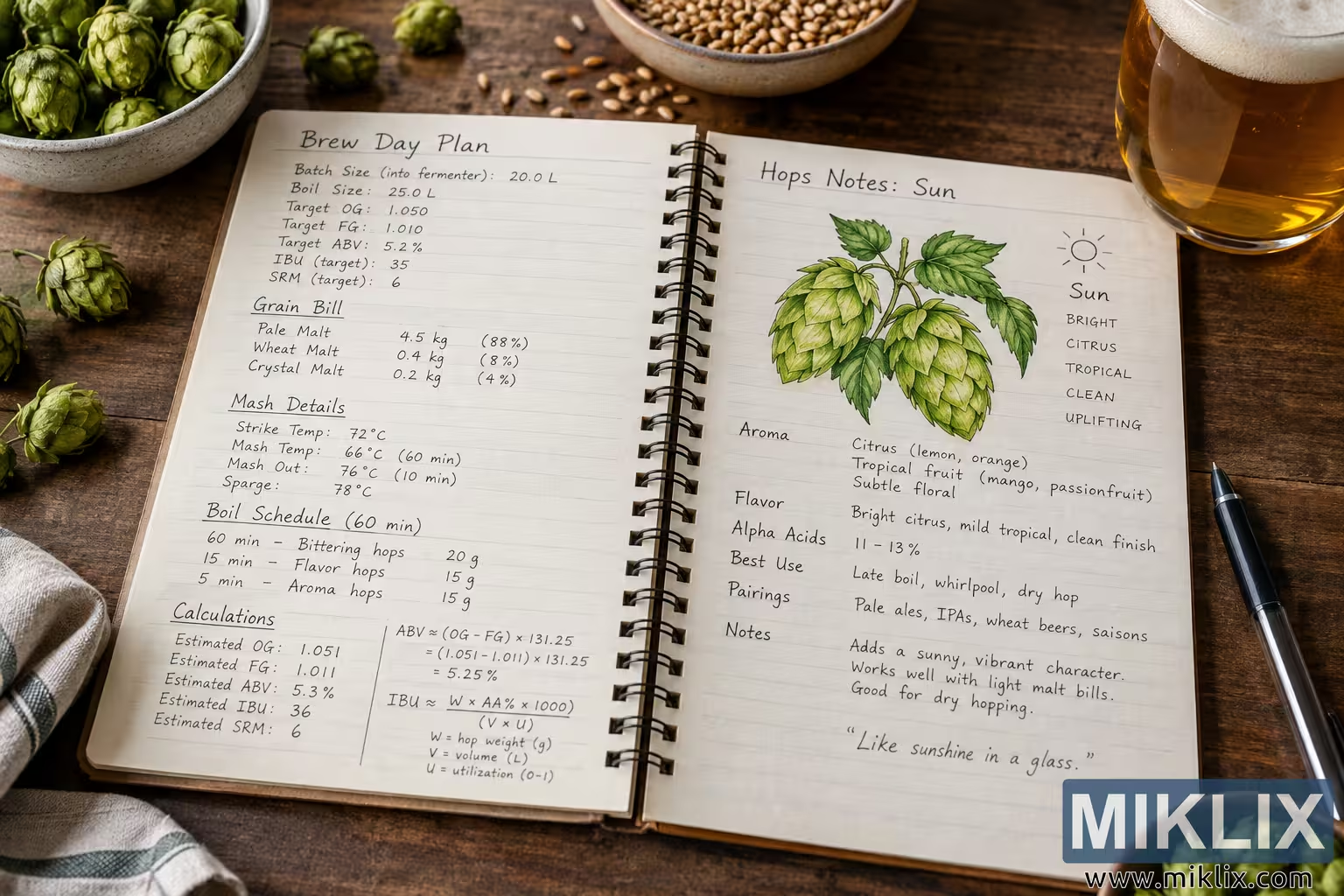
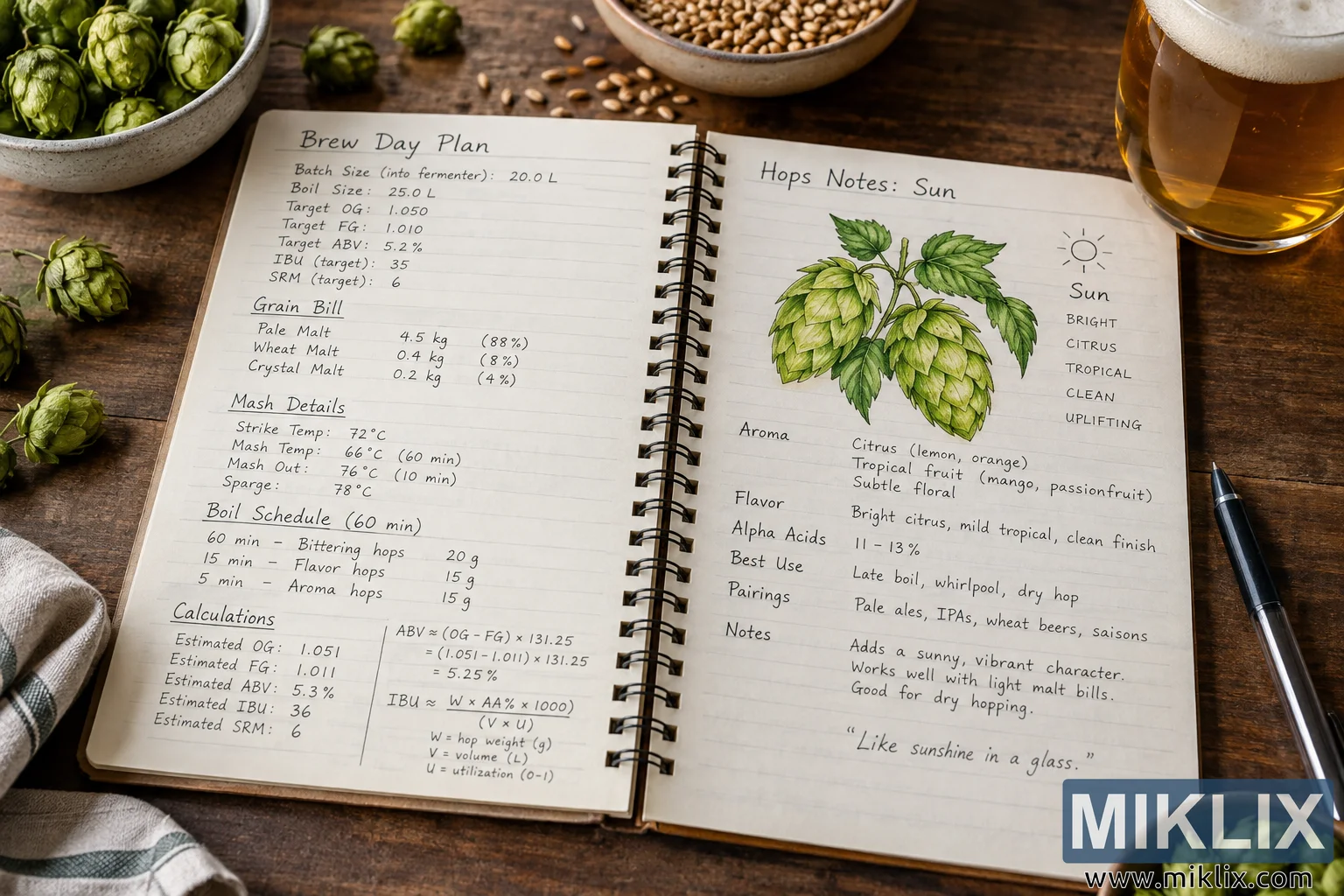
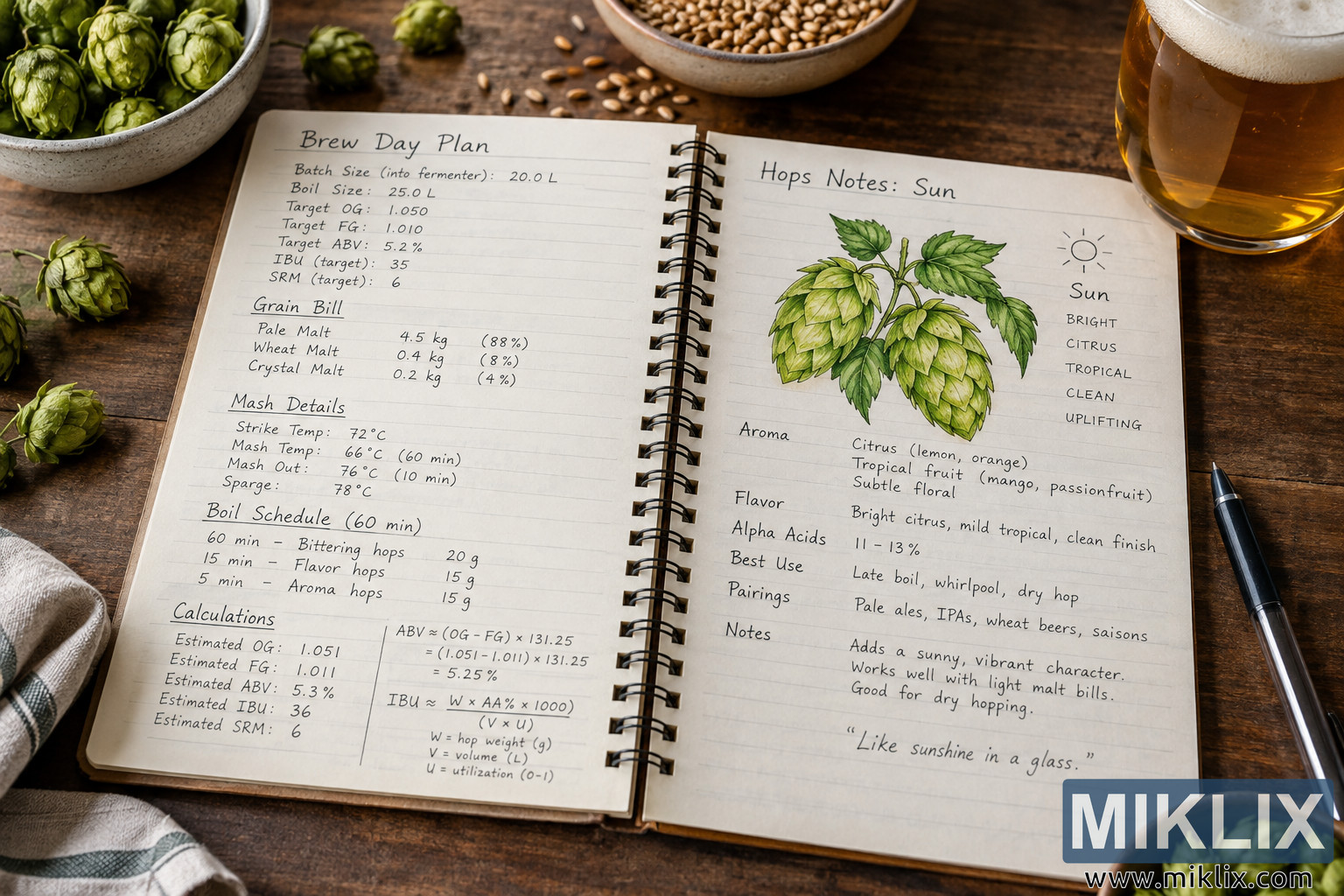
A warm, highly detailed overhead photograph depicts an open spiral-bound recipe notebook resting on a dark, richly textured wooden tabletop. The composition is arranged as a cozy craft-brewing workspace, with the notebook occupying most of the center of the landscape-oriented frame. Soft natural light falls across the pages and surrounding ingredients, emphasizing the cream-colored paper, green hop cones, golden beer, tan grains, and deep brown wood. The overall atmosphere suggests a thoughtful home brewer documenting a recipe, performing brewing calculations, and recording tasting or ingredient notes.
The notebook is opened to a two-page spread. On the left-hand page, a handwritten heading near the top reads “Brew Day Plan.” Beneath it is a compact set of brewing specifications for a 20-liter batch. The notes include figures for batch size, boil size, target original gravity, target final gravity, alcohol by volume, bitterness, and color. The handwriting is neat but informal, resembling careful notes written by hand during recipe development rather than typeset instructions. Horizontal ruled lines remain visible throughout the page, reinforcing the practical notebook aesthetic.
Farther down the left page is a section titled “Grain Bill.” It lists several brewing grains, including pale malt, wheat malt, and crystal malt, accompanied by weights and percentages. Below this is a “Mash Details” section containing temperatures and timing information for the brewing process. The notes refer to strike temperature, mash temperature and duration, mash-out temperature and duration, and sparging temperature. Another section, titled “Boil Schedule (60 min),” records hop additions at different points during the boil, with entries for bittering, flavor, and aroma additions and quantities measured in grams.
The bottom portion of the left page is dedicated to calculations. Estimated brewing values such as original gravity, final gravity, alcohol content, bitterness, and color are written in a small list. Next to these values are handwritten formulas, including an alcohol-by-volume calculation based on original and final gravity and an approximate bitterness formula involving hop weight, alpha-acid percentage, volume, and utilization. These mathematical notes give the scene a technical, experimental quality and make the notebook feel like a genuine working document used to plan and refine a brewing recipe.
The right-hand page is devoted primarily to hops and carries the heading “Hops Notes: Sun.” A large botanical-style illustration of a hop plant dominates the upper-middle portion of the page. Several pale green hop cones hang among darker green leaves and stems. The drawing has the appearance of a carefully colored notebook sketch, combining scientific observation with an artistic field-journal style. To the right of the illustration is a simple hand-drawn sun symbol consisting of a circle surrounded by short rays. Underneath it, the word “Sun” appears above a short vertical series of descriptive terms such as bright, citrus, tropical, clean, and uplifting.
Below the hop illustration, additional handwritten notes describe the ingredient's sensory character and brewing applications. The aroma section refers to citrus qualities reminiscent of lemon and orange, tropical fruit impressions such as mango and passionfruit, and a subtle floral element. The flavor notes emphasize bright citrus, mild tropical qualities, and a clean finish. An alpha-acid range is recorded as approximately 11–13 percent. The suggested uses include late-boil additions, whirlpool additions, and dry hopping, while the pairing notes mention styles such as pale ales, IPAs, wheat beers, and saisons. A final notes section describes the hops as contributing a sunny, vibrant character and working well with light malt bills and dry hopping. Near the bottom of the page, a handwritten quotation reads, “Like sunshine in a glass.”
The brewing notebook is surrounded by ingredients and objects that reinforce the subject. In the upper-left corner sits a light ceramic bowl filled with fresh-looking green hop cones. Additional loose hop cones are scattered directly on the wooden table near the notebook, including several along the left edge and one above the notebook. At the top center is another shallow ceramic bowl containing pale tan brewing grains, with a few individual kernels scattered nearby. The earthy ceramics and natural ingredients complement the rustic surface and handmade notebook.
In the upper-right corner, partially cropped by the edge of the photograph, is a clear glass containing golden amber beer. A substantial cap of pale foam sits on top. The liquid catches the warm light, producing luminous amber and honey tones that contrast with the green hops. The glass is deliberately positioned partly outside the frame, making the arrangement feel like an active workspace rather than a rigidly staged still life.
A dark pen lies diagonally along the right side of the notebook, close to the page containing the hop notes, as though it has just been set down after writing. In the lower-left corner, a loosely folded kitchen cloth with green stripes enters the frame. Another container of hop cones is partially visible at the lower-right edge. These cropped peripheral objects extend the brewing theme beyond the notebook and help create visual depth without distracting from the central pages.
The photograph uses a top-down perspective with a balanced but intentionally informal arrangement. The spiral binding creates a strong vertical line through the center, clearly dividing the technical brewing plan on the left from the botanical and sensory hop notes on the right. The wood grain runs beneath the objects and supplies a dark, tactile background that makes the lighter notebook pages stand out. Shadows are soft rather than harsh, suggesting diffused daylight from one side of the scene. Fine details in the paper, ink, grain kernels, hop leaves, ceramic bowls, glass, cloth, and weathered tabletop contribute to a realistic photographic appearance.
There are no people, logos, product labels, packages, or recognizable commercial brands visible anywhere in the image. Instead, the scene focuses entirely on the craft of recipe development and brewing: handwritten calculations, ingredient observations, raw hops and grain, and a finished glass of beer. The combination of technical formulas and expressive sensory notes communicates both the analytical and creative sides of brewing. Overall, the image presents an inviting, artisanal home-brewing workspace centered on a detailed recipe notebook and notes about a hop variety identified simply as “Sun,” with a warm rustic aesthetic and an emphasis on experimentation, ingredients, and careful documentation.
The image is related to: Hops in Beer Brewing: Sun