
Billede: Macro Detail of Hop Cone Structure and Golden Lupulin Glands
Udgivet:
Sidst opdateret: 18. september 2026 kl. 16.08.19 UTC
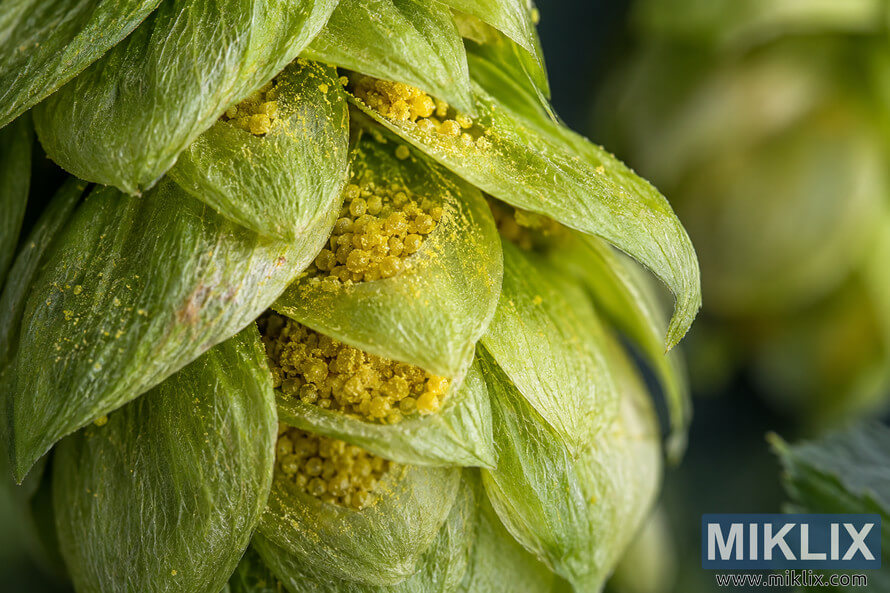
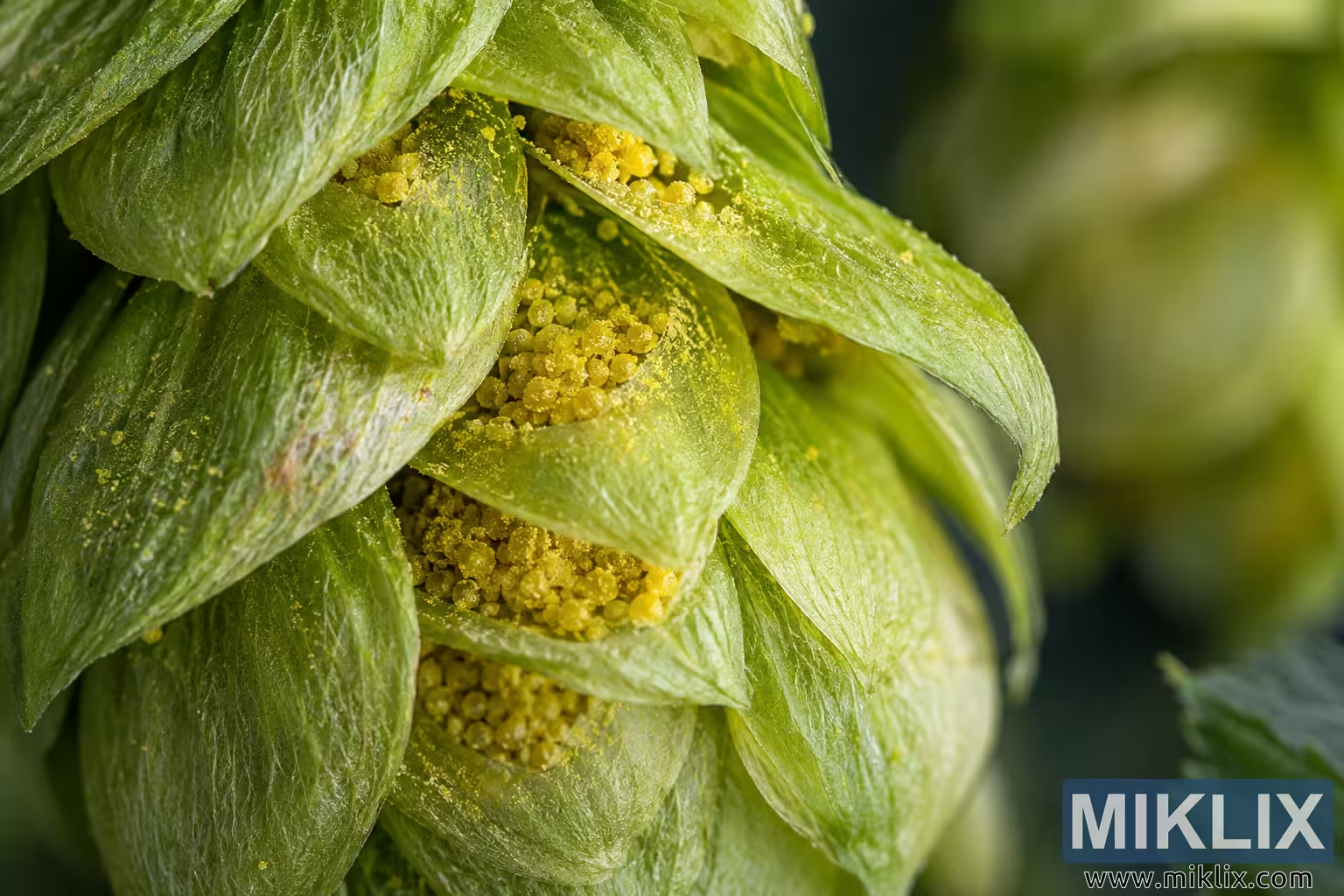
Detailed macro view of a green hop cone revealing golden lupulin glands between overlapping bracts, with crisp botanical texture and a softly blurred natural background.
Macro Detail of Hop Cone Structure and Golden Lupulin Glands
Tilgængelige versioner af dette billede
De billedfiler, der kan downloades nedenfor, er mindre komprimerede og har højere opløsning - og dermed højere kvalitet - end de billeder, der er indlejret i artikler og sider på dette websted, som er mere optimerede med hensyn til filstørrelse for at reducere båndbreddeforbruget.
Almindelig størrelse (1,536 x 1,024)
Stor størrelse (3,072 x 2,048)
Meget stor størrelse (4,608 x 3,072)
Ekstra stor størrelse (6,144 x 4,096)
Komisk stor størrelse (1,048,576 x 699,051)
- Uploader stadig... ;-)
Billedbeskrivelse
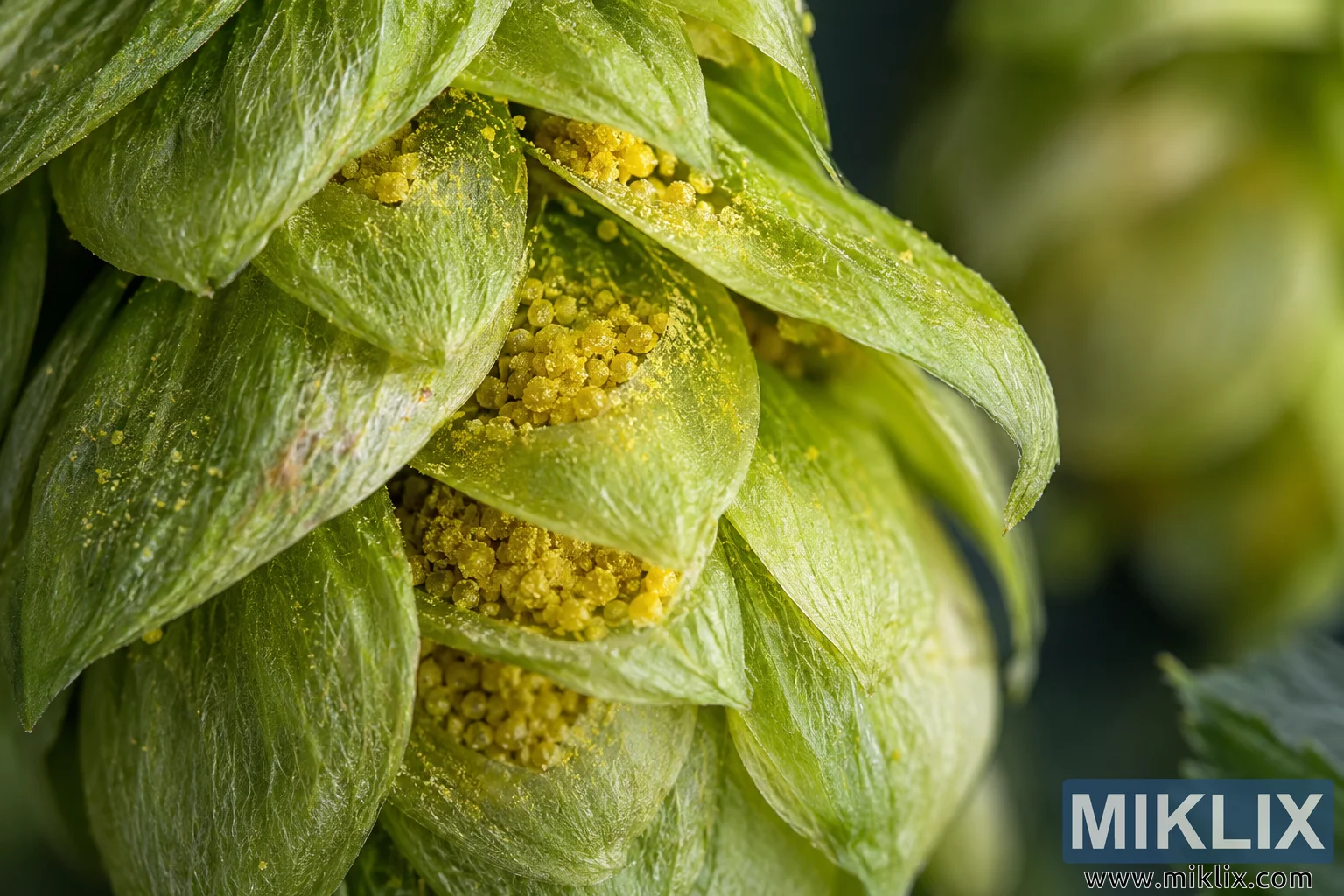
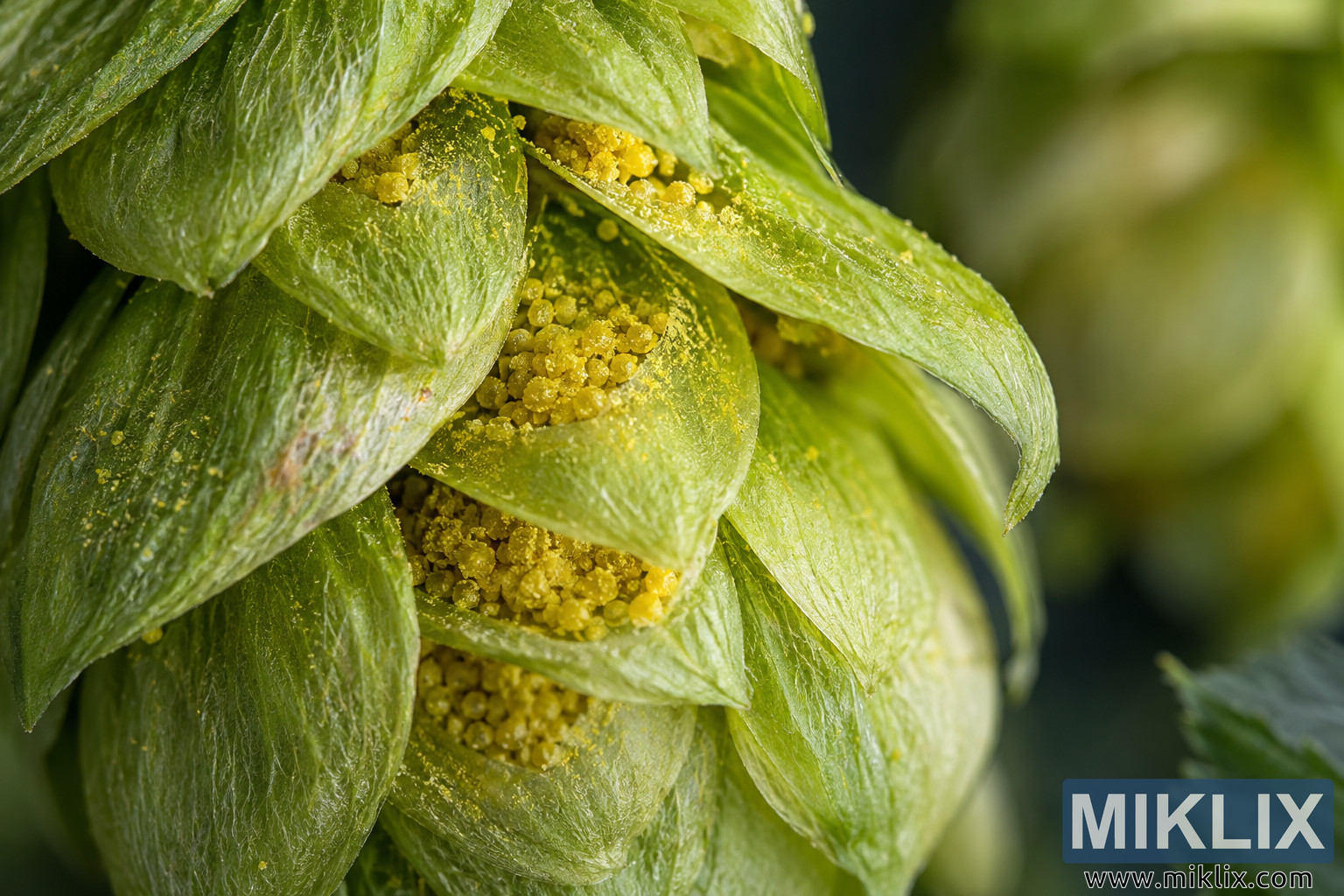
A highly detailed, landscape-oriented macro photograph presents an extreme close-up of a fresh green hop cone, concentrating on the intricate structure of its overlapping bracts and the golden-yellow lupulin glands nestled between them. The hop cone occupies most of the left and central portions of the composition, extending toward the right while gradually transitioning into a softly blurred background. The exceptionally close viewpoint reveals botanical details that would normally be difficult to observe with the unaided eye, transforming the cone into a layered arrangement of delicate green surfaces, translucent edges, fine veins, and clusters of resinous yellow material. The individual bracts overlap one another in a compact, scale-like pattern. Each bract is elongated and gently pointed, with subtle variations in shape and curvature that give the cone a natural, organic appearance. Some bracts curl slightly outward at their tips, while others remain closely pressed against the underlying layers. Their surfaces range from bright yellow-green in the strongest illumination to deeper olive and forest-green tones in areas of shadow. Fine wrinkles, cellular textures, faint veins, tiny hairs, minute speckles, and slight irregularities are visible across the plant tissue, reinforcing the impression of a freshly harvested botanical specimen photographed at very high magnification. The most visually prominent feature is the abundance of lupulin visible within the spaces created by the overlapping bracts. These glands appear as dense concentrations of small golden-yellow to mustard-yellow granules and resinous particles. Several particularly clear clusters are exposed near the upper-left-center and middle of the cone, where the bracts separate enough to reveal the material beneath. Additional deposits can be seen deeper inside the lower layers. The lupulin varies in appearance from extremely fine yellow dust coating the green surfaces to larger rounded or irregular granules gathered together in compact pockets. Some particles catch the light and appear slightly glossy or translucent, suggesting the sticky, resin-rich character associated with lupulin glands. Fine yellow residue is scattered over adjacent bracts, producing a subtle dusting that visually connects the exposed gland clusters with the surrounding cone structure. Strong but natural-looking directional illumination emphasizes the three-dimensional construction of the hop cone. Highlights trace the raised ridges and curved edges of the bracts, while narrow shadows form beneath overlapping layers. This interplay of light and shadow makes the cone appear tactile and dimensional, clearly showing how each bract sits above or beside another. The illumination also brings out variations in the green pigmentation: some thin sections appear almost luminous yellow-green, while thicker or shaded portions become considerably darker. The golden lupulin stands out strongly against these greens, creating the principal color contrast in the photograph. The depth of field is deliberately shallow. The primary portion of the hop cone is rendered with crisp macro detail, especially around the exposed lupulin clusters and the central layers of bracts, while areas farther from the focal plane become progressively softer. The background is heavily defocused into smooth green, olive, yellow-green, and very dark green shapes. On the right side, an indistinct rounded green form suggests another hop cone situated behind the main subject. Near the lower-right corner, a partially visible dark green leaf or similarly textured piece of foliage enters the frame but remains substantially out of focus. These secondary botanical elements provide environmental context without competing with the central macro subject. A dark, nearly black-green region behind the right edge of the main cone increases separation between the sharply illuminated plant and the background, further emphasizing its outline. The composition intentionally crops the primary cone so that it extends beyond the upper, left, and lower boundaries of the frame. This close cropping enhances the sense of magnification and invites attention to the internal architecture rather than presenting the entire plant. The left side contains densely layered bracts and pronounced textural detail, while the right side offers more negative space through the blurred background. The result is visually balanced despite the subject being positioned predominantly toward the left. There are no labels, logos, packaging elements, typography, people, tools, or recognizable commercial brands anywhere in the scene. The photograph is purely botanical in character and focuses exclusively on the physical appearance of the hop cone and its resin-bearing structures. Overall, the image combines the visual language of botanical macro photography with an almost scientific level of close-up observation. It emphasizes the layered construction of a mature hop cone and, in particular, the location and appearance of its lupulin glands beneath and between the green bracts. The granular golden material is shown with enough clarity to distinguish individual particles, clumps, and fine deposits, while the surrounding bracts display subtle surface textures and natural imperfections. The warm yellow lupulin contrasts vividly with the fresh green plant tissue, and the soft background isolates the specimen without removing its natural botanical context. The image communicates freshness, resin content, plant structure, and tactile detail, making it suitable as a visual representation of hop anatomy, lupulin production, brewing ingredients, botanical identification, agricultural education, or an editorial discussion of hop characteristics.
Billedet er relateret til: Hops in Beer Brewing: Bramling Cross