
Bild: Precision Brewing: The Science Behind Perfect Pitching Rates
Veröffentlicht:
Zuletzt aktualisiert: 23. Mai 2026 um 16:26:11 UTC
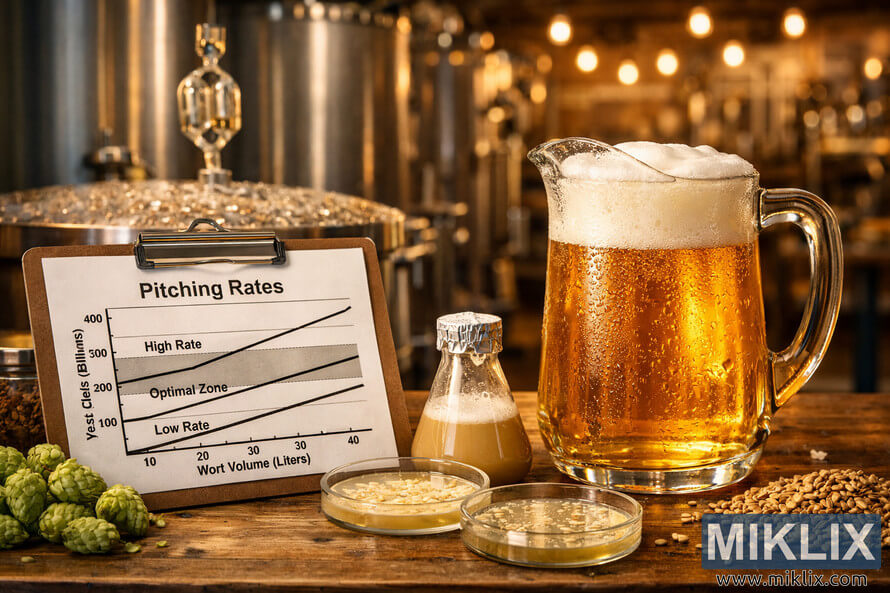
A detailed brewing laboratory scene featuring a golden lager pitcher, yeast cultures, and a pitching rate chart, symbolizing precision and craftsmanship in fermentation.
Precision Brewing: The Science Behind Perfect Pitching Rates
Verfügbare Versionen dieses Bildes
Die Bilddateien, die unten zum Download zur Verfügung stehen, sind weniger komprimiert und haben eine höhere Auflösung - und damit eine höhere Qualität - als die Bilder, die in Artikeln und Seiten auf dieser Website eingebettet sind, die mehr auf Dateigröße optimiert sind, um den Bandbreitenverbrauch zu reduzieren.
Normale Größe (1,536 x 1,024)
Großes Format (3,072 x 2,048)
Sehr großes Format (4,608 x 3,072)
Extra großes Format (6,144 x 4,096)
Komisch große Größe (1,048,576 x 699,051)
- Ich lade immer noch hoch... ;-)
Bildbeschreibung
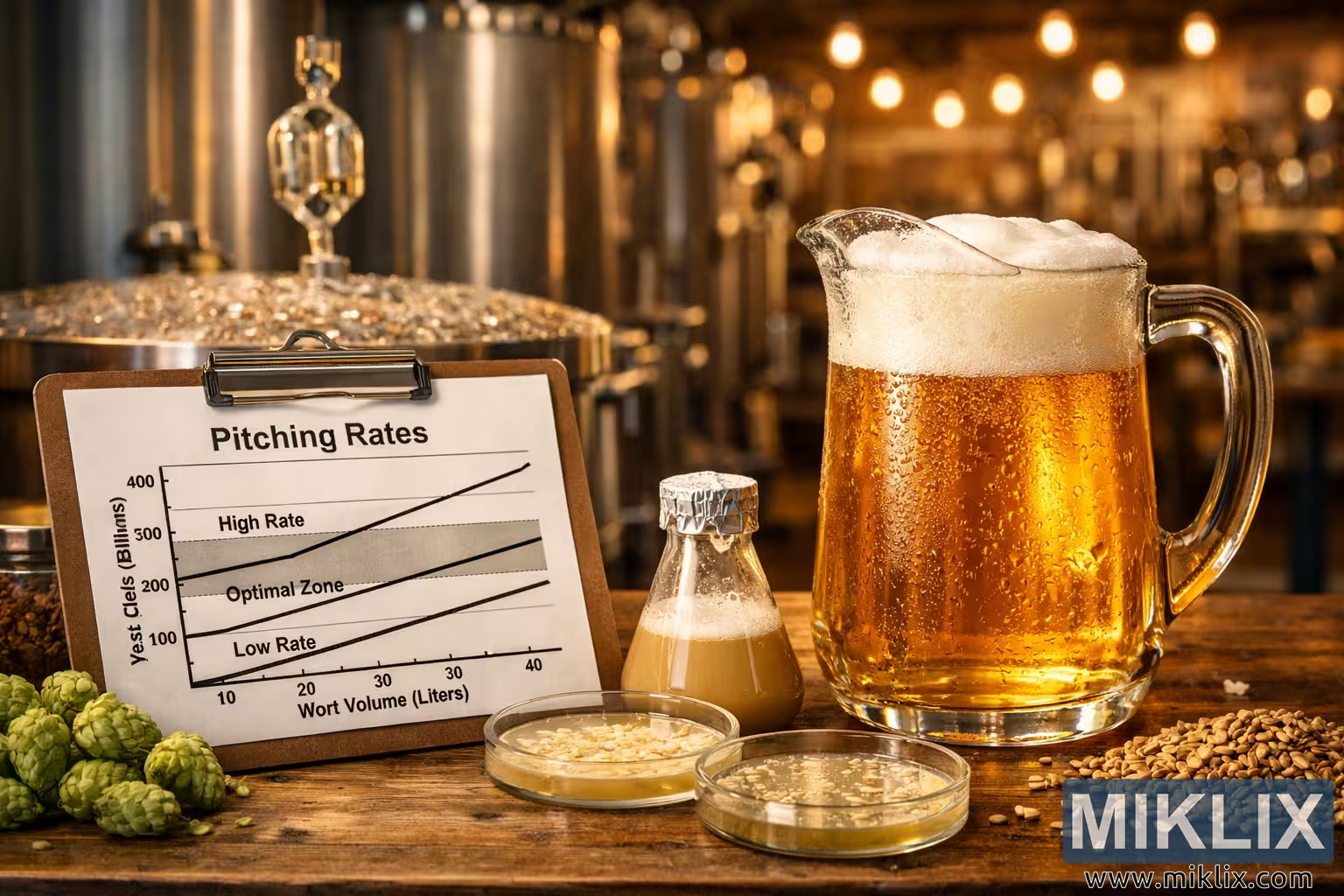
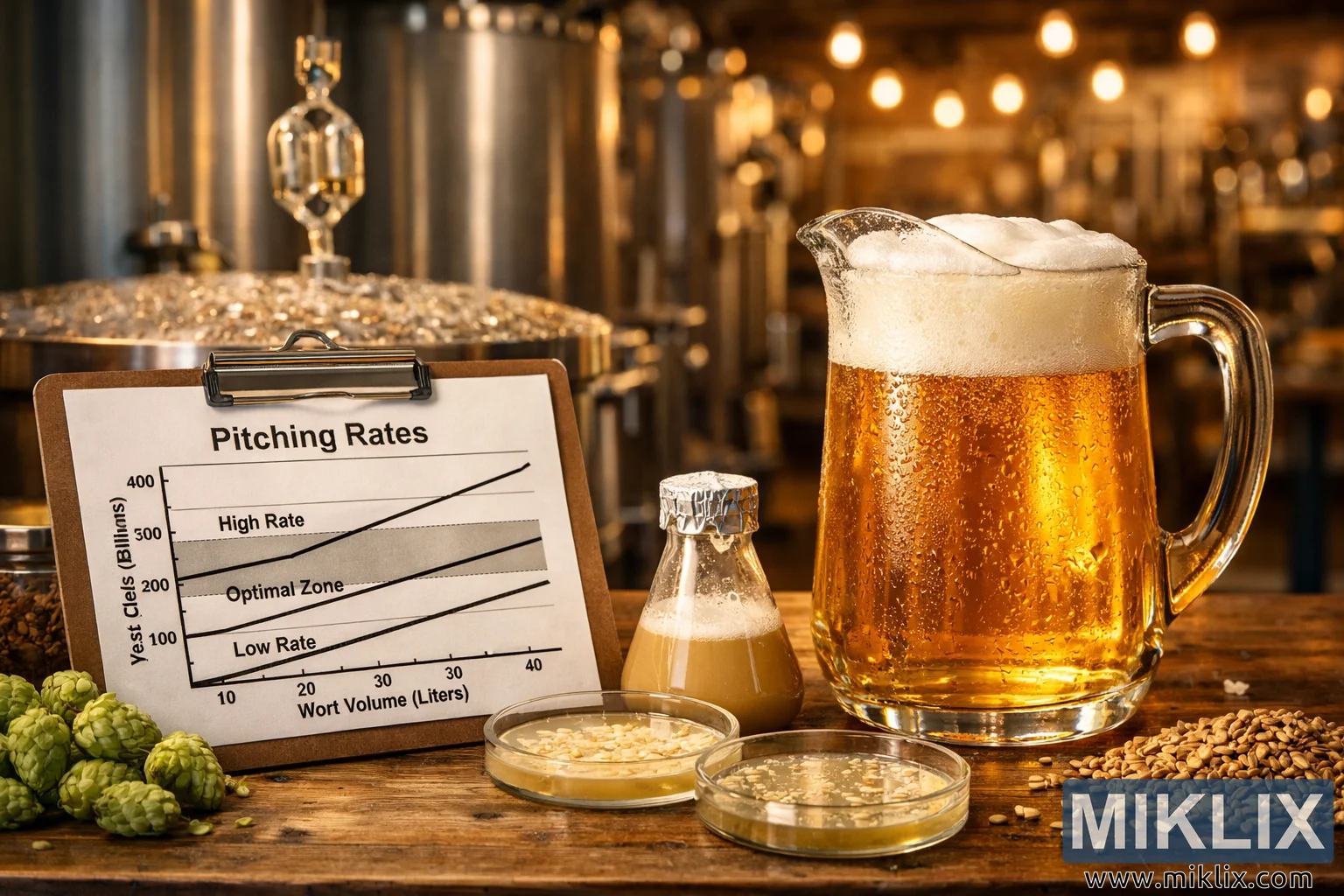
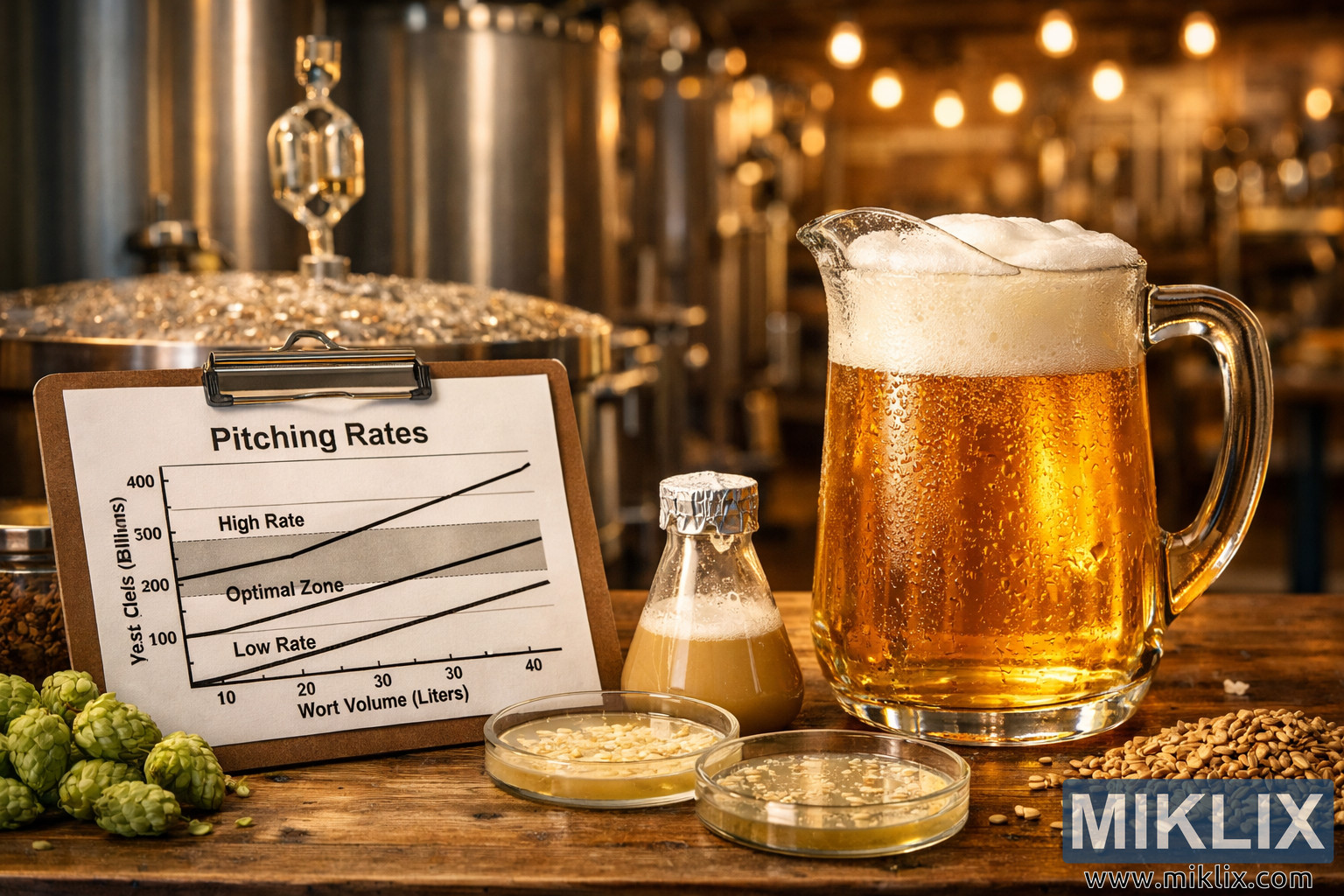
The image presents a richly detailed, high-resolution landscape composition that captures the intersection of art and science in modern brewing. At the forefront, a clear glass pitcher brimming with golden lager beer dominates the right side of the frame. The beer glows with a deep amber hue, illuminated by warm ambient light that accentuates its clarity and effervescence. A thick, frothy head crowns the top, with condensation beads glistening on the exterior of the pitcher, evoking freshness and craftsmanship. The wooden table beneath it bears subtle grain textures and faint scratches, suggesting the authenticity of a working brewer’s environment.
To the left of the pitcher, a clipboard holds a progress chart titled “Pitching Rates.” The chart is meticulously drawn, featuring bold, dark lines that trace the relationship between yeast cell counts and wort volume. The axes are labeled “Yeast Cells (Billions)” and “Wort Volume (Liters),” with numerical markers that lend scientific credibility. Three distinct curves—“High Rate,” “Optimal Zone,” and “Low Rate”—convey the precision required in yeast pitching, the critical process that determines fermentation success. The chart’s clean design and confident strokes contrast beautifully with the organic textures surrounding it, symbolizing the harmony between data and craft.
In the immediate foreground, two open petri dishes rest beside the chart. One contains a creamy white yeast culture, while the other holds a translucent liquid with visible yeast cells suspended within. Their placement suggests active experimentation and quality control. A small Erlenmeyer flask sits nearby, filled with a milky yeast starter capped with foil, representing the controlled environment necessary for cultivating healthy yeast populations. These laboratory elements introduce a scientific narrative that complements the artisanal warmth of the scene.
The middle ground transitions seamlessly into the brewing workspace. A stainless steel fermentation vessel rises on the left, its polished surface reflecting the surrounding light. A bubbling airlock atop the vessel reveals active fermentation, with tiny bubbles ascending through the transparent tube—a subtle yet powerful indicator of life and transformation. Scattered around the vessel are fresh green hop cones and a small pile of malted barley grains, tactile reminders of the natural ingredients that underpin the brewing process. Their placement feels deliberate, balancing the composition and grounding the technical elements in organic reality.
The background fades softly into a warmly lit brewery interior. String lights hang overhead, casting a golden glow that diffuses across the scene. The blurred outlines of additional brewing equipment and wooden barrels create depth and atmosphere, evoking a sense of coziness and tradition. The interplay of light and shadow enhances the photograph’s realism, while the reflections on metallic surfaces add dynamic visual interest.
Overall, the image conveys a profound sense of precision and passion. It celebrates brewing not merely as a craft but as a discipline rooted in scientific understanding. Every element—from the frothy beer to the yeast cultures and the analytical chart—contributes to a narrative of mastery, where data-driven accuracy meets sensory artistry. The composition invites viewers to appreciate the meticulous balance required to achieve brewing perfection, emphasizing that success in fermentation depends as much on careful measurement as on creative intuition.
The atmosphere is warm, inviting, and intellectually stimulating, making the viewer feel as though they are witnessing the heartbeat of a brewery where science and tradition coexist harmoniously. The image stands as a tribute to the brewer’s dual identity: both artisan and scientist, united by a shared pursuit of excellence.
Das Bild ist verwandt mit: Fermenting Beer with White Labs WLP840 American Lager Yeast