
Image: Bat Flowers Growing in a Lush Shaded Garden
Published: October 10, 2026 at 8:23:29 AM UTC
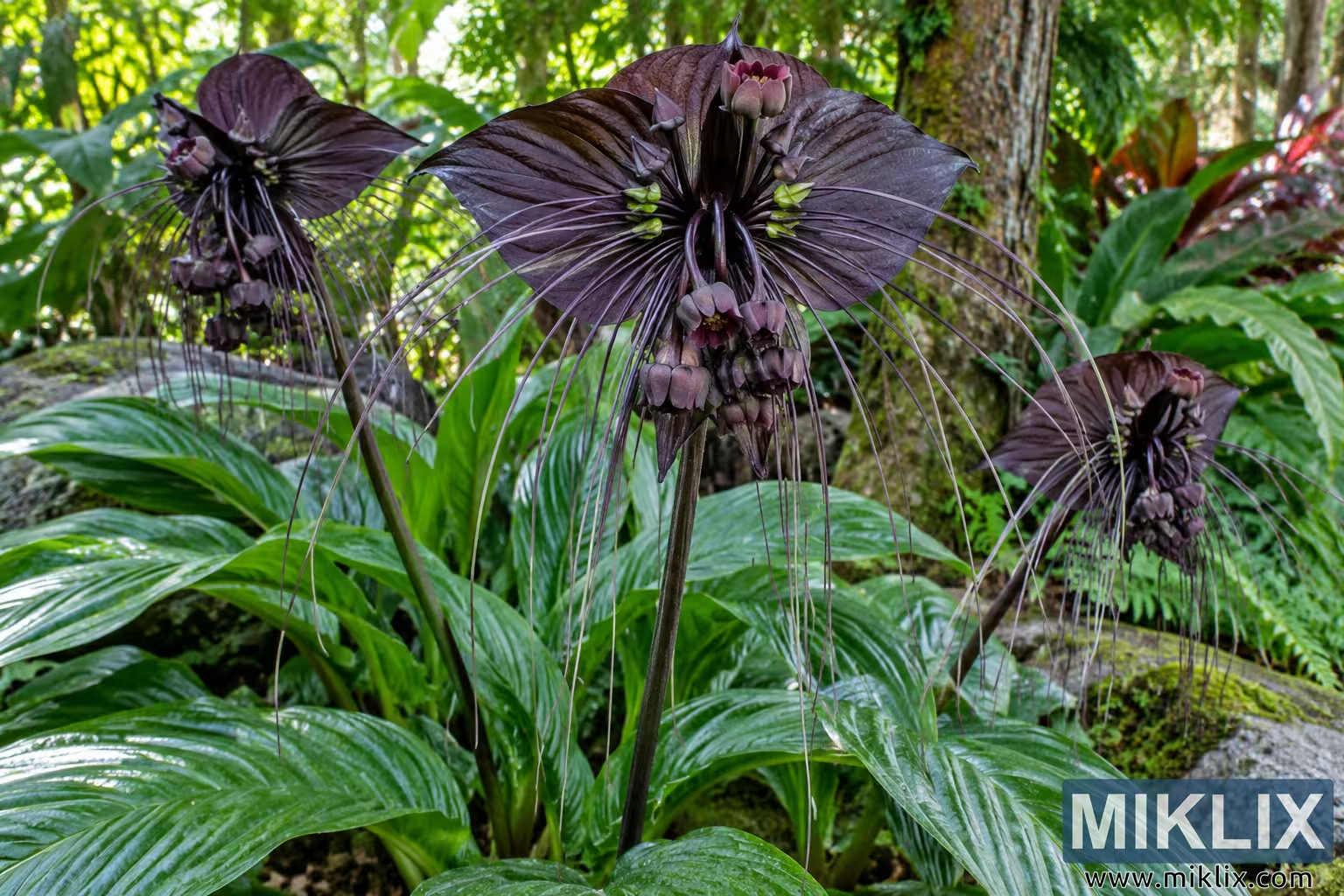
Close-up view of dark purple-black bat flowers (Tacca chantrieri) growing among glossy green foliage, mossy rocks, and lush vegetation in a shaded garden.
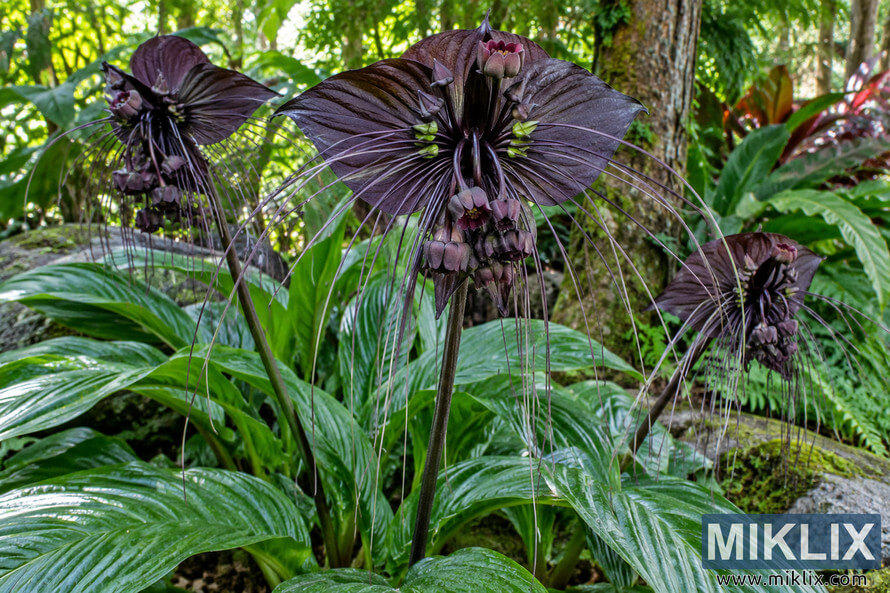
Available versions of this image
The image files available for download below are less compressed and higher resolution - and as a result of that, higher quality - than the images embedded in articles and pages on this website, which are more optimized for file size in order to reduce bandwidth consumption.
Regular size (1,536 x 1,024)
Large size (3,072 x 2,048)
Very large size (4,608 x 3,072)
Extra large size (6,144 x 4,096)
Comically large size (1,048,576 x 699,051)
- Still uploading... ;-)
Image description
A landscape-oriented, close-up garden photograph showing three dark purple-black bat flowers (Tacca chantrieri) growing among dense green foliage. The largest and most prominent flower occupies the center foreground. It has two broad, wing-like, deeply pleated bracts that spread horizontally and curve slightly backward, with a pointed projection at the top. Beneath and in front of the bracts is a cluster of small, dark mauve to purple flowers and buds, interspersed with several small green structures. Numerous extremely long, slender, thread-like purple filaments extend outward and downward from the central flower, forming loose arcs around the bloom and reaching well into the lower half of the image. The central inflorescence is supported by a tall, nearly vertical, dark brown-purple stem. A second bat flower stands in the left background. It is somewhat smaller in the composition and partially overlapped by surrounding foliage, with similarly broad dark bracts, clustered flowers, and long hanging filaments. A third bat flower appears on the right side farther back, angled slightly toward the center and partly obscured by leaves and rocks. Its dark bracts and long filaments remain clearly visible. The plants are surrounded by large, glossy, bright to deep green leaves with prominent longitudinal ribbing and gently undulating edges. Many leaves reflect highlights, giving their surfaces a wet or highly glossy appearance; whether they are actually wet cannot be determined with certainty from the image alone. The leaves overlap densely across the foreground and middle ground, creating a lush, layered setting. Behind the flowers are irregular gray and brown rocks, some with green moss-like growth. A substantial textured tree trunk rises vertically in the upper-right background, with patches of green vegetation on or near its bark. Additional broad-leaved plants and smaller fern-like foliage fill the background. Sunlight filters through dense greenery in the upper portion of the image, producing bright yellow-green highlights and areas of dappled illumination, while the flowers themselves remain comparatively shaded. The composition emphasizes the central bat flower through its larger apparent size and central placement, while the two secondary flowers on the left and right create visual depth and balance. The color palette is dominated by saturated greens contrasted with the flowers' very dark purple, burgundy, mauve, and near-black tones, along with muted gray-brown rocks and tree bark. The setting appears to be a lush, shaded garden or similar cultivated tropical planting, although the exact location cannot be determined from the image. No people, animals, containers, tools, buildings, signs, logos, brands, or other clearly identifiable manufactured objects are visible. There is no readable text in the image.
The image is related to: A Complete Guide to Growing Bat Flower in Your Own Garden