
Image: Seasonal Care Calendar for Queen of the Night Cactus
Published: November 4, 2026 at 7:45:53 PM UTC
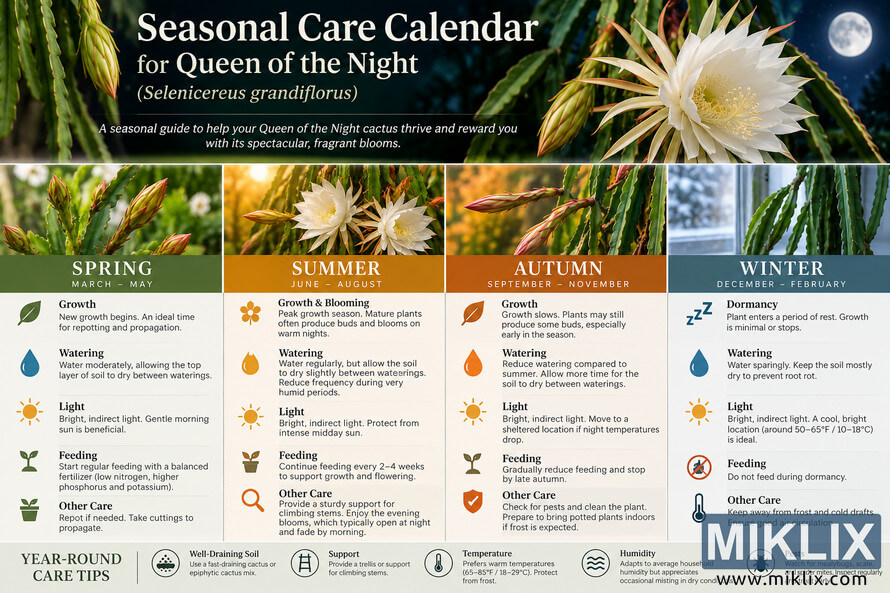
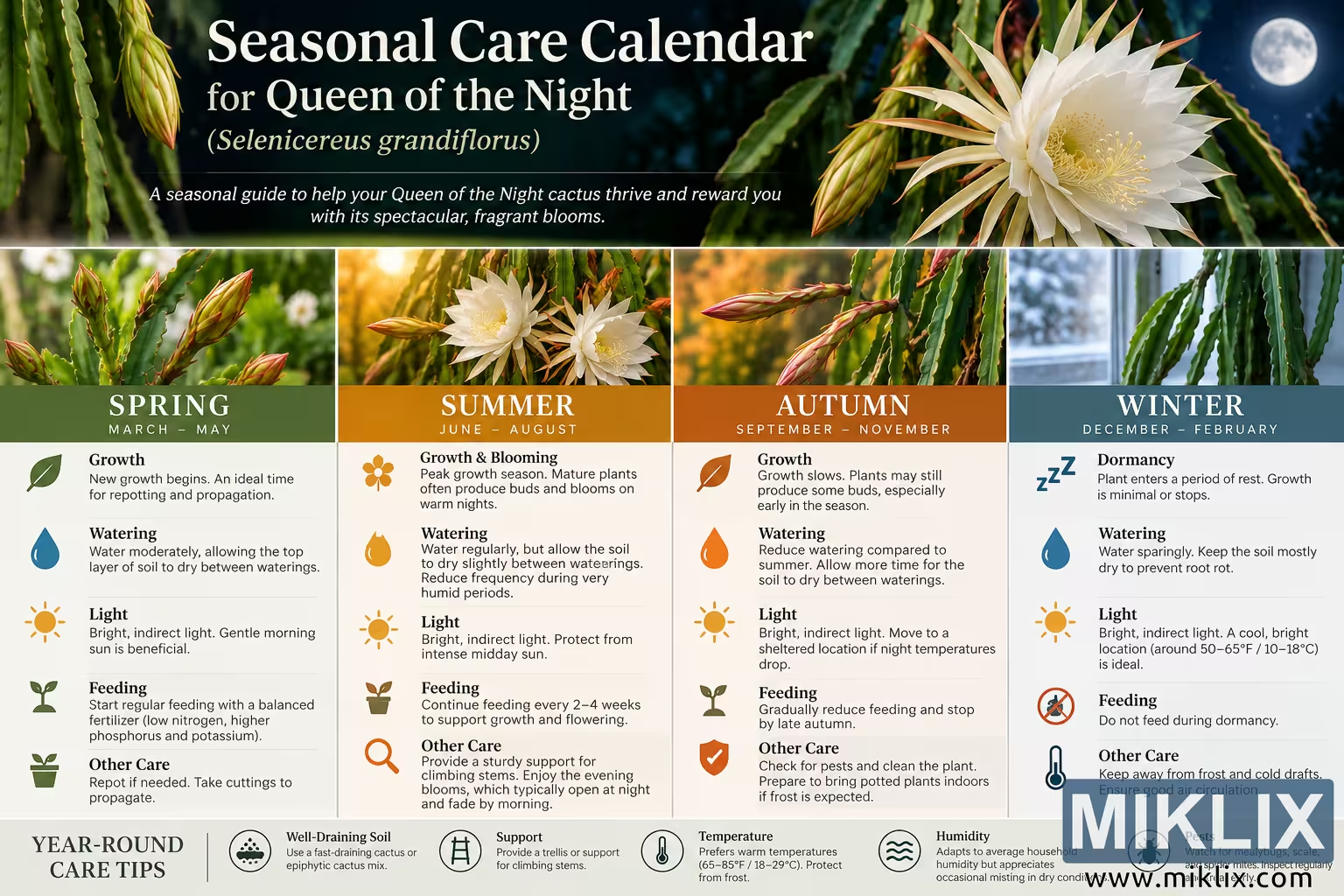
Seasonal care calendar for Queen of the Night (Selenicereus grandiflorus), covering watering, light, feeding, dormancy, blooming, soil, support, and pest care.
Available versions of this image
The image files available for download below are less compressed and higher resolution - and as a result of that, higher quality - than the images embedded in articles and pages on this website, which are more optimized for file size in order to reduce bandwidth consumption.
Regular size (1,536 x 1,024)
Large size (3,072 x 2,048)
Very large size (4,608 x 3,072)
Extra large size (6,144 x 4,096)
Comically large size (1,048,576 x 699,051)
- Still uploading... ;-)
Image description
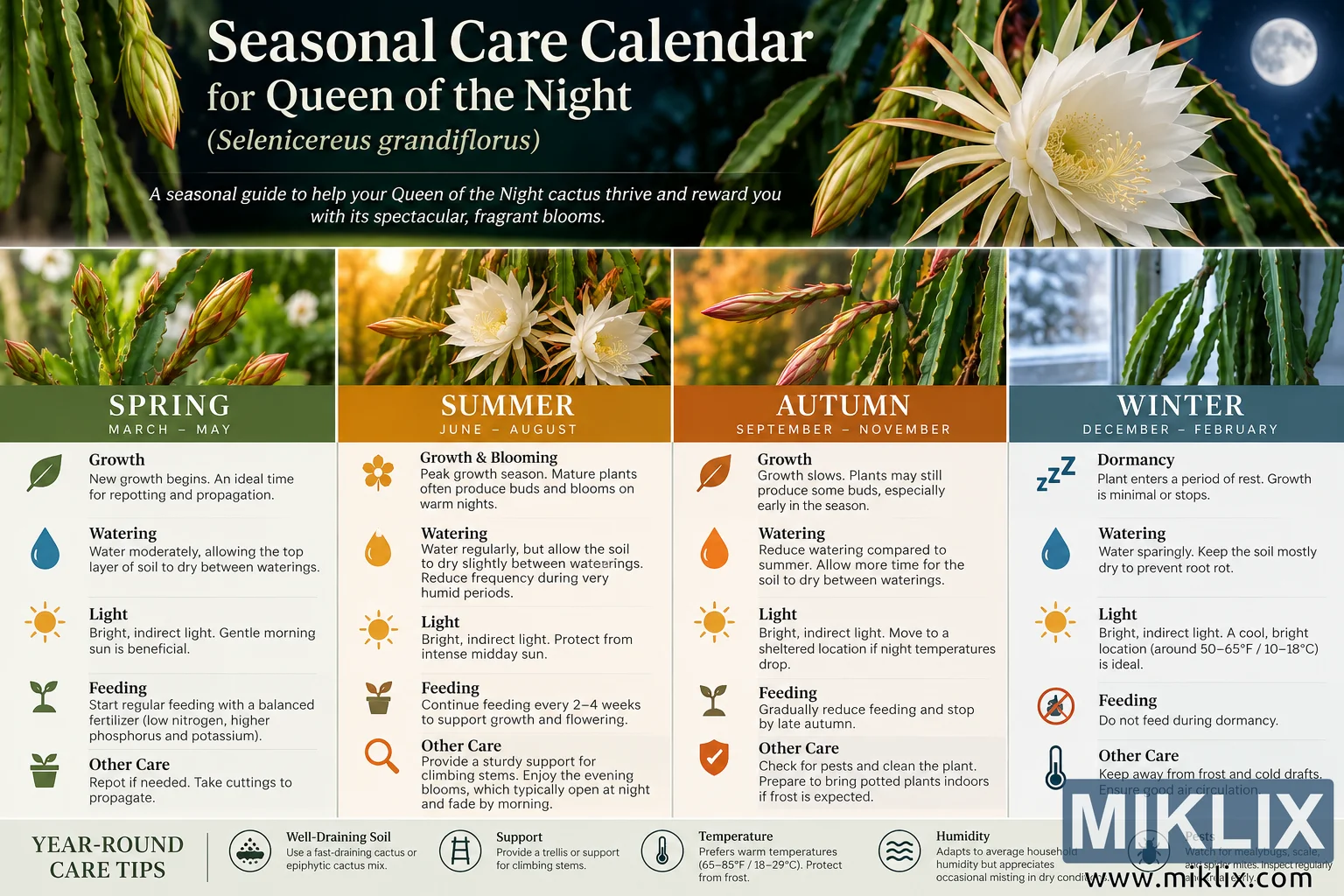
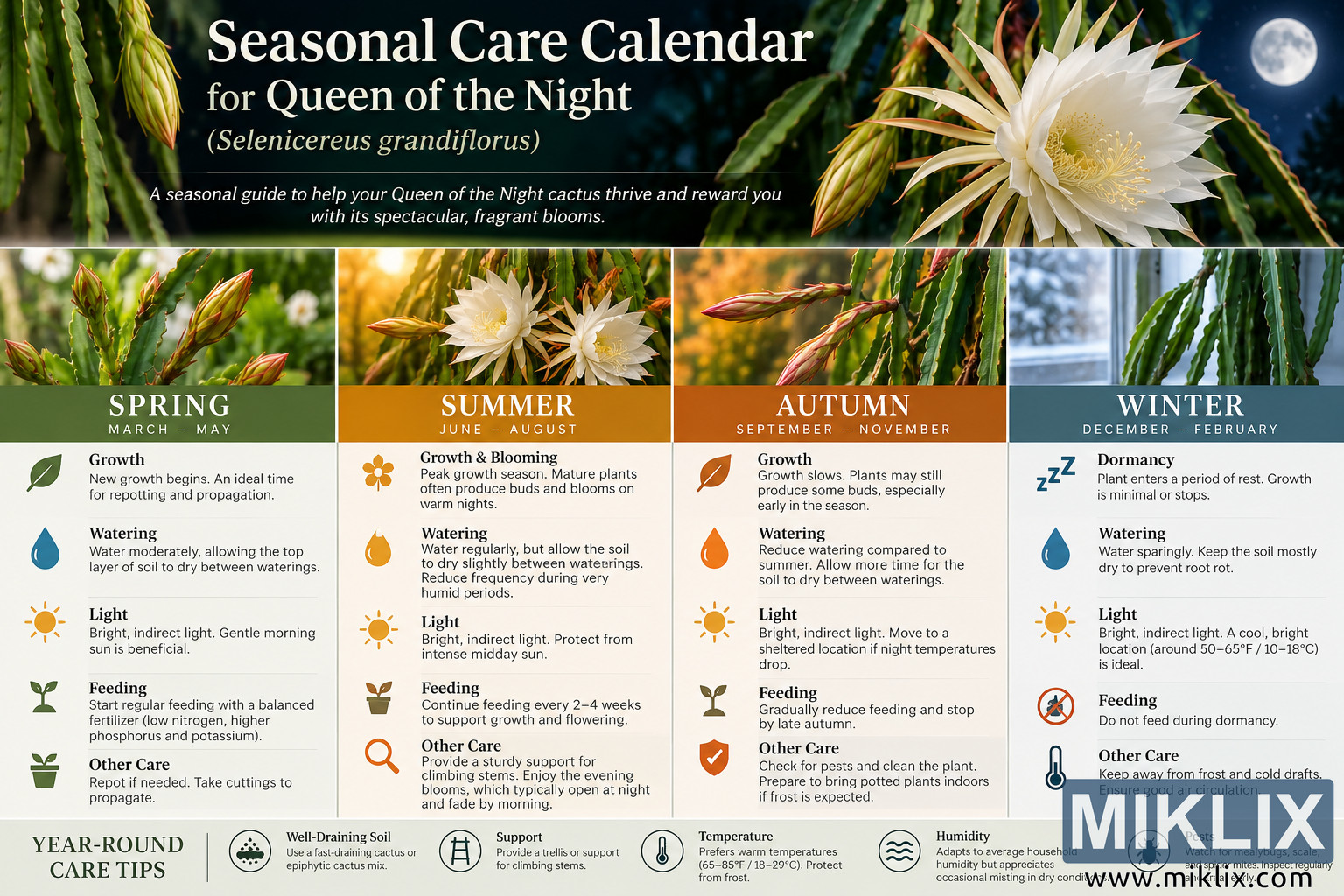
A wide landscape botanical care infographic titled “Seasonal Care Calendar for Queen of the Night (Selenicereus grandiflorus).” The design is divided into a large photographic header, four seasonal columns, and a narrow year-round care strip along the bottom. The header has a dark blue-green nighttime background with long, flattened, segmented green cactus stems hanging vertically and diagonally. On the right is a large open white Queen of the Night flower with many narrow pointed outer petals, broader white inner petals, and a dense cluster of pale yellow-white stamens. Several elongated green-and-reddish flower buds surround it, and a bright full moon appears in the upper-right corner. Large cream-colored serif text on the left reads “Seasonal Care Calendar,” followed by “for Queen of the Night” and the italic botanical name “(Selenicereus grandiflorus).” Beneath this is the sentence: “A seasonal guide to help your Queen of the Night cactus thrive and reward you with its spectacular, fragrant blooms.” Below the header are four equal vertical panels labeled SPRING, SUMMER, AUTUMN, and WINTER, each topped by a photograph and a colored season banner. The spring photograph shows green cactus growth and numerous closed reddish-green buds against a softly blurred green garden background. Its olive-green banner reads “SPRING” and “MARCH – MAY.” The spring care section lists Growth: “New growth begins. An ideal time for repotting and propagation.” Watering: “Water moderately, allowing the top layer of soil to dry between waterings.” Light: “Bright, indirect light. Gentle morning sun is beneficial.” Feeding: “Start regular feeding with a balanced fertilizer (low nitrogen, higher phosphorus and potassium).” Other Care: “Repot if needed. Take cuttings to propagate.” Small colored icons accompany the entries, including a leaf, water droplet, sun, seedling, and potted plant. The summer photograph shows multiple open white flowers and buds on green cactus stems in warm golden light. Its golden-orange banner reads “SUMMER” and “JUNE – AUGUST.” The summer section lists Growth & Blooming: “Peak growth season. Mature plants often produce buds and blooms on warm nights.” Watering: “Water regularly, but allow the soil to dry slightly between waterings. Reduce frequency during very humid periods.” Light: “Bright, indirect light. Protect from intense midday sun.” Feeding: “Continue feeding every 2–4 weeks to support growth and flowering.” Other Care: “Provide a sturdy support for climbing stems. Enjoy the evening blooms, which typically open at night and fade by morning.” The accompanying icons include a flower, droplet, sun, potted plant, and magnifying-glass-like symbol. The autumn photograph shows several long reddish-green flower buds extending from dark green cactus stems against a warm, softly blurred orange and green background. Its burnt-orange banner reads “AUTUMN” and “SEPTEMBER – NOVEMBER.” The autumn section lists Growth: “Growth slows. Plants may still produce some buds, especially early in the season.” Watering: “Reduce watering compared to summer. Allow more time for the soil to dry between waterings.” Light: “Bright, indirect light. Move to a sheltered location if night temperatures drop.” Feeding: “Gradually reduce feeding and stop by late autumn.” Other Care: “Check for pests and clean the plant. Prepare to bring potted plants indoors if frost is expected.” Icons include a leaf, droplet, sun, seedling, and shield with a check mark. The winter photograph shows long green cactus stems indoors beside a window, with a pale, cool-toned snowy or frosty exterior visible beyond the glass. Its blue-gray banner reads “WINTER” and “DECEMBER – FEBRUARY.” The winter section lists Dormancy: “Plant enters a period of rest. Growth is minimal or stops.” Watering: “Water sparingly. Keep the soil mostly dry to prevent root rot.” Light: “Bright, indirect light. A cool, bright location (around 50–65°F / 10–18°C) is ideal.” Feeding: “Do not feed during dormancy.” Other Care: “Keep away from frost and cold drafts. Ensure good air circulation.” Icons include blue sleep symbols, a water droplet, sun, crossed-out feeding symbol, and thermometer. The bottom strip has a pale cream-gray background and begins with large dark green text reading “YEAR-ROUND CARE TIPS.” Five horizontally arranged categories follow, each with a circular line icon. “Well-Draining Soil” says: “Use a fast-draining cactus or epiphytic cactus mix.” “Support” says: “Provide a trellis or support for climbing stems.” “Temperature” says: “Prefers warm temperatures (65–85°F / 18–29°C). Protect from frost.” “Humidity” says: “Adapts to average household humidity but appreciates occasional misting in dry conditions.” “Pests” says: “Watch for mealybugs, scale, and spider mites. Inspect regularly and treat early.” The overall composition uses realistic botanical photography combined with clean infographic typography and flat vector-style icons. The seasonal palette progresses from olive green in spring to golden orange in summer, deeper orange in autumn, and cool blue-gray in winter. Thin borders and horizontal rules organize the information. The poster appears clean and intentionally designed, with no visible brand names or logos.
The image is related to: Growing Queen of the Night in Your Own Garden