
Image: Healthy vs Diseased Aronia Leaves: A Detailed Comparison
Published: December 3, 2025 at 9:32:44 PM UTC
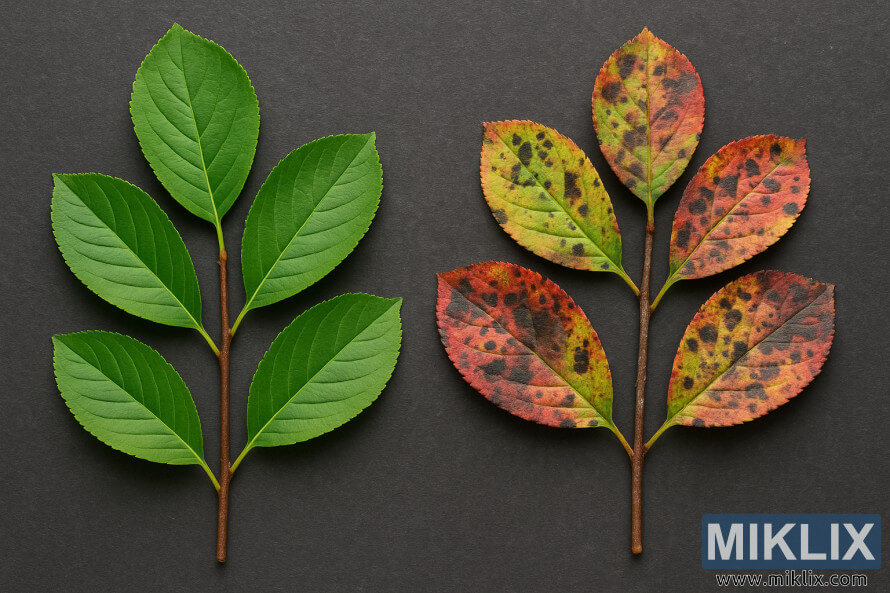
A high-resolution botanical photograph showing healthy aronia leaves next to diseased ones affected by fungal spots and discoloration, illustrating plant health differences in detail.
Available versions of this image
The image files available for download below are less compressed and higher resolution - and as a result of that, higher quality - than the images embedded in articles and pages on this website, which are more optimized for file size in order to reduce bandwidth consumption.
Regular size (1,536 x 1,024)


Large size (3,072 x 2,048)
Very large size (4,608 x 3,072)
Extra large size (6,144 x 4,096)
Comically large size (1,048,576 x 699,051)
- Still uploading... ;-)
Image description
This high-resolution botanical photograph presents a clear side-by-side comparison of aronia (chokeberry) leaves in two contrasting states of health. On the left, a sprig of healthy aronia leaves displays a vivid green hue, consistent coloration, and well-defined venation. Each leaf is smooth, turgid, and symmetrical, with finely serrated margins that reflect light evenly. The midrib and secondary veins are sharply delineated, contributing to the sense of vitality and structural integrity typical of a healthy plant. The leaves’ texture suggests optimal hydration and nutrient balance, free from any visible defects or environmental stressors.
In contrast, the right-hand side of the image showcases aronia leaves affected by common plant health issues, most likely fungal or bacterial leaf spot diseases. These leaves exhibit a dramatic palette of discoloration, transitioning from green to shades of yellow, orange, red, and brown. Distinct dark circular lesions and irregular necrotic patches dominate the leaf surfaces, particularly along the central and peripheral zones. The tissue surrounding the spots often appears chlorotic, indicating disrupted photosynthesis and localized cell death. Some areas exhibit curling or slight deformation, suggesting loss of turgor pressure and possible vascular obstruction.
The contrast between the two sets of leaves is visually striking and educationally valuable. The healthy specimen on the left represents optimal growth conditions—balanced moisture, adequate sunlight, and minimal pathogen pressure—while the damaged leaves on the right serve as a realistic example of biotic stress. The coloration and pattern of the lesions are typical of fungal infections such as leaf spot or anthracnose, which commonly afflict aronia species under humid or poorly ventilated growing conditions.
The photograph’s composition enhances its scientific and aesthetic impact. Both leaf clusters are carefully arranged on a neutral dark gray background that emphasizes their color and texture without distraction. The stems are positioned vertically, suggesting a mirrored balance between health and disease. The soft, diffused lighting minimizes harsh reflections, allowing viewers to appreciate fine morphological details such as vein patterns, surface gloss, and lesion edges. The image functions effectively as both an educational reference and an artistic representation of plant pathology.
Overall, this image captures the delicate interplay between plant vitality and disease manifestation. It serves as an illustrative tool for horticulturists, plant pathologists, educators, and photographers interested in botanical realism. The vivid juxtaposition of healthy and infected aronia leaves not only highlights the aesthetic beauty of natural variation but also underscores the importance of monitoring plant health and recognizing early signs of disease in sustainable horticultural practice.
The image is related to: A Guide to Growing the Best Aronia Berries in Your Garden