
Image: Honeyberry pruning: before and after maintenance cut
Published: December 2, 2025 at 9:54:38 PM UTC
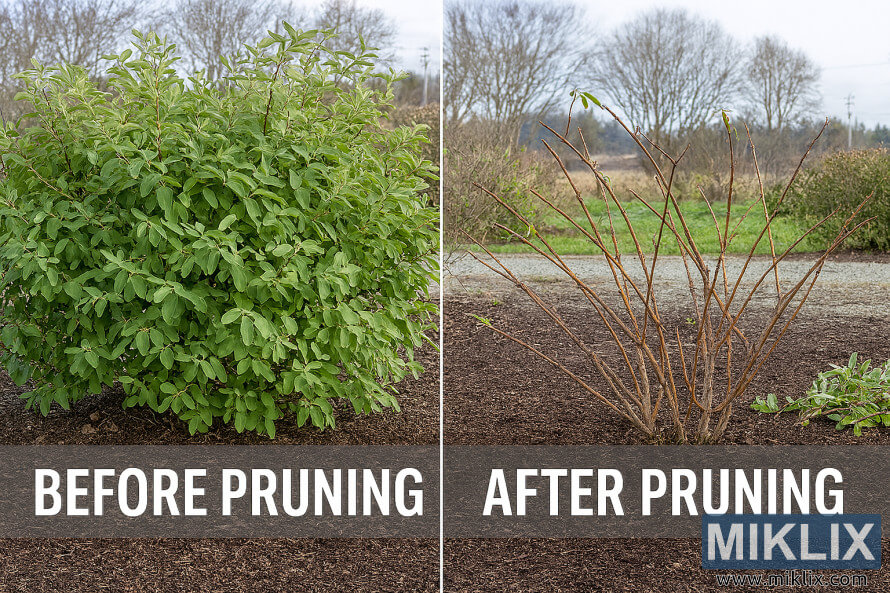
Landscape photo comparing honeyberry bushes before and after proper maintenance pruning. Clear labels, garden setting, overcast light, and visible cut branches illustrate improved structure and airflow.
Available versions of this image
The image files available for download below are less compressed and higher resolution - and as a result of that, higher quality - than the images embedded in articles and pages on this website, which are more optimized for file size in order to reduce bandwidth consumption.
Regular size (1,536 x 1,024)


Large size (3,072 x 2,048)
Very large size (4,608 x 3,072)
Extra large size (6,144 x 4,096)
Comically large size (1,048,576 x 699,051)
- Still uploading... ;-)
Image description
A high-resolution, landscape-oriented comparison photograph depicts two honeyberry (Lonicera caerulea) bushes in an outdoor garden setting, arranged side by side to illustrate the effects of proper maintenance pruning. The composition is split into two equal halves—left labeled “BEFORE PRUNING” and right labeled “AFTER PRUNING”—with clear, bold white text set on semi-transparent gray banners along the lower edge of each half. The camera’s perspective is mid-range and straight-on, allowing a detailed view of branch architecture, leaf density, and ground cover, while maintaining context of the surrounding landscape. Lighting is soft and diffuse under an overcast sky, which lends neutral, even illumination without harsh shadows.
In the left half (“BEFORE PRUNING”), the honeyberry bush appears dense and somewhat unruly. Numerous thin, woody stems crisscross and intertwine, creating a thicket-like mass. Leaves are abundant and elliptical with subtle serrations, arranged in opposite pairs along the branches; their hues range from deep to lighter greens, suggesting a mix of mature and newer growth. Some stems show a faint reddish tinge near their base. The foliage extends nearly to the ground, obscuring the plant’s basal structure and limiting airflow within the canopy. The soil is covered in dark brown mulch, with a few scattered fallen leaves that hint at seasonal transition. This side communicates the typical pre-pruning condition: congested branchwork, overlapping shoots, and competing growth that collectively reduce light penetration and complicate fruiting wood management.
In the right half (“AFTER PRUNING”), the contrast is immediate and instructive. The bush has been thinned and shaped, revealing a more open, balanced framework of fewer but sturdier branches. The remaining limbs are thicker and more evenly spaced, radiating outward and upward in a structure that prioritizes long, healthy shoots likely to bear fruit. Leaf coverage is reduced, and the simplified architecture permits clear sightlines into the shrub’s interior and down to the mulch-covered soil. A small, tidy pile of freshly cut branches topped with green leaves lies on the mulch near the right perimeter of the bush, providing visual evidence of the pruning process and reinforcing the transformation. The pruned plant exhibits improved symmetry and airflow, with distinct leaders and well-managed lateral growth, suggesting enhanced vigor and easier maintenance.
The background remains consistent across both halves, underscoring that the difference is due to pruning rather than environmental change. Behind the bushes, a light gray gravel path traces horizontally, contrasting against the rich brown mulch. Further back, leafless trees and dormant plants imply late fall or early winter. A line of utility poles recedes into the distance under a uniform gray cloud layer, adding subtle depth without distracting from the subject. The overall color palette is natural and subdued: greens of foliage, browns of mulch and branches, and neutral grays in sky and path. The image is composed to be educational and aesthetically clear, with balanced framing that gives each bush equal prominence. The left side communicates density, tangling, and an overgrown state; the right side communicates openness, structure, and readiness for healthy growth. Together, the two halves form a coherent visual narrative of proper honeyberry maintenance pruning—from chaotic thicket to well-structured shrub optimized for airflow, light, and future fruiting.
The image is related to: Growing Honeyberries in Your Garden: A Guide to a Sweet Spring Harvest