
Image: Healthy vs. Nutrient-Deficient Honeyberry Leaves
Published: December 2, 2025 at 9:54:38 PM UTC
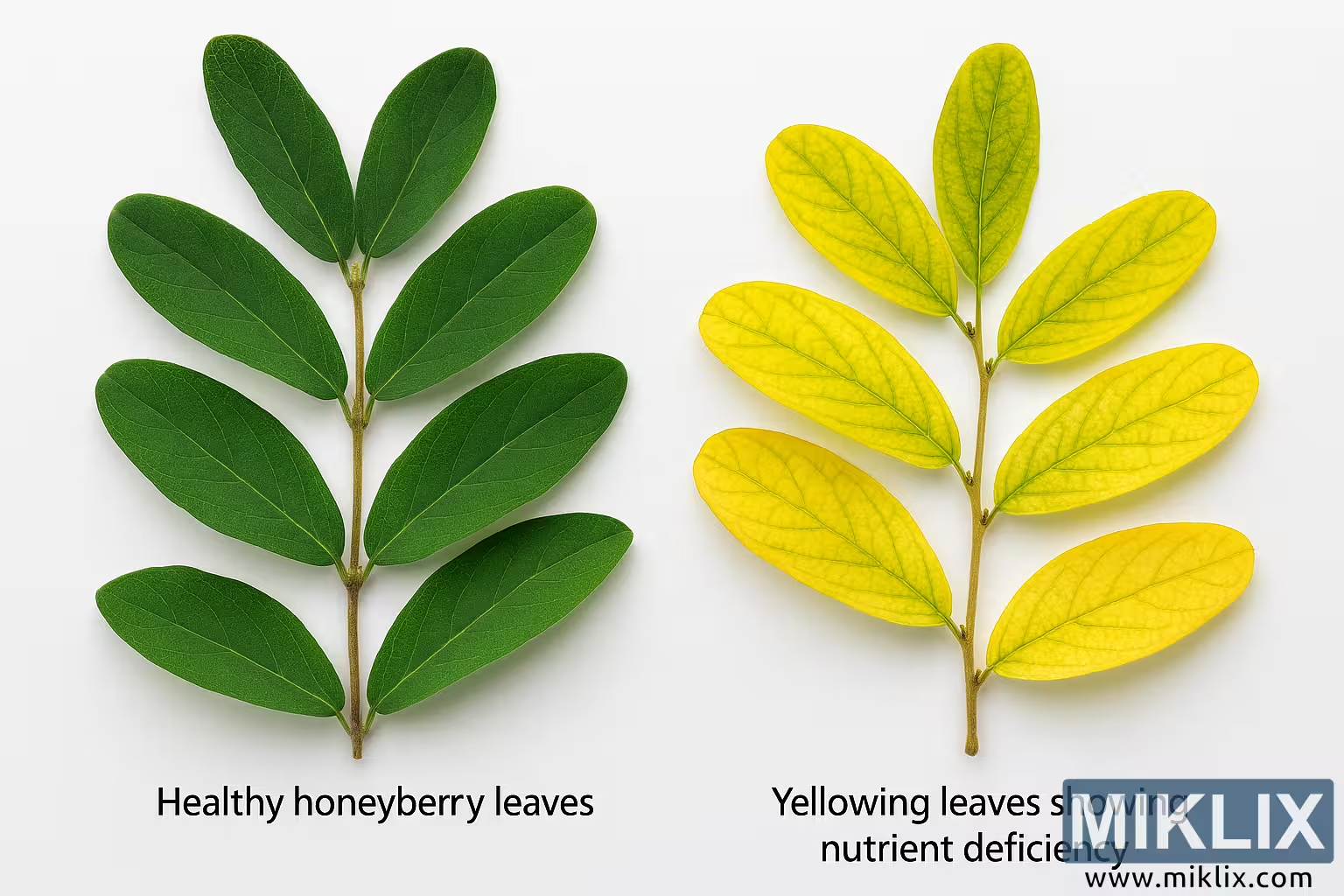
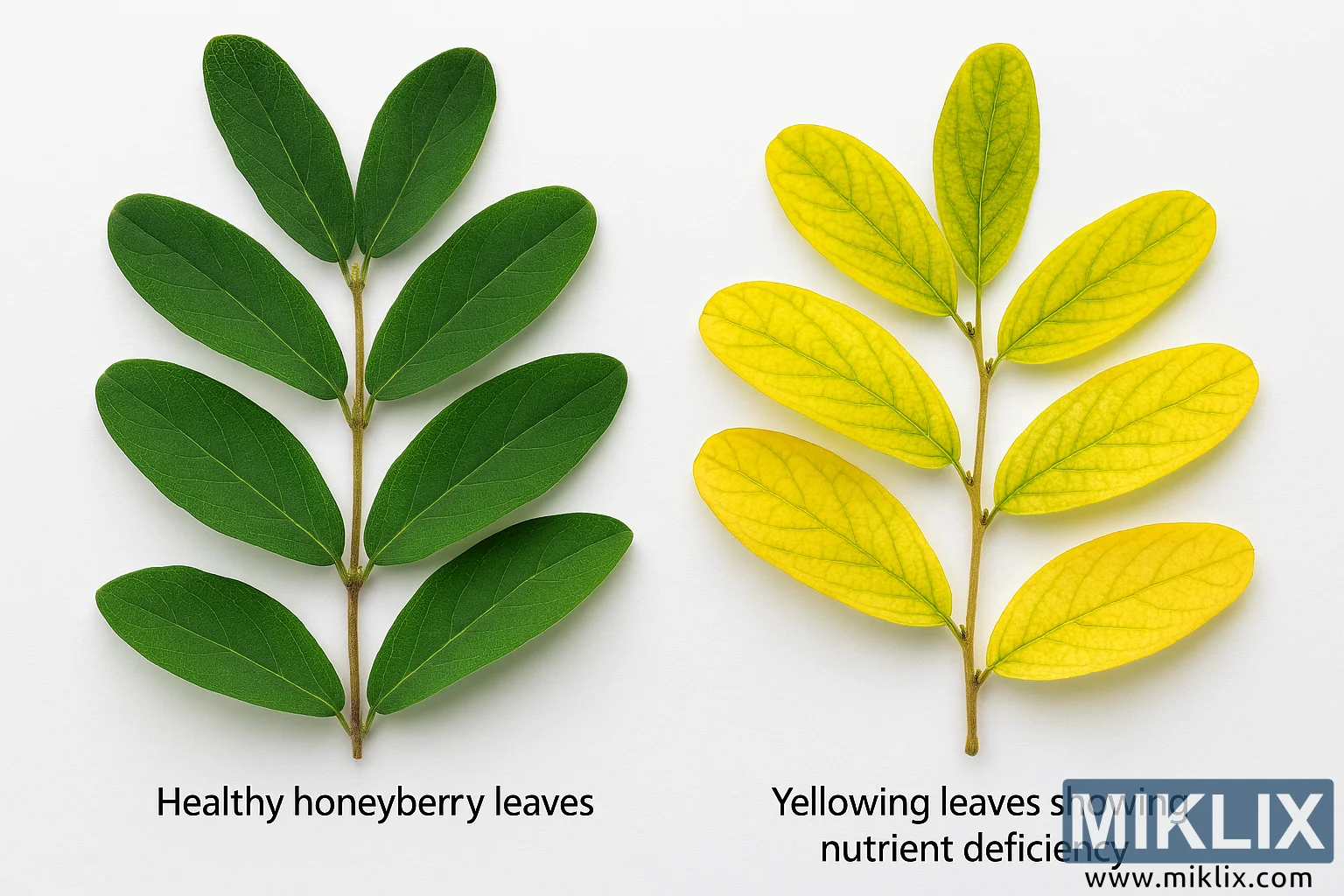
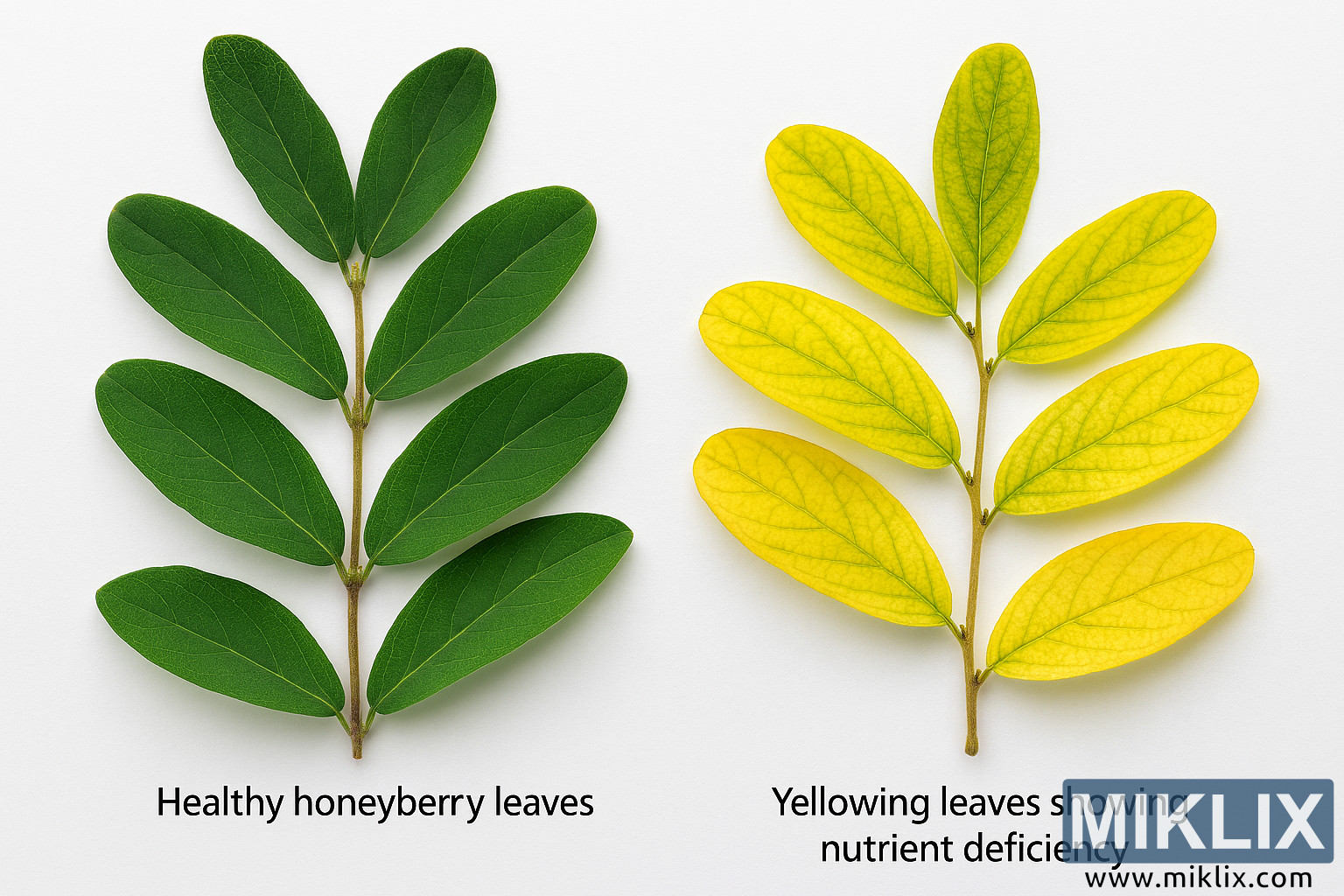
High-resolution comparison of honeyberry leaves: healthy green foliage versus yellowing leaves with nutrient deficiency, highlighting differences in color, texture, and plant health.
Available versions of this image
The image files available for download below are less compressed and higher resolution - and as a result of that, higher quality - than the images embedded in articles and pages on this website, which are more optimized for file size in order to reduce bandwidth consumption.
Regular size (1,536 x 1,024)
Large size (3,072 x 2,048)
Very large size (4,608 x 3,072)
Extra large size (6,144 x 4,096)
Comically large size (1,048,576 x 699,051)
- Still uploading... ;-)
Image description
This high-resolution landscape-oriented image presents a detailed side-by-side comparison of honeyberry (Lonicera caerulea) leaves, contrasting the appearance of healthy foliage with leaves suffering from nutrient deficiency. On the left side of the composition, the healthy honeyberry leaves are vibrant, deep green, and uniform in color. Their surfaces are slightly textured with a velvety sheen, and the veins are clearly visible, branching symmetrically from the central midrib toward the margins. The leaves are oval-shaped with smooth edges and pointed tips, arranged alternately along a slender, brownish-green stem. The largest leaf is positioned near the top of the cluster, with progressively smaller leaves extending downward, creating a natural gradient of size and form. The overall impression is one of vitality, balance, and robust plant health.
On the right side of the image, the leaves affected by nutrient deficiency display a starkly different visual profile. Instead of the uniform green of the healthy cluster, these leaves exhibit chlorosis, a condition characterized by yellowing tissue while the veins remain prominently green. The yellow coloration varies in intensity, with some areas appearing pale and washed out, while others retain patches of darker green near the veins. This uneven pigmentation highlights the disruption of chlorophyll production, a common indicator of nutrient imbalance. The texture of the deficient leaves remains similar to the healthy ones—slightly velvety and oval-shaped—but the discoloration makes them appear weaker and less vigorous. The arrangement along the stem mirrors that of the healthy cluster, with the largest leaf at the top and smaller ones below, emphasizing that the difference lies not in structure but in physiological health.
The background is a clean, bright white, ensuring that the leaves stand out sharply and that their contrasting conditions are immediately noticeable. Lighting is even and well-distributed, eliminating shadows and allowing the viewer to focus on the fine details of leaf texture, venation, and color variation. At the bottom of the image, clear labels identify each cluster: 'Healthy honeyberry leaves' beneath the green set, and 'Yellowing leaves showing nutrient deficiency' beneath the yellowing set. This labeling reinforces the educational purpose of the image, making it suitable for use in horticultural guides, plant pathology references, or agricultural training materials.
The image not only captures the aesthetic differences between healthy and deficient leaves but also serves as a diagnostic visual aid. The healthy leaves symbolize optimal nutrient uptake and photosynthetic efficiency, while the yellowing leaves illustrate the consequences of deficiencies—most commonly nitrogen, iron, or magnesium—that impair chlorophyll synthesis. By juxtaposing the two conditions in a single frame, the image provides a powerful teaching tool for gardeners, farmers, and researchers, highlighting the importance of monitoring leaf coloration as an early indicator of plant health. The high resolution ensures that even subtle details, such as the branching of veins and the gradation of yellow tones, are preserved, making the comparison both scientifically accurate and visually compelling.
The image is related to: Growing Honeyberries in Your Garden: A Guide to a Sweet Spring Harvest