
Hops in Beer Brewing: Omega
פורסם:
עודכן לאחרונה: 25 במאי 2026 בשעה 14:33:47 UTC
Omega hops hold a significant yet small place in British aroma hops history. Developed in the United Kingdom, they were bred for their scent rather than bitterness. This made them ideal for traditional ales and lager experiments, offering a distinctly European flavor profile.
Hops in Beer Brewing: Omega
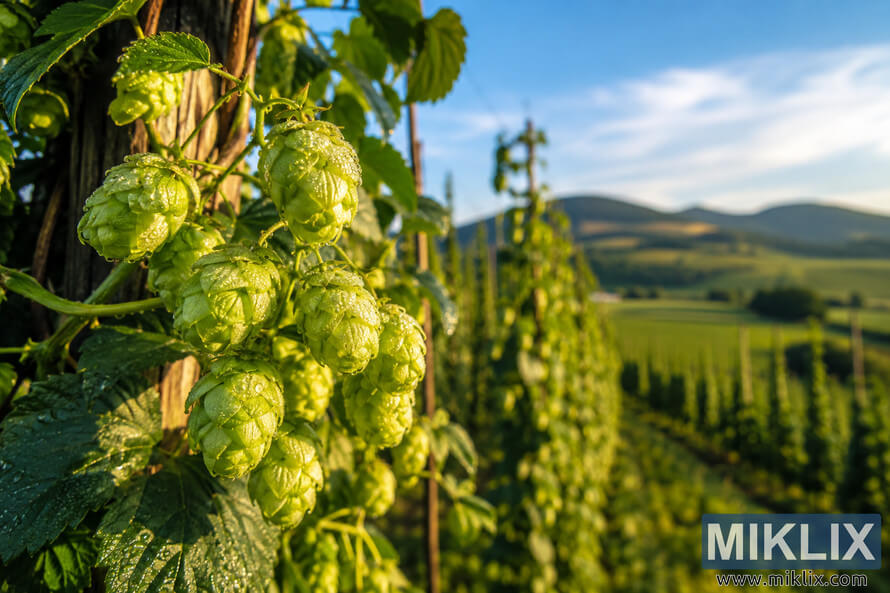
לחץ או הקש על התמונה לקבלת מידע נוסף ורזולוציות גבוהות יותר.
Although Omega hops are no longer available in commercial catalogs, their chemical values, oil breakdown, and sensory notes remain valuable. These details help brewers in their recipe design, allowing them to recreate period beers. By studying these characteristics, brewers can make informed substitutions and achieve the desired flavor profiles.
Key Takeaways
- Omega hops are a UK-bred aroma variety developed for scent rather than bitterness.
- The Omega hop variety is discontinued and not available in commercial catalogs.
- Recorded chemical and oil data remain useful for recipe design and substitution.
- Omega hop flavor fits European-style ales and subtle lager treatments.
- Historical sources such as Beermaverick, Omega Yeast, and Northern Brewer document its profile.
Overview of Omega Hops: history, origin and availability
Omega hops originated from mid-20th century English breeding efforts. They are documented as a cultivar with practical notes. Despite limited plantings, brewers and historians rely on these records to understand the availability of hops in the UK and the history of discontinued varieties.
Wye College was pivotal in developing many English hop cultivars. They selected Wye College hops for their suitability and brewing characteristics. Trials evaluated aroma, alpha acid levels, and vine performance across English soils and climates.
Records reveal Omega's parentage: a Challenger female crossed with an unknown English variety. This explains Omega's English aromatic and bittering traits. The unknown male contributed traits that remain uncharacterized.
Commercial growers faced challenges with Omega's field performance. It yielded less than expected and presented cultivation difficulties. These issues led to its decline among mainstream growers.
Growers eventually dropped Omega, making it part of a group of discontinued hop varieties. Today, Omega is not available as a commercial variety in the UK. English hops were typically harvested from early September to early October, the same time Omega would have been harvested.
Archivists and craft brewers still reference Omega hop history. They use it for substitution choices or designing archival brews. The preserved chemical profiles and tasting records help in adjusting recipes where Omega once played a role.
לחץ או הקש על התמונה לקבלת מידע נוסף ורזולוציות גבוהות יותר.
Flavor and aroma profile of Omega hops
Omega hops exhibit a classic, restrained character, often described as a pleasantly European hop. They offer a noble and continental aroma, distinct from the bright tropical notes found in other hops. This makes them ideal for lagers and traditional ales where a subtle hop character is desired.
Descriptors: "pleasantly European" characteristics
The aroma of Omega hops is reminiscent of gentle spice, light noble florals, and a clean woody backbone. This European hop quality enhances beer balance, allowing malt and yeast to take center stage. Brewers prefer Omega for its subtle Old World restraint, avoiding the bold citrus punch of other hops.
Aroma components and sensory notes useful for recipe design
- Resinous and citrus topnotes driven by myrcene add a subtle fresh lift.
- Humulene provides woody, noble, and spicy nuances that support traditional profiles.
- Caryophyllene yields peppery and herbal accents that add complexity.
- Farnesene and minor oils such as β-pinene, linalool, and geraniol give light green floral and fruity nuance.
These hop sensory notes are crucial for recipe design, offering low-key aromatics that complement malts, toasted grains, and delicate yeast esters. Use modest addition rates to avoid overpowering the base beer character.
How late additions and dry hopping preserve aroma
Given their moderate total oils and volatility, late addition hops are best for capturing Omega’s aroma. Adding hops in the whirlpool or hopstand preserves delicate compounds that would otherwise be lost in long boils.
For a stronger final nose, dry hopping Omega enhances its gentle European traits without adding bitterness. This method effectively boosts the aroma while maintaining beer balance and adherence to style.
לחץ או הקש על התמונה לקבלת מידע נוסף ורזולוציות גבוהות יותר.
Chemical brewing values for Omega hops
Understanding the chemical profile of Omega hops is crucial for brewers. The numbers below reveal its bitterness, aroma potential, and storage behavior. These values guide brewers in timing additions and preserving the hop's aromatic character.
Omega hop alpha acids range from about 9–10%, with an average near 9.5%. This is high for an English-style aroma hop, contributing notable bitterness if added early in the boil. Brewers aiming for clean bitterness should favor late-boil or whirlpool additions. This limits isomerization and retains the softer hop character.
Beta acids
Omega beta acids sit around 3–4%, averaging roughly 3.5%. Unlike alpha acids, beta acids do not isomerize into bitterness. They add resinous, aged-hop notes over time, influencing hop aroma during cellaring and bottle conditioning.
Alpha–beta ratio and co-humulone
The alpha:beta ratio typically ranges from 2:1 up to 3:1, with many samples near 3:1. Co-humulone Omega measures about 29% of the alpha acids. This moderate co-humulone level suggests a bitterness character that is neither exceptionally soft nor aggressively sharp. The timing and concentration of additions determine this.
Total oils and aromatic impact
Total oils Omega register near 1.7 mL per 100 g. This moderate oil content rewards late additions and dry hopping, where volatile compounds remain intact. Preserving total oils Omega during handling and storage ensures the best late-hop aroma lift in finished beer.
- Use late additions to avoid excess bitterness from Omega hop alpha acids.
- Expect resinous aging notes from Omega beta acids; plan cellaring accordingly.
- Balance alpha:beta ratio and co-humulone Omega when scaling IBUs.
- Protect total oils Omega with cold storage to keep aroma bright.
לחץ או הקש על התמונה לקבלת מידע נוסף ורזולוציות גבוהות יותר.
Essential oil breakdown and sensory impacts
Understanding the hop oil profile reveals why Omega hops perform uniquely in beer. The total oil mix influences aroma, volatility, and the final character of the beer. Brewers use this knowledge to time late additions and dry hops for the best scent retention.
Myrcene Omega dominates the hop essential oils, making up 52–54%. This high myrcene content imparts resinous, citrus, and fruity notes. These volatile compounds are best preserved through late-boil or dry-hop additions, ensuring a bright, fresh fruit character.
Humulene Omega, present at 16–18%, contributes woody and noble-type aromas. These tones add a stable backbone to the aroma, complementing malt sweetness with spice and depth. Humulene's stability during whirlpool rests helps maintain classic European nuances.
Caryophyllene Omega and farnesene play smaller but distinct roles. Caryophyllene, around 4–6%, introduces peppery, herbal, and woody accents. Farnesene, near 0.5%, adds faint green and floral highlights. Together, they enhance complexity without overpowering the blend.
The remaining 21–28% of oils include β-pinene, linalool, geraniol, and other trace compounds. These minor oils contribute floral, citrus, and perfumed nuances. They can significantly change during biotransformation by yeast, producing subtle new esters and thiol-derived notes.
- Myrcene Omega: strong, volatile, best preserved late.
- Humulene Omega: woody, noble, adds structural depth.
- Caryophyllene Omega and farnesene: pepper, herbal, floral touches.
- Minor oils: nuanced floral and citrus lifts that enhance complexity.
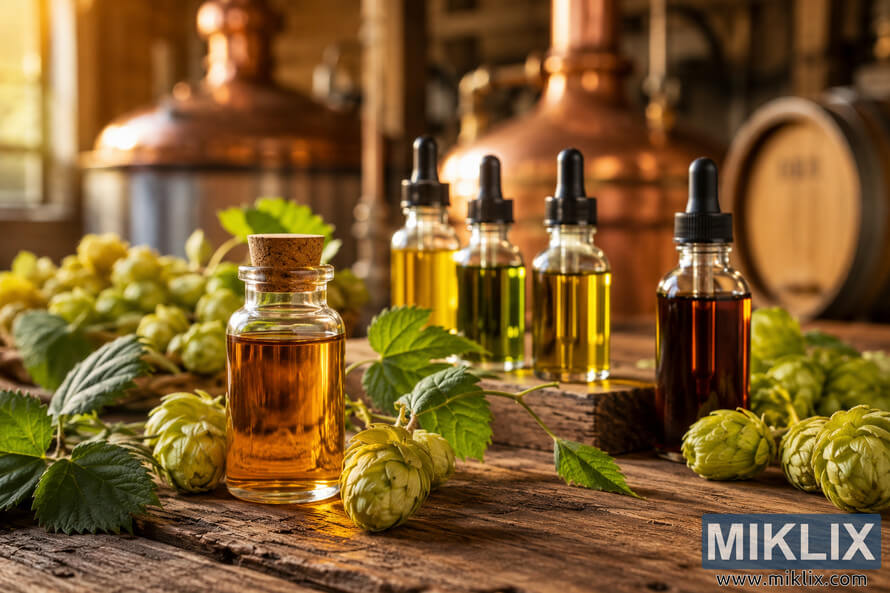
לחץ או הקש על התמונה לקבלת מידע נוסף ורזולוציות גבוהות יותר.
Brewing uses and recommended additions
Omega hops shine as an aroma hop. Brewers achieve the best citrus, resinous, and herbal flavors by avoiding heavy early additions. Instead, they focus on late timing. This guide will help you use Omega hops for aroma-forward results. It includes practical dosing and style notes.
- Make late additions in the last 10 minutes of the boil or at flameout to limit volatile oil loss.
- Whirlpool or hopstand at lower temperatures (below 180°F / 82°C) to extract aroma without harsh bitterness.
- Because of its 9–10% alpha acids, avoid using Omega for early bittering. Reserve early hops for hop varieties meant for IBUs.
Dry hopping and contact times
- Use Omega dry hopping for a clear aromatic lift. Typical rates follow style practice: 1–4 oz/gal depending on batch size and desired intensity.
- Cold dry hopping preserves floral and fruity esters best; 3–7 days of contact is a common starting point.
- Monitor aroma frequently. If grassy or vegetal notes appear, reduce contact time or dose in future brews.
Style applications
- Lagers benefit from subtle European lift when used sparingly in late additions and light dry hopping.
- Pale ales and English or continental ales gain balanced spice, citrus, and resin when Omega late additions and dry hop are combined.
- Stouts and darker session beers accept restrained herbal or citrus highlights. Use lower dry hop rates to keep malt roast character front and center.
For brewers asking how to use Omega hops, pair late additions with measured Omega dry hopping to capture its volatile oil profile. Experiment within beer styles Omega hops suit and adjust timing to fit the recipe goals.
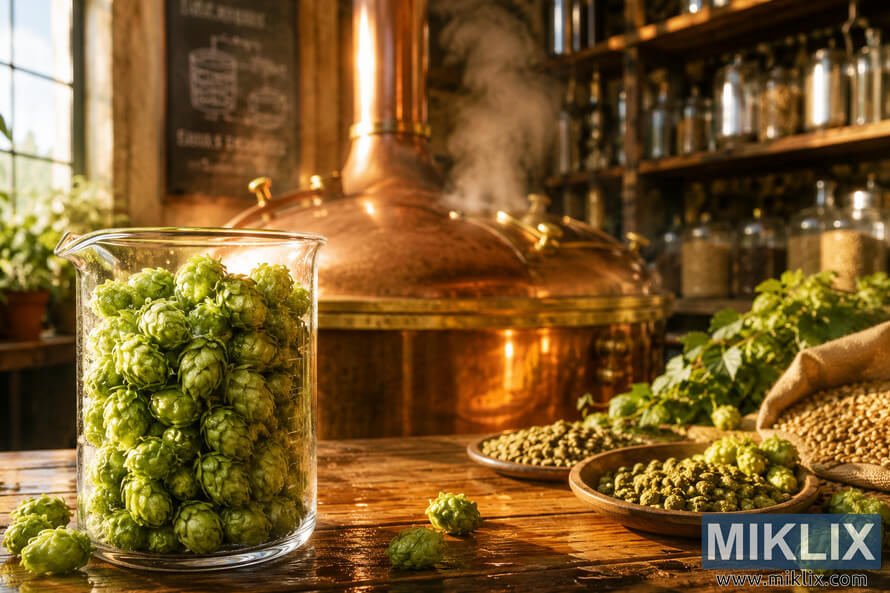
לחץ או הקש על התמונה לקבלת מידע נוסף ורזולוציות גבוהות יותר.
Omega hops substitutions and comparable varieties
Brewers often face the challenge of finding substitutes for Omega hops when they're not available. This guide aims to provide a clear plan for swapping varieties without compromising the beer's character. It covers proven substitutes, data-driven matching, and practical recipe tweaks to maintain aroma and balance.
Challenger hops are a common choice for brewers looking for a close genetic and flavor match. They offer a similar English-style herbal and woody character, making them an effective substitute for aroma-focused additions. Super Galena is another popular option for brewers seeking slightly different bitterness and backbone while retaining European tones.
When selecting a substitute, it's crucial to compare key numbers. Omega hops average about 9.5% alpha acids and roughly 1.7 mL/100g total oils. Look for substitutes with comparable alpha, myrcene-humulene-caryophyllene ratios, and total oil to preserve the aroma profile. This hop substitution guide helps prioritize these metrics to ensure aroma-driven beers remain consistent.
- Challenger hop substitute: Use near 1:1 for late additions and dry hopping. Expect similar herbal, noble-like notes.
- Super Galena vs Omega: Super Galena can bring firmer bittering and a touch more resin. Reduce or taste-adjust late-add amounts to match perceived aroma intensity.
Adjust recipes carefully when bittering is involved. If your substitute's alpha acids differ from Omega, recalculate early-boil additions to keep IBUs on target. For aroma additions and dry hops, alpha differences matter less, but monitor perceived intensity and aroma lift.
Practical tips for substitution:
- Match totals: prioritize total oil and dominant oil ratios over a single alpha number.
- Taste as you go: add slightly less when trialing Super Galena, then increase in small steps if aroma feels weak.
- Favor English-style hops: choose noble or Challenger-like varieties rather than tropical New World hops to keep Omega's restrained European character.
Use this hop substitution guide to make informed swaps and preserve recipe intent. By comparing chemistry and sensory traits, you can reduce surprises and keep your beer close to the original design when a substitute for Omega hops becomes necessary.
Storage considerations and hop stability
Proper handling is crucial when storing Omega hops. Even with a high HSI Omega of about 22% (0.22), volatile oils can degrade rapidly. Breeders and brewers emphasize the importance of hop freshness for aroma-forward additions.
To preserve aroma and bitterness, follow simple storage best practices. Store hops in a cold environment, such as a refrigerator or freezer. Use vacuum sealing or nitrogen flushes to minimize oxygen exposure. Stable temperatures slow down chemical changes in alpha and beta acids.
- Monitor HSI Omega when evaluating lots. A measured HSI helps estimate remaining hop freshness and guides usage.
- Minimize oxygen exposure. Oxygen speeds oxidation of alpha and beta acids and robs essential oils of their bright character.
- Label dates and maintain inventory rotation so older material is used for less aroma-sensitive roles.
Aging changes hop chemistry over weeks and months. Alpha acids gradually decrease, beta acid ratios can shift, and light, volatile oils like myrcene drop first. This alters the balance from resinous, citrus notes toward muted, woody tones.
For rare varieties like Omega, test available lots for HSI Omega and perform a quick sensory check. Use the freshest material for late additions and dry hopping when hop freshness will be most noticeable.
Omega hops and lupulin product availability
Omega has a clear presence in hop catalogs, but lupulin concentrates for this variety are not offered by major suppliers. Brewers should know the market reality before planning concentrated additions.
Major providers such as Yakima Chief Hops, Barth-Haas, and Hopsteiner do not list Omega Cryo, Omega Lupomax, or LupuLN2-style powders for sale. This lack of lupulin products limits direct options for hop concentrates Omega users seeking high-impact aroma with minimal vegetal carryover.
Without lupulin concentrates, dosing choices for whirlpool and dry hop work differently. You cannot swap a small weight of lupulin for a large whole-cone or pellet dose when using Omega. Expect to add more mass or use multiple additions to reach similar aromatic intensity.
- Increase dry-hop mass while watching for grassy or vegetal notes.
- Use longer cold-contact times to extract volatiles gently.
- Perform two staged dry hops to layer aroma without overloading hops at once.
- Blend Omega with available lupulin concentrates from similar-profile varieties, such as Challenger-derived Cryo products, to boost impact.
Blending strategies let brewers simulate concentrated character even when there is no official Omega Cryo or Omega Lupomax product. Choose hop concentrates Omega that share resinous and noble traits to preserve the expected European aroma.
Alternative routes include selecting substitute varieties already sold as lupulin powders or using biotransformation techniques with thiol-boosting yeast strains. These approaches can amplify perceived tropical and citrus notes when lupulin Omega availability is absent.
Practical recipe examples using Omega hops
Here are quick guides for using Omega hops in three common styles. Each example focuses on late additions, whirlpool timing, and restrained dry hop rates. This preserves Omega’s resinous, lightly citrus aroma. For discontinued lots, swap with a close substitute and adjust rates to match alpha and oil profiles.
Basic pale ale outline that highlights late hop character
- Grain bill: 10 lb US two-row or swap to 9.5 lb Maris Otter + 0.5 lb crystal 40 for English tone.
- Mash: 150–152°F for 60 minutes to keep body moderate and allow hop brightness to show.
- Hopping: minimal early bittering; 10-minute addition of Omega for flavor, flameout addition for aroma.
- Dry hop: 3–5 g/L for 3–5 days (scale to batch size) to emphasize resinous-citrus notes without vegetal character.
- Yeast and ferment: Clean ale strain like Wyeast 1056 or White Labs WLP001 to let hops speak.
- Notes: This pale ale with Omega hops relies on late additions rather than bittering to balance drinkability.
Approach for a stout or darker ale that uses hop lift sparingly
- Grain bill: Pale base with 8–12% roasted barley and chocolate malt for roast backbone.
- Mash: 152°F to keep some sweetness that tempers roast harshness.
- Hopping: tiny late addition at 5–10 minutes or a light flameout dose to add herbal-citrus lift.
- Dry hop: low rate, about 0.5–1 oz/gal in small-batch terms, 2–4 days to avoid clashing with roast malt.
- Yeast and ferment: English ale yeast like Wyeast 1968 or White Labs WLP002 gives round malt presence.
- Notes: A stout with Omega hops should treat the variety as an accent. Let roasted grains lead while Omega adds subtle European herb and citrus.
Cold-conditioned lager treatment to show subtle hop nuance
- Grain bill: Pilsner malt base with 5–10% Munich for body and depth.
- Fermentation: clean lager strain, long, cold conditioning to present hop detail.
- Hopping: late whirlpool or 10-minute post-boil additions at 160–170°F hopstand to capture delicate oils.
- Dry hop: light dosing only in modern lagers; short contact time to maintain restraint.
- Conditioning: extended lagering reduces harshness and lets noble-woody notes emerge.
- Notes: A lager using Omega benefits from low-temperature handling and careful timing to show subtle woody and noble character.
Practical dosing and substitution tips for all recipes
- Match bitterness: adjust bittering hops if replacing Omega to reach target IBUs without adding early Omega additions.
- Preserve oils: use whirlpool, hopstand, or short dry hop contacts to protect volatile oils from heat and oxidation.
- Scale rates: when using Super Galena or Challenger as substitutes, compare alpha acids and total oil to set equivalent grams per liter.
- Storage note: use fresh, cold-stored hops for these recipes to maximize the aromatic return of late additions and dry hop work.
Omega hops in modern brewing techniques
Omega hops interact with new brewing methods in ways that reward careful planning. Brewers can choose mash hopping, whirlpool additions, or timed dry hops to shape thiol expression and overall aroma. Small changes in timing and yeast choice produce large sensory differences.
Mash hopping relevance and lessons from Thiolized yeast research
Adding hops to the mash can release thiol precursors bound to proteins and glycosides. Research from Omega Yeast shows mash hopping can boost those precursors enough that a thiol-boosting strain later frees more volatile thiols.
Practical trials with mash hopping reveal greater grapefruit, passion fruit, and guava cues when paired with Thiolized yeast Omega strains. Plan mash hop additions early and track temperatures to avoid excessive polyphenol extraction.
Biotransformation potential when combined with thiol-boosting yeast strains
Thiolized yeast Omega strains increase β-lyase activity to convert bound precursors into free thiols during fermentation. This enzyme activity drives biotransformation hops toward tropical and citrus aromas that might not appear with standard yeast.
For best results, target active fermentation for contact between yeast and hop compounds. That timing encourages enzymatic conversion without losing volatile compounds to beer loss or oxygen exposure.
Considerations for whirlpool vs. mash vs. dry hop to maximize aroma
- Whirlpool vs mash hopping: Whirlpool preserves volatile oils like myrcene and linalool by using lower post-boil temperatures. Mash hopping focuses on precursor extraction for later biotransformation.
- Dry hop timing: Mid- to late-fermentation dry hopping promotes yeast-hop interaction and boosts biotransformation if using Thiolized strains.
- Blend strategies: Combine a controlled mash hopping dose with a gentle whirlpool and a mid-fermentation dry hop to capture both precursors and volatiles.
When testing these approaches, keep records of hop amounts, temperatures, and yeast strain. Replicable data helps dial in the balance between preserved aroma and enzymatic conversion. Thoughtful pairing of mash hopping Omega preparations with Thiolized yeast Omega strains offers a reliable path to unlock subtle thiol character in beers brewed with European aroma hops.
Regulatory, sourcing and embedding hop data for brewers
Brewers handling legacy varieties should start with historical chemistry and sensory notes. It's crucial to verify these facts by requesting current lab sheets or certificates of analysis. This approach minimizes surprises from hop lot variability and safeguards recipe integrity.
Consult reputable hop merchants and databases for archived entries. Reach out to companies like Yakima Chief Hops or independent labs for lot reports. When sourcing Omega hop data, prioritize primary documentation over forum recollections. This enhances reproducibility and traceability.
Lot-to-lot changes are influenced by site, season, and agronomy. Track hop lot variability by comparing alpha and beta acids, total oils, and thiol precursor markers across vintages. Use historical ranges as guidance and confirm current values with analytical reports.
- Request COAs for each lot you plan to use.
- Record grower, harvest year, and storage history with each batch.
- Re-test borderline lots prior to scaling recipes.
Many data providers offer embeddable widgets for brewery websites or recipe pages. These widgets display hop profiles using a small HTML element and a vendor script. Follow vendor instructions and host scripts as directed to avoid broken displays.
Example usage includes a div placeholder and a script tag provided by the data source. When embedding hop data, ensure the widget respects privacy and does not leak proprietary lot identifiers.
Respect intellectual property when reproducing manufacturer material. Hop data copyright often belongs to the provider or the hop grower. Always credit original sources and state non-affiliation when applicable to avoid misrepresentation.
- Note the data owner in captions or metadata where you reproduce profiles.
- Obtain written permission for extended reproductions beyond fair use.
- Comply with labeling and safety rules if formulations reference proprietary yeast or modified organisms.
When publishing, include clear disclaimers that third-party databases may be unaffiliated with hop breeders or manufacturers. This protects both legal standing and reader expectations regarding accuracy and ownership of the materials you display.
Omega hops
Omega hops are a favorite among craft brewers who aim for a classic English aroma and recipe fidelity. They have a unique chemical makeup, with moderate alpha acids and a high myrcene content. This combination creates a resinous-citrus flavor profile with woody and noble spice undertones. This brief overview highlights why Omega hops are important, discusses the trade-offs in aroma and oils, and provides guidance on whether to choose Omega or find a substitute.
Why the variety matters to craft brewers and recipe development
- Omega hops offer a distinct "pleasantly European" flavor, ideal for recreating traditional ales or achieving historic flavor profiles.
- With an alpha range of 9–10%, they provide predictable bitterness while maintaining enough oil content for late-hop aroma enhancements.
- Understanding Omega's characteristics is crucial for brewers to make informed decisions on hop additions, timing, and yeast interactions to preserve delicate noble and resinous notes.
Comparative summary: aroma, oil profile, and practical tradeoffs
- The oil composition, centered on 52–54% myrcene, 16–18% humulene, and notable caryophyllene, results in citrus-resin top notes and woody-spice depth.
- Storage stability is moderate (HSI ~0.22), ensuring aroma preservation when hops are stored cold and in low-oxygen conditions.
- However, there are trade-offs, including historical yield issues that led to discontinuation and the lack of lupulin concentrate options, limiting concentrated dosing for whirlpool or dry hop.
How to decide whether to seek Omega or select a substitute
- Opt for Omega if authenticity is paramount and you can confirm the lot's freshness. Small pilot batches can help verify aroma impact before scaling up.
- Consider Challenger or Super Galena as substitutes when Omega is not available. Match alpha acids and total oil figures, then adjust rates to achieve the desired aroma intensity.
- Employ brewing techniques when lupulin concentrates are not an option. Techniques like mash hopping, thiol-boosting yeast strains, and late or extended cold-side dry hopping can enhance perceived aromatics.
In summary, the choice between Omega hops and substitutes hinges on aroma nuance versus practical availability. Brewers weighing these trade-offs will better decide between Omega or a substitute based on flavor goals, lot chemistry, and the tools available to enhance aromatic expression.
Conclusion
Omega hops conclusion: Omega was a unique UK aroma variety, bred at Wye College. It was a mix of resinous-citrus and woody-spicy notes, reminiscent of Europe. With 9–10% alpha acids, ~3.5% beta acids, and ~1.7 mL/100g total oils, it's prized for late additions and dry hopping. This preserves its volatile oils.
Omega hop summary for brewers: it's best used as an aroma hop. Late boil or dry-hop dosing is key to protect its volatile terpene profile. If you need a substitute, Challenger or Super Galena can work, but adjust timing and rates accordingly.
Using Omega hops with modern techniques: combine aroma strategies like whirlpool and dry hop with thiol-boosting yeast strains. This enhances tropical and sulfur-linked thiol notes. Even without the variety, you can recreate subtle precursors. Store hops cold, vacuum-sealed, and low-oxygen to preserve oils and alpha acids.
Omega hop recommendations: since Omega is no longer commercially available, rely on its chemical and sensory data. Use informed substitutions, careful timing, and modern biotransformation methods to achieve similar results in your brewing.
FAQ
What is Omega and where did it come from?
Omega is a hop variety bred at Wye College in the United Kingdom. It was created for its aroma, not bitterness. The cross of a Challenger female with an unknown English variety is documented. Despite being grown in England, it was discontinued due to low yields. Today, it's not available in commercial hop catalogs.
Is Omega available to purchase today?
No. Omega was discontinued due to low yields and limited cultivation. Major suppliers do not offer Omega or its lupulin concentrates (Cryo, Lupomax, LupuLN2).
Why do brewers still care about a discontinued hop like Omega?
Brewers value Omega for its historical chemistry and sensory descriptors. These are useful for recipe design and finding substitutes. They help in recreating historical beers and achieving specific European aroma styles.
How is Omega typically described in sensory terms?
Omega is described as "pleasantly European in style." Its aroma is restrained and continental, with a balance of woody, noble, and spicy notes. It also has subtle floral and herbal facets.
What are the key chemical values for Omega?
Omega's alpha acids range from 9–10% (average ~9.5%). Beta acids are about 3–4% (average ~3.5%). Total essential oils are around 1.7 mL/100g. The Hop Storage Index (HSI) is approximately 0.22 (22%). Co-humulone is roughly 29% of the alpha acids.
How do Omega’s alpha acids affect its use in brewing?
Omega's high alpha acids make it suitable for early-boil additions. However, this can impart noticeable bitterness. Brewers prefer late additions, whirlpool/hopstand, or dry hopping to capture its aroma without excessive bitterness.
What is the essential oil breakdown and how does it influence aroma?
Omega's oils are dominated by myrcene (~52–54%, avg ~53%). Humulene is around 16–18% (avg ~17%). Caryophyllene is ~4–6% (avg ~5%), and farnesene is roughly 0–1% (avg ~0.5%). The remaining 21–28% includes β-pinene, linalool, geraniol, and other trace oils. High myrcene gives resinous, citrus, and fruity notes. Humulene adds woody/noble spice. Caryophyllene and farnesene contribute peppery, herbal, and light floral touches.
How should Omega be used in a recipe to preserve its aroma?
Use Omega as a late-boil addition (last 10 minutes or flameout), in whirlpool/hopstand at lower temperatures, or as a dry hop. These techniques preserve volatile oils—particularly myrcene and linalool—so the hop’s delicate European character remains prominent.
What dry-hopping rates and contact times work well with Omega?
Follow standard practice for the style and batch size. Typical guidance is 1–4 oz per gallon (brewhouse dependent) for 3–7 days, with cold dry hopping preserving more delicate floral and fruity notes. For darker beers or subtler applications, use lower rates and shorter contact times.
Which beer styles suit Omega?
Omega worked well in lagers, English and continental ales, pale ales, and even in stouts when used sparingly. In lagers, it offers a subtle European lift. In ales, it gives balanced resinous-citrus and spicy aroma. In stouts, it can add restrained herbal or citrus lift without overpowering roast character.
What are good substitutes for Omega?
Experienced brewers commonly substitute Challenger and Super Galena. Challenger is particularly relevant because it is a documented parent and shares English aromatic and bittering traits. Choose substitutes by matching alpha-acid levels, total oil content, and essential-oil ratios to preserve Omega’s overall character.
How should I adjust recipes when substituting Omega?
If using Challenger, start near a 1:1 substitution for aroma additions. With other substitutes, compare alpha-acid percentages and oil profiles and adjust late-addition weights to match perceived aroma intensity. For early additions, correct bittering calculations for alpha-acid differences; for late additions and dry hops, aroma potency and oil composition matter more than alpha percent.
Can I use lupulin concentrates to replicate Omega’s character?
No direct lupulin concentrates exist for Omega from major providers. To approximate concentrated character, increase dry-hop mass cautiously, perform multiple dry-hop rounds, blend with Cryo or lupulin concentrates of similar-profile hops (e.g., Cryo Challenger), or rely on thiol-boosting techniques to enhance perceived aromatics.
How can modern techniques like Thiolized yeast help if Omega is unavailable?
Thiolized yeast strains from Omega Yeast and others increase β-lyase activity and can unlock thiol precursors from hops and malt. Pairing mash hopping or mid-fermentation dry hops with thiol-boosting strains can amplify tropical/citrus notes even when using European-style hops or substitutes, enhancing perceived aroma complexity.
What are best storage practices for any legacy Omega lots I might find?
Store hops cold (refrigerator or freezer), in oxygen-barrier packaging that is vacuum-sealed or nitrogen-flushed, and keep temperature stable. Minimize oxygen exposure to slow oxidation of alpha/beta acids and essential oils. Check HSI or lab certificates where possible and perform sensory testing before committing a lot to primary aroma roles.
How does aging affect Omega’s key compounds?
Over time, volatile oils—especially myrcene—decline fastest, reducing aromatic intensity. Alpha acids decrease more slowly, beta acids and oxidized products increase, and overall aroma balance shifts toward more resinous or stale notes. Aging can therefore lessen the hop’s delicate European character.
Are there cultivation or harvest windows relevant to Omega?
Omega historically followed typical English hop harvest timing, generally from early September into early October. Poor yields in commercial trials contributed to its decline in acreage and eventual discontinuation.
Where does the data about Omega come from?
The summarized data come from hop reference listings such as Beermaverick, Omega Yeast research on thiol biotransformation, and historical product listings from suppliers like Northern Brewer. These sources preserve chemistry, oil breakdown, and sensory notes useful to brewers despite the variety’s discontinuation.
How should I choose between seeking Omega and substituting it?
Seek Omega only if you can obtain a fresh, verified lot and need historical authenticity. For practical brewing, substitute with Challenger or Super Galena and adjust technique—late additions, whirlpool, dry hop, or thiol-boosted fermentation—to reproduce the hop’s restrained European profile. Pilot small batches to fine-tune substitution ratios before scaling up.
קריאה נוספת
אם נהניתם מהפוסט הזה, אולי תאהבו גם את ההצעות הבאות: