
Gambar: Breast Cancer Prevention Research with Cruciferous Vegetables in a Modern Laboratory
Diterbitkan:
Terakhir diperbarui: 21 Juli 2026 pukul 20.40.04 UTC
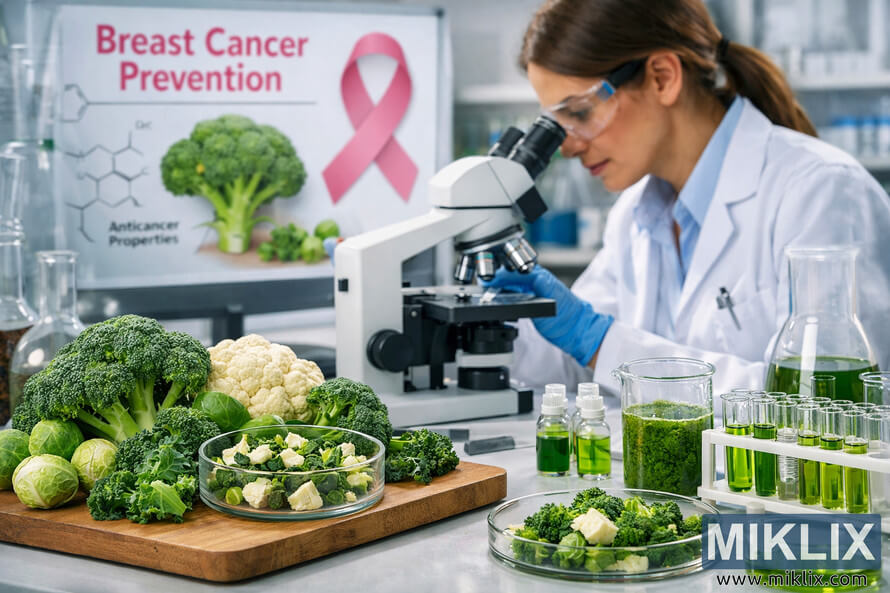
A detailed laboratory scene showing breast cancer prevention research focused on cruciferous vegetables. Fresh broccoli, cauliflower, Brussels sprouts, and kale are arranged on a cutting board beside green plant extracts in test tubes and beakers. A scientist in protective gear studies samples under a microscope, while a computer screen displays breast cancer cells and a pink ribbon symbol. A whiteboard labeled "Breast Cancer Prevention" highlights molecular structures and a broccoli diagram with anticancer properties, illustrating the connection between nutrition, biochemistry, and breast health.
Breast Cancer Prevention Research with Cruciferous Vegetables in a Modern Laboratory
Versi yang tersedia dari gambar ini
File gambar yang tersedia untuk diunduh di bawah ini tidak terlalu terkompresi dan beresolusi lebih tinggi - dan sebagai hasilnya, kualitasnya lebih tinggi - daripada gambar yang disematkan pada artikel dan halaman di situs web ini, yang lebih dioptimalkan untuk ukuran file guna mengurangi konsumsi bandwidth.
Ukuran biasa (1,536 x 1,024)
Ukuran besar (3,072 x 2,048)
Ukurannya sangat besar (4,608 x 3,072)
Ukuran ekstra besar (6,144 x 4,096)
Ukuran besar secara komik (1,048,576 x 699,051)
- Masih mengunggah... ;-)
Deskripsi gambar
The image depicts a bright, meticulously organized biomedical research laboratory dedicated to exploring the relationship between cruciferous vegetables and breast cancer prevention. The overall atmosphere is clean, professional, and hopeful, with a strong emphasis on scientific rigor and the potential of nutrition-based strategies to reduce cancer risk.
In the foreground, on the left side of the frame, a sturdy wooden cutting board rests on a smooth white laboratory bench. On this cutting board lies an abundant assortment of fresh cruciferous vegetables, carefully arranged to showcase their variety and vibrancy. There are compact heads of broccoli with tightly clustered florets, a pale, rounded cauliflower with textured curds, several small Brussels sprouts with layered green leaves, and dark, curly kale leaves fanning outward. The vegetables appear freshly washed, with a slight sheen that suggests moisture and freshness, emphasizing their natural, wholesome qualities.
Near the center of the cutting board, a clear glass Petri dish contains finely chopped pieces of broccoli and cauliflower. The small, uniform fragments indicate that these samples are prepared for detailed analysis, perhaps to isolate specific compounds believed to have anticancer properties. The Petri dish sits slightly off-center, bridging the visual space between the raw vegetables and the more technical laboratory equipment to the right, symbolizing the transition from everyday food to scientific investigation.
To the right of the cutting board, several pieces of laboratory glassware and containers form a cluster of research tools. Two small bottles, each filled with a vivid green liquid, stand upright, their contents suggesting concentrated extracts derived from cruciferous vegetables. Next to them, a glass beaker holds a larger volume of similarly green solution, hinting at ongoing experiments involving the measurement, dilution, or testing of these plant-based compounds. A test tube rack holds multiple test tubes, each containing green liquids of slightly varying shades, implying different concentrations, formulations, or stages of experimentation. The repetition of green tones visually reinforces the connection between the vegetables and the biochemical substances being studied.
On the right side of the image, a compound microscope occupies a prominent position on the laboratory bench. Its eyepieces are angled toward the center of the scene, and the body of the microscope is oriented in such a way that it appears ready for immediate use. The microscope’s presence underscores the importance of cellular-level analysis in understanding how compounds from cruciferous vegetables might influence breast cancer cells, signaling a bridge between nutrition and molecular biology. In the lower right corner, a shallow glass dish contains additional samples of broccoli and kale, arranged neatly to suggest that they are either awaiting examination or have already been part of a series of tests.
In the middle ground, a female scientist with light skin is the central human figure in the composition. She is dressed in a crisp white lab coat, which contrasts with the colorful vegetables and green solutions around her. She wears blue latex gloves, emphasizing sterile technique and careful handling of samples, and protective safety goggles that cover her eyes, reflecting standard laboratory safety protocols. Her posture is focused and intent: she leans slightly forward, looking through the microscope as she examines a sample. Her expression, though partially obscured by the goggles, conveys concentration and dedication, suggesting that she is deeply engaged in the process of discovery.
To the left of the scientist, a transparent board or glass panel displays molecular models and chemical structures. These diagrams, drawn in fine lines, represent the complex biochemical pathways and compounds under investigation. Among the structures, there are stylized representations of molecules that may correspond to phytochemicals found in cruciferous vegetables, such as isothiocyanates or other bioactive components. The presence of these molecular illustrations reinforces the idea that the research is grounded in detailed chemical analysis, not just observational studies.
In the background, a computer monitor adds another layer of scientific context. On the screen, an image of breast cancer cells is displayed, rendered in vivid detail to highlight their morphology. Surrounding the cells is a prominent pink ribbon symbol, widely recognized as an emblem of breast cancer awareness and solidarity. The combination of microscopic imagery and the ribbon suggests that this laboratory is not only focused on scientific understanding but also aligned with broader public health efforts to prevent and fight breast cancer.
To the left of the monitor, a whiteboard provides textual and visual information that ties the scene together. At the top, in bold pink letters, the phrase "Breast Cancer Prevention" is written, making the purpose of the research explicit. Beneath this heading, there are additional molecular structures and a diagram of a broccoli plant. The broccoli illustration is accompanied by a label indicating "Anticancer Properties," visually linking the vegetable to its potential protective effects. This whiteboard serves as a conceptual map, summarizing the research focus and highlighting the hypothesis that compounds in cruciferous vegetables may help reduce the risk or progression of breast cancer.
Further in the background, more laboratory glassware is visible, including flasks, beakers, and additional test tube racks. Another microscope can be seen to the right, suggesting that this is a well-equipped facility where multiple experiments may be conducted simultaneously. The arrangement of equipment is orderly, conveying a sense of professionalism and systematic inquiry. The bright, even lighting throughout the scene ensures that every detail—from the texture of the vegetables to the fine lines of the molecular diagrams—is clearly visible, reinforcing the clarity and transparency associated with rigorous scientific research.
Overall, the image weaves together elements of nutrition, chemistry, and medical science to tell a cohesive story about breast cancer prevention research. The cruciferous vegetables in the foreground symbolize accessible, everyday foods that may hold powerful health benefits. The green extracts and test tubes represent the transformation of these foods into measurable, analyzable substances. The scientist at the microscope embodies human curiosity and expertise, while the molecular diagrams, computer imagery of cancer cells, and breast cancer awareness ribbon connect the laboratory work to a larger mission: understanding how dietary choices might contribute to reducing the burden of breast cancer. The composition balances hope and seriousness, suggesting that through careful study of natural foods like broccoli, cauliflower, Brussels sprouts, and kale, researchers may uncover new strategies to support breast health and prevent disease.
Gambar terkait dengan: Collard Greens: The Leafy Green Your Diet Is Missing