
이미지: Quince Tree Branch Heavily Infested with Scale Insects
게시됨:
마지막으로 업데이트되었습니다: 2026년 3월 5일 오후 9시 48분 4초 UTC
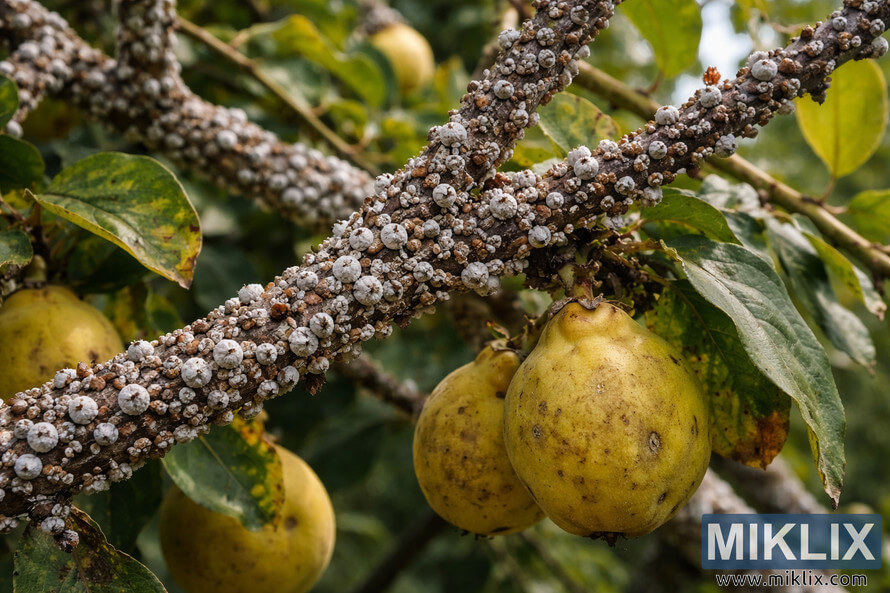
Detailed landscape photograph of a quince tree branch severely infested with scale insects, showing waxy white clusters on bark, yellowing leaves, and ripening quinces.
Quince Tree Branch Heavily Infested with Scale Insects
이 이미지의 사용 가능한 버전
아래에서 다운로드할 수 있는 이미지 파일은 이 웹사이트의 기사 및 페이지에 삽입된 이미지보다 압축률이 낮고 해상도가 높으며, 대역폭 소비를 줄이기 위해 파일 크기에 더 최적화되어 있어 품질이 더 높습니다.
일반 사이즈 (1,536 x 1,024)
대형 사이즈 (3,072 x 2,048)
매우 큰 크기 (4,608 x 3,072)
초대형 사이즈 (6,144 x 4,096)
코믹하게 큰 사이즈 (1,048,576 x 699,051)
- 아직 업로드 중... ;-)
이미지 설명
This high-resolution landscape photograph captures a quince tree branch severely infested with scale insects, presented in sharp, vivid detail. The main branch runs diagonally across the frame from the upper left toward the lower right, dominating the composition. Its bark is almost entirely encrusted with dense clusters of scale insects, which appear as small, rounded, waxy nodules tightly packed together. These insects vary slightly in size and coloration, ranging from pale gray to off-white, with some showing subtle brownish tones. Their textured, shell-like coverings create a rough, uneven surface that nearly obscures the natural bark beneath.
The infestation is extensive and clearly advanced. The scale insects cling in thick colonies along the branch and smaller offshoots, forming continuous patches rather than isolated spots. Some areas appear dusted with a faint white residue, suggesting the waxy secretions typically associated with these pests. The bark’s original brown coloration is visible only in small gaps between the insects, emphasizing how thoroughly the branch has been overtaken.
Beneath and around the infested branch, several ripe quinces hang prominently in the foreground. The fruits are large and rounded with slightly irregular contours, their skins a rich yellow with natural blemishes and small dark speckles. Their weight gently pulls them downward, and they are attached by short, sturdy stems. The surface of the quinces appears matte and slightly textured, contrasting with the crusted, granular look of the insect-covered wood above.
The surrounding leaves are dark green but show visible signs of stress. Some leaves display yellowing along the edges and faint mottling across their surfaces. A few are slightly curled or spotted, indicating damage consistent with sap-sucking pests. The veins of the leaves are clearly defined, and subtle variations in green tones add depth to the foliage.
In the softly blurred background, more branches and foliage are visible, creating a natural orchard setting. The shallow depth of field keeps the viewer’s focus on the heavily infested branch and the hanging fruit, while the background remains gently out of focus. Natural daylight illuminates the scene evenly, highlighting the textures of the insects, the rough bark, and the smooth fruit. Overall, the image conveys both the vitality of the fruiting quince tree and the serious impact of a scale insect infestation, emphasizing the contrast between productive growth and destructive pest activity.
이 이미지는 다음과 관련이 있습니다: Complete Guide to Growing Your Own Quince Trees