
Зураг: Rustic Brewing Scene with Fresh Green Hop Cones
Нийтэлсэн:
Хамгийн сүүлд шинэчлэгдсэн: 2026 оны долоодугаар сарын 23 17:58:36 (UTC)
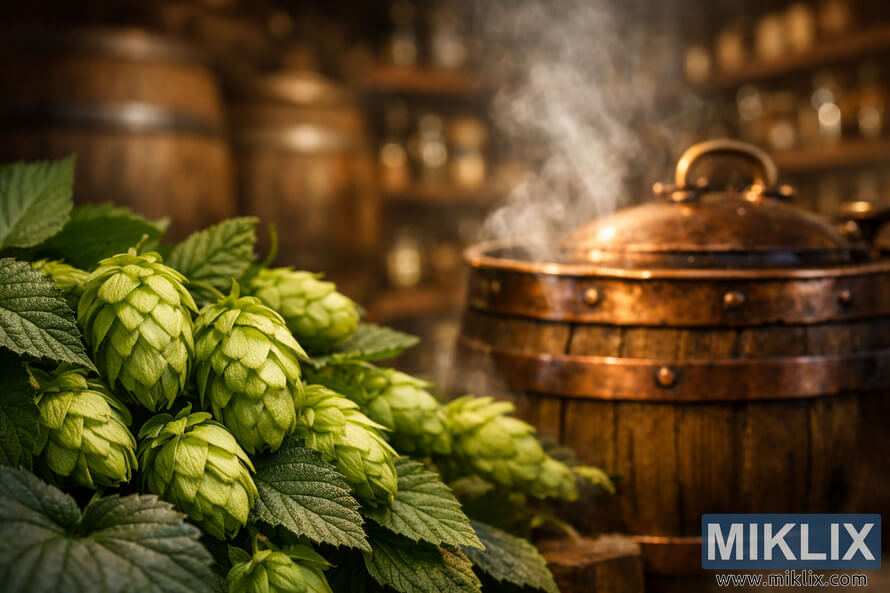
A warm, rustic brewing scene featuring fresh green hop cones in sharp focus, a steaming wooden and copper kettle, and softly blurred barrels and shelves of brewing supplies in the background, evoking craftsmanship, tradition, and the inviting atmosphere of a classic brewery.
Rustic Brewing Scene with Fresh Green Hop Cones
Энэ зургийн боломжтой хувилбарууд
Доор татаж авах боломжтой зургийн файлууд нь энэ вэбсайт дээрх нийтлэл, хуудсанд оруулсан зургуудаас бага шахагдсан, өндөр нягтралтай бөгөөд үүний үр дүнд чанар нь өндөр байдаг бөгөөд зурвасын өргөний хэрэглээг багасгахын тулд файлын хэмжээнд илүү оновчтой болгосон.
Ердийн хэмжээ (1,536 x 1,024)
Том хэмжээтэй (3,072 x 2,048)
Маш том хэмжээтэй (4,608 x 3,072)
Маш том хэмжээтэй (6,144 x 4,096)
Инээдмийн том хэмжээтэй (1,048,576 x 699,051)
- Байршуулалт хийсээр л байна... ;-)
Зургийн тайлбар
The image presents a richly detailed, close-up view into the world of traditional brewing, centered around freshly harvested hop cones and a rustic brewing environment. In the immediate foreground, occupying the left side of the composition, a cluster of vibrant green hop cones draws the viewer’s attention. Each cone is layered with overlapping scales, their tips slightly lighter in color, creating a subtle gradient from deep green at the base to a more delicate, almost yellow-green at the edges. The cones appear plump and full, suggesting peak freshness and readiness for use in brewing. Surrounding the hops are large, textured hop leaves, their serrated edges and pronounced veins adding a sense of organic complexity. These leaves extend from the lower left corner and curve gently around the cones, partially enveloping them and framing the central subject with lush greenery.
The lighting in the scene is warm and golden, casting a soft, inviting glow across the hops and leaves. Highlights catch on the edges of the scales and the ridges of the leaves, emphasizing their texture and three-dimensional form. Shadows fall gently into the recesses between the cones and beneath the foliage, creating depth without harsh contrast. This warm illumination suggests the cozy ambiance of a traditional brewery, where natural materials and handcrafted processes are celebrated. The overall color palette in the foreground is dominated by rich greens, but the warmth of the light introduces subtle hints of amber and gold, hinting at the transformation these hops will undergo in the brewing process.
Moving into the middle ground on the right side of the image, a rustic brewing kettle becomes visible. The kettle combines wooden and metal elements, with wooden staves bound by copper bands that encircle its body. The copper bands have a slightly aged patina, their reddish-brown tones catching the warm light and reflecting it in soft glints. Above the wooden body, a curved copper lid sits securely, adorned with a brass handle that arches gracefully over the top. The lid appears well-used, with faint marks and variations in tone that suggest years of service in the brewery. From a small opening or seam near the lid, wisps of steam rise gently into the air, curling and drifting upward. This steam provides a subtle but powerful visual cue that the brewing process is actively underway, connecting the fresh hops in the foreground with the transformation happening within the kettle.
The shallow depth of field used in the composition ensures that the hops remain the primary focal point. They are rendered in crisp detail, while the brewing kettle, though clearly recognizable, is slightly softened by the focus. This selective sharpness guides the viewer’s eye from the tactile, organic forms of the hops to the crafted, utilitarian shape of the kettle, reinforcing the relationship between raw ingredients and the brewing equipment that will shape them into beer. The steam rising from the kettle is also slightly blurred, giving it an ethereal quality that contrasts with the solid forms of the cones and leaves. Together, these elements evoke a sense of craftsmanship and tradition, suggesting a brewing environment where time-honored methods are still valued.
In the background, the scene transitions into a softly blurred brewery setting that further enriches the narrative without distracting from the main subjects. On the left side, wooden barrels are visible, their rounded forms stacked or arranged in a way that hints at storage and aging. The barrels are rendered with enough clarity to convey their material—wood with metal hoops—but remain out of focus, reinforcing their role as contextual elements rather than focal points. Beyond the barrels, shelves line the wall, stocked with glass jars, bottles, and various brewing supplies. These items are indistinct yet recognizable, suggesting a well-equipped brewery where ingredients, tools, and equipment are carefully organized. The shelves and barrels contribute to the sense of depth in the image, leading the viewer’s eye further into the space and implying that the brewery extends beyond the frame.
The warm, ambient lighting continues into the background, bathing the barrels and shelves in a gentle glow. This consistent lighting unifies the different layers of the composition—the foreground hops, the middle-ground kettle, and the background storage area—into a cohesive whole. Reflections on the copper surfaces of the kettle and the faint sheen on the wooden barrels hint at the interplay between light and material, adding subtle visual interest. The blurred background also helps to emphasize the intimacy of the foreground scene, making the viewer feel as though they are standing right next to the hops, close enough to reach out and touch them.
Overall, the image conveys an inviting and rustic mood, perfectly suited to illustrating the essence of brewing with fresh hops. The close-up perspective celebrates the natural beauty of the hop cones, highlighting their vibrant color and intricate structure. The presence of the steaming kettle in the middle ground connects these raw ingredients to the brewing process, while the barrels and shelves in the background suggest a broader context of storage, aging, and preparation. The shallow depth of field, warm lighting, and carefully arranged elements work together to evoke a sense of tradition, craftsmanship, and care. This is not a sterile, industrial environment, but rather a place where brewing is treated as an art, where each ingredient is respected and each step in the process is carried out with attention and pride.
The composition’s balance between organic and crafted forms—between the living hops and the man-made kettle and barrels—underscores the harmonious relationship between nature and human skill in brewing. The viewer is invited to appreciate both the raw materials and the tools that transform them, and to imagine the aromas, flavors, and experiences that will emerge from this scene. In this way, the image serves as a visual celebration of brewing tradition, capturing a moment where fresh hops, warm light, and rustic equipment come together to tell a story of dedication, heritage, and the timeless appeal of well-crafted beer.
Зураг нь дараахтай холбоотой: Hops in Beer Brewing: Pilgrim