
Imagem: Dandelion Nutrition Facts Infographic
Publicado:
Última atualização: 22 de maio de 2026 às 18:03:22 UTC
Explore the nutritional benefits of dandelion leaves with this detailed infographic highlighting vitamins, minerals, antioxidants, and fiber content per 100g.
Dandelion Nutrition Facts Infographic
Versões disponíveis desta imagem
Os arquivos de imagem disponíveis para download abaixo são menos compactados e de maior resolução - e, como resultado, de maior qualidade - do que as imagens incorporadas em artigos e páginas deste site, que são mais otimizadas para o tamanho do arquivo a fim de reduzir o consumo de largura de banda.
Tamanho normal (1,536 x 1,024)
Tamanho grande (3,072 x 2,048)
Tamanho muito grande (4,608 x 3,072)
Tamanho extragrande (6,144 x 4,096)
Tamanho comicamente grande (1,048,576 x 699,051)
- Ainda estou fazendo o upload... ;-)
Descrição da imagem
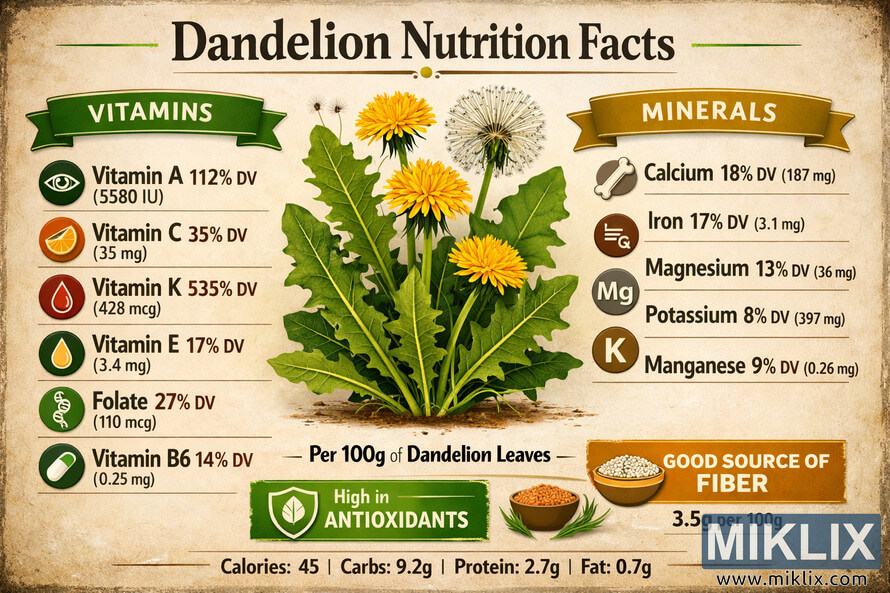
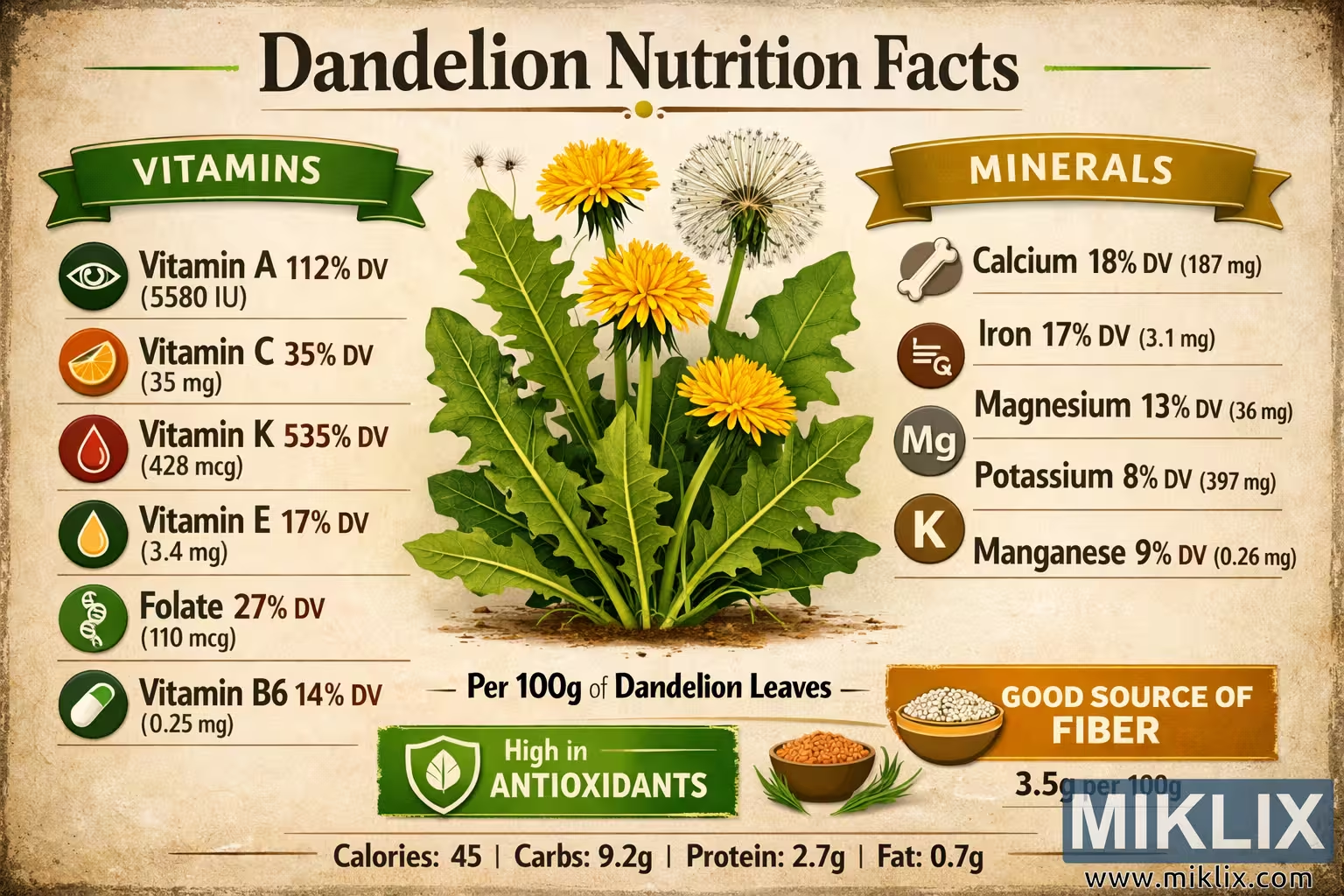
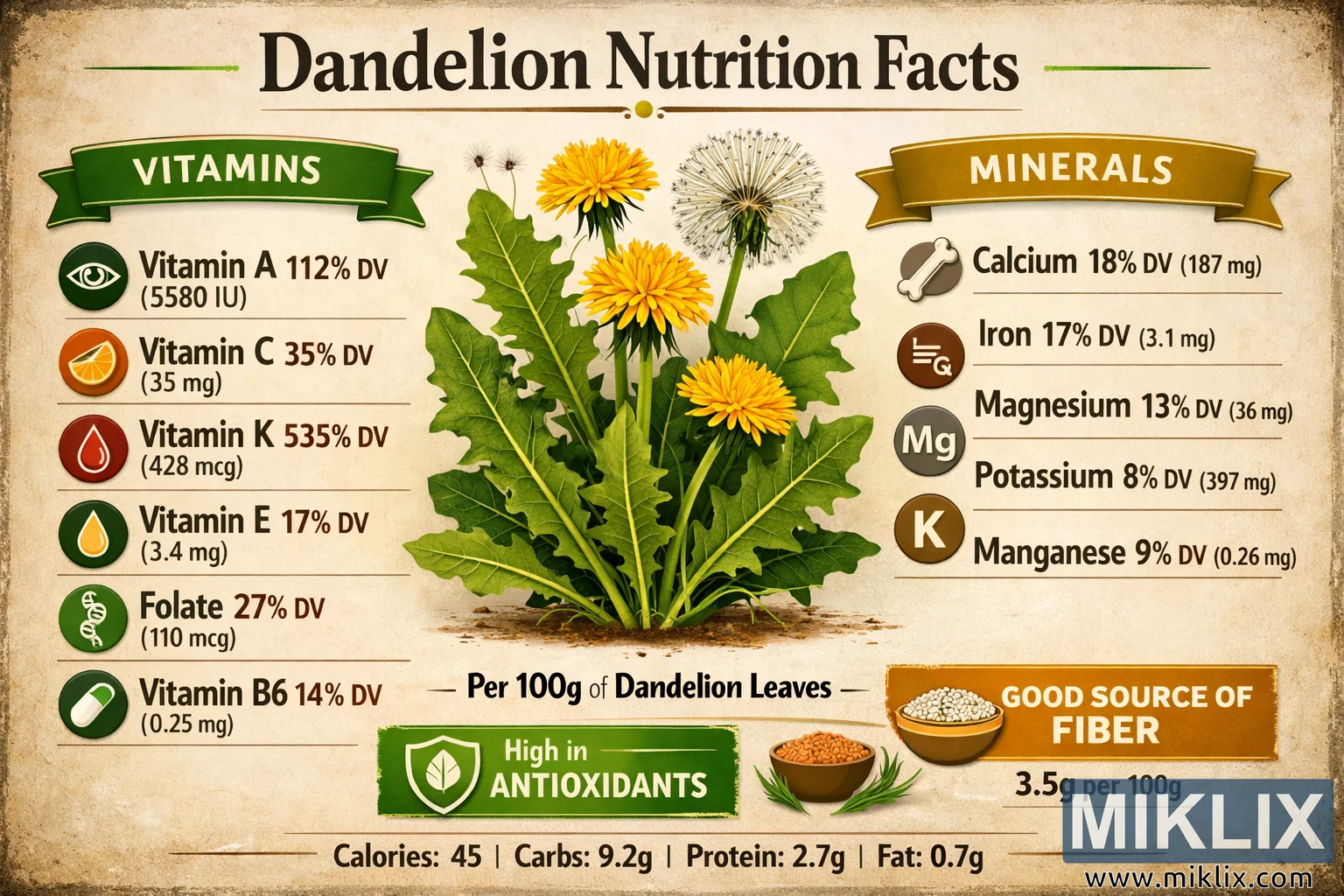
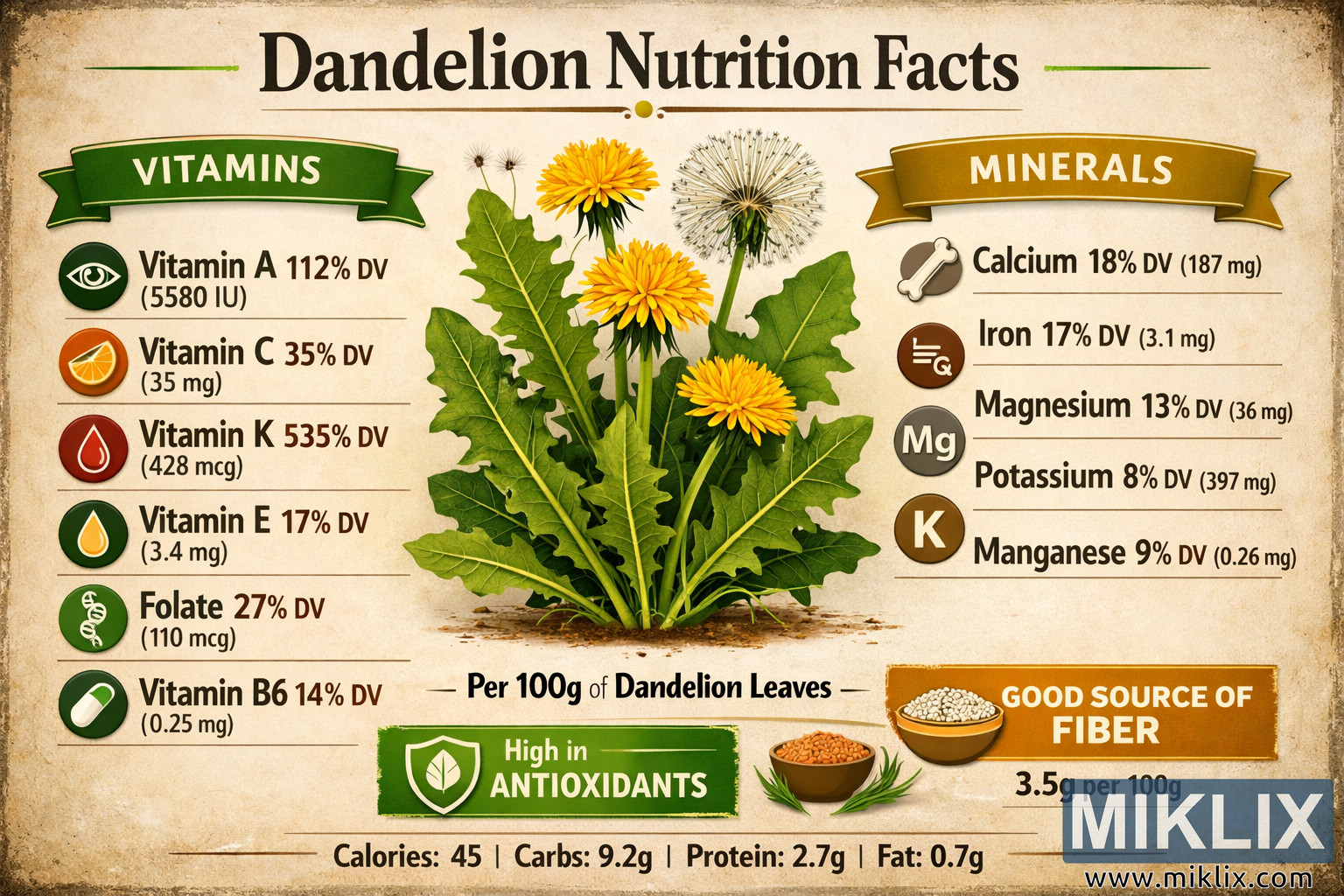
This detailed infographic titled "Dandelion Nutrition Facts" presents a comprehensive nutritional breakdown of dandelion leaves, emphasizing their rich vitamin and mineral content. The design features a central illustration of fresh green dandelion leaves accompanied by bright yellow flowers and a delicate seed head, symbolizing the plant’s natural vitality. Beneath the illustration, the text "Per 100g of Dandelion Leaves" introduces the data sections.
On the left side, a green banner labeled "VITAMINS" lists essential vitamins with corresponding icons and daily value percentages. Vitamin A (112% DV, 5580 IU) is represented with an eye icon, highlighting its role in vision health. Vitamin C (35% DV, 35 mg) appears with an orange slice icon, symbolizing immune support. Vitamin K (535% DV, 428 mcg) is paired with a blood drop icon, referencing its importance in blood clotting. Vitamin E (17% DV, 3.4 mg) is shown with a droplet icon, denoting antioxidant properties. Folate (27% DV, 110 mcg) features a DNA helix icon, and Vitamin B6 (14% DV, 0.25 mg) includes a capsule icon, both representing metabolic and cellular functions.
On the right side, a golden banner titled "MINERALS" lists key minerals with distinctive icons. Calcium (18% DV, 187 mg) is illustrated with a bone icon, Iron (17% DV, 3.1 mg) with an atom symbol, Magnesium (13% DV, 36 mg) with an Mg symbol, Potassium (8% DV, 397 mg) with a K symbol, and Manganese (9% DV, 0.26 mg) with an atomic structure icon. Each nutrient is clearly labeled with its daily value percentage and amount per 100 grams, making the chart both informative and visually engaging.
At the bottom, two highlighted sections provide additional insights. The left green box reads "High in ANTIOXIDANTS" with a shield-and-leaf icon, emphasizing the plant’s protective compounds. The right orange box states "GOOD SOURCE OF FIBER" with a bowl of grains icon, noting 3.5g of fiber per 100g. Below these, a beige banner summarizes macronutrients: Calories 45, Carbs 9.2g, Protein 2.7g, and Fat 0.7g.
The overall aesthetic combines earthy tones, parchment-like textures, and balanced typography to evoke a natural, wholesome feel. The layout is symmetrical, with green and golden color schemes distinguishing vitamins from minerals. The infographic effectively communicates that dandelion leaves are nutrient-dense, antioxidant-rich, and beneficial for overall health, offering a visually appealing and scientifically grounded overview of their nutritional profile.
A imagem está relacionada a: A Guide to the Health Benefits of Dandelions