
Hops in Beer Brewing: Bate's Brewer
Publicado:
Última atualização: 10 de julho de 2026 às 16:26:34 UTC
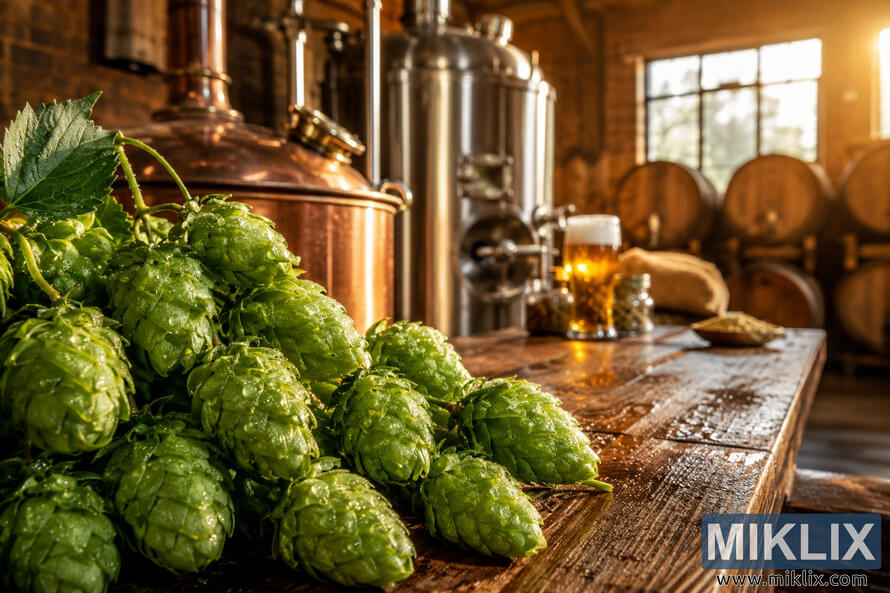
Bate’s Brewer hops are making waves in craft brewing for their bright, versatile profile. This introduction highlights why brewing with Bate’s Brewer is crucial for brewpubs, homebrewers, and professionals. It's about crafting hop-forward beers with unique aroma and balanced bitterness.
Hops in Beer Brewing: Bate's Brewer
Clique ou toque na imagem para obter mais informações e resoluções mais elevadas.
This guide offers practical advice on the Bate’s Brewer hop variety. You'll learn about alpha acid ranges, essential oil notes, and how to design recipes. It also covers dry hopping techniques. Expect clear, actionable steps to incorporate Bate’s Brewer hops into various beer styles.
Whether you're refining an IPA recipe or experimenting with a saison, this guide has you covered. It delves into the variety's origin, processing, storage, yeast interactions, and advanced methods. These highlight Bate’s Brewer's strengths in hop-forward beers.
Key Takeaways
- Bate’s Brewer hops deliver a bright, versatile aroma suited to American pale ales and IPAs.
- Brewing with Bate’s Brewer requires attention to alpha acids and aroma-preserving additions.
- The variety adapts well to dry hopping and whirlpool schedules for pronounced hop character.
- Proper storage and handling preserve hop oils that define Bate’s Brewer hop variety.
- This guide targets practical recipe design and techniques for craft brewing hops users.
Introduction to Bate’s Brewer hops and their brewing potential
Bate’s Brewer offers brewers a unique hop signature. It emerged from regional trials and small-scale releases. Its versatility allows for bright top-note aromas or subtle background complexities.
Brief history and origin
The Pacific Northwest is where Bate’s Brewer hops were bred. Experimental programs in Washington and Oregon focused on disease resistance and aroma. The hops' origin involves university trials, grower test plots in Yakima Valley, and limited plantings by specialty nurseries.
Proprietary selections often reach craft brewers through regional seed stocks and small-release offerings from established growers.
Overview of typical aroma and flavor profile
The hop aroma profile is centered on bright citrus and stone fruit. It also includes floral and light tropical notes. Resinous pine and faint spice add a balanced lift without overpowering malt.
When used late in the boil or in whirlpool additions, Bate’s Brewer produces a clear, fresh top-note aroma. In smaller doses or earlier additions, it adds a background complexity that supports layered recipes.
Why craft brewers are exploring this variety
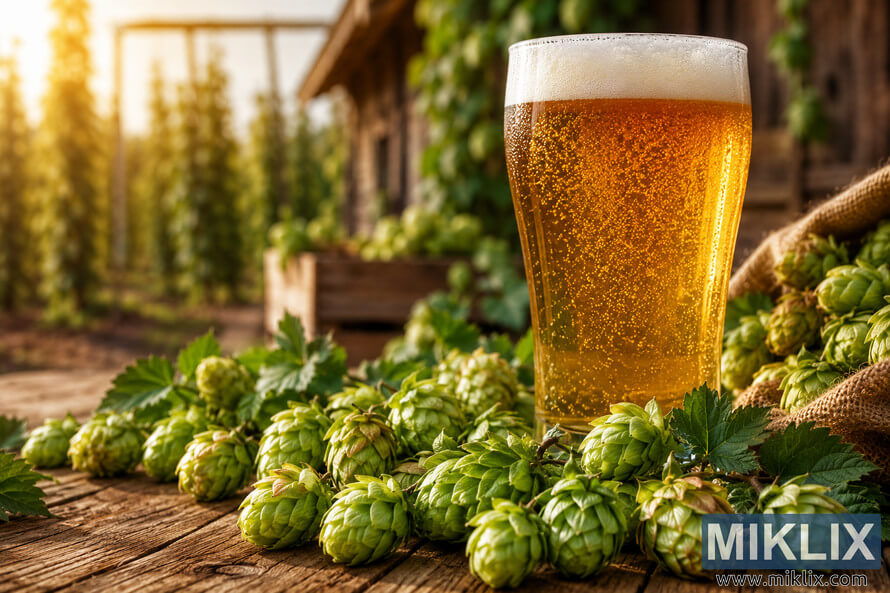
Brewers are drawn to Bate’s Brewer for its differentiation and versatility. It's used to create signature pale ales and IPAs that stand out. Its unique compounds allow brewers to experiment across various styles.
Limited releases and seasonal batches using this hop can drive interest and repeat visits from loyal customers.
Clique ou toque na imagem para obter mais informações e resoluções mais elevadas.
Key characteristics of Bate’s Brewer hops
Bate’s Brewer offers a blend of dependable bittering and vibrant aroma, making it versatile across various beer styles. Its characteristics can vary with growing conditions and from year to year. Brewers should anticipate ranges rather than exact figures when crafting recipes.
The alpha acids in Bate’s Brewer typically fall within a low-to-medium range. Values usually range from 5% to 10%, with occasional fluctuations due to terroir and harvest timing. This range impacts IBU calculations. Due to its low alpha content, brewers may need to use higher additions or combine it with a high-alpha hop to achieve desired IBUs.
Beta acids in Bate’s Brewer are generally lower than alpha acids and can vary with handling. Although beta acids do not isomerize like alpha acids during boiling, they contribute to the hop's aroma stability and perceived bitterness over time. It's beneficial to record batch lab numbers to refine bittering calculations.
The hop oil profile is a key factor in Bate’s Brewer's appeal. It includes myrcene, humulene, caryophyllene, and smaller amounts of linalool or geraniol. Myrcene contributes a resinous, green aroma, while humulene adds a woody, earthy depth. Caryophyllene brings a spicy bite. Floral and fruity notes from linalool or geraniol emerge in late and dry-hop additions.
Oil percentages can change with hop form and age. Pellet processing can release bound oils, altering the hop oil profile. Fresh whole cones often showcase volatile terpenes more vividly. Tracking oil reports helps predict aroma outcomes for a given batch.
Typical hop bitterness usage rates for Bate’s Brewer depend on alpha strength and desired IBUs. For bittering, brewers often use 0.25–0.75 oz per gallon early in the boil when alpha is in the 5–10% range. For cleaner, higher IBUs, pair Bate’s Brewer with a 12–15% alpha bittering hop and reduce overall volume.
For flavor and late additions, target 0.5–1.5 oz per gallon late in the boil or whirlpool to capture the hop oil profile without excessive vegetal notes. Dry-hop rates for homebrew scale range from 0.5–2 oz per gallon, depending on intensity goals. For commercial-scale brews, adjust doses downward using weight-to-volume conversion.
Remember that utilization curves change with boil time and wort gravity. Longer boils extract more alpha acids up to standard utilization limits. High-original-gravity worts lower utilization. Use measured Bate’s Brewer alpha acids in IBU calculators and tweak additions based on sensory feedback from pilot batches.
Clique ou toque na imagem para obter mais informações e resoluções mais elevadas.
Comparing Bate’s Brewer hops to other popular hop varieties
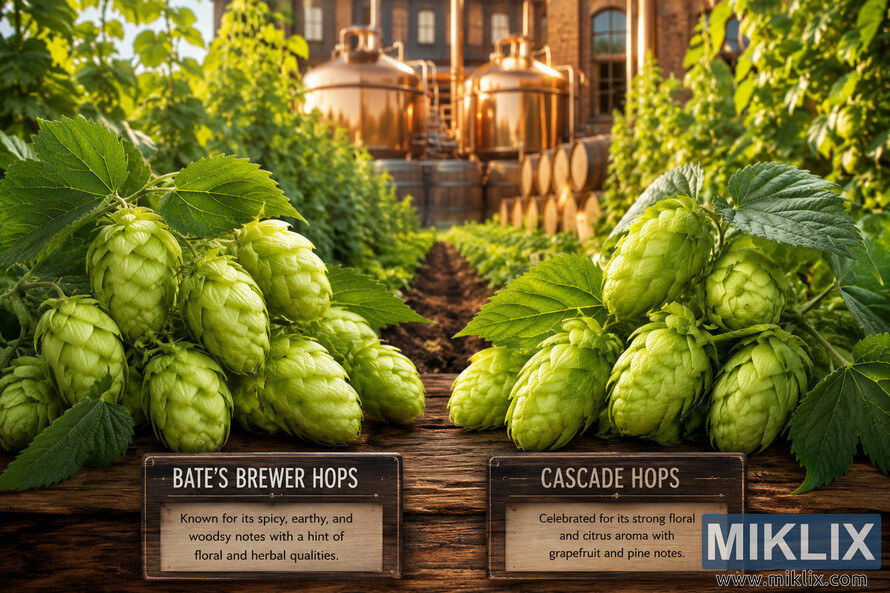
Bate’s Brewer hops find a balance between traditional American hops and the newer, fruitier varieties. It offers a blend of citrus, subtle spice, and herbal notes. This makes it ideal for adding depth without overpowering the malt or yeast.
Here are some key differences to guide your hop selection.
- Flavor and aroma contrasts with Cascade and Citra
- Bate’s Brewer vs Cascade: Cascade boasts floral and bright grapefruit notes. Bate’s Brewer, on the other hand, provides softer citrus with a hint of pepper and herbal green. It's perfect for those seeking citrus without the sharpness of Cascade.
- Bate’s Brewer vs Citra: Citra is known for its intense tropical fruit, lime, and orange peel flavors. Bate’s Brewer offers more restrained citrus and a herbal-spice base. Combining both can enhance tropical notes and add complexity.
- When to choose Bate’s Brewer over traditional bittering hops
- Use Bate’s Brewer for flavor or aroma hops in recipes needing distinctive top notes. It excels in late kettle additions, whirlpool, and dry hop applications. For straightforward bitterness, high-alpha varieties like Nugget or Warrior are better for hitting IBUs. Then, add Bate’s Brewer late to highlight its qualities.
- Choose Bate’s Brewer for balanced IPAs, pale ales, and saisons where aroma is key, not just bitterness.
- Pairing Bate’s Brewer with complementary hop varieties
- Good hop pairing ideas:
- Pair with Citra or Mosaic to enhance tropical and stone-fruit flavors while keeping citrus balanced.
- Pair with Cascade or Centennial for a classic American citrus backbone that complements Bate’s Brewer’s herbal side.
- Pair with Saaz or Styrian Golding in farmhouse or Belgian styles to soften citrus and emphasize spice and earth.
- Select pairings based on shared terpenes and contrasting esters. This strategy highlights the best qualities and adds depth without muddiness.
- Good hop pairing ideas:
Clique ou toque na imagem para obter mais informações e resoluções mais elevadas.
Best beer styles to brew with Bate’s Brewer hops
Bate’s Brewer is versatile, fitting into various beer styles. Its herbal, citrus, and mild spice notes can take center stage or support other flavors. Below, we outline practical style suggestions and target ranges for both home and craft brewers.
American pale ale and IPA
- Make Bate’s Brewer the late-boil, whirlpool, or dry-hop star in single-hop pale ales. Aim for an original gravity (OG) around 1.045–1.055 and IBUs near 40–50 for balanced, drinkable hop clarity. For a Bate’s Brewer pale ale, focus on late additions to highlight aroma without harsh bitterness.
- For a bold Bate’s Brewer IPA, push OG to 1.060–1.070 and IBUs to 50–70+. Use early bittering hops sparingly and reserve most hopping for whirlpool and dry-hop. This lets the hop’s floral and herbal notes dominate the finish.
Experimenting with saison, farmhouse, and Belgian styles
- Saison yeast brings peppery and fruity esters. Add restrained hopping so yeast remains central. Low to moderate dry-hop can lift a saison with Bate’s Brewer while keeping yeast character intact.
- Target lower bitterness and lighter hopping rates. A saison with Bate’s Brewer benefits from subtle herbal complexity that complements spicy phenolics from traditional French and Belgian strains.
Malt-forward styles that benefit from subtle hop complexity
- Amber ales, brown ales, and English-style beers gain depth from small Bate’s Brewer additions. Keep addition rates low and favor late aroma touches to avoid masking malt sweetness and caramel notes.
- Use timing to add interest rather than intensity. A gentle dry-hop or short whirlpool contact gives complexity without turning the beer hop-forward.
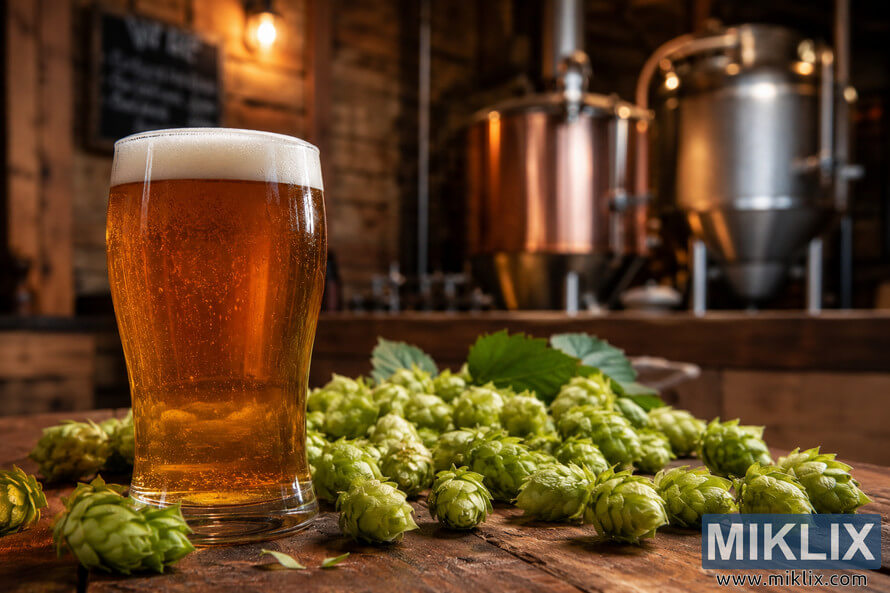
Clique ou toque na imagem para obter mais informações e resoluções mais elevadas.
How to design a recipe around Bate’s Brewer hops
Starting a recipe with Bate’s Brewer hops requires a clear vision. Determine if the hops should dominate with their aroma or complement the malt. The choice of malt and bitterness levels will shape the hop's role and the beer's style.
Balancing malt backbone and hop presence
Ensure the malt's sweetness matches the hop's intensity to avoid conflict. For beers emphasizing hops, opt for lighter malts like Pilsner, American Pale, or Vienna. This keeps the beer's character clean and focused.
In malt-centric styles, richer malts such as Maris Otter or Munich are ideal. They add depth with caramel and bready notes, enhancing Bate’s Brewer without overpowering it.
Consider the beer's mouthfeel and attenuation. Higher final gravities can soften bitterness, allowing the hop aroma to stand out. Dextrins or oats can be added for a fuller body when desired.
Suggested grain bills for different beer styles
Grain bill frameworks are essential for turning recipe ideas into reality. Below are examples to get you started, adaptable to your efficiency and desired color.
- American Pale Ale: 90% pale malt, 5% crystal 10L, 5% wheat. This combination supports a light profile, making Bate’s Brewer's aroma more pronounced.
- IPA: 85% pale malt, 7% crystal 20–40L, 8% dextrine malt or rolled oats for body and head retention.
- Saison: Pilsner base 95% with 5% Vienna. This combination ensures a lean body and dry finish, perfect for showcasing Bate’s Brewer's bright, spicy notes.
- Amber Ale: Pale malt base with 10–15% crystal 60–80L. The toasted-sweet malt complements Bate’s Brewer's fruitier edges.
Adjust specialty grain percentages for color and residual sweetness. Choose between a single-step infusion or step mash based on enzyme needs and desired attenuation.
Adjusting IBU targets for desired bitterness
Set IBU targets based on the hop schedule and desired bitterness. IBU for Bate’s Brewer varies by style and late-hop intensity.
- American Pale Ale: 30–40 IBU. This range maintains a balance between malt and hops, preserving the aroma.
- IPA: 45–65 IBU. Higher IBUs are suitable if the beer will be hop-bitter rather than hop-aromatic.
- Saison: 20–30 IBU. Lower bitterness supports the dry, spicy yeast character and late hopping.
- Amber Ale: 25–35 IBU. Moderate bitterness tames malt sweetness, allowing hop nuances to emerge.
Choose lower IBU targets for aggressive late additions or heavy dry hopping. Higher IBUs are better for early boil additions that define bitterness.
Remember, mash efficiency and boil utilization impact hop utilization and final IBU. Adjust calculations for your system and test batches if possible.
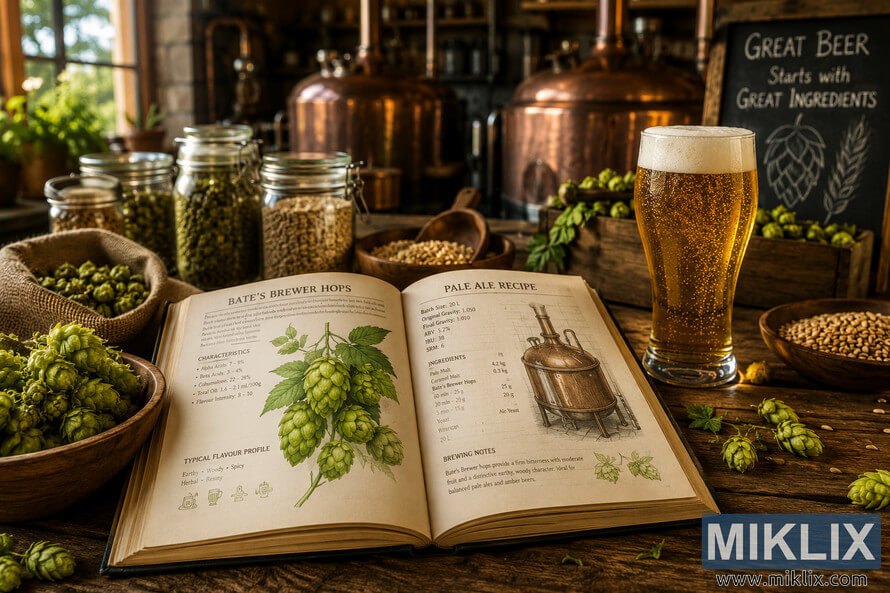
Clique ou toque na imagem para obter mais informações e resoluções mais elevadas.
Hop schedule strategies for Bate’s Brewer hops
Bate’s Brewer benefits from a well-planned hop schedule. It ensures bright top notes without harsh bitterness. Below, find practical schedules for bittering, flavor, aroma, whirlpool work, and dry hopping. Follow these steps to enhance the variety's best qualities.
- Bittering, flavor, and aroma additions
- 60-minute addition: use for base IBUs. If Bate’s Brewer shows low alpha acids, pair it with a high-alpha bittering hop such as Magnum or Warrior for predictable IBUs.
- 15–20 minute addition: targets flavor compounds without losing all volatile oils. This slot gives a rounded midrange hop character.
- 5–0 minute additions: reserve these for bright, volatile aromatics. A 5-minute flameout plus a short hop stand will preserve delicate citrus and floral notes.
- Late additions and whirlpool schedules to preserve aroma
- whirlpool hop schedule: perform a whirlpool or hop stand at 170–180°F (76–82°C) for 10–30 minutes. That range extracts essential oils while limiting isomerization.
- For intense top notes, split late additions between flameout and a short whirlpool. Steep times of 15–30 minutes often capture subtle citrus and herbal facets.
- Keep the kettle covered during the hop stand to retain volatile aromatics. Use hop bags or a hop strainer to simplify removal and reduce solids transfer to fermenters.
- Dry hopping timing and dosing for maximum impact
- Timing: start dry hopping when primary fermentation nears completion, within 2–4 gravity points of the final gravity. This reduces loss of aroma to CO2 blowoff.
- Dosing (homebrew): 0.5–2 oz per gallon, depending on desired intensity. Commercial brewers scale proportionally by batch size and target aroma.
- Contact time: 48–96 hours is typical at cellar temps. For low-temperature dry hops, extend to 7–10 days while watching for vegetal extraction.
- Technique: split or double dry-hop additions to layer complexity. A small early charge followed by a larger finishing addition builds depth without overpowering the beer.
Use this Bate’s Brewer hop schedule as a starting template. Tweak additions, whirlpool times, and dry-hop doses to match your recipe, yeast strain, and fermentation profile. Small adjustments yield big gains in aroma clarity and flavor balance.
Using Bate’s Brewer hops in different brewing methods
Bate’s Brewer hops are versatile across various brewing methods. Small adjustments in mash, extract additions, and hop timing can enhance citrus, resin, and floral notes. These adjustments help brewers transition from all-grain systems to simple kit builds, preserving the hop's essence.
- Target mash temperatures of 148–152°F to balance body and attenuation. A slightly lower mash boosts fermentability, allowing the hop profile to shine in a Bate’s Brewer all-grain beer.
- Adjust the grain bill to avoid heavy dextrins. Use a pale malt base with small amounts of Munich or Vienna for subtle malt support without masking hops.
- Expect different hop utilization in larger kettles. Strong wort clarity improves whirlpool aroma extraction for Bate’s Brewer. Increase whirlpool contact time when kettle volume dilutes hop intensity.
Extract and partial mash adaptations
- When extract brewing with Bate’s Brewer, emphasize late hop additions. Additions at flameout and a 20–30 minute whirlpool capture bright oils lacking from extract wort.
- Steep specialty malts—such as crystal 10–20L or a touch of Munich—to mimic all-grain complexity. These malts improve mouthfeel and enhance hop esters.
- Dry-hop aggressively in extract beers. Two rounds of dry-hopping at high krausen and post-fermentation offer layered aroma for extract brew with Bate’s Brewer.
Homebrew kit hops upgrade
- Simple swaps make a big difference. Replace kit hops with Bate’s Brewer for late and dry-hop stages to refresh a commercial kit with new aromatic character.
- Use hop bags, a whirlpool hop basket, or a hop sock to contain trub and simplify cleanup. These tools let you dose hops precisely during whirlpool and dry-hop.
- Adjust hop quantities upward when doing a homebrew kit hops upgrade. Kits often have higher gravity and larger volumes that can mute hop impact. Increase late and dry-hop rates by 20–40% to compensate.
Each method rewards attention to timing and dosage. Whether choosing Bate’s Brewer all-grain or making an extract brew with Bate’s Brewer, modest tweaks yield distinct results. A targeted homebrew kit hops upgrade brings craft-level aroma to ready-made kits without complex procedures.
Dry hopping techniques and best practices
Dry hopping can elevate hop aroma to prominence with careful execution. At Bate’s Brewer, slight adjustments in form and timing significantly alter outcomes. This guide offers insights on whole cone vs pellet, optimal cold soak timing, and strategies to sidestep hop vegetal flavors.
Whole-cone hops impart a softer, cleaner aroma and are simpler to remove at packaging. Pellets, with their higher surface area, release oils more swiftly. Bate’s Brewer in whole-cone form retains delicate volatile oils for longer, whereas pellets facilitate quicker extraction and a more pronounced nose. Opt for whole cones when utilizing inline filters or desiring minimal trub. Conversely, pellets are ideal for rapid aroma capture or in closed transfer systems.
Cold-side dry hopping is crucial for preserving fragile oils and minimizing polyphenol pull. For Bate’s Brewer, aim for a cold soak between 36–50°F. A typical contact time of 48–96 hours is recommended to maximize aroma without extending grassy notes. If warm dry hopping is unavoidable, shorten contact time to prevent excessive vegetal extraction and schedule additions closer to terminal gravity.
To prevent grassy or vegetal off-flavors, adhere to practical steps. Employ a clean yeast strain that has completed active fermentation. Add hops near or after terminal gravity to limit biotransformation, which can introduce green notes. Limit prolonged exposure by timing hop removal or kegging promptly.
- Use moderate doses rather than extreme amounts for long periods.
- Consider stainless mesh hop spiders or hop bags to reduce trub and ease removal.
- For pellet hops, allow a brief settling period before transfer to avoid clogging filters.
- Keep sanitation tight to prevent infections that can mask hop character.
When refining technique, track variables such as hop form, dose, temperature, and contact time. Record sensory changes across batches to refine the balance between aromatic lift and avoiding hop vegetal flavors. Thoughtful application of dry hopping Bate’s Brewer results in bright, clean hop character without unwanted green notes.
Processing and storage of Bate’s Brewer hops
Proper handling is key to keeping Bate’s Brewer hops fresh for brewing. It's important to control oxygen, light, and heat to slow down the loss of essential oils and alpha acids. Use airtight, opaque packaging with minimal headspace for both short- and long-term storage.
Proper storage to preserve oils and alpha acids
Store hops in a cold, dark place to preserve their aroma and bitterness. Refrigeration can extend the shelf life of pellets for months. Freezing can keep alpha acids usable for years. Use foil oxygen-barrier bags to block light and air for both pellets and whole cones.
Vacuum sealing and refrigeration guidance
Vacuum sealing is a great way to keep hops fresh for longer. Remove as much air as possible and seal in oxygen-barrier foil. Store in a refrigerator between 32–40°F or a freezer at 0°F for long-term preservation.
When moving hops from freezer to brew area, thaw in the sealed bag at fridge temperature. This prevents condensation on the hops. If you plan frequent access, portion hops into smaller sealed packs before freezing to avoid repeated temperature swings.
Signs of hop degradation and how to mitigate
Look out for signs of hop degradation: faded aroma, a papery or musty smell, darker color, and measurable drops in alpha acid or perceived bitterness. These signs indicate oils and acids have broken down.
- Use older hops for early bittering additions where aroma is less critical.
- Compensate aroma loss by increasing late or dry hop doses, but test small batches first.
- Buy from reputable suppliers like Yakima Chief or Hopsteiner and rotate stock FIFO to keep inventory fresh.
Good storage and hop vacuum sealing practices reduce waste and protect the unique character of Bate’s Brewer hops. Regular sensory checks and simple lab measures help you spot degradation early and adapt your recipe choices.
Yeast choices and fermentation profiles that complement Bate’s Brewer hops
Choosing the right yeast is crucial for showcasing Bate’s Brewer hops. The right strain can enhance citrus, spice, and floral notes, or introduce fruit and funk. This choice depends on whether you want the hops to dominate or have a dialogue with the yeast's complexity.
Neutral ale strains to showcase hop character
For a clean showcase, opt for a neutral ale yeast. Wyeast 1056, White Labs WLP001, and Safale US-05 are reliable options. These yeasts ferment cleanly, produce minimal esters, and let the hop aroma take center stage.
Consider the yeast's attenuation and flocculation. Moderate attenuation helps maintain body, ensuring hop oils are balanced. Low flocculation aids in clarity without sacrificing hop aroma.
Estery and phenolic yeasts for experimental pairings
- For a peppery, fruity twist, try Wyeast 3724 or White Labs WLP565 with Bate’s Brewer.
- Belgian ale yeasts, with their clove and banana notes, are perfect for when yeast and hops should converse.
- Brettanomyces adds wild, funky complexity to hop-forward beers, ideal for aged projects.
Use these yeasts with caution. Strong ester or phenolic profiles can overpower hop nuances if not balanced by recipe and fermentation control.
Fermentation temperature control and its effect on hop perception
Fermentation temperature significantly impacts hop perception. Warmer temperatures increase esters and fusels, enhancing fruitiness and softening bitterness. Cooler temperatures preserve hop clarity and crispness.
For neutral American ales, ferment at 64–68°F to maintain hop clarity. Belgian and saison strains benefit from 68–75°F to develop desired esters. Brett fermentations require warmer temperatures during active phases, then cool for conditioning.
- Monitor and record temperatures daily.
- Use temperature-stable environments or a controller for consistency.
- Consider diacetyl rest or ramping schedules only when needed for the chosen yeast.
Adjusting yeast selection and fermentation temperatures allows brewers to fine-tune how Bate’s Brewer hops are perceived in the final beer. Even small changes can significantly alter aroma, flavor, and perceived bitterness.
Water chemistry and mash pH considerations when using Bate’s Brewer hops
Mastering water chemistry with Bate’s Brewer enhances its bright, resinous flavors without harshness. Even slight changes in mineral balance and mash pH can significantly alter bitterness and hop aroma. It's crucial to have a detailed plan before scaling up a recipe.
When adjusting salts and acids, precision is key. Start by measuring your source water and calculating the necessary additions. Gradually tweak a single batch to observe how the beer evolves. Utilize brewing calculators and lab reports for accurate data.
Adjusting sulfate-to-chloride ratios for hop forward beers
To emphasize hops, increase the sulfate-to-chloride ratio. Aim for a ratio of 2:1 to 3:1 to achieve crisp, dry bitterness that highlights hop bite.
For beers that focus more on malt, aim for a lower ratio, around 1:1 or less. This softens bitterness and adds roundness. Typical additions for 5 gallons include 2–4 grams of gypsum and 1–3 grams of calcium chloride, based on your starting profile.
Mash pH targets to enhance hop brightness
Strive for a mash pH between 5.2 and 5.5 at room temperature. This range optimizes enzyme activity, making hop-derived aromas cleaner and more vibrant in the final beer.
Mash pH significantly impacts hop perception. Lower pH tends to enhance brightness, while higher pH can dull hop clarity.
Practical adjustments for municipal water supplies
First, test your municipal water. Use a local water report or a lab like Ward Laboratories for a comprehensive profile. Then, input these values into a brewing calculator, such as Bru'n Water or EZ Water, to predict changes.
- If alkalinity is high, dilute with reverse osmosis (RO) water or add phosphoric acid to lower mash pH.
- When chloride or sodium is low, add calcium chloride to bolster mouthfeel and roundness.
- When sulfate is low, add gypsum to lift perceived bitterness and dryness.
For extreme municipal hardness, rebuild with RO water plus measured salts. Always weigh salts on a scale and record the sulfate chloride ratio and mash pH for consistent results.
Tasting notes and sensory evaluation for Bate’s Brewer hop beers
Careful tasting is key for brewers to turn aroma and flavor into repeatable recipes. A focused tasting workflow captures hop details, records outcomes, and guides future adjustments. An organized hop evaluation simplifies comparing batches and spotting subtle changes over time.
- Title: Beer name, batch number, brew date.
- Aroma intensity (0–10) with space for top, middle, and base notes.
- Descriptors checklist: citrus, tropical, floral, herbal, resinous, spicy, stone fruit.
- Bitterness level (0–10) and mouthfeel (thin to full).
- Finish and overall impression (0–10).
- Brewing particulars: OG, FG, IBU, yeast strain, water profile, hopping schedule.
- Notes field for off-notes and storage condition remarks.
Common aroma and flavor descriptors to expect
- Primary top notes: citrus zest, orange, lemon, lime.
- Secondary fruit: peach, apricot, light stone fruit.
- Tertiary tones: herbal, mild spice, faint resin.
- Possible off-notes if hops are degraded: vegetal, papery, musty.
Recording and iterating on brewing outcomes
Keep a consistent hop sensory sheet for every brew. Compare entries across batches to track how timing, dose, and yeast shift perception. Run blind tasting panels and include a single-hop control beer to isolate Bate’s Brewer tasting notes from malt or yeast influences.
When adjusting recipes, change one variable at a time. Log hop addition times, dry-hop contact hours, and product form (pellet or whole cone). Review the hop evaluation data before repeating changes to build a reliable library of results for future brews.
Brewing experiments and advanced techniques with Bate’s Brewer hops
Exploring advanced hop work with Bate’s Brewer unlocks fresh aroma layers and layered bitterness control. Below are practical methods to extract volatile oils cleanly, to sequence dry-hop additions, and to manage hop-forward beers intended for short and long storage. Each method notes temperatures, contact time, sanitation, and risk management.
Hop infusion and hopback techniques push hot wort through a bed of fresh or pellet hops for bright, clean aroma. For a hopback, aim for wort temperatures between 170°F and 190°F and contact times of 2–6 minutes to capture volatile oils without pulling grassy vegetal notes. Inline infusers used during transfer allow lower contact time and gentler extraction.
- Pros: clearer, fresher hop aroma and minimal hop debris in the fermenter.
- Cons: extra sanitizing steps, added heat exposure risk, and potential for tannin pickup if contact is too long.
- Sanitation: steam or caustic clean all hopback parts and use rapid transfers to reduce infection risk.
Fractional dry hopping gives control over aroma saturation and stability. Split your dry-hop charge into two or three additions to layer the aromatic profile. Consider a first dose at high krausen or within 48 hours of terminal gravity to capture biotransformation effects. Add a second dose after cold crash to refresh volatile lift and reduce polyphenol extraction.
- Example dosing: 50% at high krausen, 30% at terminal gravity, 20% post-cold crash.
- Contact times: 24–72 hours for each active addition; shorten to 12–24 hours after cold conditioning to limit vegetal uptake.
- Use modest total rates to avoid harsh grassy notes when practicing sequential additions.
Aged hop beers demand specific planning because hop aroma fades and oxidizes over time. Bate’s Brewer can retain character for months in cool, low-oxygen storage, but many hop-driven beers shine best young. To preserve brightness, consider dry hopping after extended cellaring or blending fresh-hopped lots with aged barrels.
- Packaging: oxygen-scavenging caps, low-oxygen fills, and refrigerated storage slow aroma loss.
- Post-age finishing: a light post-cellar dry hop with Bate’s Brewer can revive floral and citrus notes without overwhelming the base beer.
- Risk management: monitor for oxidative notes and adjust blending ratios to maintain balance in aged hop beers.
Combine these techniques to suit your goals. Use a hopback Bate’s Brewer pass for a bright burst up front, then layer fractional dry hopping for complexity. If cellaring is planned, dry hop late or blend fresh to maintain the signature profile.
Conclusion
This Bate’s Brewer summary highlights its key features: a bright, citrus-floral aroma with subtle herbal notes. It's versatile for late additions and dry hopping. Its predictable alpha-acid levels make it easy to dose. It's best used in American pale ales, IPAs, and experimental saisons.
Proper processing and storage are crucial. Vacuum sealing and refrigeration preserve oils and alpha acids for peak freshness. This ensures the beer's quality and flavor.
For a clear brewing conclusion and hop selection takeaway, focus on whirlpool and dry-hop doses. This showcases Bate’s Brewer’s aromatic profile. Pair it with a neutral ale yeast like Safale US-05 to let hop character shine.
Try an estery strain for more complexity. Monitor contact time during dry hopping to avoid grassy notes. Use fresh pellets or whole cones stored cold to keep the aroma bright.
Next steps for brewers include running small-scale test batches. Use BeerSmith or BrewFather to model recipes. Rely on water calculators and John Palmer’s How to Brew for process references.
Work with regional hop suppliers in the United States for fresh inventory. Record sensory evaluations and iterate on grain bills and hop schedules. These steps turn the hop selection takeaway into distinctive taproom offerings and signature beers.
FAQ
What makes Bate’s Brewer hops different from other American aroma varieties?
Bate’s Brewer hops are celebrated for their unique aromatic profile. They often feature bright citrus notes like lemon and orange rind. Alongside, they have secondary stone-fruit and subtle herbal or spicy undertones. Their essential oil composition balances myrcene, humulene, and caryophyllene, with linalool/geraniol-type compounds adding floral and fruity nuances. This balance positions Bate’s Brewer between classic U.S. varieties and modern fruit-forward hops, making it ideal for brewers seeking a distinctive yet familiar American hop character. Keywords: hop aroma, essential oil composition, myrcene, humulene.
What are typical alpha acid and beta acid ranges for Bate’s Brewer hops?
Bate’s Brewer hops typically fall in the low-to-mid alpha range, around 5–11%. Beta acids are generally moderate, affecting aging and bitterness perception. For brewing, treat Bate’s Brewer mainly as a flavor/aroma hop. Use a high-alpha hop like Nugget or Warrior for primary bittering if tight IBU control is needed. Keywords: alpha acids, beta acids, IBU calculations.
How should I schedule Bate’s Brewer additions in the brew kettle and whirlpool?
For maximum aromatic impact, minimize long boil additions. Use Bate’s Brewer sparingly at 60 minutes if needed for base bitterness. Prioritize 15–20 minute flavor additions and 5–0 minute aroma hops. Whirlpool or hop stands at 170–180°F for 10–30 minutes preserve volatiles and pull out expressive oils. Split late additions and combine with a rotary or hop basket to control break material. Keywords: whirlpool, hop stand, late additions.
What dry-hopping rates and timings work best on a homebrew scale?
Homebrewers typically use 0.5–2 oz per gallon for Bate’s Brewer, depending on desired intensity. For most pale ales and IPAs, 0.75–1.5 oz/gal in a split dry-hop is recommended. Contact times of 48–96 hours at cold-side temperatures preserve volatile oils. Monitor for green or grassy notes and avoid prolonged warm contact. Keywords: dry hopping, contact time, cold dry hop.
Should I use whole-cone or pellet Bate’s Brewer hops for dry hopping?
Both forms work, but they differ. Pellets offer faster extraction due to higher surface area and stronger immediate aroma. Whole cones yield a smoother character and are easier to remove but extract more slowly. Choose pellets for quick, intense aroma in closed systems or whole cones for easier handling and softer profiles. Adjust doses downward slightly for pellets to avoid harsh vegetal extraction. Keywords: whole cone, pellet, hop form.
How do I adjust my grain bill to showcase Bate’s Brewer hops in an APA or IPA?
For hop-forward beers, use a pale, clean malt backbone. APA examples work well with about 85–90% base pale malt and small specialty additions. IPAs can use ~80–85% pale malt, 7–8% crystal 20–40L, and up to 8% dextrine or oats for mouthfeel. These bills give the hops space to pop without an overly sweet backdrop. Target OG/IBU ranges typical to style (APA OG 1.045–1.055, 40–50 IBU; IPA OG 1.060–1.070, 50–70 IBU). Keywords: IPA recipe, grain bill, mash temperature.
How should I store Bate’s Brewer hops to preserve aroma and alpha acids?
Store hops away from oxygen, light, and heat. Vacuum-seal pellets or whole cones in oxygen-barrier foil and refrigerate at 32–40°F or freeze for long-term storage. When removing from the freezer, thaw hops sealed to avoid condensation. Signs of degradation include a papery or musty smell, faded aroma intensity, or lower-than-expected bittering performance. Older hops can be repurposed for bittering where aroma is less critical. Keywords: hop storage, vacuum sealing, refrigeration.
What yeast strains work best with Bate’s Brewer hops?
Neutral American ale strains—Wyeast 1056, White Labs WLP001, or Safale US-05—are excellent for showcasing Bate’s Brewer’s aroma. If you want experimental complexity, saison or Belgian strains (Wyeast 3724, WLP565) or Brettanomyces can add estery/phenolic layers. Use temperature control to prevent yeast esters from masking delicate hop characters. Keywords: neutral ale yeasts, estery yeasts, fermentation temperature.
How does water chemistry affect hop perception with Bate’s Brewer?
Sulfate-to-chloride balance strongly influences hop perception. For crisp, hop-forward beers increase sulfate relative to chloride (2:1 to 3:1 sulfate:chloride) using gypsum (calcium sulfate). For malt-forward beers lower that ratio for a rounder mouthfeel. Target mash pH around 5.2–5.5 to enhance hop brightness. Test source water and use calculators like Bru’n Water or BrewFather to dial additions safely. Keywords: sulfate-to-chloride, mash pH, water chemistry.
Can Bate’s Brewer be used in Belgian and farmhouse styles?
Yes. Bate’s Brewer’s herbal and spicy facets complement saison and farmhouse yeasts. Use restrained hopping and lower IBU targets so yeast phenolics remain prominent. Dry hopping lightly adds dry-hop complexity without overwhelming the yeast character. Consider pairing with Saaz or Styrian Golding for a more classic farmhouse profile. Keywords: saison, farmhouse, Saaz.
What are common off-flavors to watch for and how do I avoid them?
Off-flavors include grassy or vegetal notes from overlong or warm dry-hop contacts, and musty/papery aromas from degraded hops. Prevent these by dry hopping at cold-side temps (36–50°F), limiting contact time (48–96 hours typically), using fresh, properly stored hops, and timing additions near terminal gravity. Sanitation and healthy fermentation reduce yeast-derived faults that can mask hop nuance. Keywords: vegetal off-flavors, hop degradation.
How does Bate’s Brewer compare to Cascade and Citra in blending and pairing?
Bate’s Brewer sits stylistically between Cascade and Citra. It often offers citrus brightness like Cascade but with different citrus character and added herbal/spicy layers absent in Citra’s intense tropical-citrus focus. Use Bate’s Brewer to add complexity: blend with Citra or Mosaic to amplify tropical fruit, or pair with Cascade/Centennial to create a balanced citrus backbone. For contrast, add Saaz or Styrian Golding in farmhouse styles. Keywords: Cascade, Citra, pairing Bate’s Brewer.
What advanced techniques can I try with Bate’s Brewer for unique beers?
Try hopback or inline infusion to capture bright, forward aroma from hot wort; use fractional dry hopping with split additions to layer volatile profiles; and experiment with whirlpool at lower temps (170–180°F) to preserve delicate oils. For aged hop-forward beers, consider dry-hopping post-age or blending fresh-hopped lots with cellared batches to retain vibrancy. Monitor oxidation and package under CO2 to preserve hop character. Keywords: hopback, fractional dry hopping, whirlpool schedule.
How do I evaluate Bate’s Brewer beers sensorially and iterate recipes?
Build a tasting sheet covering aroma intensity, descriptor categories (citrus, stone fruit, floral, herbal, resinous, spicy), bitterness perception, mouthfeel, and finish, scoring each 0–10. Record OG, FG, IBU, yeast, water profile, and hop schedule. Conduct blind comparisons with single-hop controls and adjust hop timing, dose, or yeast choice based on results. Keep concise logs for repeatable iteration. Keywords: sensory evaluation, tasting sheet, brew log.
Leitura adicional
Se gostou deste post, também pode gostar destas sugestões:
- Lúpulo na cerveja caseira: introdução para iniciantes
- Lúpulo na Produção de Cerveja: Cluster (Estados Unidos)
- Lúpulo na produção de cerveja: Cluster (Austrália)