
Gambar: Resistant Starch Journey Through the Human Digestive System – Educational Infographic
Diterbitkeun:
Panungtungan diropéa: 4 Agustus 2026 jam 13.57.29 UTC
Educational infographic showing how resistant starch travels through the digestive system, from ingestion to fermentation in the colon. The diagram explains digestive stages, gut microbiota activity, production of short-chain fatty acids, and the resulting digestive and gut health benefits in a clear medical-style illustration.
Resistant Starch Journey Through the Human Digestive System – Educational Infographic
Versi anu sayogi tina gambar ieu
File gambar anu sayogi kanggo diunduh di handap ieu kirang dikomprés sareng résolusina langkung luhur - sareng akibatna, kualitasna langkung luhur - tibatan gambar anu dipasang dina artikel sareng halaman dina halaman wéb ieu, anu langkung dioptimalkeun pikeun ukuran file supados ngirangan konsumsi bandwidth.
Ukuran biasa (1,536 x 1,024)
Ukuran ageung (3,072 x 2,048)
Ukuran anu ageung pisan (4,608 x 3,072)
Ukuran anu ageung pisan (6,144 x 4,096)
Ukuran anu ageung pisan (1,048,576 x 699,051)
- Masih kénéh di upload... ;-)
Pedaran gambar
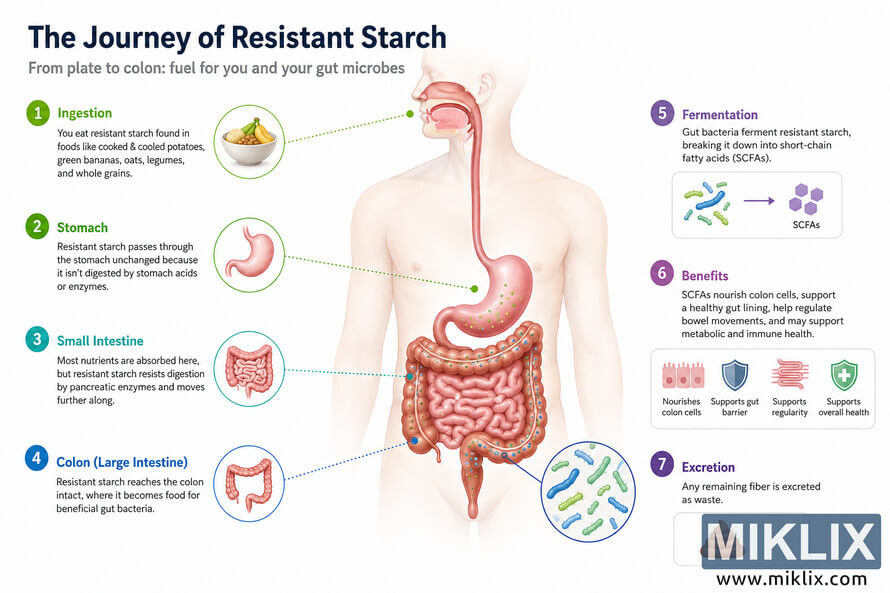
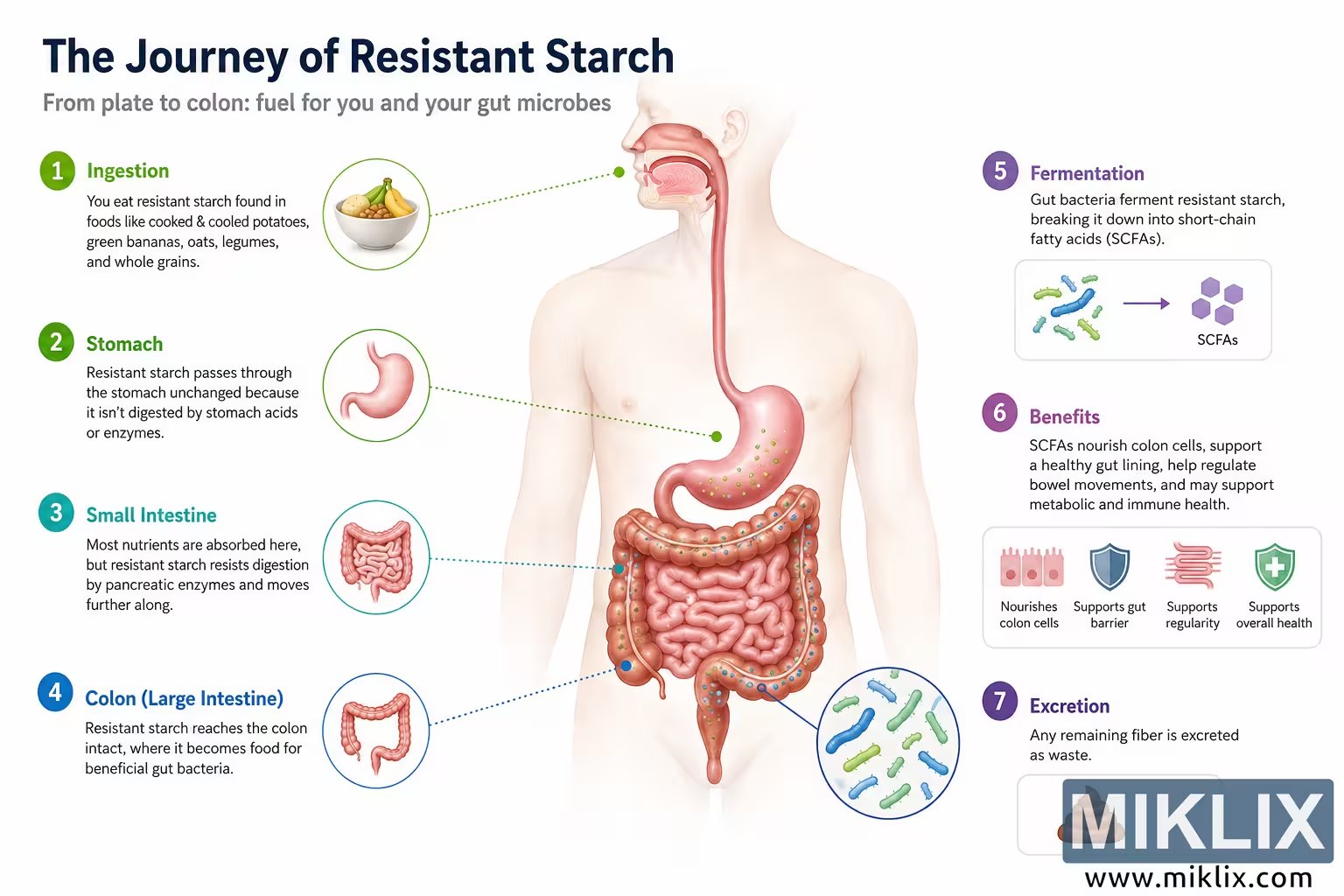
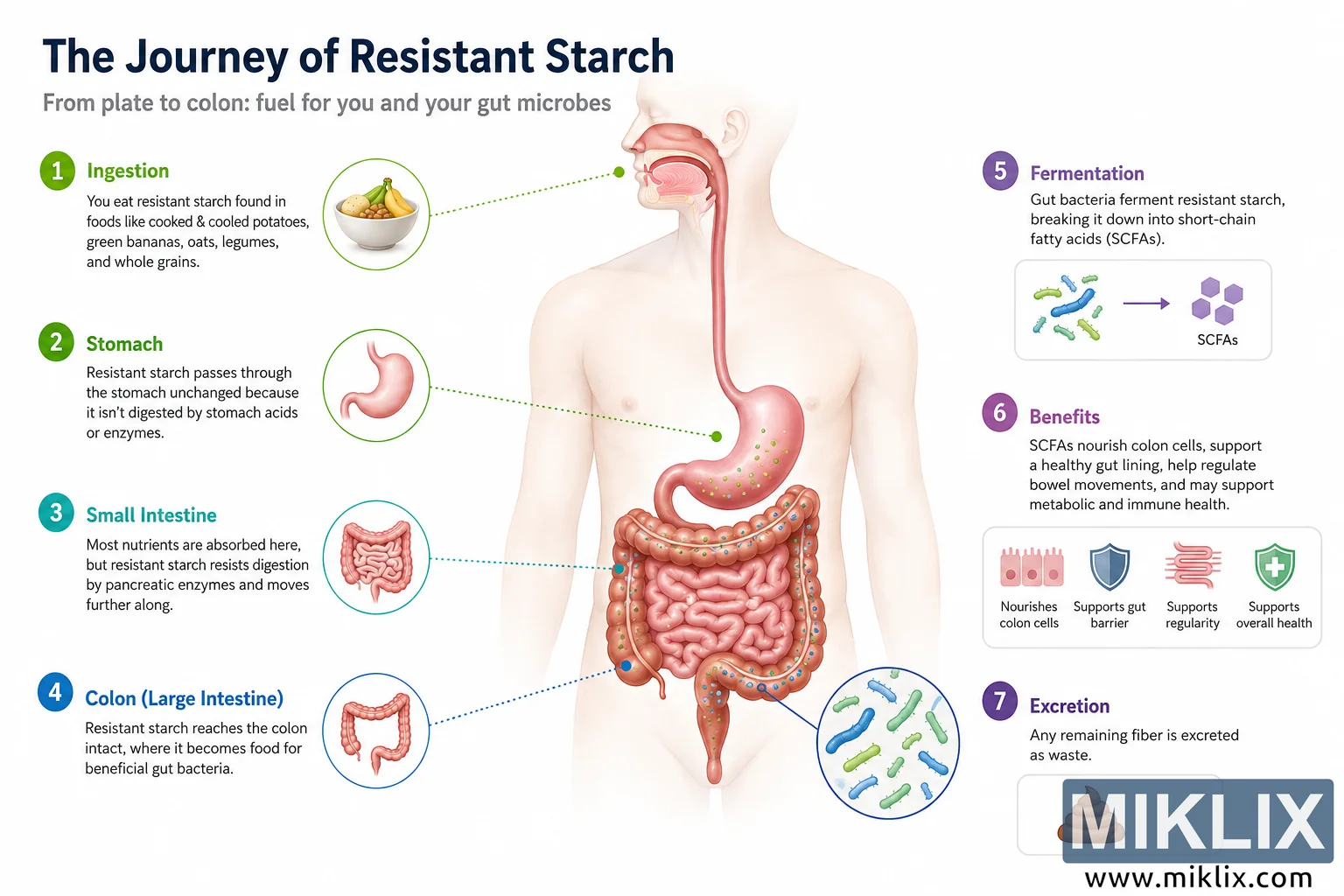
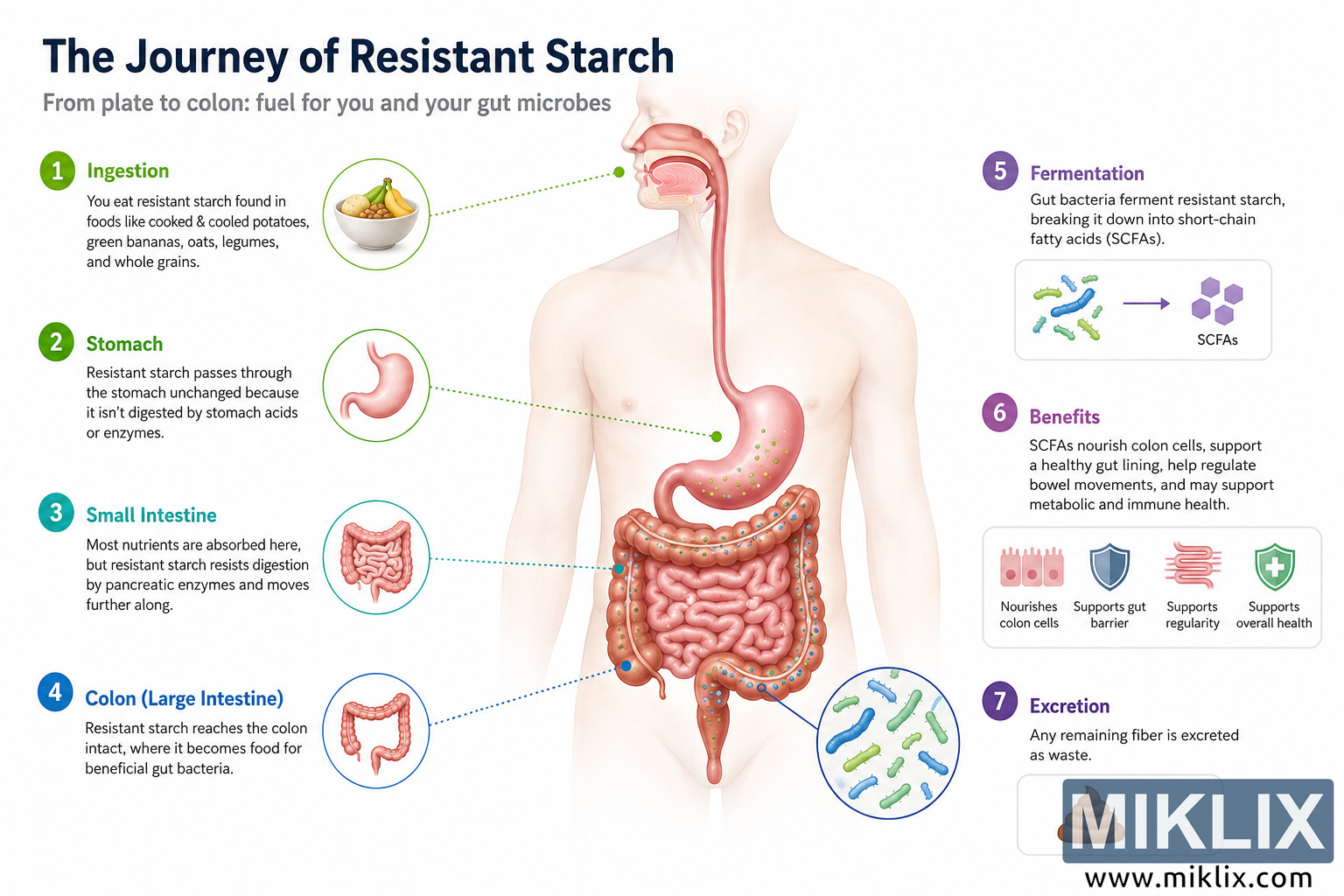
This image is a landscape-oriented educational medical infographic that explains the journey of resistant starch through the human digestive system. The overall design uses a bright white background with subtle gradients that create a clean, clinical appearance similar to modern healthcare educational materials. The composition is balanced around a large central illustration of a semi-transparent human upper body, allowing the digestive organs to be clearly visible while keeping the surrounding explanatory content easy to read. The layout is designed to guide the viewer through a logical sequence of events using numbered sections, connecting dotted guide lines, colorful icons, and concise explanatory panels.
At the top of the image is a prominent title introducing the subject of resistant starch and its journey through the digestive system. Directly beneath the title is a short subtitle explaining that resistant starch travels from food to the colon, where it becomes an important energy source for beneficial gut microorganisms. The typography uses large, bold lettering for the main heading and smaller supporting text underneath, helping establish a clear visual hierarchy.
The center of the infographic features a detailed anatomical illustration of a human torso viewed from the front. The digestive tract is highlighted and includes the mouth, esophagus, stomach, small intestine, large intestine, rectum, and surrounding digestive anatomy. The organs are rendered in realistic shades of pink, red, and tan while the rest of the body is softly faded to emphasize the digestive system. Small colored dots appear within portions of the digestive tract to suggest the movement of resistant starch through each stage of digestion.
Along the left side of the infographic are four sequential numbered sections representing the first half of the digestive journey. The first stage illustrates ingestion using a bowl containing foods commonly associated with resistant starch. A dotted line points from the food illustration toward the mouth of the anatomical figure, indicating where digestion begins. The accompanying text explains that resistant starch is consumed in foods such as cooled potatoes, green bananas, oats, legumes, and whole grains.
The second stage focuses on the stomach. A simplified stomach icon accompanies text describing how resistant starch largely passes through the stomach unchanged because it is resistant to breakdown by stomach acid and digestive enzymes. A connecting dotted line visually links this explanation to the stomach within the anatomical illustration.
The third stage highlights the small intestine. A simplified intestinal icon appears beside explanatory text stating that while many nutrients are absorbed in the small intestine, resistant starch largely avoids enzymatic digestion and continues traveling through the digestive tract. Another dotted connector links this explanation to the small intestine shown in the central anatomy.
The fourth stage describes the arrival of resistant starch in the colon, also identified as the large intestine. A large intestine icon is paired with text explaining that resistant starch reaches the colon substantially intact, where it serves as nourishment for beneficial gut microorganisms. The corresponding dotted guide line connects directly to the large intestine within the anatomical figure.
On the right side of the infographic are three additional numbered sections describing what happens after resistant starch reaches the colon. The fifth section explains fermentation. A small illustrated panel depicts stylized microorganisms transforming resistant starch into short-chain fatty acids through fermentation. Arrows illustrate this biological conversion while the accompanying text explains that gut bacteria perform the fermentation process.
The sixth section presents the primary health-related outcomes of fermentation. Several symbolic icons represent concepts such as nourishment of colon cells, support of the gut barrier, digestive regularity, and overall health. The explanatory text notes that the short-chain fatty acids generated during fermentation support colon cell nutrition, help maintain the intestinal lining, contribute to bowel regularity, and may positively influence metabolic and immune health.
The seventh and final section illustrates excretion. A simple symbolic icon represents waste elimination while the accompanying text explains that any remaining indigestible material ultimately leaves the body through normal excretion after fermentation and nutrient-related processes have occurred.
Throughout the infographic, dotted colored connector lines visually associate each numbered stage with its corresponding location inside the digestive tract, making it easy for the viewer to follow the progression from ingestion to elimination. Each numbered heading is displayed inside a colored circular badge, with different accent colors distinguishing the sequential stages while maintaining a cohesive overall design.
The visual style combines realistic anatomical rendering with simplified educational icons, making the content approachable for a broad audience including students, healthcare professionals, nutrition educators, and members of the general public interested in digestive health. The generous white space, consistent spacing between sections, and clean typography contribute to excellent readability. Color is used strategically to organize information without overwhelming the viewer, while the anatomical illustration serves as the central visual anchor around which the educational content is arranged.
Overall, the infographic communicates the complete pathway of resistant starch through the digestive system, emphasizing that unlike rapidly digestible starches, resistant starch survives digestion in the upper gastrointestinal tract, reaches the colon intact, is fermented by beneficial gut bacteria into short-chain fatty acids, supports gut health through multiple mechanisms, and ultimately completes its passage through the digestive system with any remaining indigestible material being excreted.
Gambar aya hubunganana sareng: The Surprising Health Benefits of Potatoes: A Complete Nutrition Guide