
Hops in Beer Brewing: Cerera
Публикувано:
Последна актуализация: 7 март 2026 г. в 18:31:26 ч. UTC
Cerera hops, a Slovenian variety, emerged in the 1980s through breeding programs. They are a seedless Super Styrian triploid, bred from Styrian Golding and a Yugoslav male. Known for their Saaz-like continental aroma, Cerera hops serve both as bittering agents and contributors to late-aroma applications.
Hops in Beer Brewing: Cerera
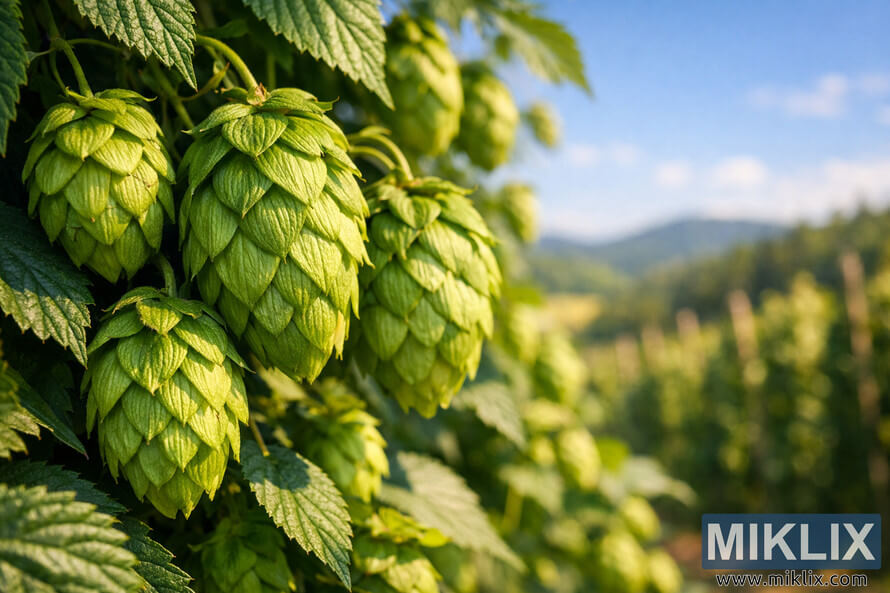
Кликнете или докоснете изображението за повече информация и по-висока резолюция.
Unfortunately, Cerera brewing is hindered by poor storage stability. This limitation has restricted its commercial production. Yet, small suppliers and homebrew retailers in the United States occasionally offer Cerera for craft and experimental brews.
When used with care, Cerera hops introduce delicate herbal and noble-like flavors to lagers and light ales. Their profile is ideal for brewers aiming to achieve a continental character reminiscent of Saaz hops. At the same time, they offer the versatility of a Super Styrian for blended bittering.
Key Takeaways
- Cerera hops are a Slovenian hops variety developed in the 1980s with Saaz-like aroma.
- The Cerera hop variety is a seedless Super Styrian triploid (Styrian Golding × Yugoslav male).
- Cerera brewing is valued for aroma and blended bittering but limited by storage stability.
- Availability in the U.S. is sporadic; some homebrew suppliers stock Cerera for niche use.
- Best suited to continental lagers and delicate ales where herbal, noble character is desired.
Introduction to Cerera hops
Cerera is a niche continental hop, celebrated for its delicate, Saaz-like aroma. It's perfect for pilsners and light lagers. Brewers opt for it to introduce subtle herbal and floral notes, enhancing the beer without overpowering the malt.
The history of Cerera hops traces back to Slovenia in the 1980s. It was bred as a seedless Super Styrian triploid. This origin highlights a deliberate attempt to capture noble-style aromas with better agronomic traits.
The breeding involved Styrian Golding crossed with a Yugoslav male. This lineage is the source of Cerera's continental, lightly spicy profile. Its genetic ties explain its aroma and functional role in traditional European beers.
Cerera is closely related to the Celeia sister hop, sharing a common breeding history and many aromatic traits. Both exhibit the classic noble-like character cherished by northern European brewers. This connection makes Cerera an attractive alternative to Saaz for hobbyists and craft brewers.
Cerera's significance lies in its ability to balance and add nuance to beers. Its Saaz-like aroma provides a refined floral-herbal lift when used in late boil, whirlpools, or as a gentle dry-hop. Its limited commercial production and niche availability make it a sought-after choice for brewers seeking distinct continental-style aroma hops.
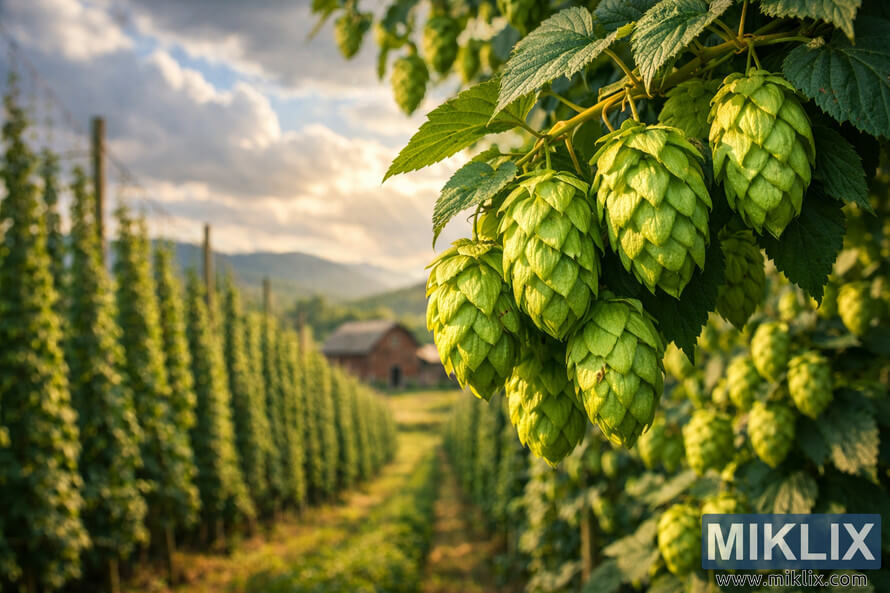
Кликнете или докоснете изображението за повече информация и по-висока резолюция.
Aroma and flavor profile of Cerera
Cerera offers a subtle, continental character, often likened to Saaz hops. Its aroma is clean and delicate, perfect for lagers and pilsners. It's chosen for its ability to add a noble touch without overpowering the beer.
The hop essential oils in Cerera define its scent and taste. With total oil at 1.54 mL/100g, myrcene dominates at about 58%. Humulene, caryophyllene, and farnesene add depth. Myrcene brings a resinous, herbal quality. Humulene and caryophyllene introduce spicy, woody, and herbal notes. Farnesene adds a light green and floral touch.
Key aromatic traits are grouped for practical use:
- Herbal and resinous notes from myrcene that remain restrained in finished beer.
- Spicy-woody complexity from humulene and caryophyllene that supports malt or yeast character.
- Delicate floral and green cues from farnesene that lift the aroma without dominating.
Beers hopped with Cerera have a gentle flavor profile. Expect light herbal, subtle spice, and faint floral notes. This makes Cerera perfect for late additions, whirlpool, or light dry-hopping. It's ideal for a Saaz-like aroma without a bold hop presence.
Practical takeaway: use Cerera to add nuanced continental character. Balance it with clean malts and neutral fermentation. This preserves a refined, noble-like finish.
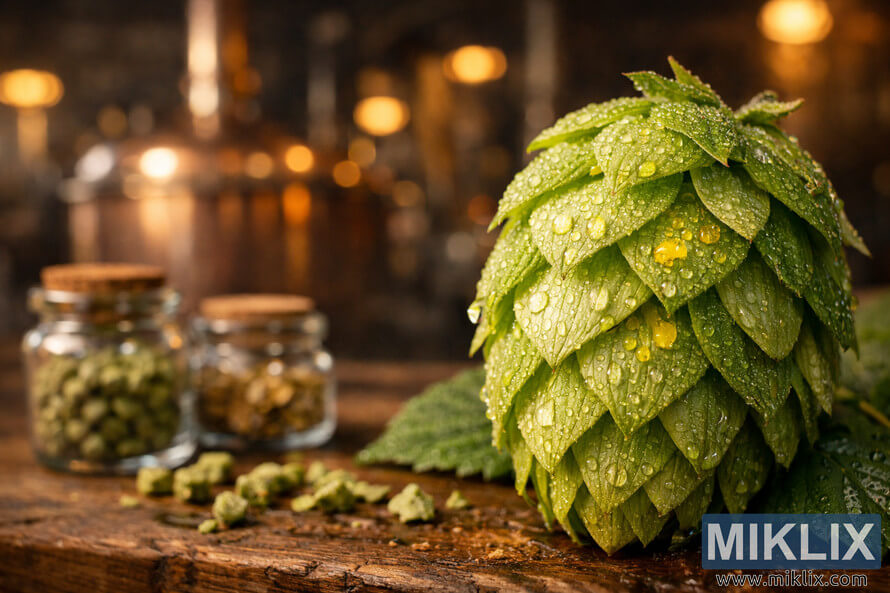
Кликнете или докоснете изображението за повече информация и по-висока резолюция.
Alpha, beta and co-humulone composition
Cerera's chemical makeup influences how brewers approach its use. It boasts modest alpha values and a balanced oil content, ideal for enhancing aroma rather than primary bitterness. Here, we delve into the specifics and their implications for recipe formulation.
Typical alpha acids (5%–6%) and what that means for bitterness
Cerera's alpha acids range from 5% to 6%. This moderate range positions Cerera well for late additions and dry-hopping. It allows for the expression of its Saaz-like character without overpowering the beer with bitterness. To achieve the desired bitterness, brewers often combine Cerera with high-alpha hops for early additions, reserving Cerera for its aromatic and subtle bittering contributions.
Beta acid range (4%–4.5%) and flavor stability
The beta acids in Cerera are approximately 4% to 4.5%. Beta acids are crucial for maintaining flavor stability over time, more so than initial bitterness. This characteristic means Cerera will influence the beer's aroma during aging more than its bitterness. Brewers should consider this when planning for storage and hop usage to preserve the beer's flavor.
Co-humulone at ~25% and implications for bitterness character
Cerera's co-humulone content is about 25% of its total humulones. This mid-range co-humulone contributes to a more pronounced bitterness perception compared to hops with lower co-humulone levels. Cerera's bitterness is clean but slightly more pronounced when used extensively for bittering. For a milder finish, pairing Cerera with hops of lower co-humulone content can soften the bitterness.
- Use Cerera late for aroma and minimal astringency.
- Blend with high-alpha varieties for efficient early bittering.
- Account for beta acids Cerera when planning shelf life and aging.
- Adjust ratios to manage perceived Cerera bitterness tied to hop co-humulone.
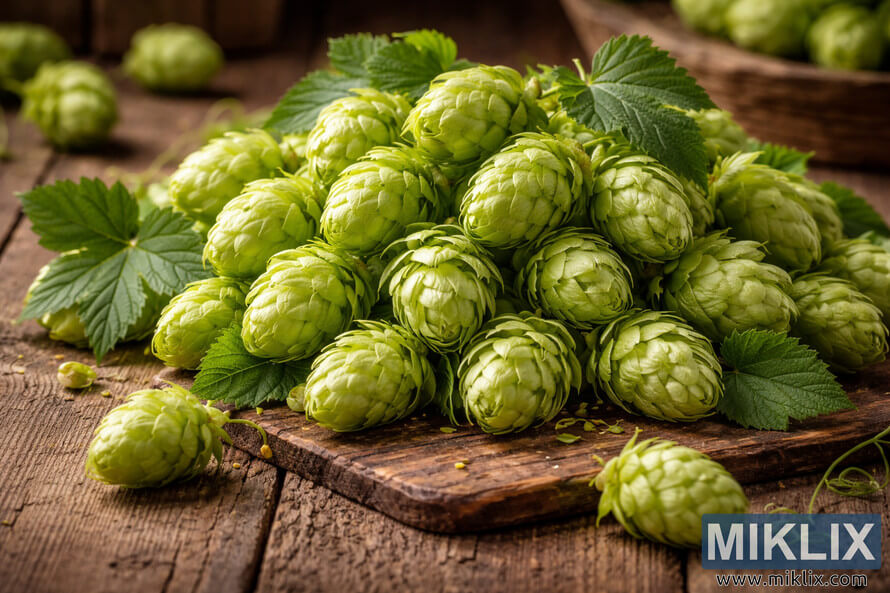
Кликнете или докоснете изображението за повече информация и по-висока резолюция.
Brewing uses and recommended applications
Cerera shines in late additions and blended schedules. It's perfect for adding a delicate, Saaz-like aroma to beers. Brewers should use Cerera for its floral and herbal notes, avoiding harsh tannins in the final product.
Adding Cerera in the last minutes of the boil or as a short dry-hop is best. This method showcases its aroma without excessive tannins. Expect gentle spice, floral tones, and a fine continental character.
Don't use Cerera as the sole bittering hop. Its higher tannoids can cause astringency and harsh bitterness when boiled for long periods. This can result in an unbalanced finish.
- Use Cerera for late-boil aroma and whirlpool additions.
- Reserve short dry-hop contact to boost fragrance.
- Avoid long, high-temperature bittering with Cerera.
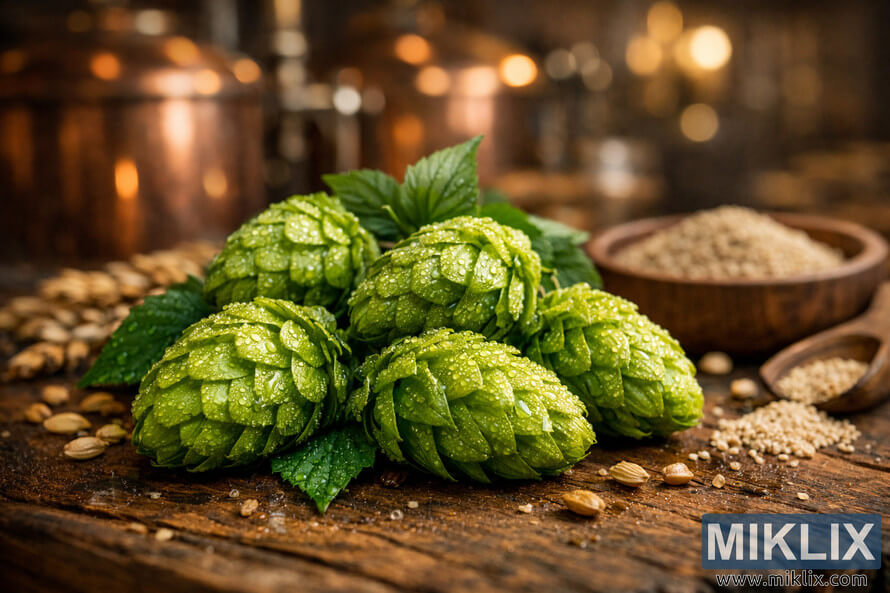
Blending Cerera with high-alpha, lower-tannin varieties helps control bitterness and preserves aroma. Target most IBU contribution from a stout, clean bittering hop like Magnum, Warrior, or Columbus. Then add Cerera late to layer aroma. This method allows for blending Cerera to achieve desired bitterness while minimizing tannin extraction.
- Calculate target IBUs and assign primary bittering to a high-alpha hop.
- Add Cerera late for aroma, typically in whirlpool or 5–10 minute late-boil additions.
- Use small, measured dry-hop doses of Cerera to enhance bouquet without overdoing polyphenols.
To avoid hop astringency, minimize long hot-side contact and limit trub carryover when using Cerera. Cold-side additions and short steeping reduce polyphenol extraction. This helps avoid hop astringency. Keep hop-on-hops contact time short during dry-hopping and consider using a hop bag or mesh to ease removal.
When blending Cerera, consider it a finishing spice rather than a base bittering agent. Proper pairing and timing will showcase Cerera's aroma while allowing other varieties to provide clean, stable IBUs. This approach delivers aroma clarity and keeps astringent notes out of the beer.
Кликнете или докоснете изображението за повече информация и по-висока резолюция.
Stylistic pairings and beer styles that suit Cerera
Cerera's delicate, Saaz-like aroma makes it perfect for beers that appreciate subtle floral and herbal notes. It's ideal for adding nuance without overpowering the malt and yeast. This approach keeps the hop presence refined and complementary.
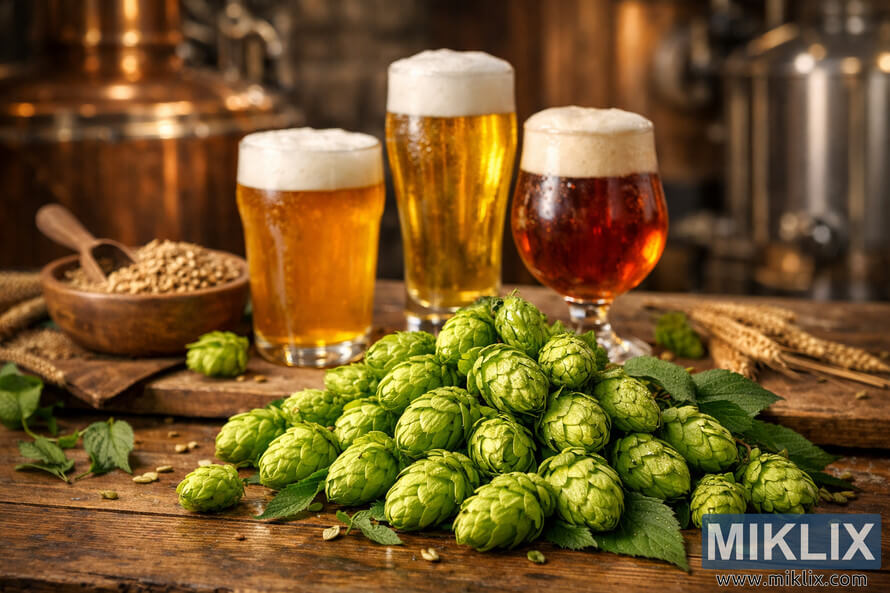
Traditional lagers and continental pilsners benefit from Cerera in pilsner, especially as a late-flameout or whirlpool addition. It enhances the noble-like aroma without overwhelming the crisp lager backbone. Small late doses during lautering or whirlpool preserve volatile oils for a classic, restrained finish.
- Use light pilsner malts and clean lager yeast.
- Add Cerera late to highlight its floral notes.
- Keep bittering low and balanced for clarity.
Cerera in ales is great for light, sessionable styles where hop weight shouldn't dominate. Pale ales with lower bitterness or blonde ales can showcase a gentle continental character. This character sits behind esters or bread crust malt.
- Pair with English or American ale yeasts for contrast.
- Favor late additions and brief dry hops to avoid astringency.
- Consider blending with low-resin hops to preserve balance.
Experimental and mixed-fermentation beers gain subtle complexity from Cerera when used sparingly. Brettanomyces-driven saisons and oak-aged blends welcome the hop's herbal lift. This is provided additions come late or as a light dry hop. This approach highlights aroma without extracting harsh polyphenols.
- Use Cerera for finishing or kettle hop stands at moderate temperatures.
- Combine with citrus or herbal adjuncts for layered aroma.
- Trial small pilot batches to dial in the optimal dosage.
For homebrewers and commercial brewers exploring beers for Cerera, think restraint. A measured Cerera pairing preserves its noble-like subtlety. It enhances rather than hides native beer character.
Кликнете или докоснете изображението за повече информация и по-висока резолюция.
Agronomy and cultivation background
Cerera's origins date back to the 1980s in Slovenia, where it was bred for specific traits. These include cones suitable for brewing, low seed content, and consistent aroma. These characteristics are highly valued by European brewers.
The cultivar emerged from a cross between Styrian Golding and a Yugoslav male. This cross resulted in a seedless, triploid plant known as a Super Styrian triploid. This classification highlights the unique cone structure and propagation needs of growers.
Practical cultivation of Cerera emphasizes its triploid, seedless nature. This characteristic minimizes seed bitterness in beer. Growers must plan for propagation and field layout, focusing on vegetative methods and certified planting material.
- Development: bred in Slovenia in the 1980s, reflecting Cerera origin Slovenia.
- Genetics: Styrian Golding × Yugoslav male, leading to the Super Styrian triploid classification.
- Seed traits: triploid, largely seedless, with implications for cone quality and propagation.
Vine vigor is high to very high. Bines grow vigorously, promising strong yields with proper trellis support and nutrient management. Timely pruning and training enhance cone quality and reduce shading.
Yield potential makes Cerera attractive for commercial hop yards. Attention to soil fertility, irrigation, and pest management is crucial. Matching site conditions to Cerera's needs rewards growers with high yields.
Harvesting, yield and seasonal maturity
Cerera is a late-season hop, requiring growers to plan harvests later than usual. This timing impacts labor, drying capacity, and storage for both craft and commercial growers in the United States.
Notes on Cerera seasonal maturity highlight a consistently later finish. Growers should monitor cone color, lupulin development, and aroma. This ensures picking at peak character, rather than by a fixed date.
The typical Cerera yield is about 1,090 kg per hectare, or roughly 965 lbs per acre. This places it among the more productive continental varieties. Brewers can rely on a steady supply if managed correctly.
Ease of harvest depends on cone firmness and handling needs. As a triploid, seedless variety, Cerera's cones can be delicate during late-season harvests. Careful handling during picking and transport is crucial. It protects aroma oils and minimizes bruising.
- Plan harvest crews and equipment for later dates to match Cerera harvest time.
- Monitor cone firmness daily as seasonal maturity approaches.
- Adjust drying schedules to retain hop oil profile and minimize loss.
Disease resistance and vineyard management
Cerera hops exhibit moderate resistance to downy mildew. This characteristic reduces the risk but underscores the necessity for vigilant monitoring and effective hop management. Cultivating plants with care enhances their productivity and lessens the reliance on fungicides.
Moderate resistance to downy mildew
Field trials and catalog data indicate Cerera's moderate resistance to downy mildew. Growers can anticipate fewer severe outbreaks compared to highly susceptible varieties. However, infections may still occur under prolonged wet conditions. Therefore, early scouting and prompt identification are crucial.
Susceptibilities and common management practices
- Maintain canopy airflow by pruning lower shoots and setting appropriate training widths.
- Monitor moisture after rains and irrigation to spot early symptoms of Cerera mildew resistance issues.
- Rotate and time fungicide applications to local extension recommendations, focusing on wet periods and pre-sporulation windows.
- Sanitation of equipment and removal of diseased bines reduce local inoculum loads.
Recommendations for growers in U.S. climates
In humid regions, adhere to state extension guidance for downy mildew control. Establish scouting schedules during spring and after storms. Opt for sites with good slope and wind exposure when feasible.
For hop management Cerera, integrate cultural controls with targeted spray programs and meticulous record-keeping. This comprehensive strategy minimizes crop loss and maintains yield quality. It leverages Cerera’s moderate tolerance to mildew effectively.
Storability and stability concerns
Cerera hops demand meticulous care from harvest to mash to safeguard their sensitive alpha acids and oils. Understanding Cerera storage stability is crucial for brewers. It aids in planning purchases and adjusting recipes when fresh hops are hard to find.
Lab results highlight a significant drop in alpha acid retention for Cerera after six months at 20°C (68°F). This loss makes storing them at room temperature ineffective. Brewers must account for this rapid decline in inventory planning to ensure consistent bittering.
The poor storage performance has reduced commercial interest, limiting market availability. When hops lose both alpha and aroma, suppliers and wholesalers are less inclined to stock them. This scarcity, coupled with Cerera's niche appeal, makes it less accessible than more durable varieties.
To slow degradation and preserve beer quality, follow these Cerera hop storage best practices.
- Vacuum-seal or nitrogen-flush packages before cold storage.
- Refrigerate at 0–4°C (32–40°F) for medium-term holding; freeze for long-term storage.
- Minimize time at room temperature during receiving and handling.
- Request recent alpha testing from suppliers and label packs with test dates.
- Use first-in, first-out rotation and plan small, frequent orders for fresh batches.
Implementing these measures can bridge the gap between the potential of harvested hops and the final beer. Treating Cerera as a short-window ingredient enhances the quality of lagers and delicate ales. These styles benefit from Cerera's subtle aroma and balance.
Oil composition and its brewing impact
Cerera’s oil profile is key to its brewing behavior. It has a total oil content of about 1.54 mL per 100 g. This gives brewers a significant aromatic punch, especially when hops are added late. Managing contact time and temperature is crucial to preserve volatile compounds during whirlpool and dry-hop stages.
The breakdown of hop oils is essential for timing and technique. Myrcene in Cerera contributes herbal, resinous, and green notes. However, its volatility means early-boil additions lose these topnotes. So, late additions are best for maximizing aroma pickup.
Humulene Cerera levels are significant for structure. It has about 13.2%, delivering woody, spicy balance. This balances myrcene's bright edge. Caryophyllene adds spicy depth, and farnesene brings subtle floral and green nuances. Together, they form a rounded continental profile.
- Use late-boil and whirlpool additions to retain delicate aromatics.
- Consider short contact times and cool wort for dry hopping to protect myrcene in Cerera.
- Blend with higher alpha hops when bittering is required, keeping aromatic hop oils Cerera prominent.
Practical handling is crucial. Cold storage and vacuum-sealed packaging slow oil loss and protect myrcene in Cerera from oxidation. Brewers aiming for a soft, noble-like character should prioritize gentle extraction methods. This showcases humulene Cerera and its complementary oils.
Substitutes and comparable hop varieties
Cerera's Saaz-like continental aroma makes finding substitutes easier when stock runs low or shipping risks harm aroma. Brewers seeking that gentle, herbal-sweet character often turn to classic noble-like hops or craft-friendly continental varieties. These options help preserve a similar palate and bouquet.
When freshness is a concern, Saaz replacement options are practical. Saaz itself offers a soft, spicy-sweet profile that mirrors Cerera. Styrian Golding is another good choice for Cerera substitutes, sharing continental nuance and a mild floral backbone.
Choose Cerera alternatives when long transit or storage could erode fragile oils. If fresh Cerera is available, use it for late additions and dry hop. If not, opt for a Saaz replacement for finish aroma and hold back bolder hops for bittering.
- Use a Saaz-like hop for primary aroma to capture herbal and peppery notes.
- Add a small portion of a myrcene-forward hop to warm the profile and add fruitiness.
- Finish with a humulene/caryophyllene-dominant variety for subtle spice and depth.
Blending strategies can mimic Cerera’s oil balance without changing recipe intent. Start with a Saaz replacement at 70–80% of the late-hop mix. Add 10–15% of a myrcene-rich hop like Cascade or Hallertau Mittelfrüh variant. Finish with 5–10% of a humulene/caryophyllene-forward hop like Northern Brewer or East Kent Golding to round the spice.
For bittering, pair the blend with a higher-alpha variety and reserve the delicate noble-like hops for whirlpool and dry-hop additions. This approach keeps bitterness clean and protects the floral-herbal aroma that defines the Cerera character.
Where to buy Cerera and sourcing tips
Cerera is often scarce in commercial markets due to its delicate oils and limited production. Brewers seeking this unique aroma must anticipate irregular availability. They should plan their purchases well in advance to secure Cerera hops for their batches.
Availability challenges
The fragility of Cerera's oils limits its retail shelf life. Many wholesalers hesitate to stock Cerera regularly, fearing losses from alpha acid degradation. Small, specialty farms or boutique growers might offer fresh Cerera only shortly after harvest.
Recommended stockists and suppliers
Seek out specialty hop farms, boutique suppliers, and reputable homebrew retailers that offer national shipping. Brewgrass Homebrew in Louisville, KY, is an example of a shop that might carry unique varieties.
- Contact regional hop farms that publish harvest dates.
- Check dedicated homebrew shops for limited-release listings.
- Ask Cerera suppliers about upcoming harvests and allocation policies.
Buying checklist for freshness and quality
When purchasing Cerera hops, ask for the latest alpha testing results and the harvest or packaging date. Opt for vacuum-sealed or nitrogen-flushed packaging to preserve the oils.
- Verify harvest or packaging date on the lot.
- Request a COA or alpha acid analysis from the seller.
- Choose refrigerated or frozen shipping when possible to retain aroma.
- Confirm return or replacement policy for compromised lots.
For U.S. buyers, look for Cerera stockists that explicitly offer hops shipping US and list Cerera in their inventory. Discuss storage practices with Cerera suppliers to ensure you receive the freshest batch. Early planning helps avoid settling for older, less aromatic hops.
Practical recipe examples and hopping schedules
Below are compact, usable notes and a sample recipe for a continental-style pilsner. It showcases Cerera’s Saaz-like aroma while keeping bitterness clean. The goal is to use Cerera for late additions, whirlpool, and a short dry-hop. This ensures the delicate oils shine without extracting tannins.
- Batch size: 5 gallons (19 L)
- Target OG: 1.048, FG: 1.010
- Malt bill: 90% Pilsner malt, 5% Vienna, 5% Munich light
- Primary bittering hop: Magnum or Perle at 60 minutes for 25–30 IBU
- Late aroma: Cerera at 5 minutes (10–15 g), flameout (30–40 g), whirlpool below 80°C/176°F (30–40 g)
- Dry-hop: Cerera 15–30 g for 24–48 hours at cold conditioning
- Yeast: Wyeast 2278 or White Labs WLP800 for a clean lager profile
Hopping schedule suggestions
- Use a high-alpha hop early in the boil for stable IBUs. This preserves head retention and clarity.
- Add Cerera at 5–0 minutes to lift floral and herbal notes with minimal harshness.
- Hop in the whirlpool when wort temperature is below 80°C/176°F to protect volatile oils like myrcene.
- Dry-hop briefly—24 to 72 hours—to reinforce aroma without pulling tannins from leaf material.
Dos and don’ts to avoid hop astringency
- Do use Cerera sparingly for late-aroma touches in Cerera recipes and the Cerera pilsner recipe above.
- Do blend Cerera with a firm bittering hop so you do not rely on it for primary IBUs.
- Don’t overuse Cerera in lengthy high-temperature contact. Prolonged boil time can make tannins bitter.
- Don’t cold-steep whole cones for long periods at room temperature; that can increase vegetative astringency. Short, cold dry-hops work better.
- Do monitor contact time during whirlpool and dry-hop to avoid extracting polyphenols and to avoid hop astringency.
Conclusion
Cerera summary: This Slovenian Super Styrian hop brings a unique Saaz-like, continental aroma. It excels in late additions and dry hopping. With alpha acids around 5%–6% and co-humulone near 25%, it's ideal for aroma and blended bittering, not single-hop bittering.
Its oil profile, about 1.54 mL/100g, is dominated by myrcene. This gives delicate herbal and floral notes that enhance lagers and light ales.
Cerera hops overview also touches on practical aspects. Developed in the 1980s, it matures late and yields roughly 1,090 kg/ha. It shows moderate resistance to downy mildew but has limited storage stability, retaining roughly half its alpha after six months at 68°F.
This fragility limits its broad commercial availability. Fresh sourcing is crucial for U.S. brewers.
Cerera brewing conclusion: U.S. brewers should focus on fresh hop lots. Use Cerera for late whirlpool and dry-hop additions. Blend it with a higher-alpha bittering hop to control IBUs and avoid astringency.
Careful storage in cool, oxygen-minimized conditions is key. It helps preserve its volatile oils and subtle continental character for the best results.
FAQ
What is Cerera and where did it originate?
Cerera is a Slovenian hop variety developed in the 1980s. It is a seedless Super Styrian triploid bred from Styrian Golding crossed with a Yugoslav male. It is a sister variety to Celeia and was created to provide a continental, noble-like aroma similar to Saaz.
How does Cerera’s aroma compare to Saaz and other continental hops?
Cerera delivers a Saaz-like continental aroma: delicate, herbal, slightly spicy and gently floral rather than bold citrus or tropical notes. Its oil profile gives restrained noble character suitable for pilsners, lagers, and light ales.
What are Cerera’s key essential oil components and how do they affect beer aroma?
Total oil content is about 1.54 mL/100g. Myrcene is dominant (~58%), contributing resinous, herbal, and green notes. Humulene (~13.2%) and caryophyllene (~6%) add spicy, woody, and herbal complexity. Farnesene (~3%) provides delicate green and floral accents. The volatile myrcene makes late additions important to preserve aroma.
What are the typical alpha and beta acids for Cerera and what do they mean for brewing?
Cerera typically tests at 5%–6% alpha acids (low-to-moderate) and beta acids around 4%–4.5%. Alpha levels mean it is better used for aroma and blended bittering rather than as a sole kettle bittering hop. Beta acids affect long-term flavor stability rather than initial bitterness.
What is Cerera’s co-humulone level and why does that matter?
Co-humulone is about 25% of total alpha acids. This mid-range co-humulone can contribute a firmer perceived bitterness than very low co-humulone varieties, so brewers should account for perceived astringency when formulating bitterness.
Can I use Cerera as the only bittering hop in a recipe?
It is not recommended. Cerera has higher tannoid content that can produce astringency and harshness when used as the single kettle bittering hop. It performs best as a late-addition aroma hop or blended with higher-alpha, lower-tannin varieties for bittering control.
How should I schedule Cerera additions for best aroma and minimal astringency?
Use Cerera for late boil additions (5–0 minutes), flameout, whirlpool below ~80°C (176°F), and short dry-hop periods (24–72 hours). Reserve early-kettle bittering to a high-alpha hop like Magnum or Perle and use Cerera late to emphasize delicate continental aromatics.
Which beer styles benefit most from Cerera?
Cerera suits continental lagers, traditional pilsners, light ales, and herb-forward beers that want a noble-like, restrained hop presence. It also works well in experimental and mixed-fermentation beers where subtle hop complexity is desired.
What are practical blending strategies when using Cerera?
Blend Cerera with a higher-alpha bittering hop to reach target IBUs while diluting tannin impact. To mimic Cerera, pair a Saaz-like hop with a myrcene-forward variety and a humulene/caryophyllene-dominant hop. Keep Cerera reserved for late additions to highlight its delicate oils.
How vigorous is Cerera as a hop plant and what are its growth traits?
Cerera shows a high to very high growth rate, indicating vigorous bines and strong yield potential under suitable conditions. It is late-maturing and classified as a triploid, seedless variety, which affects cone characteristics and propagation.
When is Cerera typically harvested and what yields can growers expect?
Cerera has a late seasonal maturity compared with earlier varieties. Typical yield is around 1,090 kg per hectare (about 965 lbs per acre), reflecting good productive potential under proper management.
How easy is Cerera to harvest?
No specific ease-of-harvest rating is standardized, but growers should monitor cone firmness and handling due to the seedless triploid classification and late-season maturity. Proper timing helps preserve cone quality for aroma retention.
What disease resistance does Cerera have and what management is recommended?
Cerera is moderately resistant to downy mildew but not immune. Growers should maintain canopy airflow, scout regularly, and use integrated pest management. In humid U.S. regions, follow local extension guidance and apply fungicide programs as recommended.
How well does Cerera store and what impact does storability have on availability?
Cerera has poor storage stability. At 20°C (68°F) it retains only about 49% of alpha acids after six months. This fragility limits commercial production and contributes to niche market availability. Fresh-harvest sourcing and cold storage are important.
What are best practices for handling and storing Cerera hops?
Store Cerera vacuum-sealed or nitrogen-flushed and keep refrigerated or frozen when possible. Minimize time at room temperature, request recent alpha testing from suppliers, and prefer quick shipping in cold packs to preserve alpha and volatile oils.
If Cerera is unavailable, what substitutes work well?
Saaz and Styrian Golding are natural substitutes for Cerera’s noble-like continental aroma. When substituting, consider blending to match Cerera’s oil balance—add a myrcene-forward hop and a humulene/caryophyllene contributor, and use Cerera-like hops for late aroma additions.
Where can brewers buy Cerera given its limited availability?
Availability is limited due to storability and constrained commercial production. Specialized hop farms, boutique suppliers, and dedicated homebrew shops that ship nationally are the best places to look. Some U.S. homebrew retailers, such as Brewgrass Homebrew in Louisville, KY, may occasionally stock Cerera.
What should I check when purchasing Cerera hops?
Ask for harvest and packaging dates, current alpha acid analysis, and confirm vacuum-sealed or nitrogen-flushed packaging. Prefer refrigerated or frozen shipping and request recent lab testing to ensure freshness and reliable alpha/oil values.
How can I use Cerera in a sample brewing recipe?
For a continental-style pilsner, use a high-alpha bittering hop (Magnum or Perle) at kettle start for IBUs. Add Cerera at 5–0 minutes, flameout, and in the whirlpool below 80°C, then consider a short dry-hop to add delicate noble aroma without excessive tannins.
What are the dos and don’ts when working with Cerera?
Do use Cerera sparingly for late aroma and dry-hop additions. Do blend with higher-alpha, low-tannin hops for bittering. Don’t rely on Cerera for sole kettle bittering due to tannins. Don’t expose it to prolonged high temperatures or long, warm storage that degrades alpha and volatile oils.
Допълнително четене
Ако ви е харесала тази публикация, може да ви харесат и тези предложения: