
Hops in Beer Brewing: Dunav
Published: March 13, 2026 at 8:37:23 PM UTC
Dunav, a rare hop variety, hails from the former Yugoslavia. Developed in the 1960s to replace the low-yielding Backa, it has remained a niche ingredient. Primarily produced in Serbia, Dunav is sought after for its unique brewing history and chemical profile, as documented in USDA/ARS hop chemistry references.
Click or tap the image for more information and higher resolutions.
This article delves into the Dunav hop variety, covering essential brewing topics. You'll learn about its alpha and beta acids, co-humulone levels, oil profile, and agronomy. It also explores how Dunav behaves in recipes. Whether you're a professional brewer, a craft brewer, or a homebrewer in the United States, understanding Dunav can guide your decision-making. It's particularly useful for determining its role in bittering, aroma, or dual-purpose applications in beer.
Key Takeaways
- Dunav hops are a Serbian hop variety developed in the 1960s to improve yields versus Backa.
- Production remains limited, so sourcing Dunav hops can be regional and intermittent.
- USDA/ARS records provide primary chemical data for recipe planning and analysis.
- Dunav offers a balance of bittering and aromatic potential useful in several beer styles.
- Understanding its oil profile and storability helps preserve hop-forward flavors in finished beer.
Introduction to Dunav hops and their place in brewing
Dunav hops occupy a unique spot among European varieties. They are valued for their dual-purpose nature, offering both bitterness and a subtle aroma. This makes them appealing to brewers seeking distinctive ingredients with a Central European heritage.
The origins of Dunav hops are fascinating. They trace back to the 1960s in the former Yugoslavia. The goal was to replace Backa with a more resilient vine, preserving key brewing qualities. This effort resulted in a triploid hop, a blend of Northern Brewer, Styrian Golding, and a wild male. This unique combination enhances both aroma and bitterness.
Serbian hop breeding in the mid-20th century emphasized practical traits. Researchers focused on yield, disease resistance, and consistent alpha acid levels. Dunav embodies these goals while maintaining a distinct flavor profile. It serves as a valuable example in the study of regional hop development.
Commercial adoption has been modest. Despite its intended purpose, Dunav never gained widespread acceptance among large producers. Its availability is mostly confined to Serbia and nearby regions. Small suppliers occasionally offer Dunav, shipping it domestically when supplies permit. This makes it a niche product rather than a mainstream hop.
So, why should brewers consider Dunav? Its variable alpha acid range and moderate beta acids offer flexibility in recipes. Homebrewers and craft breweries can use Dunav for bittering, late additions, or dry hopping. This adds subtle herbal and woody notes to their brews. For those looking to experiment with unique ingredients or alternatives to common hops, Dunav is a valuable resource.
Click or tap the image for more information and higher resolutions.
Botanical profile and lineage of Dunav
Dunav is a cultivated hop with a clear breeding story and traits that matter to growers and brewers. Its genetic make-up explains variable alpha acid readings and robust field performance. The plant shows late seasonal maturity with very high growth vigor, making it notable among regional varieties.
Triploid cross parentage
Dunav comes from a triploid cross involving a Northern Brewer cross, the Styrian Golding lineage, and a wild male. Triploid genetics can cause wider swings in alpha acid expression and give unique agronomic features. This breeding aimed to blend bitterness stability from Northern Brewer with aromatic finesse from Styrian Golding lineage while adding resilience via the wild male.
Sibling varieties
This variety sits alongside hop siblings developed in the same Central European programs. Neoplanta and Vojvodina share portions of the genetic background and breeding objectives. Comparing these cultivars helps clarify Dunav’s role within regional hop selection efforts.
Plant characteristics
- Growth rate: Very high, producing vigorous bine development and fast canopy closure.
- Seasonal maturity: Late; harvest windows often fall after many commercial varieties.
- Cone size and density: Profiles note good cone size and solid density without exact primary-data figures; observed yields support productive cone set.
Yield records, roughly 1565 kg per hectare (about 1,400 lbs per acre), reflect strong field output despite limited commercial adoption. Those metrics make Dunav an attractive choice where growers seek productive varieties with defined heritage in Dunav parentage and a nod to the Northern Brewer cross and Styrian Golding lineage.
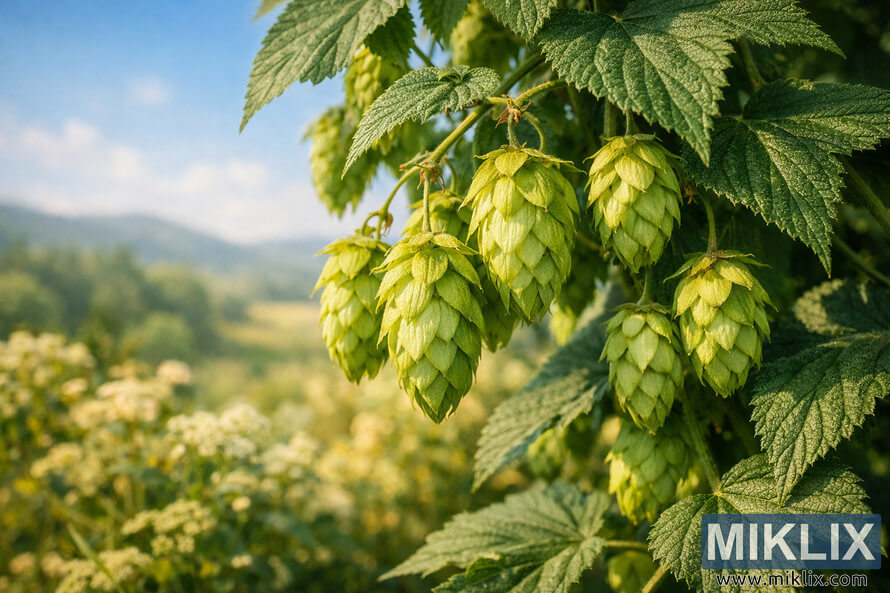
Click or tap the image for more information and higher resolutions.
Aromatic and flavor characteristics relevant to brewing
Dunav offers a balanced aroma, falling between traditional bittering hops and modern aroma varieties. It presents resinous and woody flavors with herbal undertones. This profile is a testament to its Northern Brewer and Styrian Golding heritage. It adds structure without overpowering the malt.
The hop oil aroma of Dunav is characterized by a total oil content of approximately 1.19 mL/100g. It contains myrcene, humulene, caryophyllene, and farnesene. Myrcene contributes a resinous and citrus-green impression but evaporates quickly under heat.
Humulene, on the other hand, provides woody and spicy notes that endure through gentle handling. Caryophyllene adds a peppery, spicy accent, enhancing darker or malt-forward beers. Farnesene introduces faint green and floral notes, especially in low-IBU, hop-forward brews.
These compounds blend to create a hop flavor profile that values subtle complexity over bold fruit esters. Hopping time influences which oils end up in the final beer. Early kettle additions mainly contribute alpha-acid-derived bitterness.
Volatile components like myrcene are lost in the boil, diminishing fresh, resinous topnotes.
- Late kettle and whirlpool hops retain more humulene and caryophyllene, adding woody and spicy aroma without heavy citrus.
- Dry hop Dunav highlights green, floral, and spicy facets from farnesene and caryophyllene while preserving humulene’s backbone.
For brewers aiming for controlled aroma, split additions are effective. Use a portion for late kettle character and a dry hop Dunav charge to restore lifted green and floral topnotes. This method leverages the hop oil aroma profile while managing bitterness and volatility.
Click or tap the image for more information and higher resolutions.
Chemical composition: alpha acids, beta acids, and co-humulone
Dunav's chemical makeup is crucial for brewers. Its alpha acids vary from 5.1% to 9.6%, influenced by genetics and site conditions. This range positions Dunav as having a moderate to high bittering potential. Brewers must consider vineyard and harvest specifics when planning recipes.
Beta acids in Dunav range from 2.8% to 4.6%. These compounds are less significant in fresh hop bittering. However, they become more important during storage and aging. Oxidized beta acids can introduce a lingering bitterness that evolves over time.
Co-humulone makes up about 30% of Dunav's alpha acids. This falls in the middle of the spectrum for brewing hops. With a 30% co-humulone content, Dunav can offer a crisp bite. Yet, it should not result in an overly harsh finish when used judiciously.
Practical notes for brewers:
- Adjust bittering additions to measured Dunav alpha acids rather than using a single nominal value.
- Factor in beta acids when planning long-cellar beers; aroma-forward beers benefit from fresher hops.
- Expect a moderate influence from hop co-humulone on hop bitterness perception, and balance malt and hopping schedules accordingly.
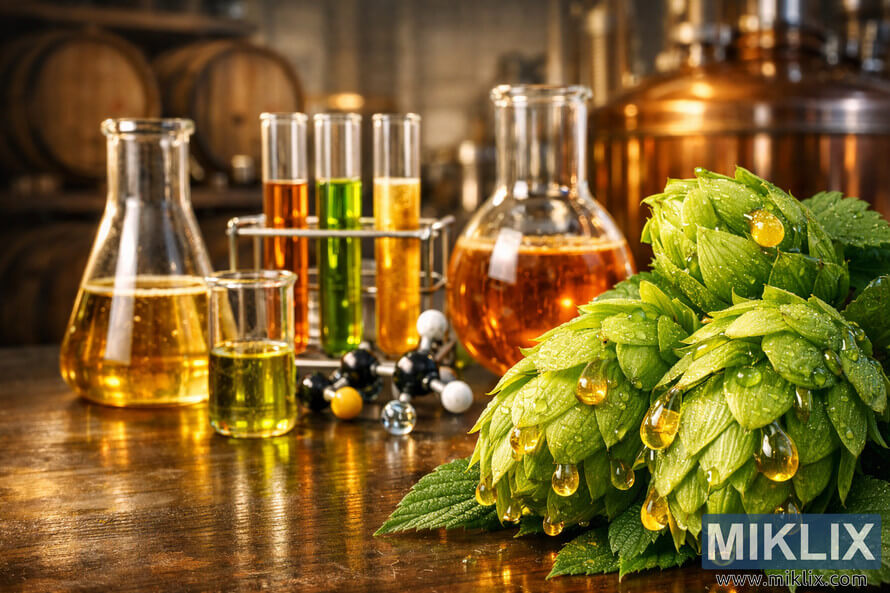
Click or tap the image for more information and higher resolutions.
Hop oil breakdown and sensory implications
Dunav’s oil profile is a detailed guide for brewers, outlining aroma and aging behavior. It has a total oil content of 1.19 mL per 100 g, which is relatively modest. This modest level ensures both bittering reliability and a subtle aromatic lift, especially in late additions or dry hopping.
The composition of Dunav's oils influences its performance in the kettle and bottle. Myrcene, at nearly 19%, contributes resinous, citrus, and green notes, which are highly volatile. Humulene, also at 19%, adds woody and herbal tones, more stable during storage. Caryophyllene and farnesene, present at about 6% and 6.2%, respectively, introduce spicy and floral-green accents.
The myrcene and humulene percentages indicate a balanced volatile and stable fraction. The significant myrcene portion provides a fresh-resinous character in late additions. Meanwhile, the humulene share preserves woody-herbal depth over time. Expect an initial citrus and resin burst that evolves into herb and spice as the beer ages.
Storage is crucial for hop-forward beers. The volatile myrcene fraction declines rapidly under oxygen, heat, or light. This decline explains the loss of citrus and resin notes after months in transit or in poorly sealed warehouses. However, more stable oils like humulene and caryophyllene remain, leading to aged beers with woody and spicy aromas.
- Use fresh Dunav for forward citrus and resin thanks to myrcene.
- Plan for a flavor shift over months; woody-herbal tones will persist.
- Control oxygen and temperature to limit hop storage effects and retain aromatic nuance.
In practice, Dunav hop oil offers a predictable journey: bright and resinous at first, then more herbal and spicy with age. This trajectory is beneficial for crafting beers that highlight fleeting fresh-hop notes or aim for balanced aroma layers over time.
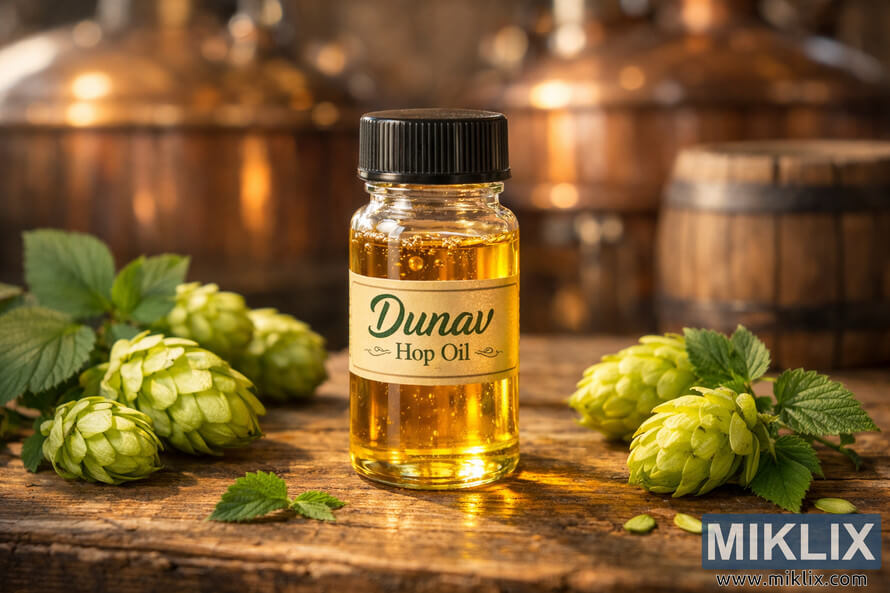
Click or tap the image for more information and higher resolutions.
Brewing uses: bittering, aroma, or dual-purpose
Dunav hops occupy a unique space between bittering and aromatic roles. With alpha acids ranging from low to moderate, brewers can fine-tune IBUs with early additions. Alternatively, they can preserve herbal and resinous flavors with late additions and dry hopping. This versatility makes Dunav ideal for beers that benefit from subtle spice and woodsy notes.
Dunav's bitterness is stable enough for boil additions, yet its oil profile supports late-stage aroma work. It's a prime choice for dual-purpose hops, offering flexibility in both grist and hopping strategies. Brewers should use precise alpha acid percentages for bittering additions, rather than relying on averages.
Recipes with Dunav vary by style. For lagers and traditional European ales, focus on clean, restrained additions to highlight herbal and woody tones. In pale ales and session IPAs, pair Dunav with brighter hops to balance its resinous backbone and keep citrus notes prominent. In modern West Coast or fruity hazy IPAs, Dunav can serve as a supporting actor.
- Early bittering (60 min): use lab-verified AA% to hit target IBUs, then add complementary hops for topnotes.
- Late kettle or whirlpool (5–15 min or ~170°F): capture humulene-driven herbal and woody aromas without excessive vegetal character.
- Dry hop (1–3 g/L): boost resinous, floral highlights; expect some loss of volatile myrcene but retain humulene and caryophyllene presence.
Example hop schedules can guide trial batches. For a 5-gallon pale ale, a small bittering charge of Dunav at 60 minutes sets IBUs. A 10-minute whirlpool addition builds mid-palate spice, and a modest dry hop enhances fresh topnotes. For a clean lager, keep late additions minimal and rely on 60-minute dosing for subtle structure.
When drafting recipes with Dunav, document alpha acids and oil data for each lot. This practice enhances repeatability and ensures Dunav performs as intended. Whether used primarily for bittering, aroma, or as part of a dual-purpose hops plan, Dunav's performance will be consistent.
Comparisons and suitable substitutes for Dunav hops
Dunav hops occupy a unique space between resinous bittering hops and delicate noble varieties. They are chosen for their balanced woody resin and subtle herbal notes. When Dunav is hard to find, brewers opt for substitutes that maintain the recipe's essence, adjusting the focus towards bitterness or finesse.
When selecting substitutes, aim for hops with similar alpha acid levels and oil profiles. Dual-purpose hops with moderate alpha acids are ideal for matching IBUs and enhancing aroma. For straightforward swaps, compare alpha acids, myrcene and humulene levels, and the hop's typical flavor notes.
- Northern Brewer is a primary substitute for Dunav, offering firmer bittering and resinous character. This comparison reveals it typically has higher alpha acids and a brighter resinous profile.
- Styrian Goldings are suitable for those seeking softer, noble-style herbal and floral accents. Swapping Styrian Goldings for Dunav shifts the beer towards delicate spice and floral contrast.
- Other dual-purpose hops with moderate alpha acids serve as flexible options for balancing bitterness and aroma without extreme changes.
Use Northern Brewer to enhance bitterness and introduce menthol or cedar-like tones. This will result in a sharper, more resin-forward profile than Dunav. Styrian Goldings, on the other hand, soften the resin and elevate noble herbal notes, creating a gentler, more floral profile than Dunav.
- Substitute when Dunav is unavailable or to emphasize a specific trait—resinous depth or noble finesse.
- Adjust by scaling alpha acid differences in IBU calculations and tweaking late-hop additions to preserve aroma balance.
- Expected differences: swaps will alter citrus/resin balance, shift woody and spicy depth, and change perceived bitterness even if calculated IBUs match.
In practice, choose Northern Brewer for assertive bittering and backbone. Opt for Styrian Goldings when aiming for subtle noble character. For a closer hybrid, blend a small portion of Northern Brewer with Styrian Goldings to recreate Dunav’s midpoint between resinous and herbal traits.
Growing Dunav: agronomy and regional considerations
Dunav thrives in environments where growers plan for a long season and vigorous bines. Planting decisions must align with site fertility, irrigation capacity, and local climate. Trellising and timing are crucial to maximize yield without stressing the plants late in the season.
- Yield expectations: documented field trials show average production near 1565 kg/hectare, roughly 1400 lbs/acre. This makes Dunav appealing for commercial hop yards that can provide consistent water and nutrients.
- Seasonal maturity and growth: Dunav is late-maturing and has a very high growth rate. Plan planting dates and support systems to ensure bines reach full height before the first fall frosts. Late maturity can enhance sugar and oil accumulation when the season permits.
- Disease profile: Dunav offers moderate resistance to downy mildew, reducing pressure from that pathogen compared to susceptible varieties. Local disease pressures vary, so integrating scouting, sanitation, and fungicide plans into standard hop agronomy is essential to protect yield and quality.
For growers evaluating hop agronomy, conducting soil tests, staggering plantings, and monitoring vine vigor are key. Practical steps like balanced fertilization and targeted pest control improve Dunav yield and support healthy bines through a long season.
Harvesting, processing, and storability of Dunav hops
The timing and care in collecting hops significantly impact their quality. Growers of Dunav hops, known for their late maturity and high yield, follow regional practices. Where available, mechanical pickers are used. However, small farms often prefer manual picking to protect the delicate cones and preserve the essential oils.
After harvesting, it's crucial to dry the hops quickly to prevent spoilage. The process involves low-temperature drying, gentle kilning, and prompt cooling. This method helps in preserving the volatile oils and alpha acids essential for flavor and bitterness.
Lab tests confirm Dunav hops' storability under moderate conditions. Stored at around 20°C (68°F), they retain about 74% of their alpha acids after six months. This level of retention is above average for varieties focused on aroma.
To preserve the aroma and bittering potential, follow some best practices. Minimize oxygen exposure by vacuum-sealing or using nitrogen-flushed bags. Refrigeration or freezing extends shelf life and preserves the myrcene-rich topnotes. Pellets offer slightly improved storage life, but handle cones gently for the best aroma retention.
- Dry to stable moisture quickly after hop harvest Dunav to avoid degradation.
- Package using vacuum or inert gas for optimal storing Dunav hops performance.
- Store cold and limit storage time to protect hop oil profile and alpha acids.
For brewers planning inventory, monitor aroma regularly and prioritize recent lots for dry hopping. By following these practices, you can enhance Dunav storability. This ensures the variety contributes its intended bitterness and aroma to the finished beer.
Using Dunav in popular beer styles
Dunav is a versatile ingredient, adding subtle resinous and woody notes to various recipes. It's perfect for classic ales and clean lagers. Below, we explore practical ways to incorporate Dunav into your brews, along with quick recipe ideas that pair it with common malts and yeasts.
How to employ Dunav in pale ales and IPAs
- Use Dunav as a bittering hop when alpha-acid variability requires precise dosing. Calculate IBUs from the tested AA% to set a stable backbone.
- Reserve late additions and whirlpool hops for subtle resin and woody aroma. For hop-forward designs aim for restraint rather than tropical intensity.
- Try dry hopping with moderate amounts to add an English-style spice and resin finish. This works well in American-interpretation pale ales that lean toward classic bitterness.
Suitability for lagers, traditional European ales, and hybrids
- Dunav in lagers shines when paired with pilsner malt and a clean lager yeast such as Wyeast 34/White Labs 2007 to highlight noble-herbal character.
- Traditional ales benefit from Dunav’s woody and herbal profile; it supports balanced, malt-forward beers rather than overpowering them.
- Hybrid styles that bridge lager crispness and ale fruitiness can use Dunav to add subtle structure without dominating delicate malt flavors.
Recipe ideas and malt pairings
- Classic Amber Pale: Base 85% Maris Otter or pale malt, 10% light crystal 20L, 5% Munich. Use Dunav for bittering and a small whirlpool addition. Choose an English ale yeast to complement caryophyllene-driven spice.
- Crisp Euro Lager: 100% pilsner malt, soft water profile, single decoction or simple mash. Use Dunav in lagers for noble-herbal notes with a clean lager strain to show hop nuance.
- Balanced IPA: Pale malt base with 5–8% dextrine or Vienna for mouthfeel. Measure Dunav for early bitterness and add modest late hops or a 1–2 g/L dry hop to bring resin without tropical esters.
Pair Dunav with moderate caramel or pilsner malts for clarity. Neutral or clean-fermenting yeasts let the hop character sing. English strains will blend nicely with Dunav’s spice. Use specialty malts sparingly so malt flavors do not mask hop nuance in any beer recipe Dunav appears in.
Homebrewing with Dunav: tips and substitution guidance
Dunav offers homebrewers a unique blend of resinous bitterness and subtle herbal notes. Before calculating IBUs, always check the lot-specific alpha acid on the supplier certificate. This ensures accurate bitterness predictions and maintains balance in your beer.
When planning your recipe, select Dunav based on its measured alpha acid. Its alpha acid range varies from 5.1% to 9.6%. Use the actual AA% from the certificate for precise calculations. For a 5-gallon batch, adjust the 60-minute bittering addition to achieve the desired IBUs based on the measured AA.
Should Dunav be unavailable, follow substitution guidelines to maintain your beer's character. Northern Brewer is ideal for a resinous, assertive bitterness. Styrian Goldings offer a more noble, herbal lift. Match the substitute's AA% to achieve the same IBUs, expecting flavor shifts towards the substitute's signature.
Implementing simple practical schedules enhances Dunav's character without overcomplicating brewing. Use a 60-minute bittering addition based on measured AA to establish IBUs. Add a whirlpool or 10–15 minute late hop to emphasize herbal and humulene notes. Finish with a short dry hop for fresh resinous aroma.
- 60-minute: bittering addition using measured AA to reach target IBUs Dunav.
- 10–15 minute or whirlpool: late addition to emphasize herbal and humulene notes.
- Dry hop schedules: 3–5 days to capture fresh resin and volatile oils.
Adjust hop rates according to style. For lagers or session ales, keep late and dry hop rates low to maintain clean bitterness. In IPAs or pale ales, increase late additions and dry hop for resin and aroma complexity. Track the lot AA and record outcomes to refine IBUs and aroma in future batches.
Be realistic with Dunav substitutions. Northern Brewer will introduce firmer, resinous bitterness. Styrian Goldings will add a softer, floral-herbal aroma. Match AA% for IBUs, then adjust late and dry hop schedules to steer aroma towards your goal.
Sourcing Dunav hops: availability and suppliers
Securing Dunav hops for brewing is a challenge. Developed in Serbia in the 1960s, its rarity is due to limited production and low demand. Brewers seeking authentic flavors often must venture beyond common retail outlets.
Seek out Dunav through specialty hop merchants, local Serbian suppliers, and global hop brokers. Many Dunav suppliers offer small batches and ship within their country. University hop directories and USDA records can guide you to current suppliers and past trials.
- Specialty merchants — ideal for small, single-batch purchases and expert advice.
- Regional Serbian suppliers — primary producers with occasional export availability.
- International brokers — useful for larger orders and rare lot locations.
Choose the form that aligns with your brewing goals. Raw cones are perfect for small batches, offering fresh-hop character but require careful storage. Dunav hop cones are favored by artisan brewers for their aroma.
Pellets offer convenience and compact storage, ideal for larger batches. They ensure consistent dosing but may lose some delicate aromatics during processing.
Extracts provide bittering consistency and long-term stability. They lack the fresh hop oil nuance of cones and pellets, making them suitable when precise bitterness is crucial.
When purchasing Dunav hops, consider storage capacity, batch size, and desired aroma. Contacting multiple suppliers increases your chances of finding stock. Inquire about harvest year and storage conditions to assess freshness.
Quality control and testing references for Dunav
Reliable lab data is crucial for brewers to predict bitterness and aroma when using Dunav. Growers and buyers should consult published chemistry records and run batch checks before scaling a recipe.
Key laboratory references include USDA and university entries that list alpha acids, beta acids, and oil totals. The USDA hop chemistry Dunav entry and Oregon State University varietal lists provide authoritative baselines for hop analysis.
- Request lot-specific lab sheets for AA%, beta acids, and total oil to account for the wide alpha acid range in Dunav.
- Use GC or accredited third-party testing for hop analysis when precision is needed for IBUs and aroma planning.
- Keep records of each harvest lot to track trends across seasons and storage conditions.
Small brewers should monitor stability during storage. Routine checks for alpha acid degradation and oil loss lead to consistent results in finished beer.
Community resources complement formal testing. BrewersFriend hop tables, USDA germplasm records, and university breeding program lists offer comparative data and practical substitution charts. These are useful for day-to-day decisions about Dunav testing and hop analysis.
Conclusion
Dunav summary: This Serbian triploid hop is a reliable choice for brewers seeking a versatile dual-purpose variety. It boasts alpha acids between 5.1% and 9.6%, with a co-humulone content near 30%. Its total oil content is roughly 1.19 mL/100g. This balance allows for both bittering and a woody, herbal aroma, especially when used in late or dry hop additions.
Brewing with Dunav requires careful IBU calculations for bittering and strategic late additions. This approach highlights its myrcene- and humulene-driven character. Its agronomy is also noteworthy, with a high growth rate, late maturity, and moderate downy mildew resistance. Yields are near 1565 kg/ha, making it practical for specialty growers. Storage data shows about 74% alpha retention after six months at 20°C, aiding in handling and inventory decisions.
Dunav hops overview: When Dunav is hard to find, Northern Brewer or Styrian Goldings are good substitutes. They offer different profiles, depending on whether you need a strong bittering backbone or floral-herbal notes. Obtain Dunav from specialty suppliers and check the lot chemistry to ensure recipe consistency. This approach helps achieve the desired balance in various beer styles, from pale ales to lagers and hybrids.
FAQ
What is Dunav and where did it originate?
Dunav is a hop variety bred in the former Yugoslavia in the 1960s. It was created to replace the low-yielding Backa. Developed from Northern Brewer, Styrian Golding, and a wild male parent, it is a Serbian triploid hybrid.
Why didn’t Dunav achieve wide commercial adoption?
Despite its good yield and useful brewing traits, Dunav remained mainly a regional variety. Limited global demand, small production volumes, and competition from better-known international varieties kept it in limited commercial production mainly in Serbia.
What are the key chemical composition figures for Dunav?
Dunav’s alpha acids vary between about 5.1% and 9.6%. Beta acids range from 2.8% to 4.6%. Co-humulone is around 30% of the alpha fraction. Total oil content is recorded at 1.19 mL per 100 g.
How do Dunav’s alpha acid variations affect brewing?
The wide alpha acid range means measured AA% per lot should be used when calculating IBUs. Depending on growing conditions and lot variability, Dunav can serve as a moderate to moderately high bittering hop.
What does the oil profile of Dunav look like and how does it influence flavor?
Major oil components are myrcene (~19%), humulene (~19%), caryophyllene (~6%), and farnesene (~6.2%). Myrcene offers resinous, citrus/green notes but is volatile. Humulene contributes woody, herbal aroma and is more stable. Caryophyllene and farnesene add spicy and green/floral facets.
When should I add Dunav during the brew to get specific effects?
Early 60-minute additions provide bittering from alpha acids but little volatile aroma. Late-kettle or whirlpool additions (low-temperature stand) and dry hopping preserve humulene-driven woody/herbal and some resinous notes from myrcene. Dry hop additions emphasize fresher topnotes.
Is Dunav suitable as a dual-purpose hop?
Yes. With its balanced oil profile and variable alpha acids, Dunav functions as a dual-purpose hop—usable for bittering when added early and for aroma or dry hopping when added late.
How stable is Dunav during storage?
Dunav shows above-average stability for alpha acids, retaining roughly 74% of alpha content after six months at 20°C (68°F). Volatile oils, particularly myrcene, degrade faster, so aroma freshness declines more rapidly than bittering potential.
What are the recommended storage practices for Dunav?
Store cones or pellets vacuum-sealed or in nitrogen-flushed packaging at cool temperatures (refrigerated or frozen if possible). Minimize oxygen exposure and limit storage time to protect myrcene and other volatile aromatics.
What beer styles suit Dunav best?
Dunav fits traditional European lagers and ales where woody/herbal character is desired, and can be used in pale ales or session IPAs that accept a restrained resinous/woody aroma. It is less suited as the sole star in modern tropical/citrus-forward IPAs.
How should I schedule hops when brewing with Dunav?
Typical approaches: use Dunav at 60 minutes for bittering calculated from the lot AA%; add a whirlpool or 5–15 minute late kettle addition to capture humulene-driven herbal notes; dry hop 1–3 g/L for 3–5 days to boost fresher resinous and floral topnotes.
What are good substitutes for Dunav?
Northern Brewer and Styrian Goldings are logical substitutes. Northern Brewer leans more resinous and bittering; Styrian Goldings offers a more noble, herbal profile. Match AA% for IBUs and expect changes in citrus/resin and woody/herbal balance.
How does Dunav compare to its parent varieties?
Dunav blends traits from Northern Brewer and Styrian Golding. It is generally more resinous and woody than Styrian Goldings and typically less aggressive than some Northern Brewer selections. Expect a midpoint flavor between the two parents.
What are Dunav’s agronomic characteristics and yield expectations?
Dunav exhibits a very high growth rate, late seasonal maturity, and substantial yields—documented around 1565 kg per hectare (about 1400 lbs per acre). These traits make it productive where season length and supports match its growth habit.
How disease-resistant is Dunav?
Dunav shows moderate resistance to downy mildew. Information on other disease susceptibilities is limited, so growers should apply standard hop management and consider local pathogen pressures.
What are practical harvest and post-harvest notes for Dunav?
Primary sources don’t quantify cone size or ease of harvest, but high yields and late maturity suggest conventional mechanical or manual harvesting methods used regionally. Follow standard drying, kilning, and rapid cooling protocols to preserve oils and acids.
Where can brewers source Dunav hops?
Dunav is mainly available from specialty hop merchants, regional Serbian suppliers, and select international brokers. Suppliers that list Dunav often ship nationally within their country. Check USDA/ARS records, university hop lists, and specialty retailers for leads.
In what forms is Dunav sold and what are the trade-offs?
Dunav is sold as raw cones, pellets, or extracts. Cones suit small-batch and craft use but require careful cold storage. Pellets are convenient and compact but may lose some delicate aroma. Extracts provide consistent bittering but lack hop oil nuance.
Are there laboratory references for Dunav’s chemistry?
Yes. Authoritative chemistry data are available from USDA/ARS hop chemistry records (USDA/ARS Hop Chemistry: Dunav entry). Other references include germplasm records and university hop catalogs such as those from Oregon State University.
How should brewers monitor Dunav lot-to-lot consistency?
Request lot-specific analysis from suppliers (AA%, beta acids, total oils) or conduct in-house testing. Because Dunav’s alpha acids and oil content vary, verifying certificate of analysis ensures accurate IBU calculations and flavor expectations.
What pairing suggestions work well with Dunav?
Pair Dunav with clean pale malts or Vienna/Pilsner malt to highlight woody and herbal notes. Neutral ale or lager yeasts will showcase hop character; English yeasts can complement caryophyllene-driven spice. Use specialty malts sparingly to avoid masking hop nuance.
How much Dunav should I use for dry hopping?
A typical homebrew range is 1–3 g/L for dry hopping, adjusted by batch size and desired intensity. Because myrcene degrades with storage, adjust expectations for citrus/resin notes based on hop freshness.
Does Dunav have any notable sibling varieties?
Dunav is related to other regional varieties such as Neoplanta and Vojvodina, which originated from similar breeding programs in the former Yugoslavia region.
Where can I find community or university resources about Dunav?
Useful sources include USDA germplasm records, Oregon State University hop publications, BrewersFriend hop tables, and homebrewing community forums where brewers and growers share lot data and substitution experiences.
Further Reading
If you enjoyed this post, you may also like these suggestions: