
Hops in Beer Brewing: Lubelska
Published: December 31, 2025 at 12:34:58 AM UTC
Lubelska hops, also known as Lublin hops or the Lublin noble hop, are a classic aroma variety in beer brewing. They are cherished for their soft floral and spicy notes. These hops are particularly effective in enhancing late-boil and dry-hop additions.
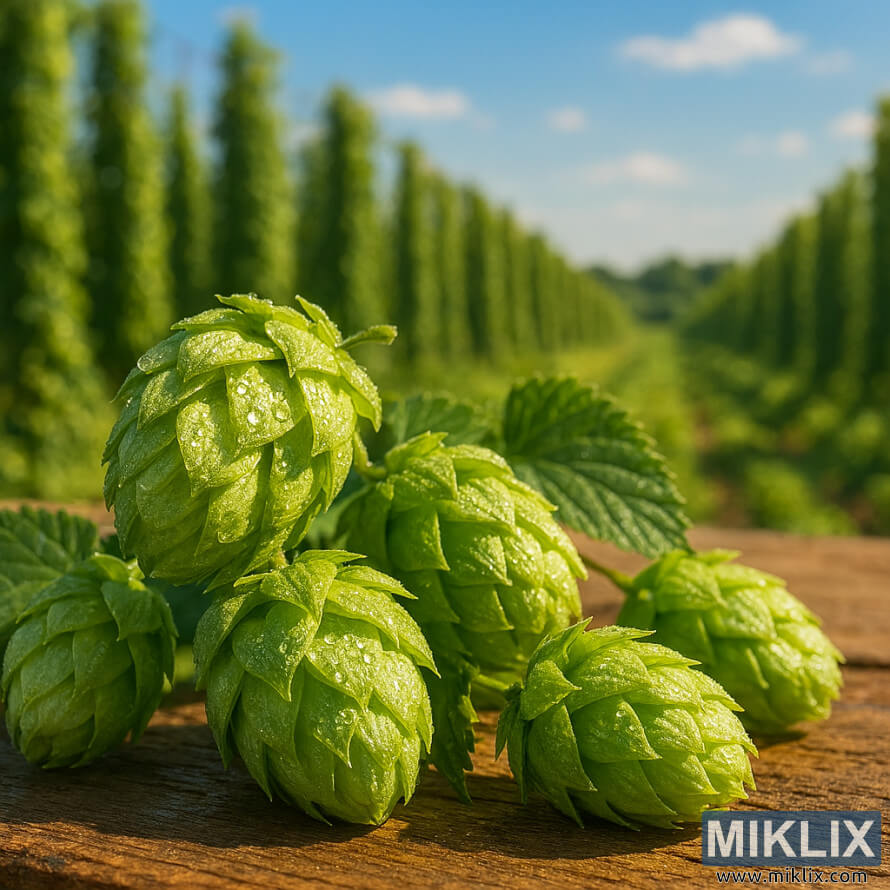
Click or tap the image for more information and higher resolutions.
Although closely associated with Polish hops today, Lubelska's roots trace back to Saaz cultivar material from Žatec in Czechia. This connection links Central European noble-hop character to modern Polish cultivation and craft-brewing practices.
This article is aimed at U.S. craft brewers, homebrewers, and brewing professionals. It offers practical guidance on using Lubelska hops in brewing. We will explore its brewing uses, chemistry, sensory impact, and handling. This will help you determine if Lublin hops are right for your recipes.
Key Takeaways
- Lubelska hops (Lublin hops) are an aroma-focused, noble-type hop favored for late additions and dry hopping.
- Also known as the Lublin noble hop, it shares heritage with the Saaz cultivar yet is strongly associated with Polish hops.
- Use Lubelska to add delicate floral and spicy aroma without overpowering malt or yeast character.
- Target audiences include craft breweries and homebrewers in the United States seeking classic European aroma profiles.
- Upcoming sections will detail botanical data, flavor use cases, substitutes, and storage best practices.
Origins and genealogy of Lubelska hops
Lubelska hops trace their roots back to Žatec in Czechia, where the Saaz cultivar lineage started. Saaz, a classic noble hop, has shaped Central European brewing for centuries. Plant breeders chose Saaz material that thrived in Polish soils, leading to variants used by local growers.
Commercial catalogs list Lubelska's country of origin as Poland and use the international code LUB. The name, appearing in forms like Lublin or Lubelski, reflects ties to the city of Lublin. These Polish identifiers remained after widespread cultivation and trade through the 20th century.
The Lublin hop genealogy explains why brewers expect noble, floral, and earthy notes from Lubelska. Its genetic link to Saaz sets a baseline for aroma and bitterness. This knowledge guides brewers in selecting hops for lager, Pilsner, and other traditional European styles.
Polish hops history reveals a pattern of adopting and adapting foreign cultivars. Growers in Poland propagated Saaz-derived plants under local names. Over time, the hop became synonymous with Polish agriculture and brewing, while its Saaz lineage remained part of its identity.
- Žatec origin: ties to Saaz and Czech brewing tradition
- Commercial identity: listed as Polish with code LUB
- Genealogy impact: flavor expectations for brewers
Botanical and chemical profile of Lubelska
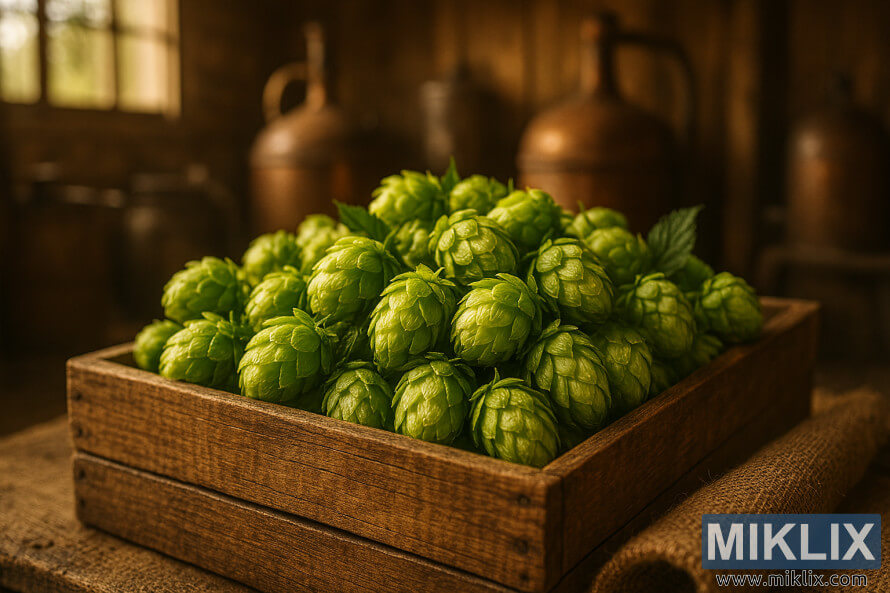
Lubelska is a traditional European aroma hop known for its gentle, noble-like character. It exhibits typical bine vigor and cone size found in Central European cultivars. Growers appreciate its firm, elongated cones, which dry well and retain aromatic oils.
Alpha acid content in Lubelska falls within the low–moderate range, usually between 3–5%. The average is around 4%. Beta acids range from 2.5–4%, with an alpha-beta balance near 1:1. Co-humulone values are between 22–28%, affecting bitterness in kettle additions.
Total oils in Lubelska are modest, ranging from 0.5–1.2 mL per 100 g, averaging 0.9 mL. This modest oil content positions Lubelska as an aroma-lead variety rather than a bittering hop. Its oil weight facilitates efficient extraction in late additions and dry hopping.
The dominant components of Lubelska's oil composition are humulene farnesene myrcene. Myrcene typically makes up 22–35% of the oils, averaging about 28.5%. This gives a subtle green and resinous base. Humulene is unusually high for Lubelska, often 30–40% with an average near 35%.
Farnesene is particularly notable in Lubelska, commonly 10–14% and averaging 12%. This elevated farnesene contributes magnolia and floral top notes, adding a lavender-like lift to floral and earthy aromatics.
- Myrcene: 22–35% (avg 28.5%)
- Humulene: 30–40% (avg 35%)
- Caryophyllene: 6–11% (avg 8.5%)
- Farnesene: 10–14% (avg 12%)
Minor compounds like β-pinene, linalool, geraniol, and selinene appear in trace amounts. These traces refine the hop's floral and green profile, enhancing complexity when blended or used in subtle late additions.
Interpreting Lubelska's chemical profile reveals its aroma-focused role in brewing. Its low alpha acid content makes it suitable for late kettle or whirlpool additions. High humulene and farnesene steer the aroma toward floral, magnolia, and gentle green notes, rather than bright citrus or resin-heavy character.
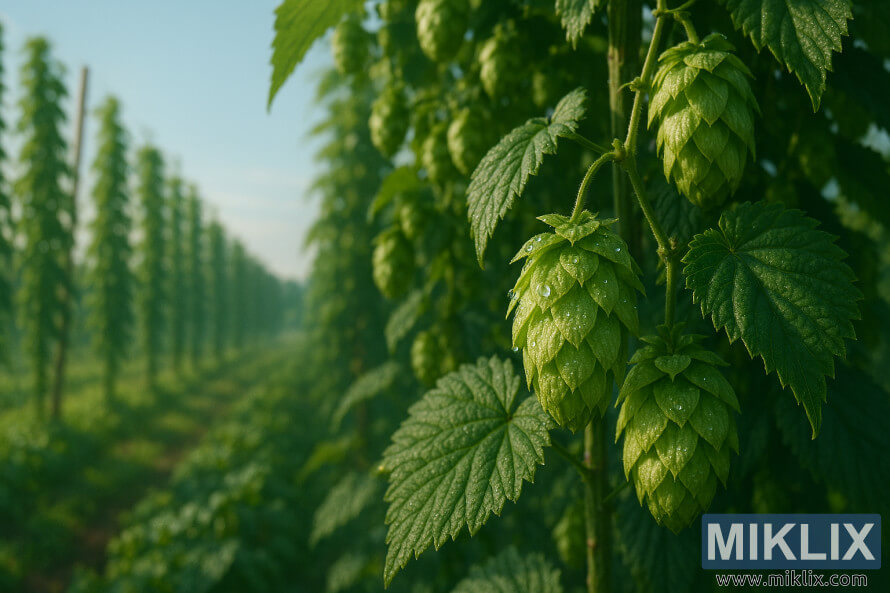
Click or tap the image for more information and higher resolutions.
Flavor and aroma characteristics valued by brewers
Brewers highly value Lubelska for its clean, refined flavor profile. It brings floral complexity without harsh sharpness. The variety often presents as magnolia lavender hops on the nose, offering a soft, perfumed top note. This pairs well with malt-driven backbones.
Many tasters note floral spicy hops in the midnote. Gentle spice lifts the bouquet without overwhelming it. Herbal undercurrents balance the flowers, while a subtle pinch of baking spice rounds the palate.
Late-harvest crops can show pronounced bergamot cinnamon hop notes. These notes include a light citrus edge that hints at lemon peel. The bergamot highlights add a bright counterpoint to the more floral magnolia and lavender character.
To preserve delicate aromatics, brewers favor late kettle additions, whirlpool hops, or dry hopping. These techniques help maintain oil-driven aromatics. They allow the magnolia lavender hops to fully express in the finished beer.
Final blends benefit from Lubelska’s restrained personality. It adds complexity and subtle elegance when a noble-floral character is desired. However, it will not push the beer toward aggressive citrus or tropical extremes.
Brewing uses: where Lubelska shines
Lubelska is all about aroma, not bitterness. It's perfect for late boil additions and whirlpool treatments. Its volatile oils bring out floral and herbal notes. Use it to preserve delicate scents like magnolia and lavender.
Handling it with care is key. Avoid long, high-heat boils to keep its essential oils intact. A short late boil and a gentle whirlpool treatment will preserve its aroma without adding harsh bitterness.
It's also great for fermentation additions. Dry hopping with Lubelska at moderate rates enhances the scent without upsetting the balance. Pair it with a straightforward bittering hop for a solid alpha-acid backbone. Remember, Lubelska is for enhancing aromas, not for bittering.
- Use late boil hop addition to keep aroma bright.
- Deploy whirlpool Lubelska at cooler whirlpool temperatures to retain humulene and farnesene.
- Apply Lubelska dry hop for fresh floral lift during conditioning.
On brew day, consider its low–moderate alpha acids, usually 3–5 percent, when calculating IBUs. A blend of strategy and timing is crucial for extracting the best scent without affecting mouthfeel. Small changes in dosage and contact time lead to consistent, aromatic results.
Start with small-scale trials before scaling up. Keep records of hop weights, contact times, and temperatures for late boil, whirlpool, and dry hopping. This way, you can replicate the desired scent profile in your recipes.
Click or tap the image for more information and higher resolutions.
Beer styles that benefit from Lubelska hops
Lubelska hops introduce a soft floral and noble spice, enhancing various beer styles. They add a subtle earthy note to European lagers, without overpowering them with citrus. This balance is key.
In ales, Lubelska contributes refined floral and peppery notes. It's often blended with brighter hops in Pale Ales to achieve balance. Used sparingly in IPAs, it brings a restrained, old-world charm that complements modern hops.
Wheat beers benefit from Lubelska's echo of yeast phenolics. In German hefeweizens and American wheat ales, it enhances clove-like and floral impressions. This is done without overwhelming the banana esters.
Saisons and farmhouse ales appreciate the hop's spicy-fragrant profile. Lubelska supports complex yeast-driven flavors. It can also act as a finishing note, brightening malt and peppery yeast tones.
- European Lagers: use Lubelska for lagers to add noble floral-earthy lift.
- Pale Ales: blend a touch for floral backbone without masking malt.
- IPAs: use Lubelska in IPAs in modest doses to avoid being drowned by citrus-forward hops.
- Wheat beers: wheat beers Lubelska pairs well with yeast phenolics and light malt.
- Saisons: add as a finishing hop to support spicy yeast character.
When pairing, use Lubelska in moderation in highly hopped beers. This ensures it remains present but doesn't get lost. In delicate styles, let this hop be a defining aromatic note, rather than a dominant force.
Lubelska hops: bitterness and mouthfeel considerations
Lubelska hops are known for their gentle bitterness. With alpha acids ranging from 3–5%, they contribute a mild bitterness. Brewers often use them for late additions and dry hopping, reserving higher-alpha varieties for precise IBU targets.
The alpha acids in Lubelska, along with a co-humulone near 25%, result in a softer bitterness. This makes them ideal for aroma-focused beers like pilsners, saisons, and session ales. Early additions in the boil yield a subtle, rounded bitterness, avoiding a sharp bite.
The mouthfeel impact of Lubelska hops is minimal. Their essential oils enhance aromatic complexity and freshness. However, they do not significantly alter the beer's body or viscosity. The true mouthfeel changes come from the grain bill, yeast strain, and fermentation choices.
Blending hops can balance bitterness and texture. Use Lubelska for its aroma and nuanced bitterness, then blend with a higher-alpha hop for calculated IBUs. This preserves the delicate floral and spicy notes while achieving the desired bitterness.
Lubelska hops are well-suited for aging and stability. Their moderate beta acids and balanced alpha-beta ratio ensure steady aroma retention and predictable bitterness over time. Proper storage of hops is crucial to maintain both aroma compounds and alpha acids through aging.
- Best use: late-kettle and dry hop additions for aroma and mild bitterness.
- When to avoid: sole bittering hop in high-IBU recipes.
- Blending tip: pair with high-alpha bittering hops to hit IBUs while keeping aromatic character.
Substitutes and comparisons to Lubelska
When Lubelska is hard to source, experienced brewers recommend a few reliable substitutes. Saaz, in both Czech and U.S. forms, is often at the top of the list. Sterling and Tettnang also work well, depending on the recipe.
The debate between Saaz and Lubelska is common in brewing forums. Saaz closely mirrors Lubelska's noble, earthy, and floral characteristics in lagers and pilsners. Despite genetic ties, small variations in farnesene and humulene can affect floral notes.
Tettnang serves as a good substitute for its noble and spicy character with a hint of herbal notes. It can replicate the backbone of a beer with a Lubelska-forward profile, especially in late additions or dry hops.
- Saaz: closest genetic alternative; best for preserving magnolia and lavender tones when used in late additions.
- Tettnang: steady noble profile; useful where a slightly spicier finish is acceptable.
- Sterling: leans herbal-citrus; fits beers that tolerate brighter top notes.
When swapping hops, adjust late additions to protect aroma. Expect small shifts in magnolia and lavender intensity. Brewers often increase dry hop weight slightly to compensate for aromatic loss when a substitute replaces Lubelska.
Hop comparison Lubelska should include format limitations. No lupulin powder versions such as Cryo, LupuLN2, Lupomax, or Hopsteiner concentrates are available for Lubelska. This removes a concentrated substitution route others rely on for aroma intensity.
Practical tips: perform a bench trial with a single-batch substitution, note how Saaz vs Lubelska shifts the floral balance, and tweak late hop timing. This method keeps recipes true to their original intent while allowing for ingredient variation.
Availability, sourcing and purchasing Lubelska hops
Lubelska hops are listed in many catalogs under the international code LUB and the country code POL. Retailers and wholesale Lubelska suppliers often show alpha and beta ranges, harvest year, and package sizes. It's crucial to check these details before buying Lubelska hops to ensure they match your recipe needs.
Multiple marketplaces and specialized hop merchants carry stock, including some listings on Amazon and dedicated brewing suppliers. When comparing Lubelska availability among vendors, look for the best price and freshest lots. Inventory can vary by region and crop year.
When you purchase Lublin hops online, expect standard payment options such as major credit cards, PayPal, Apple Pay, and Google Pay. Reputable vendors use secure payment processing and do not retain full card numbers. It's important to review vendor policies for shipping, returns, and freshness guarantees.
Crop year matters. A late harvest can bring stronger bergamot and lemon notes, while earlier years may read cleaner. Ask Lubelska suppliers for tasting notes, alpha acid test results, and storage conditions to assess quality before you purchase Lublin hops.
Practical buying steps:
- Confirm the harvest year and alpha/beta ranges.
- Compare package sizes and prices from at least three Lubelska suppliers.
- Check seller reviews and freshness or storage statements.
- Review payment and shipping options to the United States.
Expect some variability by crop year and supplier. Track Lubelska availability across seasons and keep notes on supplier analytics to guide future purchases and recipe planning.
Click or tap the image for more information and higher resolutions.
Practical recipe examples using Lubelska hops
Below are compact recipe frameworks that use Lubelska primarily in whirlpool and dry-hop stages. These examples show flexible hop schedule Lubelska choices while keeping bitterness controlled with a neutral high-alpha bittering hop at 60 minutes when IBUs are required.
- European lager framework — use a classic Pilsner or Lager malt bill. Add a neutral bittering hop at 60 minutes for target IBUs. Whirlpool Lubelska at 5–10 g/L for 15–30 minutes to lift noble florals. Dry-hop 2–4 g/L for gentle aroma and a clean finish. This Lubelska lager recipe favors restraint and balance.
- Pale ale framework — base with Maris Otter or two-row, crystal 5–8% for color. Bitter with UK Goldings or Nugget at 60 minutes. Add Lubelska as late kettle hops, 10–20 g per 5 gal, and dry-hop 5–10 g per 5 gal for floral top notes. Use hop schedule Lubelska to time late additions at 10–0 minutes and a moderate whirlpool rest for aroma extraction.
- Saison/Wheat framework — lighter base with pilsner malt or wheat adjuncts. Keep late additions of Lubelska to 8–15 g per 5 gal and mirror that in a short dry-hop for layered citrus and floral lift. Place Lubelska near the end of the boil to preserve delicate bergamot character without masking spicy yeast phenolics.
- IPA approach — employ a higher-alpha bittering hop at 60 minutes to set IBUs. Use Lubelska as a late-hop accent and dry-hop component rather than primary bittering. For a Lubelska IPA recipe, add 15–25 g per 5 gal in late additions and 10–15 g in dry-hop. Expect subtle floral-citrus notes that complement resinous American varieties when used sparingly.
Notes on late-harvest Lubelska: if hops show enhanced bergamot or lemon, reduce citrus-forward additions elsewhere to keep the beer balanced. Adjust whirlpool temperature to 72–80°C to favor aroma extraction without excessive vegetal oils.
These Lubelska recipes and hop schedule Lubelska suggestions are frameworks meant for adaptation. Scale grams per volume, tweak timing, and taste at each stage to refine the final beer.
Processing and storage best practices for Lubelska
Lubelska hops are rich in volatile oils such as myrcene, humulene, and farnesene. To maintain their freshness, it's crucial to limit exposure to oxygen and heat from the moment of harvest to brewing. Cold storage is key in slowing down oil loss, thus preserving the delicate bergamot and floral notes.
Vacuum packing hops is highly recommended. This method significantly reduces oxygen contact, thereby extending the hops' shelf life. If vacuum packing is not feasible, ensure that whole-cone or pellet bags are tightly sealed, removing as much air as possible.
Adhere to the best practices for hop storage: maintain a frozen temperature of -18°C (0°F) or below. Store hops in opaque containers and label them with the harvest year. This practice ensures that you select the freshest lots for aroma-forward additions.
- Prefer pellets for compact storage, but still freeze and seal them.
- Whole-cone hops require careful handling to avoid crushing and oxidation.
- Since cryo or lupulin powder is not available for Lubelska, manage whole-cone and pellet formats accordingly.
When transferring hops to the brewhouse, thaw sealed packs in a refrigerator to minimize condensation. Once opened, use the hops promptly. To preserve Lubelska's freshness, schedule late additions, whirlpool hops, and dry-hop steps rather than prolonged boil times.
- Store Lubelska hops in vacuum or airtight freezer bags.
- Keep inventory rotated by harvest year to use the freshest lots first.
- Minimize time at room temperature during handling and transfer.
To retain aroma, avoid prolonged exposure to high heat. Late kettle additions and short whirlpool rests help lock in citrus and floral character. Dry-hop after primary fermentation to capture bright oils and maximize sensory impact.
Implement these hop storage best practices to safeguard aroma and flavor. Effective cold-chain routines and vacuum pack hops help preserve the signature profile that brewers seek in Lubelska varieties.
Click or tap the image for more information and higher resolutions.
Impact of Lubelska on sensory evaluation
Lubelska introduces a distinct floral profile, with magnolia and lavender dominating the aroma. Beneath these, a noble earthiness provides balance and depth. This combination creates a harmonious experience for the senses.
In aroma evaluation, Lubelska reveals herbal undertones and subtle spice. Tasters often pick up on cinnamon and bergamot. These notes intensify with late-harvest cones and warm whirlpool additions.
To truly appreciate Lubelska hops, taste beers with minimal hop varieties. Blind triangle tests are effective for both trained panels and homebrewers. They help identify the subtle floral differences.
Yeast and malt significantly influence the perceived flavor. Yeast esters in saisons and wheat beers can either enhance or clash with floral-spice notes. Small-batch trials are crucial for finding the right pairings before scaling up.
Over time, aging affects the aroma. Volatile oils mellow, while the noble character remains when stored cool and sealed. Monitoring these changes in aroma evaluation Lubelska is essential.
- Use late additions or dry hop to bring forward bergamot and lemon notes found in tasting notes Lublin hop.
- Keep malt bill simple to avoid masking magnolia and lavender.
- Run triangle tests for consistent sensory Lubelska hops assessment across tasters.
Lubelska in commercial brewing and craft trends
Lubelska commercial brewing stands out for breweries aiming at noble, floral flavors and a rich heritage. It's perfect for European-style lagers and ales with notes of magnolia and lavender. Small to mid-size producers prefer it for its subtlety, avoiding the high-citrus intensity found in other hops.
The interest in Lubelska among brewers is steady, driven by a quest for authenticity. Tasting rooms and brewpubs showcase the hop's presence on menus and packaging, emphasizing tradition. Big names like Sierra Nevada and Boston Beer Company have explored recipes that highlight complexity over harsh bitterness.
However, Lubelska's popularity is constrained by supply issues. The lack of lupulin or cryogenic products makes it less appealing for large-scale operations that rely on consistent, intense extracts. Crop-year variability forces brewers to plan blends or use Lubelska as a finish hop, where small amounts achieve the desired aroma.
- Commercial adoption: ideal for lagers, pilsners, and classic ales.
- Market limits: inconsistent availability and no cryo substitutes.
- Opportunity: differentiation through packaging, tasting notes, and taproom storytelling.
Smaller breweries can use Lubelska to create a unique brand identity. By focusing on floral aromatics and heritage, they attract consumers looking for nuanced flavors. This approach supports Lubelska commercial brewing and keeps craft trends alive in local markets.
Retail and draft programs can highlight Lubelska's popularity without exaggerating its volume. Emphasizing its origin, harvest year, and pairing suggestions integrates it into a craft story that consumers find compelling.
Technical brewing data and typical analytics for Lubelska
Lubelska alpha acid levels are generally lower than those of high-alpha varieties. The alpha acid range is 3–5%, with an average of 4%. Beta acids range from 2.5–4%, averaging 3.3%.
Co-humulone levels in Lubelska are moderate, between 22–28% of total alpha fractions. This information is crucial for brewers aiming to achieve the right balance in their recipes. For accurate hop analytics Lubelska, refer to the supplier's certificate of analysis for the specific harvest year.
- Total oils: 0.5–1.2 mL/100g, with an average of 0.9 mL/100g.
- Myrcene: 22–35%, averaging 28.5% of oils.
- Humulene: 30–40%, averaging 35% of oils.
- Caryophyllene: 6–11%, averaging 8.5%.
- Farnesene: 10–14%, averaging 12%.
Understanding Lubelska's oil composition is key to predicting its aroma. The high humulene content contributes to floral and noble aromas. Myrcene adds green and fruity notes, while caryophyllene and farnesene introduce spice and delicate topnotes.
For brewing calculations, use the average Lubelska alpha acid value to estimate IBUs. If used primarily for late additions, Lubelska's contribution to IBUs will be minimal. Plan for base bitterness from higher-alpha hops if achieving a specific IBU is crucial.
- Use the average alpha acid (≈4%) for bittering calculations if Lubelska is used as a bittering hop.
- When used as an aroma hop, set the Lubelska IBU calculation to near-zero and allocate IBUs to other hops.
- Adjust utilization based on wort gravity and boil time for accurate IBU predictions.
Year-to-year crop variation impacts these analytics. Always review the lot-specific hop analytics Lubelska provided by growers like Polish hop cooperatives or commercial suppliers. This step helps minimize batch-to-batch flavor drift in production.
Combining lab data with sensory checks provides the best insight for formulation. Track Lubelska IBU calculation outcomes alongside tasting notes to refine recipes over time.
Conclusion
Lubelska hop summary: Lubelska, also known as Lublin or Lubelski, is a noble hop derived from Saaz. It's celebrated for its notes of magnolia, lavender, and light florals, with a hint of spice. Its low alpha acids, usually around 3–5%, are perfect for late additions and dry hopping. This preserves delicate oils, enhancing aroma without harsh bitterness.
Choosing Lubelska hops means embracing subtle elegance over bright citrus. It's ideal for European lagers, classic ales, wheat beers, and saisons. If Lubelska is hard to find, Saaz, Tettnang, or Sterling can serve as good substitutes, offering similar noble character.
Lubelska brewing tips: Ensure you purchase from trusted suppliers. Verify the harvest year and lab analytics. Store the hops cold in oxygen-free packaging to maintain volatile oils. Avoid long boils to preserve the delicate magnolia and lavender notes. Opt for hop schedules that highlight late additions and dry hopping.
For brewers seeking refined, traditional floral and herbal depth, Lubelska is a standout choice. Use it judiciously as an aroma hop. It will elevate classic styles with subtle complexity and timeless charm.
Further Reading
If you enjoyed this post, you may also like these suggestions: