
Fermenting Beer with White Labs WLP565 Belgian Saison I Yeast
Published: March 15, 2026 at 7:17:48 PM UTC
White Labs WLP565 Belgian Saison I Yeast is a favorite among brewers aiming for the rustic, spicy essence of Wallonian saisons. It's specifically designed for brewing saison-style beers.
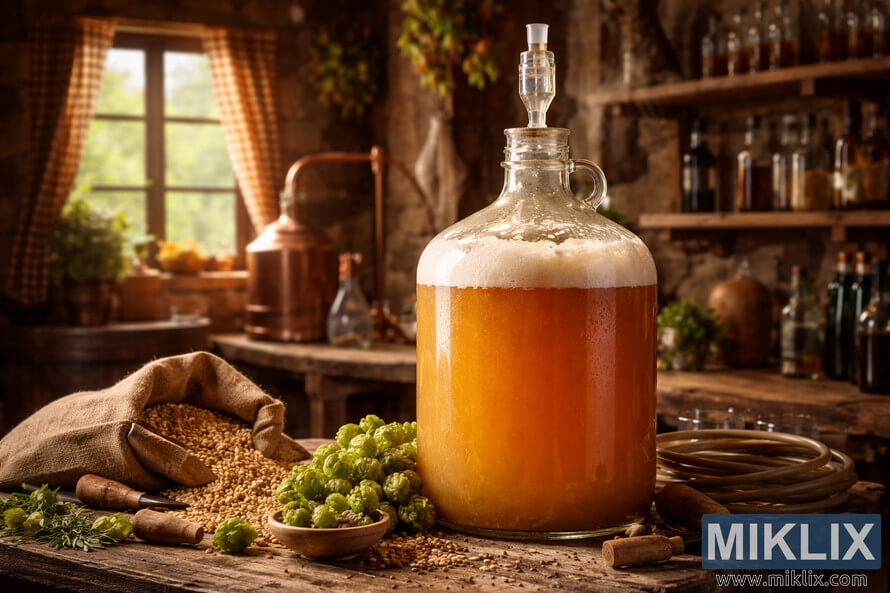
Click or tap the image for more information and higher resolutions.
On the palate, WLP565 offers earthy, peppery, and spicy flavors with a hint of lingering sweetness. This suits the traditional Belgian saison fermentation profile. Its attenuation is typically in the mid 60s to mid 70s, though some reports suggest higher ranges. The yeast's flocculation is medium, influencing both mouthfeel and clarity.
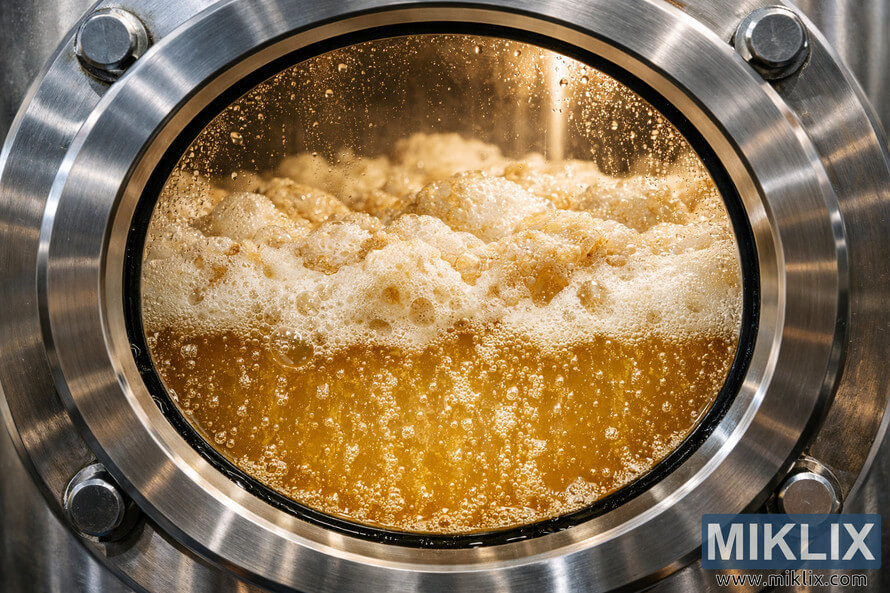
Fermentation with WLP565 can be quite lively. Brewers often let the temperature rise freely and ensure thorough wort oxygenation to aid complete fermentation. Review threads for WLP565 mention occasional stalls followed by later re-fermentation. Some brewers finish with a cleaner strain, like WLP001, to achieve additional dryness in high-gravity saisons.
Key Takeaways
- White Labs WLP565 Belgian Saison I Yeast is formulated for saison-style beers and shipped in White Labs PurePitch pouches.
- The strain produces earthy, peppery, and spicy flavors that define Belgian saison fermentation.
- Expect medium flocculation and moderate to high attenuation, with possible variability between sources.
- Thorough oxygenation and a temperature free-rise help avoid stalls; some brewers add a finishing strain when extra dryness is desired.
- WLP565 review reports and handling notes recommend thermal packaging and proper storage to preserve viability.
Why Choose White Labs WLP565 Belgian Saison I Yeast for Saison Brewing
White Labs WLP565 Belgian Saison I is a top pick for brewers aiming to capture the essence of farmhouse ales. This strain comes from Wallonia and is a staple in White Labs’ collection, with organic options available. Its origins in Belgian brewing traditions make it accessible to both homebrewers and professionals.
Profile overview and origin
The strain's roots are deeply in Wallonia, Belgium. This heritage explains its unique characteristics and performance. Brewers find it ferments cleanly, adding a rustic touch to their saisons.
Flavor and aroma contributions: earthy, peppery, spicy notes
This yeast brings a distinct flavor profile with earthy, peppery, and spicy notes. When allowed to free-rise, it enhances phenolic spice and farmhouse funk. These aromas complement light malt bills and citrus or herbal adjuncts.
Why it’s suited for traditional Wallonian saisons
The strain's phenolic expression aligns with the traditional Belgian saison character. It has moderate attenuation, preserving a malt backbone. This supports the rustic profile without overshadowing the yeast-driven spice. Brewers aiming for authenticity will find WLP565 meets classic Wallonian saison expectations.
Click or tap the image for more information and higher resolutions.
Understanding Attenuation and Mouthfeel with WLP565
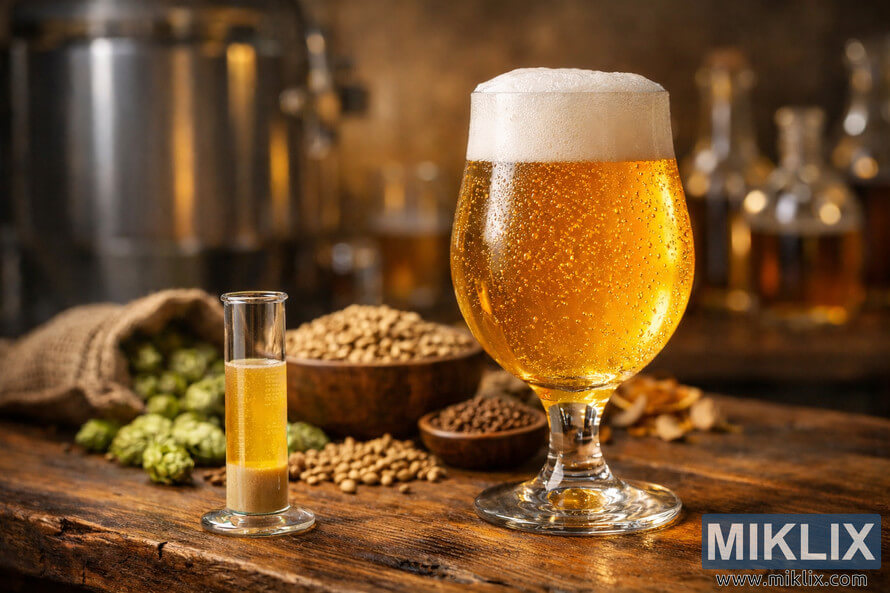
WLP565 attenuation is key to a saison's finish and malt presence. Brewers often see attenuation between 65–75%. This range leaves a noticeable malt presence without being cloying.
- Attenuation range and expected residual sweetness
- Attenuation around 65–75% leaves some residual sweetness. This balances yeast esters without heaviness.
- Higher values, 78–85%, might reflect test variance or packaging differences. Higher attenuation results in a drier taste.
- How attenuation influences body and malt perception
- Mid-range attenuation keeps the saison mouthfeel chewy. It balances spice and phenolics with a strong malt backbone.
- Higher attenuation makes the beer lighter, increasing perceived dryness and alcohol. This changes how hops and spices taste.
- Managing expectations for high gravity saisons
- High gravity saisons can stall or leave more residual extract. Plan your mash and fermentables to avoid unfermentable sugars.
- To achieve a drier finish, brewers often use WLP001 after 50–75% attenuation. Staggered pitching helps reach beyond WLP565's typical range.
- Monitor gravity closely and adjust pitching rate, oxygenation, or nutrient additions early. These steps reduce stress and improve attenuation in high gravity saisons.
Click or tap the image for more information and higher resolutions.
Fermentation Temperature Range and Management
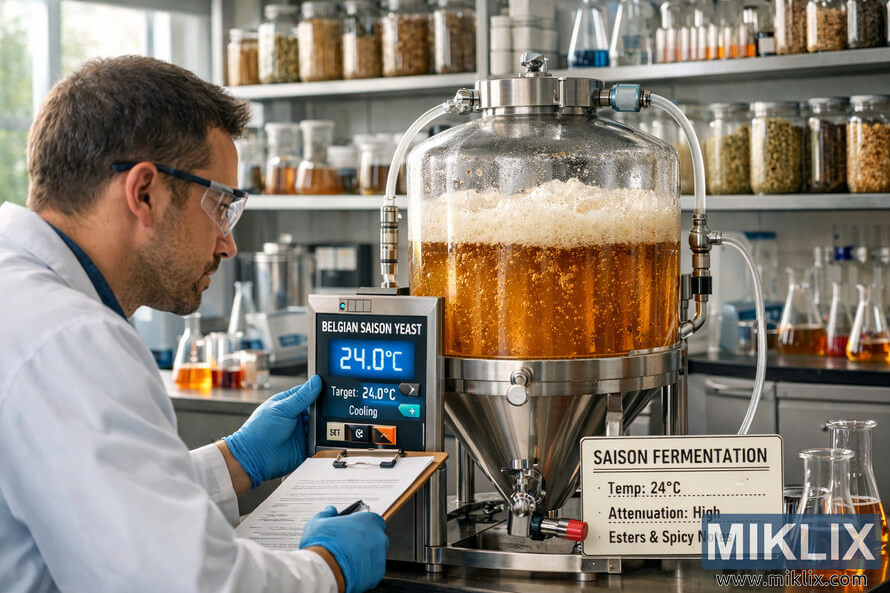
The fermentation temperature for WLP565 spans a broad range, crucial for developing the unique saison character. White Labs suggests a range of 68–85°F (20–30°C). A specific recommendation is to aim for 68–75°F for a balanced flavor. Adjusting the temperature within this range can influence the levels of phenolics and esters.
Recommended temperature window (68–85°F / 20–30°C)
Begin fermentation near the lower end of the range for a cleaner, spicier profile and better attenuation. Moving towards the mid 70s enhances earthy and peppery notes. Fermenting in the upper 70s to low 80s can lead to higher ester levels and a drier finish.
Free-rise fermentation technique for optimal character
Free-rise fermentation allows the yeast to naturally warm up as activity peaks. Start by pitching the yeast at a cooler temperature. Then, let the wort warm up to the desired range without strict temperature control. This method enhances the strain's spicy characteristics.
Timing the free-rise to coincide with krausen formation is key. A gradual rise helps avoid fusel formation while promoting complex aromas.
Temperature control tips for homebrewers in the United States
Effective temperature control doesn't require complex equipment. Use an insulated cooler, a heat wrap with a thermostat, or a warm room. For those seeking precision, a fermentation chamber is an option.
- Monitor krausen and gravity daily to track progress.
- Avoid sustained temperatures above 85°F to prevent off-flavors.
- If fermentation stalls, a brief controlled rise can help complete fermentation.
Click or tap the image for more information and higher resolutions.
Pitching Rates and PurePitch Next Generation Benefits
Starting with the right yeast count is crucial for a clean, steady fermentation of saisons. White Labs' PurePitch Next Generation comes in a pouch with a cap. This design combines the ease of a vial with the advantages of a larger pitch. It makes it easier for brewers to hit their target cell counts without extra effort.
What the higher pitch supplies
PurePitch Next Generation offers double the usual pitch at 7.5 million cells/mL. This increased concentration supports commercial-style pitching rates. It also reduces the need for a time-consuming starter for most 5–10 gallon batches. Brewers can count on a strong initial population, which shortens lag time and promotes predictable attenuation.
When to consider a starter
For very high gravity saisons or when expecting long transit or lag times, a starter or additional pitching is still advisable. Even with PurePitch Next Generation, extreme original gravities or extended warm storage can lower viability. Determine the need for a yeast starter based on wort gravity, pitching schedule, and the urgency of starting fermentation.
How correct pitching improves fermentation
Meeting the recommended WLP565 pitching rate reduces yeast stress and minimizes off-flavors like solventy higher alcohols and lingering diacetyl. Adequate pitching ensures consistent phenolic and peppery character from the strain. A healthy initial cell count also helps avoid prolonged stalls and supports reaching target attenuation without repeated interventions.
- Use PurePitch Next Generation to simplify pitching for standard-strength saisons.
- Plan a starter when targeting very high alcohol levels or when viability is uncertain.
- Track pitching yeast cells/mL to match White Labs guidance for WLP565 pitching rate and reliable performance.
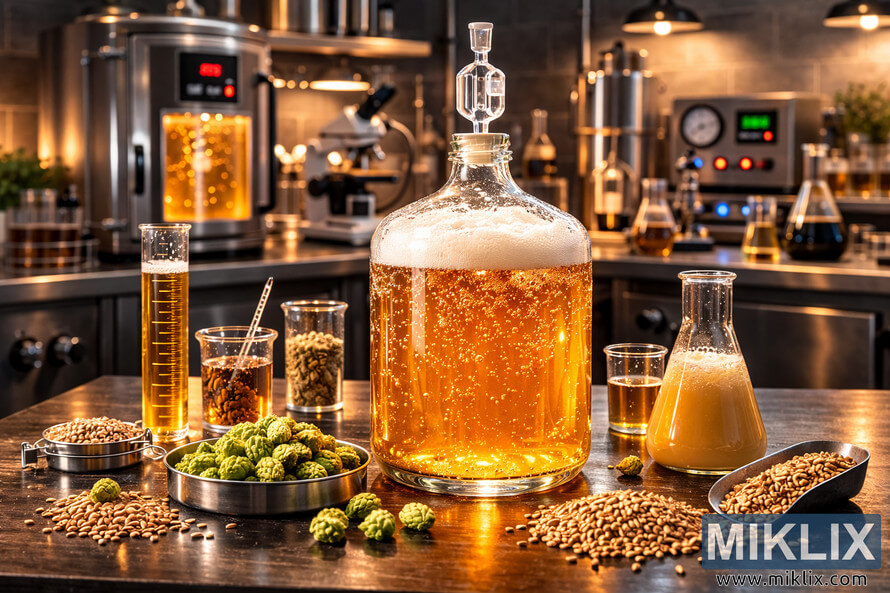
Click or tap the image for more information and higher resolutions.
Oxygenation and Nutrient Needs for Complete Fermentation
Preparing wort thoroughly before pitching is key for a healthy saison fermentation. White Labs emphasizes the importance of oxygenation for WLP565 to avoid stalls and support yeast growth. Ensure the yeast has enough oxygen to build biomass and start fermenting vigorously.
Here are some practical tips for oxygenating wort and ensuring proper fermentation nutrition for saison strains.
- Target dissolved oxygen near 8–10 ppm for typical pitches when using pure cultures. Use pure oxygen with a diffuser for best control on high gravity worts.
- For lower gravity batches, vigorous shaking or aeration with clean air can suffice if done immediately before pitching.
Saison yeast nutrients are often necessary for WLP565, especially in high gravity recipes. These strains quickly consume free amino nitrogen and trace minerals. Add a balanced yeast nutrient or a White Labs/Wyeast nutrient blend to the wort pre-pitch when brewing rich or sugary saisons.
- Measure original gravity and adjust nutrient dose upward for worts above 1.065.
- Include zinc, magnesium, and B vitamins when using adjuncts or simple sugar additions that dilute malt-derived nutrients.
- Consider a staggered nutrient addition: part at boil, part at chill, to improve uptake during growth and fermentation phases.
Watch for signs of oxygen or nutrient deficiency in fermentation. A sluggish start, long lag time, weak krausen, or a stalled gravity drop indicate insufficient nutrition.
If deficiency appears early, gentle re-oxygenation within the first 12–18 hours can revive activity. Avoid oxygenating later in active fermentation to reduce oxidation risk. When in doubt, measure gravity and monitor krausen before taking corrective steps.
Click or tap the image for more information and higher resolutions.
Fermentation Behavior: Stalling and Restarting Patterns
WLP565 can exhibit uneven activity during fermentation. Brewers often witness a slow start, followed by a pause, and then renewed vigor days or weeks later. This unpredictable timing necessitates careful tracking of gravity and yeast health for consistent results.
Common stall behavior with WLP565 and why it happens
White Labs notes that the strain may stall and then restart up to two weeks later. Causes include low initial oxygen, underpitching, nutrient limits, and temperatures below the strain’s comfort zone. High gravity worts increase the risk of a stalled fermentation due to osmotic stress and alcohol inhibition.
Monitoring gravity and recognizing re-fermentation
Monitor specific gravity daily during the active phase, then every two to three days as activity slows. A plateau signals a stall. Look for renewed krausen, bubbles in the airlock, or a drop in gravity to confirm re-fermentation. Record readings to spot subtle declines that signal yeast activity has resumed.
Practical steps when fermentation appears to stall
- Verify oxygen and pitching: Ensure proper oxygenation at pitch and use PurePitch or a starter to avoid a WLP565 stall from underpitching.
- Raise temperature: Allow a free-rise or gently warm the fermenter toward the higher end of the recommended range to encourage a restart fermentation.
- Gently rouse yeast: Swirl or stir the fermenter to resuspend yeast if gravity has held steady for several days and no spoilage signs appear.
- Add nutrients: A measured dose of yeast nutrient can relieve a nutrient-limited saison stalled fermentation.
- Consider repitching: For prolonged stalls, repitch a robust finishing strain such as WLP001 or a fresh WLP565 starter to complete attenuation, especially in high gravity saisons.
Alcohol Tolerance and High Gravity Considerations
WLP565's alcohol tolerance varies across White Labs documentation. Some pages mention medium tolerance, while others report very high tolerance, sometimes exceeding 15%. This discrepancy highlights the need for brewers to consider WLP565's alcohol tolerance as conditional. Factors such as pitch rate, oxygenation, nutrients, and temperature control play a crucial role.
When brewing high-gravity saisons, it's essential to prioritize yeast health. Begin with thorough wort oxygenation, use PurePitch or a suitable starter, and add yeast nutrients early. These steps increase the likelihood of strong attenuation without prolonged fermentation stalls.
- Pitching: use higher cell counts to reduce stress and shorten lag time.
- Oxygen: aim for thorough dissolved oxygen at the start, especially for very high OGs.
- Nutrients: provide zinc and nitrogen sources to support extended fermentations.
- Temperature: free-rise initially, then allow a controlled warm phase to help finish sugars.
For saisons with very high ABV, blending yeast strains can be beneficial. A robust saison strain handles ester and phenol production, while a cleaner ale strain can tackle difficult sugars. This approach balances the beer's character and attenuation, fitting well into high gravity saison strategies.
White Labs suggests adding a finishing yeast when WLP565 slows down near mid-fermentation. Introducing a clean, attenuative strain after roughly 50–75% attenuation can help reach the target gravity. WLP001 finishing strain is often chosen for this role due to its ability to ferment dextrins cleanly and preserve the saison's spice.
- Monitor gravity trends rather than a fixed timetable.
- If the drop stalls and oxygenation or nutrients won’t help, prepare to add a finishing strain.
- Pitch WLP001 finishing strain at moderate temperatures to avoid undoing phenolic complexity.
Implementing these strategies can effectively manage WLP565's alcohol tolerance and ensure reliable high gravity saison brewing. Thoughtful planning minimizes risks and helps maintain the beer's style integrity while achieving higher alcohol levels.
Flocculation and Clarity Expectations
WLP565 exhibits medium settling behavior, leading to a moderate drop of yeast after fermentation. This results in saisons with a hint of haze due to suspended proteins and polyphenols. Brewers aiming for a clearer pour should implement conditioning steps that promote yeast compaction without losing the beer's rustic essence.
Employ gentle conditioning at cellar temperatures for weeks to allow yeast and trub to settle fully. This slow maturation enhances saison clarity while maintaining delicate phenols and esters. Premature aggressive handling can re-suspend solids, hindering clarity.
- Cold crash saison batches moderately to accelerate drop-out, but avoid extreme chilling that mutes aroma.
- Extended time in the bright tank or keg often yields clearer beer than quick refrigeration.
For brewers aiming for near-bright presentations, consider fining or light filtration. Irish moss during the boil and post-fermentation agents like gelatin or Biofine can reduce haze without heavy processing. Filtration, however, provides the clearest result but may remove some mouthfeel and character.
Strike a balance. If you prefer a more traditional, slightly cloudy saison, accept some suspended yeast as part of the style. For clarity needed in competitions or taproom pours, combine conditioning, a measured cold crash routine, and selective fining to achieve your goal.
Practical Recipe Guidelines with WLP565
For the best results with WLP565, choose grains and hops that complement the yeast's unique flavors. Opt for a light malt base and gentle hopping. This ensures the yeast's peppery and earthy notes shine through.
Keep your saison's malt bill straightforward. Use Pilsner or U.S. two-row pale malt as the base. Add modest specialty malts for body and color. Vienna or Munich malts at 5–10% add warmth, while light crystal at 2–5% balances without hiding the spice.
For beers aiming at 65–75% attenuation, retain a touch of malt sweetness for mouthfeel. If targeting higher OG saisons, increase dextrins with cara-pils or up to 8% Munich. This helps WLP565 clean up well during fermentation.
- Base malt: Pilsner or two-row (85–92%)
- Support: Vienna or Munich (5–10%)
- Color/body: Light crystal or cara-pils (2–5%)
For hops, choose varieties that enhance the beer's spice without overpowering it. European noble hops like Saaz, Hallertau Mittelfrüh, and Styrian Golding work well. Use modest bittering and favor late additions or whirlpool hops for subtle floral or herbal notes.
- Bittering: low IBUs, aimed at balance not dominance
- Aroma: late additions of Saaz or Hallertau for delicate floral notes
- Dry hop: small amounts if you want a gentle brightness
Use saison adjuncts sparingly to enhance WLP565's profile. Black peppercorns, orange peel, and coriander can mirror the yeast's spicy traits. Lemon zest adds brightness without overpowering. Add these ingredients in secondary or late in the boil for a clean integration.
- Pepper: cracked black pepper to taste, added late or in conditioning
- Citrus: bitter or sweet orange peel, small doses at flameout
- Grains: wheat or oats (5–10%) for body and head retention
Here's a sample mash and fermentation plan for a 5-gallon batch: mash at 148–152°F for balanced body. Oxygenate well and pitch WLP565 at recommended rates. Ferment in the 68–75°F range for classic phenolics. Allow a free-rise to the low 80s for more attenuation and peppery esters.
When crafting or testing WLP565 recipes, make adjustments with caution. The goal is to support the yeast's unique earthiness and spice, not to overwhelm them.
Packaging, Conditioning, and Carbonation with Saison Yeast
Choosing the right packaging method for a saison with WLP565 yeast is crucial. Bottle conditioning allows the yeast to continue fermenting, enhancing flavors like spice and earthiness. On the other hand, kegging offers precise control over carbonation levels, reducing the risk of over-pressurization.
It's important to consider the yeast's ability to ferment beyond the primary stage. For bottle conditioning, calculate the priming sugar carefully, especially if the yeast is STA1-positive. When kegging, force-carbonate to achieve the desired carbonation levels and monitor the pressure closely for a stable finish.
- Target carbonation: saisons often aim for 2.5–3.0 volumes CO2 depending on substyle and mouthfeel.
- When bottle conditioning saison, reduce priming sugar when attenuation was high or gravity was elevated.
- WLP565 carbonation can continue slowly in the bottle; plan aging windows accordingly.
Start with these priming rates: lighter farmhouse saisons at 2.5 volumes, and more effervescent styles near 3.0 volumes. Adjust the priming sugar based on batch gravity and temperature. If you suspect residual dextrins or diastatic activity, be conservative.
Phenolics and pepper in saisons will evolve over weeks to months. Young bottles may exhibit bright spice and lively esters. Extended aging mellows high ABV saisons, integrating malt, hops, and alcohol.
- Check final gravity twice before priming to confirm fermentation is finished or stable.
- If bottle conditioning saison, sanitize and measure priming sugar per bottle or batch accurately.
- For kegs, carbonate by CO2 set to desired volumes and taste before packaging to bottles.
Watch bottles in the first weeks for signs of over-carbonation. If issues arise, chill suspect bottles to slow yeast activity and reduce pressure risk. Keep records of WLP565 carbonation behavior across batches to refine future saison priming rates and aging windows.
Product Formats, Shipping, and Storage Recommendations
White Labs provides WLP565 in various formats to meet different brewing requirements. Homebrewers can select from PurePitch Next Generation pouches, standard vials, or certified organic WLP565 for projects requiring specific ingredients. The PurePitch pouches come with a higher cell count, making it possible for many brewers to skip the starter for typical gravity saisons.
When placing an order, it's crucial to consider the impact of transit. Liquid yeast is particularly vulnerable to heat. WLP565 shipping includes a 3 oz ice pack as standard. However, adding a Thermal Shipping Package can offer additional protection during warm weather or extended transit times. Despite the ice, prolonged delivery periods can still affect viability.
- PurePitch pouches: 7.5 million cells/mL, reduced need for starters.
- Vials: traditional format for smaller batches and testing.
- Organic WLP565: certified option for organic brewing programs.
Proper yeast storage begins as soon as the package arrives. It's essential to refrigerate the yeast immediately and maintain a cold environment until it's time to pitch. Cold storage helps preserve viability and reduces stress during inoculation. If there's doubt about viability, a small starter or visual check for cloudiness and sediment can help assess.
Practical steps to protect yeast during shipping and storage:
- Choose expedited shipping in warm months.
- Request a Thermal Shipping Package when available.
- Refrigerate on arrival and minimize time at room temperature.
- Use PurePitch pouches as delivered to lower starter needs, but remain mindful of potential viability loss from transit.
Effective handling is key to successful fermentation. Paying attention to WLP565 shipping conditions and maintaining consistent yeast storage will help preserve the strain's distinctive peppery, earthy flavor. This ensures reliable performance in your saison batches.
Troubleshooting Common Issues with WLP565 Fermentations
When a saison with White Labs WLP565 shows slow or odd activity, a short checklist helps pinpoint the cause. Brewers often encounter low attenuation or unexpected flavors. Clear steps let you troubleshoot WLP565 and get the beer back on track without risking oxidation or contamination.
- Low attenuation or incomplete fermentation troubleshooting
- Check pitch rate and yeast freshness. Underpitching reduces fermentative power.
- Verify oxygenation and wort nutrient levels before or at the start of fermentation.
- Confirm temperature. WLP565 benefits from a free-rise into its recommended range.
- Gently raise temperature or swirl the fermenter to rouse yeast if gravity is stuck early.
- If attenuation remains low after corrective steps, consider repitching with a stronger attenuating strain like WLP001.
- Off-flavors to watch for and mitigation strategies
- Esters and fusel alcohols often come from stress: low oxygen, underpitching, or high fermentation temps.
- Sulfur compounds can appear with some saison strains under nutrient or oxygen deficits.
- Maintain proper pitch, oxygen level, and stable temperatures to reduce off-flavors saison brewers fear.
- If off-flavors appear, allow conditioning time; many volatile compounds mellow with age and carbonation.
- When to repitch, oxygenate, or add an alternate yeast
- If gravity stalls well above target for longer than expected, act to fix stalled fermentation.
- Early in fermentation, a controlled oxygenation and nutrient addition can revive yeast.
- Avoid late oxygenation to prevent oxidation and stale aromas.
- If revival fails, repitch with fresh WLP565 or a clean, high-attenuating strain such as WLP001 to finish and dry the beer.
Use this flow: diagnose pitch and oxygen first, adjust temperature next, then consider nutrients or repitching. This approach helps resolve saison fermentation problems efficiently and limits the risk of persistent off-flavors saison batches can suffer.
Comparing WLP565 to Other Saison and Belgian Ale Strains
In the world of brewing, WLP565 is often compared to other saison and Belgian ale strains. The focus is on phenolic spice, attenuation behavior, and blending options. WLP565 is known for its earthy, peppery flavor, which is reminiscent of traditional Wallonian saisons. This makes it a standout choice for brewers seeking a strong peppery profile over fruity esters.
Flavor-wise, WLP565 offers a unique blend of sharp phenolic notes and rustic spice. This trait is perfect for creating rustic saisons or adding depth to lighter Belgian pales. Brewers aiming for a drier finish often experiment with blends, rather than relying on a single strain.
- Blending options: finishing with WLP001 or a neutral ale strain can tame residual phenolics and push attenuation. The WLP565 vs WLP001 pairing is popular for high gravity saisons where full attenuation matters.
- Practical steps: pitch WLP565 early to shape the peppery base, then dose a finishing amount of WLP001 late if a cleaner end profile is required.
When exploring beyond saisons, consider crossover strains. WLP565 can enhance dubbels, tripels, witbiers, and Belgian pale ales with the right mash profile and attenuation control. In richer styles, it's crucial to balance the spice with malt and hop choices to avoid overpowering the beer.
- For dubbels and tripels: reduce mash temperature to encourage fermentability, then blend in a clean strain if needed to avoid cloying sweetness.
- For witbiers and pale ales: keep WLP565 dosage modest so citrus and wheat characters remain clear.
- When to compare WLP565 in tasting panels: include both single-strain and blended ferments to assess how crossover strains shift aroma and finish.
To conduct a focused saison yeast comparison, brew side-by-side batches with identical wort and temperature schedules. Monitor attenuation, phenolic intensity, and final mouthfeel to quantify differences. This approach ensures that the outcomes of using WLP565 versus other saison strains or clean finishers are clear and consistent.
Conclusion
White Labs WLP565 conclusion: sourced from Wallonia, this saison strain offers earthy, peppery, and spicy notes. The WLP565 review summary highlights its suitability for traditional saisons and Belgian-inspired ales. It provides the rustic phenolics brewers seek, while also being adaptable for pale saisons and crossover recipes.
Key takeaways: expect medium flocculation and moderate-to-high attenuation, commonly 65–75%, with a wide fermentation window up to 85°F. Reports of stalled then restarted fermentations are real; prevent issues with thorough wort oxygenation, appropriate pitching (PurePitch 7.5M cells/mL or a starter), nutrient additions, and free-rise temperature management.
For practical use, WLP565 ranks among the best saison yeast choices for standard-strength saisons when you want pronounced spice and earthiness. For very high gravity beers, increase pitch rate, oxygen, and nutrients, or finish with a cleaner strain such as WLP001 to reach final gravity goals. Follow White Labs’ shipping and storage guidance to protect viability and get the most from this yeast strain.
FAQ
What is White Labs WLP565 Belgian Saison I and why pick it for saison brewing?
White Labs WLP565 Belgian Saison I is a strain from Wallonia, offered in PurePitch Next Generation pouches with 7.5 million cells/mL. It's chosen for its traditional Wallonian character. This includes earthy, peppery, and spicy phenolics, along with a slightly sweet finish. It complements a rustic malt backbone well.
What flavor and aroma profile does WLP565 produce?
WLP565 consistently produces earthy, peppery, and spicy notes. It also has subtle traditional saison aromatics when allowed to free-rise. The slightly sweet finish balances the yeast's phenolic expression.
What attenuation can I expect and how does it affect mouthfeel?
White Labs lists typical attenuation around 65–75%, though one source reports 78–85%. At 65–75% expect some residual malt sweetness and fuller body. If it reaches the higher range, the beer will be drier and lighter in mouthfeel.
How should I manage high gravity saisons with WLP565?
For very high gravity beers, plan robust oxygenation, higher pitching rates or a starter, and yeast nutrients. Many brewers add a finishing strain such as WLP001 after ~50–75% attenuation to dry the beer and ensure complete fermentation.
What temperature range does WLP565 ferment best in?
White Labs reports 68–85°F (20–30°C) as the fermentation window. Some documentation emphasizes 68–75°F as optimal. Allowing free-rise into the higher end (up to mid/upper 70s or higher) encourages its earthy and spicy character.
What is the free-rise technique and why use it?
Free-rise means allowing the fermenting wort to warm naturally after pitching rather than holding a tight temperature. This encourages production of WLP565’s signature phenolics and esters, producing more pronounced peppery and earthy notes.
How should homebrewers in the U.S. control fermentation temperature?
Use ambient warm rooms, heat wraps, or a fermentation chamber to allow a gradual free-rise. Monitor krausen and gravity. Avoid overheating above about 85°F to prevent stressed-off flavors. Increase temperature late in fermentation if a stall is suspected.
What are the PurePitch Next Generation benefits?
PurePitch Next Generation pouches deliver 7.5 million cells/mL—double typical pitch—so many brewers can pitch without a starter. Higher initial cell counts reduce lag, stress, and the likelihood of prolonged stalls.
When is a starter still necessary with PurePitch pouches?
A starter or additional pitching is recommended for extremely high gravity worts, long lag-time concerns, or if viability is uncertain due to transit or storage. PurePitch reduces the need for starters but doesn’t eliminate it for every situation.
How does correct pitching rate affect fermentation and off-flavors?
Adequate pitching lowers yeast stress, reduces diacetyl and higher alcohol formation, and limits stalls. Correct cell counts support consistent attenuation and desirable phenolic development with WLP565.
How important is wort oxygenation with WLP565?
Thorough wort oxygenation before pitching is essential. Oxygen supports early yeast growth, reduces risk of stalled or sluggish fermentation, and improves overall attenuation—especially important for saison strains like WLP565.
Should I use yeast nutrients with this strain?
Yes. Saison strains benefit from adequate free amino nitrogen and micronutrients. Use White Labs or commercial yeast nutrient blends, especially for high gravity worts, to reduce stalled fermentations and off-flavors.
What signs indicate oxygen or nutrient deficiency during fermentation?
Signs include a prolonged lag, slow start, stalled gravity early, weak krausen, and possible later restarts. Monitor gravity and activity; if these signs appear, consider early corrective steps such as nutrient addition or improved oxygenation strategies next time.
Does WLP565 commonly stall and then restart?
Yes. White Labs notes WLP565 tends to stall and can restart as long as two weeks later. Causes include low oxygen, underpitching, nutrient deficiency, or too-cool temperatures. Proper pitching, oxygenation, nutrients, and free-rise can reduce this behavior.
How should I monitor and respond if fermentation stalls?
Track specific gravity regularly and watch for renewed krausen or CO2 activity. Remedial steps include warming the fermenter, gentle rousing, adding nutrients early, repitching a healthy yeast, or later adding a finishing strain like WLP001 to finish attenuation.
What alcohol tolerance does WLP565 have?
Reports vary: some White Labs data mark tolerance as medium, while other listings suggest very high tolerance (15%+). Performance depends on pitch rate, oxygenation, and overall fermentation management.
What strategies help reach very high ABV with this strain?
Use robust oxygenation, higher pitching rates (PurePitch), yeast nutrients, temperature management, and consider blending strains or adding a finishing yeast. Staged fermentation management and planning the mash/grain bill help achieve target ABV.
How does WLP565 flocculate and what clarity should I expect?
WLP565 shows medium flocculation. Expect moderate settling but saisons often remain slightly hazy. Extended conditioning, moderate cold crashing, fining agents, or filtration can improve clarity if desired.
Should I cold crash or filter saison beers made with WLP565?
Moderate cold crashing and conditioning will improve clarity but may mute some saison aromatics. For clearer presentations, use finings like Irish moss, gelatin, or Biofine, or filter. Traditional saisons often retain a bit of haze.
What malt bill suits WLP565 to showcase its character?
Use a pale base such as Pilsner or pale two-row with modest specialty malts (Vienna, Munich, light crystal) to provide structure without overpowering the yeast. Leave some malt sweetness if aiming for 65–75% attenuation and a fuller body.
What hop choices and timing work best with this yeast?
Choose neutral to spicy or floral European hops like Saaz, Styrian Goldings, or Hallertau at conservative rates. Emphasize late additions or dry hopping sparingly so hop aroma doesn’t mask WLP565’s peppery and earthy character.
What adjuncts complement WLP565 in saisons?
Adjuncts such as cracked pepper, orange peel, coriander, lemon zest, oats, or wheat can complement the yeast’s spice and earthiness. Use adjuncts to enhance, not obscure, the yeast-driven character.
Should I bottle or keg beers fermented with WLP565?
Kegging offers greater control and reduces risk of overcarbonation, especially with STA1-positive strains. Bottle conditioning is traditional but requires caution with priming amounts because residual diastatic activity can continue to ferment sugars in bottles.
What carbonation level is typical for saisons with WLP565?
Saisons are typically highly carbonated. Target about 2.5–3.0 volumes CO2 depending on substyle and preference. Adjust priming sugar carefully if bottle conditioning to avoid overcarbonation.
How does WLP565 evolve with aging?
Over weeks to months, spiciness and earthiness can develop or mellow. Very high ABV saisons may benefit from extended aging to harmonize flavors. Monitor for continued fermentation if STA1 activity is present to prevent bottle overpressure.
What product formats and shipping options are available?
WLP565 is available in PurePitch Next Generation pouches (7.5M cells/mL), standard vials, and some organic SKUs. Liquid yeasts ship with a 3 oz ice pack; White Labs recommends thermal shipping packages for warm or long transit to preserve viability.
How should I store WLP565 before pitching?
Refrigerate upon arrival and before pitching. Keep yeast cold to preserve viability. PurePitch high-pitch pouches reduce starter needs, but viability can be impacted by transit and storage, so inspect and consider a starter if in doubt.
What causes low attenuation or incomplete fermentation and how do I troubleshoot?
Causes include underpitching, insufficient oxygen, nutrient deficiency, and temperature too low. Troubleshoot by confirming pitch rate, ensuring oxygenation, adding nutrients, allowing a free-rise, warming the fermenter, rousing, or repitching with a clean high-attenuating strain like WLP001 if needed.
What off-flavors should I watch for and how do I prevent them?
Watch for fusel alcohols, solventy notes, sulfur, or other stress-related compounds from underpitching, low oxygen, or extreme temperatures. Prevent by pitching adequate cells, oxygenating wort, using nutrients in high gravity worts, and controlling temperature within recommended ranges.
When should I repitch, oxygenate, or add an alternate yeast?
If fermentation stalls and gravity remains well above target for an extended period, consider warming, gentle rousing, nutrient addition, or repitching with a healthy yeast. Add an alternate finishing strain like WLP001 after ~50–75% attenuation for high gravity beers to achieve a drier finish.
How does WLP565 compare to other saison or Belgian strains?
WLP565 emphasizes earthy, peppery, and spicy phenolics characteristic of Wallonian saisons, often more phenolic and rustic than fruitier saison strains. It pairs well with a finishing or blending strain like WLP001 when a cleaner, drier finish is desired.
Can WLP565 be used in other Belgian styles?
Yes. White Labs suggests WLP565 for Belgian Pale Ale, Dubbel, Tripel, Witbier, and Saison. Use care in richer styles: manage attenuation and phenolic intensity through mash, pitching, and blending strategies to suit the style.
Further Reading
If you enjoyed this post, you may also like these suggestions:
- Fermenting Beer with Fermentis SafAle BE-134 Yeast
- Fermenting Beer with Lallemand LalBrew Diamond Lager Yeast
- Fermenting Beer with Bulldog B38 Amber Lager Yeast