
Image: Bottle-Conditioned Beer at Four Aging Stages
Published: October 5, 2026 at 4:26:46 PM UTC
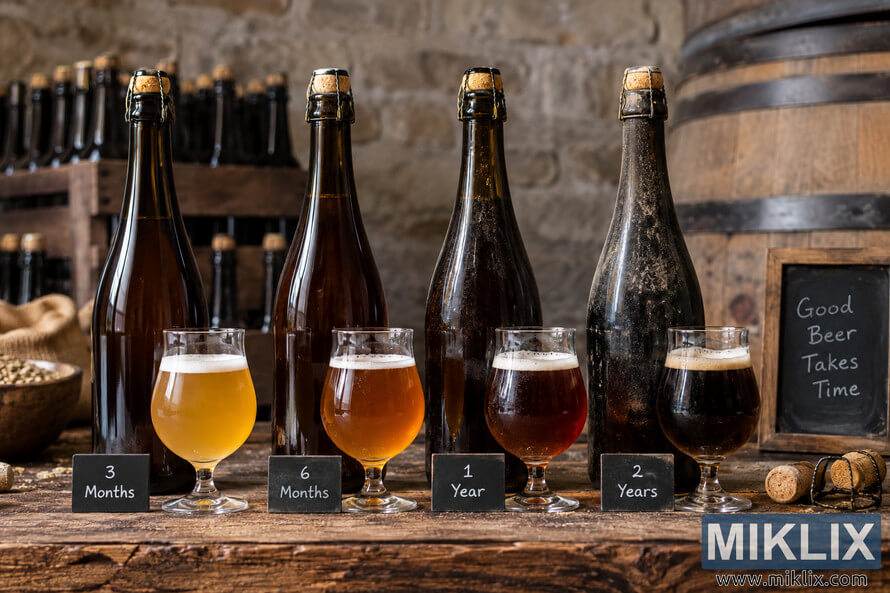
Four bottle-conditioned beers at aging stages from 3 months to 2 years, displayed with matching glasses in a rustic cellar setting.
Available versions of this image
The image files available for download below are less compressed and higher resolution - and as a result of that, higher quality - than the images embedded in articles and pages on this website, which are more optimized for file size in order to reduce bandwidth consumption.
Regular size (1,536 x 1,024)
Large size (3,072 x 2,048)
Very large size (4,608 x 3,072)
Extra large size (6,144 x 4,096)
Comically large size (1,048,576 x 699,051)
- Still uploading... ;-)
Image description
A landscape-format, photorealistic still life depicts four stages of bottled beer aging on a rough wooden table in a rustic cellar-like setting. Four tall, dark brown glass bottles are arranged in a row across the middle of the image. Each bottle is sealed with a natural-colored cork held in place by a dark wire cage. The bottles progressively appear more aged from left to right: the first two are relatively clean and glossy, the third has visible spotting and residue on its surface, and the fourth is heavily coated with pale dust or cellar residue. In front of the bottles are four stemmed tulip-shaped beer glasses, each containing beer of a different color. From left to right, the beers progress from hazy golden yellow, to amber-orange, to dark reddish brown, to nearly opaque very dark brown. Each glass has a pale cream-colored foam layer at the top, with differences in thickness and texture. Small rectangular black chalkboard-style labels sit along the front edge of the arrangement. Their white handwritten text reads, from left to right, "3 Months", "6 Months", "1 Year", and "2 Years". The bottles and glasses are positioned so that each aging label corresponds visually to one bottle-and-glass pairing. On the far right is a larger framed black chalkboard leaning upright against the background. Written on it in white chalk-like lettering is the phrase "Good Beer Takes Time". Several loose corks and a detached wire cage lie on the tabletop near this sign. The table surface is heavily textured, weathered brown wood with scratches, grain, uneven coloration, and scattered small debris. At the far left foreground is a shallow wooden bowl containing pale grains or seeds, with additional grains scattered nearby. Behind it is a loosely folded piece of tan burlap or coarse fabric. The background has a rough beige-gray stone wall. On the left, wooden racks or crates hold numerous additional dark glass bottles, most of them out of focus because of the shallow depth of field. On the right, a large wooden barrel occupies much of the background. It is made from warm brown wooden staves held together by broad dark metal hoops. The lighting is warm and directional, creating bright reflections along the glass bottles and glasses while leaving parts of the background softly shadowed. The composition is symmetrical enough to emphasize the four-stage progression, while the surrounding barrel, bottle storage, grains, corks, weathered wood, and stone provide a rustic cellar atmosphere. No people, commercial labels, logos, or identifiable brands are visible.
The image is related to: Fermenting Beer with White Labs WLP644 Saccharomyces brux-like Trois Yeast