
Image: Advanced Belgian Ale Yeast Optimization and Brewing Techniques
Published: September 26, 2026 at 8:36:03 AM UTC
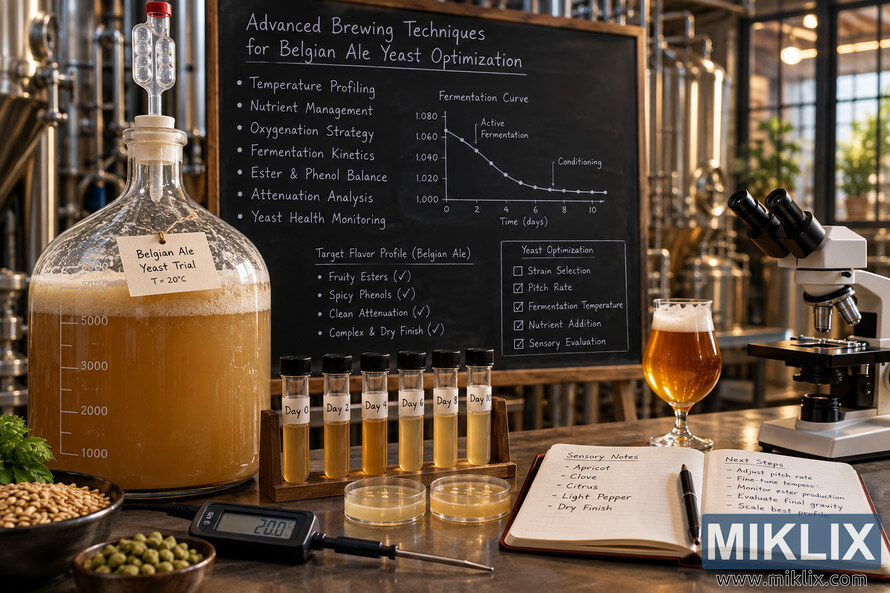
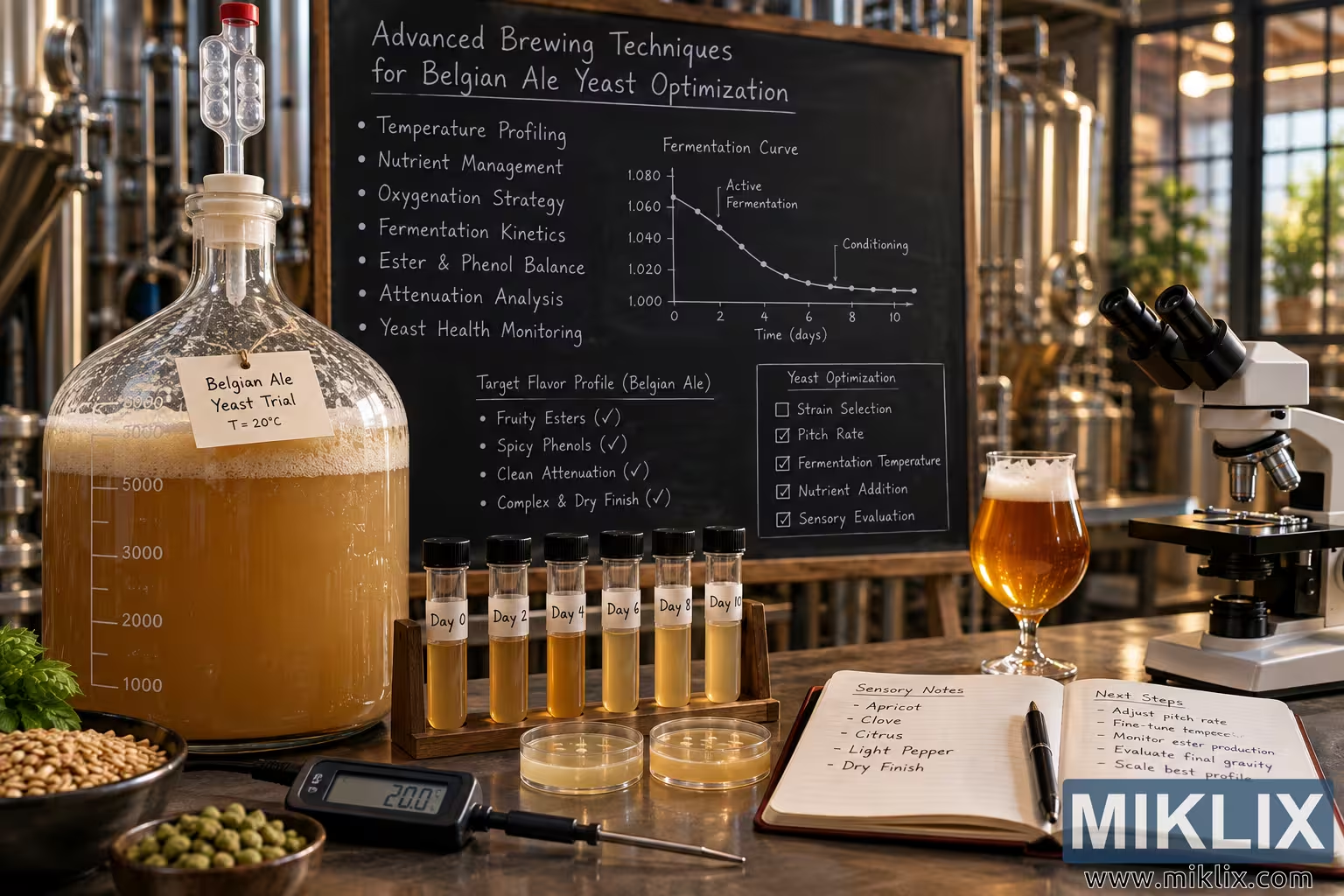
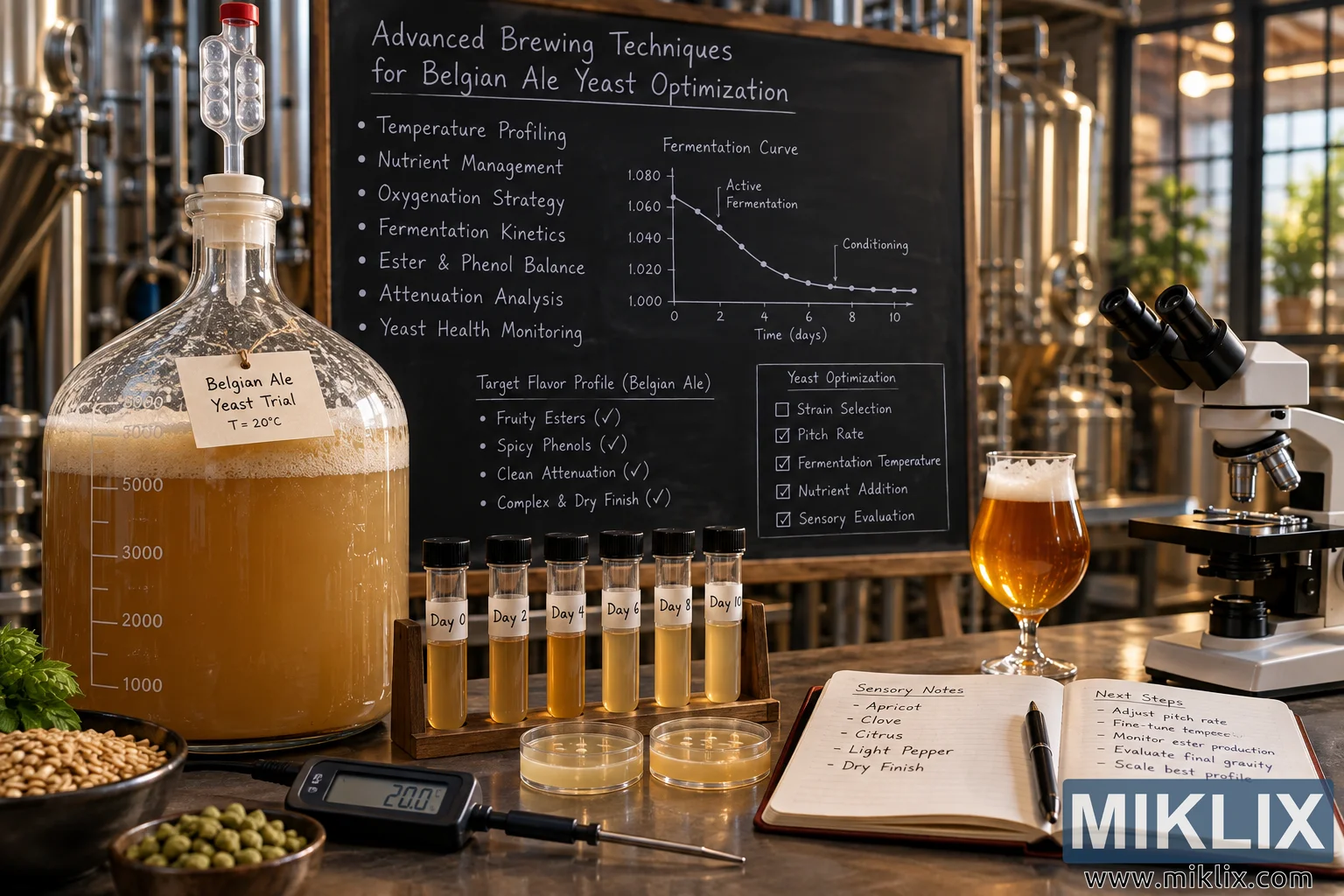
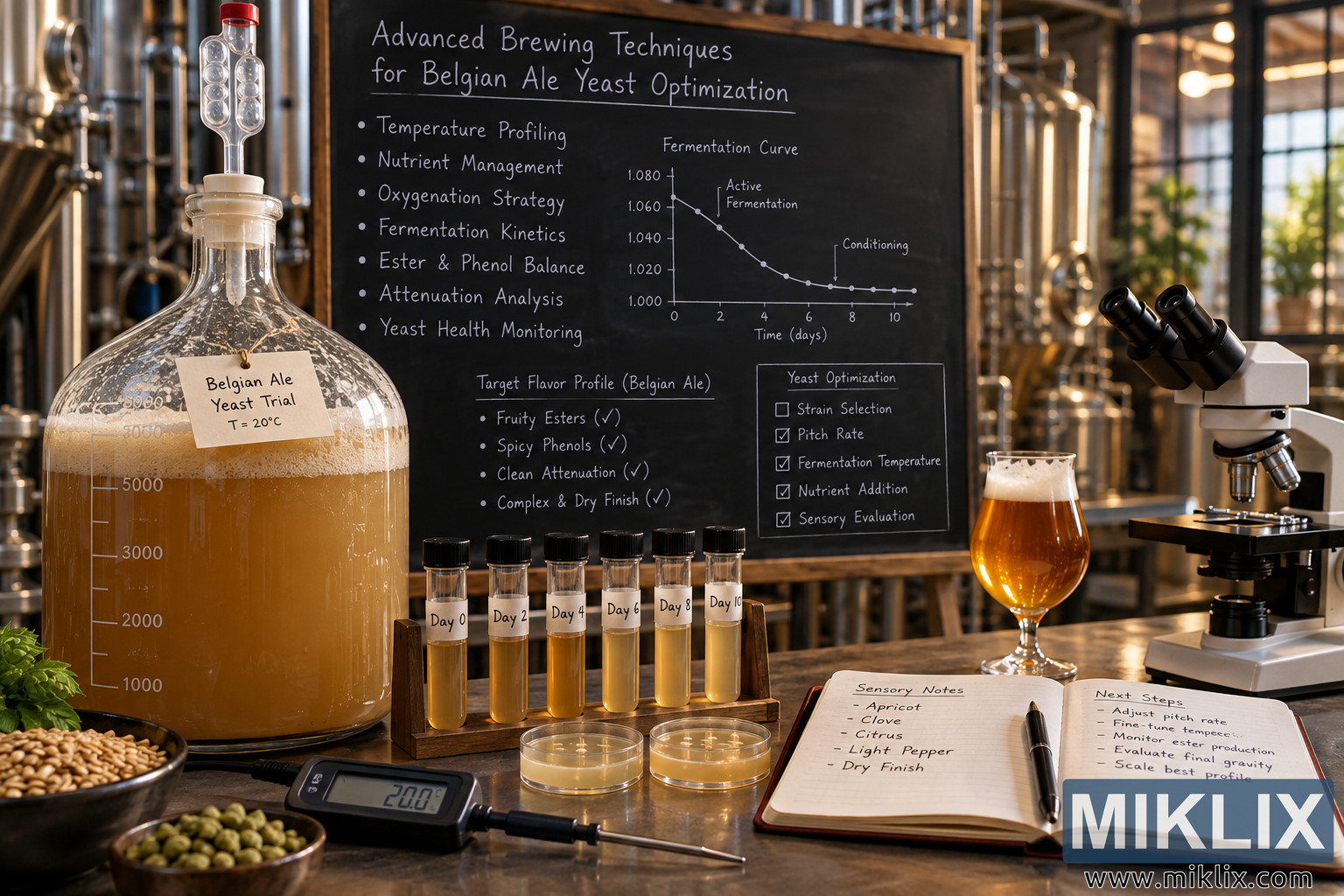
A detailed brewery laboratory scene showing Belgian ale yeast optimization with fermentation samples, temperature monitoring, sensory notes, microscopy, and brewing parameters.
Available versions of this image
The image files available for download below are less compressed and higher resolution - and as a result of that, higher quality - than the images embedded in articles and pages on this website, which are more optimized for file size in order to reduce bandwidth consumption.
Regular size (1,536 x 1,024)
Large size (3,072 x 2,048)
Very large size (4,608 x 3,072)
Extra large size (6,144 x 4,096)
Comically large size (1,048,576 x 699,051)
- Still uploading... ;-)
Image description
A detailed, photorealistic landscape image of a brewery workspace arranged to illustrate advanced Belgian ale yeast optimization. The foreground is a stainless-steel work surface covered with brewing and laboratory equipment. On the left is a large clear glass fermentation vessel containing cloudy golden-brown liquid with a thick, uneven layer of pale foam and residue around the upper interior. The vessel has white volume markings, including visible labels for 1000, 2000, 3000, and 5000, and is sealed with a stopper and a clear fermentation airlock with a red cap. A paper label attached to the vessel reads "Belgian Ale Yeast Trial" and "T = 20°C." In front of the fermenter are bowls containing pale tan grain and green hop cones; some green leafy plant material is also visible at the far left edge. Near the center foreground is a black digital temperature instrument with a metal probe. Its display reads "20.0°C." Behind it, six transparent sample tubes with black caps are held upright in a wooden rack. Their handwritten labels read "Day 0," "Day 2," "Day 4," "Day 6," "Day 8," and "Day 10." The tubes contain small amounts of pale golden liquid, with visible differences in clarity and color. Two shallow transparent laboratory dishes containing pale amber liquid sit in front of the sample rack. On the right side is an open cream-colored notebook with a dark red or brown cover and a black pen resting diagonally across the pages. The left page is headed "Sensory Notes" and lists "Apricot," "Clove," "Citrus," "Light Pepper," and "Dry Finish." The right page is headed "Next Steps" and contains several handwritten action items. The clearly or substantially legible items include "Adjust pitch rate," "Fine-tune temp," "Monitor ester production," "Evaluate final gravity," and "Scale best profile," although some individual lettering is slightly unclear. Behind the notebook is a clear stemmed beer glass filled with transparent amber-gold beer and topped by a layer of white foam. At the far right is a white and black binocular laboratory microscope with multiple objective lenses, positioned on the same work surface and angled toward the center. Dominating the middle background is a large black chalkboard in a medium-brown wooden frame. The heading reads "Advanced Brewing Techniques for Belgian Ale Yeast Optimization." A bulleted list on the left reads "Temperature Profiling," "Nutrient Management," "Oxygenation Strategy," "Fermentation Kinetics," "Ester & Phenol Balance," "Attenuation Analysis," and "Yeast Health Monitoring." In the upper center-right of the board is a graph titled "Fermentation Curve." Its vertical scale is marked approximately from 1.000 to 1.080, and its horizontal axis is labeled "Time (days)," with points running from day 0 through day 10. A descending plotted line is annotated "Active Fermentation" near the early, steeper section and "Conditioning" near the later, flatter section. Below the graph is a section titled "Target Flavor Profile (Belgian Ale)," listing "Fruity Esters (✓)," "Spicy Phenols (✓)," "Clean Attenuation (✓)," and "Complex & Dry Finish (✓)." To the right is a boxed checklist titled "Yeast Optimization" containing "Strain Selection," "Pitch Rate," "Fermentation Temperature," "Nutrient Addition," and "Sensory Evaluation." The first checkbox appears empty while the remaining four appear checked. The brewery environment continues behind the chalkboard, with numerous stainless-steel tanks, pipes, valves, fittings, and cylindrical vessels visible in soft focus. Large dark-framed windows occupy part of the right background, with daylight and indistinct greenery visible beyond or near them. Warm artificial lights create bright circular highlights in the upper background. The overall palette combines amber and golden beer tones, warm brown wood, black chalkboard and instrument details, clear glass, white laboratory equipment, and reflective silver stainless steel. The composition places the fermenter prominently on the left, the chalkboard centrally, and the microscope and beer glass on the right, while the sample tubes, dishes, thermometer, ingredients, and notebook form a continuous band of experimental materials across the foreground. The lighting is warm and directional, producing reflections on glass and metal and a shallow-depth-of-field appearance in the brewery background. No people or visible commercial brand names or logos are present.
The image is related to: Fermenting Beer with Wyeast 3655-PC Belgian Schelde Ale Yeast