
Hops in Beer Brewing: Eastern Green
Publicat:
Última actualització: 15 de juliol del 2026, a les 14:28:04 UTC
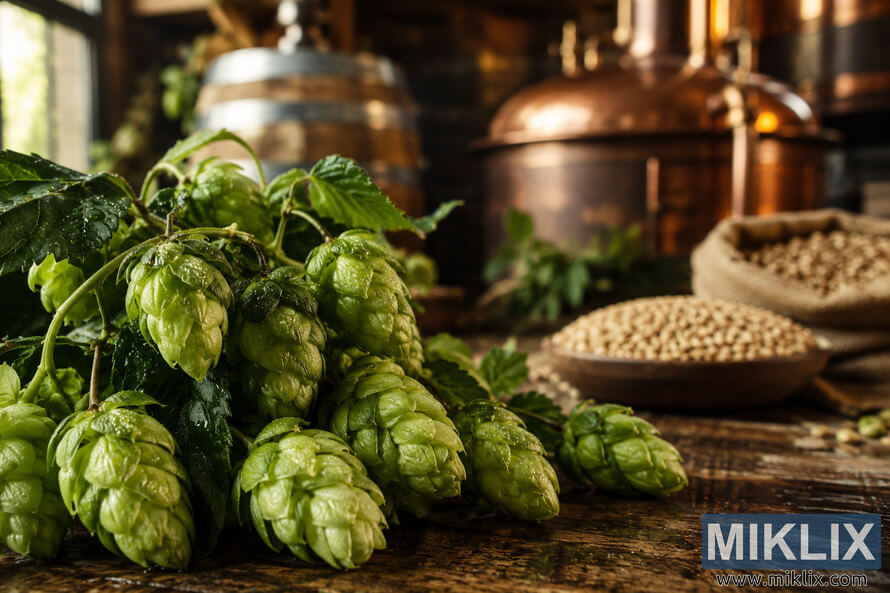
Eastern Green hops are gaining popularity among homebrewers and small craft breweries. They are known for their bright aromatics and versatility in brewing. This article will guide you through brewing with Eastern Green, covering its origin, flavor, and practical tips for crafting hop-forward beers.
Hops in Beer Brewing: Eastern Green
Feu clic o toqueu la imatge per obtenir més informació i resolucions més altes.
Key Takeaways
- Eastern Green hops bring citrus and herbal aromatics useful in hop-forward beers.
- Brewing with Eastern Green works well in IPAs, pale ales, and lighter hybrid styles.
- Oil composition and alpha acid numbers guide timing for aroma versus bitterness.
- Proper storage and dry-hop technique preserve delicate floral and citrus notes.
- Sourcing lot data from Yakima Chief Hops, Hopsteiner, or university releases is advised.
Introduction to Eastern Green hops and brewing context
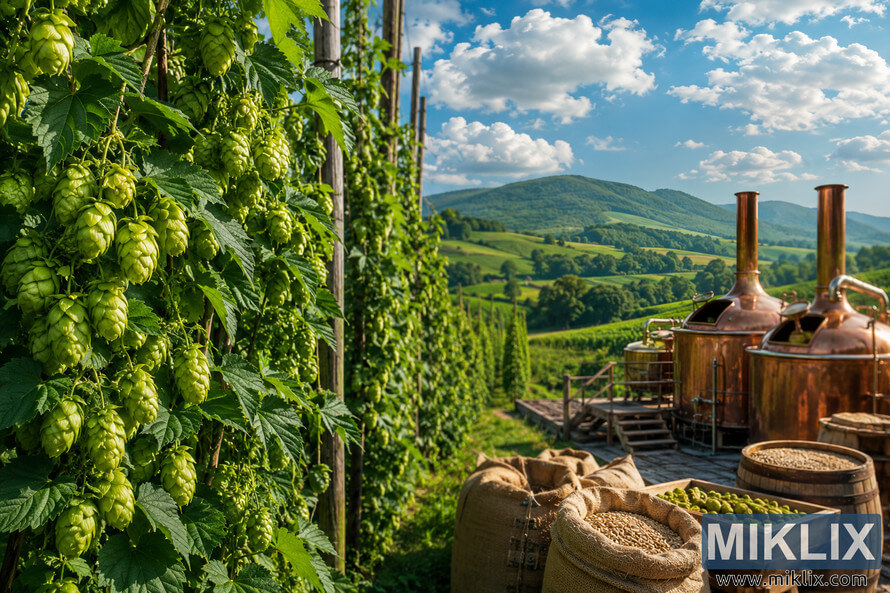
Eastern Green was developed through focused breeding to enhance disease resistance, adapt to specific regions, and achieve a distinct flavor profile. Lab reports and breeder statements are the most reliable sources to verify the exact lineage and origin of any hop batch.
Renowned institutions like the New York State Agricultural Experiment Station and Oregon State University have a history of introducing influential hop varieties. Private entities such as Yakima Chief Hops, Hopsteiner, and BarthHaas often acquire these varieties, then collaborate with farmers to increase their cultivation.
This shift is crucial for small-scale brewers. New hop varieties can significantly alter both the aroma and availability of hops. Varieties with better yields or disease resistance become more accessible. This change impacts the selection of hops for homebrewing and the ability to experiment with unique recipes.
Eastern Green hops are known for their citrus, herbal, and floral notes, aligning them with U.S. hop varieties like Citra and Cascade. They differ from traditional European noble hops, such as Saaz and Hallertau, which emphasize spice and herbal tones. Modern high-oil varieties, like Mosaic and Nelson Sauvin, offer complex tertiary aromas, distinct from the straightforward citrus-herbal profiles of Eastern Green.
When considering new hop varieties, it's essential to consult detailed lab analyses and independent sensory evaluations. Marketing claims can be overly optimistic. Begin with small batches to test the hop's performance in your preferred beer styles before committing to a larger purchase.
Feu clic o toqueu la imatge per obtenir més informació i resolucions més altes.
Flavor profile of Eastern Green hops
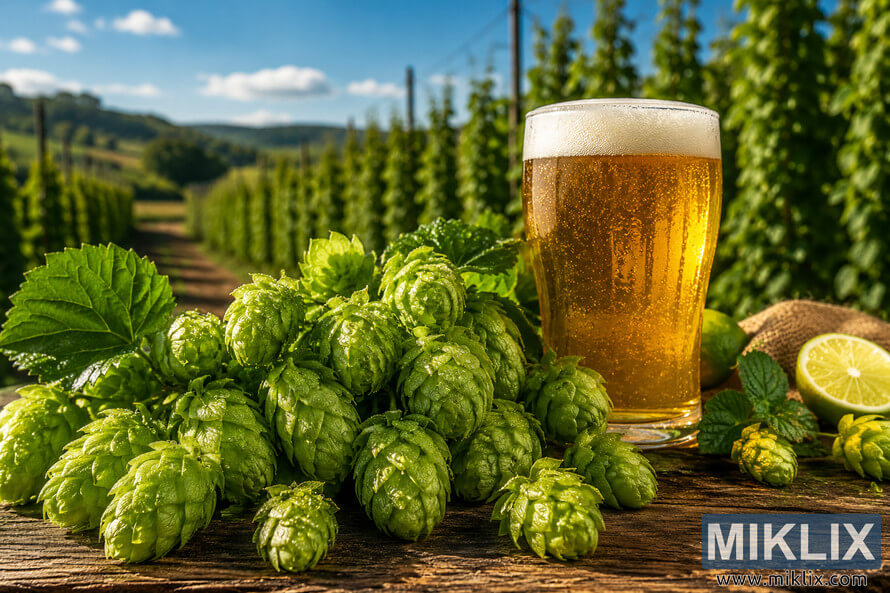
The Eastern Green flavor profile is characterized by a bright, accessible aromatic range. Brewers appreciate its versatility. The top note is a clear citrus, reminiscent of lemon zest, lime, or orange peel. Below this, a green, herbal character emerges, evoking fresh-cut herbs, bay leaf, or lemongrass.
A faint floral layer of white flower or jasmine adds depth, balancing the overall impression. The combination of citrus, herbal, and floral notes is frequently mentioned on supplier sheets and tasting panels.
In pale ales and IPAs, these aromatics create a juicy, zesty sensation. The citrus becomes more pronounced, and the herbal notes sharpen. This results in a lively hop tasting notes profile that is bright and persistent.
In lighter blonde ales or lagers, the floral and green elements are more delicate and airy. This gives a softer impression on the palate.
In malt-forward or darker beers, the same hop character acts as a lift against sweetness. Citrus and herbal notes add contrast without overwhelming the roast or caramel malt. Controlled additions and lower dry-hop rates help preserve subtle floral cues while avoiding a harsh resinous backnote.
Professional and homebrew sensory reports often highlight similar hop tasting notes. These include intensity, citrus type, herbal freshness, and any resin or vegetal hints. Brewers should record ABV, grist composition, hopping rate, and timing when comparing panels. Cross-referencing supplier lab sheets with independent panels yields clearer insight.
- Single-hop trials: run 1–2 gallon (4–8 L) batches to isolate expression.
- Vary yeast and fermentation temp to see ester impacts on aroma.
- Log persistence and perceived bitterness alongside aroma intensity.
Practical tasting practice helps dial in expectations. Create simple single-hop versions across a few styles and note how Eastern Green flavor profile shifts. Keeping detailed notes improves repeatability and sharpens interpretation of hop aroma citrus herbal floral in future recipes.
Feu clic o toqueu la imatge per obtenir més informació i resolucions més altes.
Aroma and essential oils of Eastern Green hops
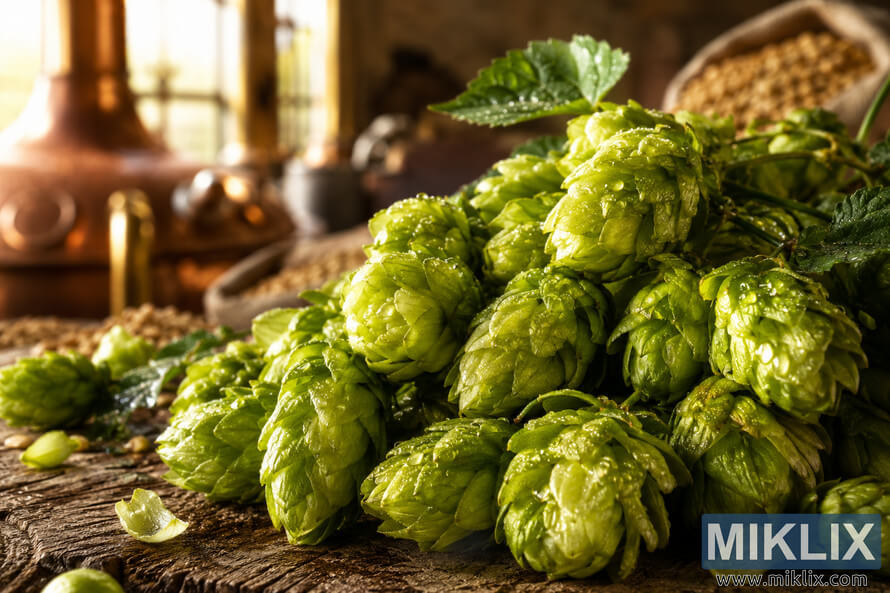
Eastern Green hop oils define the variety's distinct, herbal-citrus profile. Brewers aiming to capture fresh floral and citrus notes must grasp the role of specific compounds. They must also understand how handling affects their expression.
Key hop oils present and their contribution to aroma
Myrcene imparts herbaceous and resinous qualities, often leading with a citrus punch. Humulene adds a woody, spicy element. Caryophyllene contributes a peppery backbone, enhancing complexity without overpowering light fruit notes.
Linalool and geraniol introduce floral, lavender, and rosy notes, adding freshness to dry-hop bouquets. Citronellol enhances bright citrus and lemon-peel clarity. In Eastern Green, expect a mix where linalool, geraniol, and citronellol amplify citrus and herbal traits, while myrcene provides a resinous foundation.
How oil composition influences dry hopping results
Higher levels of linalool, geraniol, and citronellol contribute to perceived freshness in dry hopping Eastern Green. These stable terpenes create lasting floral and citrus top notes in the glass.
Myrcene, with its intense, volatile citrus and resin, can dominate early but quickly fades or oxidizes. Brewers should manage dry hopping time to capture the myrcene-driven aroma without losing it to rapid degradation or harsh oxidation.
Storage and handling to preserve essential oils
Preserving hop aroma begins with limiting oxygen and heat exposure. Store hops in vacuum-sealed foil bags or nitrogen-blanketed packaging when feasible. Cold storage at -18°C (0°F) is ideal for long-term preservation; refrigeration suffices for short-term use.
Pellet and cryo formats concentrate oils differently than whole-cone hops, potentially requiring dose adjustments. Always check supplier harvest and pack dates, along with lot sheets for alpha and oil breakdown. Use fresher lots for aggressive dry hopping Eastern Green to avoid muted results.
- Use airtight containers and minimize headspace when transferring hops.
- Dry hop closer to secondary fermentation temperatures that favor oil solubility but limit oxygen uptake.
- Rotate stock on a first-in, first-out basis and record pack dates for quality control.
Feu clic o toqueu la imatge per obtenir més informació i resolucions més altes.
Alpha and beta acid composition for Eastern Green hops
Alpha and beta acids are crucial for brewers to predict bitterness and aging behavior. Expect variability between lots. Always check supplier lot sheets before finalizing a recipe. This ensures you use accurate hop lab data for planning additions.
Typical alpha acid range and bitterness potential
Aroma-focused Eastern Green lots have a lower hop alpha range. Expect roughly 4–9% alpha acids for delicate aroma hops. Dual-purpose lots range about 7–12% alpha acids. Use the exact Eastern Green alpha acids value from the lot sheet in your IBU calculator to estimate theoretical bitterness when boiled.
When planning bittering additions, treat alpha% as the primary input for Tinseth or Rager calculations. Adjust for wort gravity and boil time to hit your target bitterness potential without overshooting harshness.
Beta acids and their role in stability and flavor
Beta acids do not isomerize to form bitterness during the boil. They oxidize over time into compounds that change aged-hop character. Higher beta acid levels often mean a different aging profile and can influence perceived bitterness in cellared beers.
Consider beta acid content when formulating beers intended for long-term storage or when assessing dry-hop stability. Lots with moderate beta acids may preserve fresher aroma longer than those with very low or very high values.
Using lab numbers for recipe formulation
- Step 1: Enter the supplier alpha% and batch size into a bitterness calculator (Tinseth, Rager) and factor in boil time.
- Step 2: Check cohumulone percentage in hop lab data to gauge potential perceived harshness at high IBUs.
- Step 3: Use oil metrics—total oil, myrcene, humulene, linalool—from the hop lab data to plan late and dry-hop rates for aroma impact.
- Step 4: For aroma-forward beers, favor late additions and dry hopping guided by oil numbers instead of bulk alpha values.
- Step 5: For predictable bittering, either choose a stable high-alpha bittering hop or adjust Eastern Green boil additions to the measured alpha to reach the desired bitterness potential.
Following these steps keeps recipe decisions tied to measurable hop lab data. This practice reduces surprises and helps you match bitterness potential to style goals while preserving the hop's aromatic strengths.
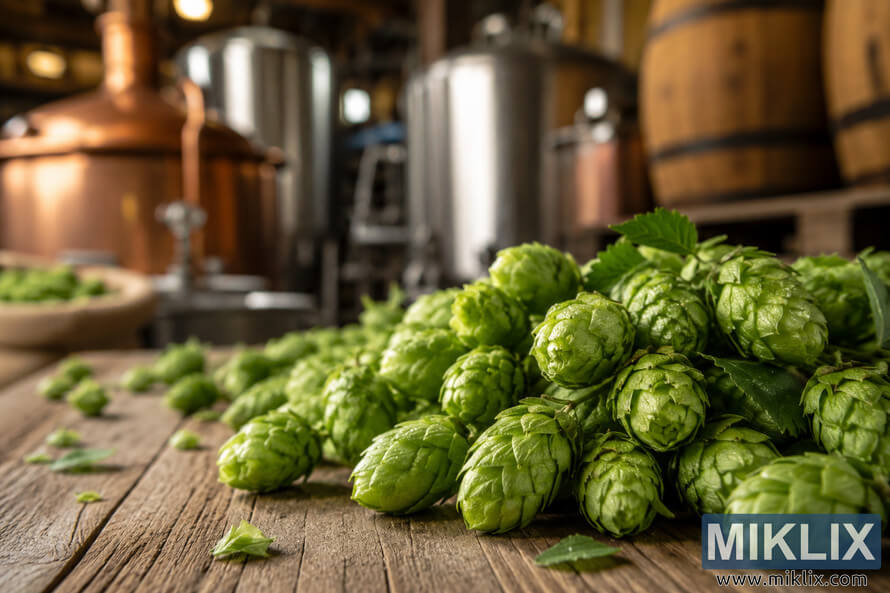
Feu clic o toqueu la imatge per obtenir més informació i resolucions més altes.
Best beer styles to showcase Eastern Green hops
Eastern Green shines when its citrus, herbal, and floral notes are highlighted. It's best as a primary aroma hop or a subtle accent. Late-kettle, whirlpool, and dry-hop additions are key to capturing its bright top notes. This approach helps avoid grassy or vegetal flavors.
In American Pale Ales and single- or mixed-hop IPAs, Eastern Green adds a lively citrus and herbal zest. Use 3–6 oz per 5 gal (85–170 g/19 L) across whirlpool and dry-hop additions. This ensures a clear, focused aroma. Blend it with Citra, Mosaic, or Centennial to add tropical or resinous layers, while keeping Eastern Green's floral notes prominent.
Blonde ales, saisons, and hybrid styles
Lighter beers benefit from a more subtle approach. Blond ales, kolsch-style brews, and saisons can use 1–2 oz per 5 gal (28–57 g/19 L). This small amount adds nuance without overwhelming the malt. In saisons, pair Eastern Green with a spicy, phenolic yeast like Saison ale strains. This combination creates layered complexity and a gentle interplay of herb and yeast-driven spice.
Experimental pairings: lagers and hop-forward stouts
Eastern Green can also elevate lagers with modern aromatic twists. Use minimal late additions and a short dry-hop to make hop-forward lagers pop. This approach preserves clarity and smoothness. For stouts and porters, add tiny late additions to introduce citrus lift that cuts through roast. Avoid heavy dry-hopping in dark beers to prevent odd perceived flavors.
- Single-hop APA: 3–6 oz per 5 gal across late/whirlpool/dry-hop for a showcase beer.
- Lighter styles: 1–2 oz per 5 gal to maintain subtle floral and herbal notes.
- Modern lager trial: low-temp late-hop and brief dry-hop to preserve crispness.
Adjust rates and timing based on your style goals. Refer to recipe and technique sections for detailed hop rates, water chemistry, and temperature guidance. This will help you create the best beers featuring Eastern Green in your lineup.
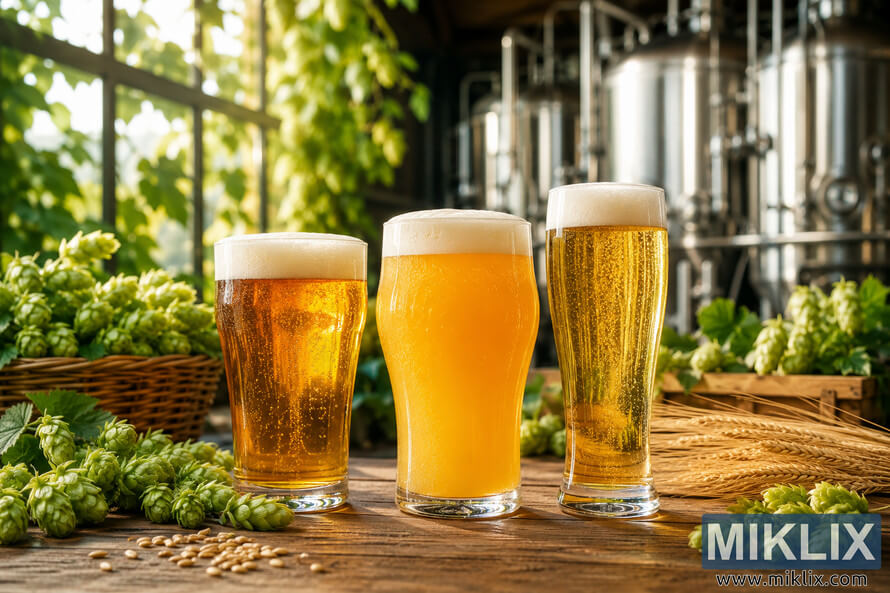
Feu clic o toqueu la imatge per obtenir més informació i resolucions més altes.
Recipe design principles with Eastern Green hops
Creating a recipe with Eastern Green hops requires a well-thought-out approach. It's essential to establish a clean malt base, manage hop timing, and select yeast that complements the hop's citrus and herbal notes.
Ensure the malt backbone supports the hop's character. Opt for a pilsner or pale malt for a crisp example. Alternatively, Maris Otter or a light Munich can add body without obscuring the hop's brightness. For IPAs, incorporate 5–8 SRM crystal malt to enhance mouthfeel while preserving hop clarity.
Focus on aroma by adjusting hop rates and timing. Calculate bittering IBUs based on the alpha% lab value and use conservative early additions. Add hops at 15–10 minutes for mid-kettle flavor and at 5–0 minutes plus whirlpool to preserve volatile oils. Dry-hop in stages for a fresh impact.
- Start with bittering additions to reach target IBU, then taper late hops.
- Whirlpool at 170–180°F to capture oils without harshness.
- Stage dry hops over several days to layer aromas.
Select adjuncts and yeast that enhance the hop profile. Incorporate light adjuncts like pilsner malt or flaked oats to increase mouthfeel without obscuring aromatics. Use coriander or zested orange peel sparingly to highlight citrus facets. Avoid heavy lactose or dense fruit blends unless aiming for a dessert-style result.
For yeast selection, neutral American ale strains like Fermentis Safale US-05 are ideal when you want the hop to dominate. For a blend of hop and fruity esters, consider Wyeast 1318 London Ale III or a saison strain that adds spicy complexity. Record sensory feedback and adjust yeast choice for future brews.
- Formulate a clean malt backbone and target final gravity for desired body.
- Set conservative bittering and emphasize late-hop and whirlpool additions.
- Plan staggered dry-hop schedules and note hop timing effects on aroma.
- Pick yeast for aromatic hops based on whether you prefer neutrality or complementary esters.
Small adjustments can significantly impact the final product. Consider adding flaked oats or dextrin malt to enhance mouthfeel in hop-forward beers. Keep detailed notes on hop timing and malt balance to refine your recipes with Eastern Green hops towards your ideal profile.
Boil schedule strategies for flavor and bitterness
Mastering the boil schedule for Eastern Green requires precise hop addition timing and careful whirlpool management. Plan your early and late additions with IBUs and aroma goals in mind. Even small timing adjustments can significantly alter bitterness and preserve floral and citrus notes.
Early additions, from 60–90 minutes, are crucial for achieving measured IBUs. Calculate alpha-acid contributions and limit quantities if aroma is more important than bitterness. Long boils ensure full bitterness isomerization but risk losing volatile oils. Therefore, reduce early boil rates when preserving Eastern Green's aroma is key.
For flavor and aroma preservation, add Eastern Green late in the boil. Place additions at 10–5 minutes for a bright flavor lift. Flameout or 0-minute additions help retain delicate floral and citrus compounds. Shorter boil times after late additions minimize hot-side oxidation and preserve volatile oils.
Whirlpool additions are most effective at 170–180°F (77–82°C). Holding hops in a whirlpool for 10–30 minutes extracts oils with less polyphenol pickup. Rapid chilling after the whirlpool and separating hop solids reduces oxidation risk. For maximum oil retention, use a short hop stand and minimize time at elevated temperatures after adding hops.
- Practical caution: avoid keeping hops at 180–200°F for long; myrcene can volatilize and flatten aroma.
- Use hop bags or a false bottom to ease removal and reduce vegetative extraction when desired.
- Track hop addition timing against your mash and boil vigor to keep utilization predictable.
Test small adjustments across batches. A few minutes earlier or later in hop addition timing can noticeably shift bitterness vs. aroma. Tweak whirlpool for hop aroma to suit the beer style and preserve Eastern Green's signature notes.
Dry hopping techniques using Eastern Green hops
Dry hopping with Eastern Green hops brings out the beer's bright aromas without increasing bitterness. Follow these tips to enhance your beer's style and aroma. This method protects delicate oils and minimizes vegetal extraction.
Dosage ranges for fresh aromatic impact
Adjust the dry hopping dosage based on the desired intensity and hop form. For a subtle aromatic effect, aim for 0.25–0.5 oz/gal (6–12 g/L). For a more pronounced aroma, use 0.6–1.0 oz/gal (15–25 g/L). For a 5 gal (19 L) batch, this translates to 2–6 oz (56–170 g) total. Adjust for cryo or lupulin to avoid overloading.
Contact time and temperature recommendations
For most ales, cold-contact dry hopping at 40–55°F (4–13°C) for 48–72 hours enhances floral and citrus notes. It minimizes grassy compounds. For warm-contact in a secondary fermenter, keep the contact under five days to avoid vegetative oil extraction.
For New England–style hazy IPAs and ultra-juicy profiles, use shorter contact of 24–48 hours at slightly warmer temps. This captures volatile esters. After the chosen contact window, consider a cold crash to drop hop solids and lock in aroma.
Methods to avoid grassy or vegetal off-notes
Start with pellets or cryo lupulin when possible. Pellets shed less leaf material, reducing grassy character. Cryo or concentrated lupulin delivers intense aroma at lower mass, avoiding grassy hops while maintaining potency.
- Split additions: add hops in two or more stages to layer aroma and limit heavy extraction.
- Limit contact time: avoid leaving hops on for more than seven days unless you want more extraction.
- Minimize oxygen: purge hop containers and add gently to reduce oxidation that can amplify vegetal tones.
- Gentle mixing: use slow, careful agitation or pumpovers rather than vigorous rousing to prevent breaking plant cell walls.
- Use hop bags or stainless mesh when convenient to ease removal and reduce particulate retention.
These practices fine-tune Eastern Green dry hop performance for clean citrus, herbal, and floral expression. Adjust dry hopping dosage and contact windows to match your recipe and tasting goals.
Hop combinations and blending with Eastern Green hops
Blending Eastern Green hops opens a world of possibilities for brewers. They can aim for bright citrus or layered complexity. A clear goal is essential when experimenting with hop combos and adjusting ratios.
For citrus and hoppy blends, consider Citra, Mosaic, Amarillo, Simcoe, Azacca, and Galaxy. These hops enhance lemon, orange, and tropical notes while Eastern Green remains the aromatic core. For a lighter spice or floral touch, Nelson Sauvin or Saaz can be used in small amounts.
Contrasting hops add depth. Centennial, Chinook, and Columbus bring earthy, pine, or resinous tones. These hops structure without overpowering aromatics. Pairing a noble-style hop with Eastern Green adds herbal sophistication and balance to hop-forward ales.
- Start bittering at 60 minutes with a modest base to control perceived bitterness.
- Add a flavor blend at 15–10 minutes to layer fruit and spice.
- Whirlpool additions should be dominated by Eastern Green to lock aroma.
- Split dry-hop into two doses: an early dose for conditioning and a late dose before packaging to preserve top-note freshness.
Example IPA blend: 40% Eastern Green (late/whirlpool/dry), 30% Citra or Mosaic for fruit complexity, 30% Centennial or Simcoe for backbone and resin. Adjust those percentages based on sensory goals and lab oil data when available.
Document sensory outcomes and oil profiles each batch. Track how different hop combos affect bitterness, aroma longevity, and haze stability. Small, systematic changes yield faster learning than major recipe overhauls.
Water chemistry adjustments for hop expression
Adjusting water chemistry for hops significantly impacts the taste of Eastern Green. Even slight changes in mineral content can alter bitterness, brightness, and malt roundness. Begin by deciding if your recipe aims for a crisp, hop-forward pale ale or a softer, malt-driven saison.
The sulfate chloride ratio is key to a beer's dryness or fullness. Higher sulfate enhances hop crispness and bitterness. Conversely, higher chloride adds malt fullness and smoothness. For hop-forward beers, aim for a sulfate:chloride ratio of 2:1 to 3:1. Aiming for 150 ppm sulfate and 50–75 ppm chloride can boost hop brightness without harshness.
mash pH hops and its influence
Mash pH greatly impacts enzyme activity and hop perception. Target a mash pH of 5.2–5.4 at room temperature. This range optimizes extraction, reduces tannin harshness, and balances hop taste. A lower mash pH sharpens hop perception but must remain above 5.0 to avoid astringency.
Practical ion additions for common styles
- Use gypsum (calcium sulfate) to increase sulfate and calcium for drier, crisper hop forward beers.
- Use calcium chloride to boost chloride and calcium for more malt body and roundness.
- Add Epsom salt (magnesium sulfate) sparingly to nudge sulfate without affecting flavor too strongly.
- Use sodium salts very lightly, under 50 ppm, to round flavor in lighter blondes and some saisons.
Tools and testing
Utilize water calculators like Bru’n Water or Brewer’s Friend to model changes before additions. Choose a target profile—West Coast for bright, hoppy beers or New England for softer, malted haze—and adjust ions accordingly. Confirm with a lab report or reliable test strips to ensure accuracy.
Quick profiles to try
- West Coast IPA: ~150 ppm sulfate, 50 ppm chloride, mash pH 5.2–5.3.
- Hazy IPA: ~100 ppm sulfate, 100–125 ppm chloride, mash pH 5.2–5.4.
- Blonde/Saison: ~50–75 ppm sulfate, 50–75 ppm chloride, sodium
Keep records of water source, additions, and measured mash pH. Small, repeatable changes help you learn how water chemistry for hops and the sulfate chloride ratio shape the final beer.
Brewhouse techniques to highlight Eastern Green hops
To maximize Eastern Green's potential, focus on straightforward, consistent methods in the brewhouse. These should protect the volatile oils and emphasize the variety's citrus and herbal flavors. Ensure each step is clear to maintain the hop's vibrancy until packaging.
Mash schedules and conversion considerations
Employ a single infusion mash for 60 minutes at 150–154°F (65–68°C). This balance ensures fermentability and mouthfeel. A stable conversion is crucial to avoid astringency and preserve hop aroma.
For drier beers, elevate the mash to 156–158°F. For a richer body, aim slightly below 150°F. Always confirm complete conversion with an iodine test or consistent gravity readings before lautering.
Boil vigor and hop utilization impacts
A steady rolling boil is essential for reliable hop utilization. Vigorous boils enhance alpha acid isomerization but avoid excessive boil-off. This prevents wort concentration and alters bitterness perception.
Manage kettle trub and long hop stands with hop bags or a hop spider. This minimizes polyphenol extraction from hop matter, preserving Eastern Green's clean aromatic profile.
Fermentation management to preserve hop character
Control fermentation temperatures to safeguard delicate oils. Use neutral ale strains in the 64–68°F range to prevent esters from overshadowing hop aroma. For New England IPAs or juicy ales, select an English or NE yeast and allow slightly warmer temperatures to enhance the hop's profile.
Minimize oxygen pickup after boiling with closed transfers, CO2 purging, or gentle racking. Cold crash when necessary to clarify without stripping aroma. These steps ensure the beer retains its bright, fresh hop notes.
Scaling recipes: homebrew to small commercial batches
Transitioning a beloved homebrew to a microbrewery or pilot system requires more than just multiplying ingredient weights. Begin with a clear goal for batch volume. Ensure consistency in units like g/L or oz/gal. Also, maintain the ratio of late and dry additions when scaling Eastern Green hop recipes. It's crucial to recalculate IBUs using the actual alpha% of each hop lot, rather than relying on assumed values.
Adjusting hop amounts by batch size
- Start with direct mass scaling by volume as your baseline. Convert your 5 gal recipe to g/L or oz/gal. Then, apply that rate to the new batch size.
- Preserve late addition and dry-hop proportions. If your late hops are 0.5 oz/gal, maintain that ratio. Adjust for alpha% to achieve the desired aroma and IBUs.
- When converting to pellet or cryo, adjust mass based on concentration. Cryo often requires less mass than whole cone to achieve the same aromatic lift.
Loss factors and utilization changes at scale
- Large kettles and deeper hop beds alter hop utilization. Vigorous, long boils increase early-addition utilization. Shallow whirlpools and packed hop screens can lower late-addition extraction.
- Consider trub, filter, and packaging losses. Plan extra hops for dry hopping to account for retention in filters and fermenter trub.
- Run pilot batches and measure IBUs. Pilot data provides empirical evidence of utilization rates for your equipment, making hop scaling more precise.
Quality control tips when scaling up
- Track every lot: record harvest date, supplier lot, and alpha% for each hop shipment. Lot tracking prevents flavor drift when using commercial brewing hops at scale.
- Keep pilot runs between 20–200 L. Use these small runs to validate flavor, IBU, and gravity before committing to full production.
- Use sensory panels and lab checks. A combined kit of trained tasters plus lab IBU and gravity data gives a reliable read on how hop scaling affected the beer.
- Consider format and logistics. Shipping costs for 500 gal production favor pellet or cryo forms over bulky whole cones. Cryo can reduce handling weight and preserve aromatic lupulin.
Practical example
- Scaling from 5 gal to 500 gal: convert your recipe rates to g/L, multiply by target volume, then add contingency hops for trub and filter loss.
- Plan increased dry-hop inventory. If dry hopping at 0.6 oz/gal in a 5 gal batch, maintain that rate across 500 gal while checking for handling efficiencies when using cryo or pellets.
- Sample at each stage: kettle, whirlpool, fermentation, and packaging. Early sampling flags utilization differences so you can tweak upcoming batches.
Harvest, storage, and sourcing Eastern Green hops
Choosing fresh hops begins with the harvest. Fresh lots have bright green cones, sticky lupulin, and a vibrant aroma. Over time, hops lose volatile oils, developing a hay-like or papery taste. Always verify the harvest and pack dates on invoices before purchasing Eastern Green hops.
Proper hop storage is crucial to preserve aroma. Store hops in cold, dark, and oxygen-free conditions to maintain oils and color. For shipments, ensure the cold chain is maintained and packaging is vacuum or nitrogen-flushed. Suppliers should provide guidance on hop storage for whole cone, pellet, or cryo products.
- Whole cone: gentle on oils, ideal for immediate use. However, it's bulky and susceptible to oxidation if not stored cold.
- Pellet (Type 90/45): densified, stable, and efficient in the boil. Suitable for commercial brewers, but must be sealed to avoid vegetal off-notes.
- Cryo/lupulin concentrate: high impact at low mass, low vegetal matter, perfect for dry-hopping. Though more expensive, it saves weight and space in packaging.
In the United States, purchase Eastern Green hops from established suppliers and trusted homebrew shops. Consider Yakima Chief Hops, Hopsteiner, John I. Haas (BarthHaas), and reputable retailers like MoreBeer and Northern Brewer. Local Pacific Northwest farms may sell directly at harvest for extremely fresh lots.
- Request hop lot data with every purchase: alpha and beta acids, total oil, and individual oil breakdowns such as myrcene and humulene.
- Ask for harvest and pack dates plus a COA for bulk buys. Verify storage recommendations and whether the lot was vacuum-sealed or nitrogen-flushed.
- Confirm handling for long shipments. Proper documentation of hop lot data helps predict performance in recipes and dry-hopping outcomes.
Perform simple checks on delivery. Smell a sample, inspect cone color or pellet integrity, and compare invoice dates to the supplier’s lot sheet. These steps reduce risk and ensure the variety’s aroma and bitterness perform as expected in the brewery.
Potential challenges and troubleshooting with Eastern Green hops
Eastern Green hops add a vibrant character to many beers. However, brewers may encounter issues like hop off-flavors, a faded aroma, or harsh bitterness. This guide will help you identify and address these problems, ensuring your beer remains top-notch.
Common hop off-flavors include grassy, vegetal, resinous, soapy, or dull notes. Grassy and vegetal flavors often stem from extended dry-hop contact or excessive hop mass. Resinous or soapy notes can arise from myrcene oxidation. A faded aroma typically indicates stale hops or oxygen exposure during storage or transfer.
Identifying the root cause is usually straightforward. Poor storage conditions, such as heat, light, or oxygen exposure, can reduce volatile oils. High temperatures during hot-side hopping or prolonged hop stands can extract harsh compounds. Oxygen exposure during racking, kegging, or bottling accelerates staling and aroma loss.
To combat oxidation, minimize oxygen exposure. Use CO2 to purge tanks and kegs before transfers. Cold storage helps preserve aroma; chill the beer immediately after packaging. Ascorbic acid should be used sparingly and only when necessary for the style and packaging method.
To address grassy or vegetal notes, shorten dry-hop time and reduce hop mass. Opt for pellet or cryo hops over whole cones for cleaner extraction. Cold crashing after dry hopping can halt further extraction. If the beer already exhibits vegetal character, rack it away from trub and hop matter quickly.
- Reduce dry-hop time to 48–72 hours for most ales.
- Use cryo additions in small doses to restore late aroma without excess vegetal extraction.
- Lower dry-hop temperature to yeast-free cold ranges when possible.
Over-bitterness can be mitigated by increasing malt body or dextrin content. Add a late malt addition or choose higher-dextrin malts to balance perceived bitterness. For a current batch, blend with a maltier beer or designate it as a stronger, more bitter special release.
Mid-process rescues can salvage a significant amount of beer. If late aroma loss is detected, perform a gentle post-fermentation dry-hop with a small cryo dose. If vegetal extraction is present, rack off solids and shorten remaining contact time. When oxidation is suspected, package under CO2, cold-store, and plan quicker distribution.
- Identify the dominant off-note: grassy, resinous, harsh, or faded aroma.
- Trace back to storage, hot-side handling, dry-hop mass/time, or oxygen exposure.
- Apply the targeted fix: purge and cold-store for oxidation, shorten contact or switch formats for vegetal notes, adjust malt or blend for bitterness.
Keeping detailed logs for lot numbers, storage conditions, addition times, and transfer atmospheres can expedite troubleshooting. Small adjustments often resolve common issues, ensuring consistent quality in future batches.
Conclusion
Eastern Green hops conclusion: this variety offers a unique citrus-herbal-floral profile. It requires careful handling to unlock its full potential. When used correctly, Eastern Green adds bright aroma without harsh bitterness. A balanced malt backbone and targeted yeast choice enhance these flavors in pale ales, IPAs, and hybrid styles.
Practical next steps for brewers include conducting single-hop trials and verifying supplier lot data. Use Eastern Green hops with conservative early additions and adjust water chemistry and mash pH. This approach helps shape perceived bitterness. Store hops cold and airtight to preserve essential oils. Try split dry-hop schedules to layer complexity.
For U.S. homebrewers and small craft brewers, the hop selection summary is clear. Eastern Green is a promising option to differentiate recipes. Start with pilot batches, blend thoughtfully with complementary varieties, and prioritize late additions and careful sourcing. This approach maximizes aromatic impact and reduces common off-flavors, showcasing Eastern Green's unique qualities.
FAQ
What is Eastern Green and where did it come from?
Eastern Green is a new hop variety, developed through modern breeding. It comes from public university breeding stations or private breeders. Suppliers like Yakima Chief Hops, Hopsteiner, or John I. Haas commercialize it. Always check the supplier's lot sheet for details on the hop's origin.
What are the primary aroma and flavor characteristics of Eastern Green?
Eastern Green offers bright citrus notes like lemon, lime, and orange peel. It also has green herbal tones and subtle floral nuances. The flavor can vary based on yeast, grist, and hopping technique. Try single-hop trials to understand its behavior in your recipes.
How do the hop oils in Eastern Green influence brewing choices?
The hop oils in Eastern Green, such as myrcene and linalool, shape its citrus, herbal, and floral profile. High linalool and geraniol enhance fresh floral and citrus aromas. High myrcene boosts citrus/resin aromatics but is volatile. Use lot oil breakdowns to plan your hopping strategy.
What alpha and beta acid ranges should I expect, and how do they affect recipe formulation?
Eastern Green is known for its modest alpha range, typically in the low-to-mid single digits. Beta acids influence aged character and stability. Use the supplier's lot data in your IBU calculators and adjust early additions to preserve aromatic clarity.
Which beer styles best showcase Eastern Green?
American Pale Ales and IPAs are ideal for highlighting Eastern Green's citrus/herbal/floral notes. Lighter styles like blonde ales, kolsch, and saisons also benefit from its delicate aromatics. Use small, careful additions in lagers or dark beers to add lift without odd vegetal contrasts.
How should I design a malt bill and yeast choice to support Eastern Green?
Use a clean, supportive malt base like pilsner or pale malt for bright beers. For more body, consider Maris Otter or light Munich. Keep crystal malts modest in IPAs. For yeast, neutral American ale strains preserve hop clarity, while London or saison strains can add complexity.
What boil schedule and whirlpool practices preserve Eastern Green's aromatics?
Minimize long hot contact for late additions. Use early additions only for needed IBUs. Add Eastern Green at 10–0 minutes for flavor and aroma. Consider whirlpool/hop stands at 170–180°F for 10–30 minutes to extract oils while limiting polyphenols.
What dry‑hopping dosages, contact times, and temperatures work best?
For aroma, use 0.25–0.5 oz/gal. For strong impact, use 0.6–1.0 oz/gal. For a 5-gallon batch, that's roughly 2–6 oz, depending on hop form. Cold contact (40–55°F) for 48–72 hours reduces grassy extraction. For NEIPA style, shorter warm contact (24–48 hours) at slightly higher temps preserves juicy notes.
Which hops blend well with Eastern Green in multi‑hop recipes?
Citrus and fruit-forward varieties like Citra, Mosaic, and Amarillo pair well with Eastern Green. For backbone and bittering balance, use Centennial, Simcoe, or Chinook in small proportions. Consider a blend like 40% Eastern Green, 30% Citra/Mosaic, 30% Centennial/Simcoe for a balanced IPA.
How should I adjust water chemistry to showcase Eastern Green hops?
Target a sulfate-to-chloride ratio that favors hop brightness—around 2:1 to 3:1 for hop-forward beers. Maintain mash pH near 5.2–5.4 for optimal enzyme activity and clean hop perception. Use gypsum to raise sulfate and calcium chloride to raise chloride, and model profiles with tools like Bru’n Water before brewing.
What brewhouse and fermentation practices help preserve hop character?
Run a consistent mash (single infusion 150–154°F) to control body and avoid astringency. Maintain a steady rolling boil for predictable utilization, but avoid excessive boil-off that alters perceived bitterness. Ferment in the yeast's recommended temp range (neutral strains 64–68°F) to keep esters from masking hop aromatics. Minimize oxygen pickup post-fermentation with closed transfers and CO2 purging.
How do I scale Eastern Green recipes from 5 gallons to commercial batches?
Start by scaling mass proportionally (g/L or oz/gal), but expect utilization changes at scale. Larger kettles and different whirlpool designs alter extraction—pilot runs of 20–200 L help validate adjustments. Track lot numbers, harvest/pack dates, and do sensory panels during scale-up. Consider cryo or lupulin at larger scale to reduce handling and improve aromatic intensity per mass.
How should I store Eastern Green hops to preserve oils and freshness?
Store hops cold and oxygen-free. Ideal short-term storage is refrigerated; long-term at −18°C (0°F) in vacuum-sealed foil bags or under nitrogen/CO2. Check harvest and pack dates and demand COA or lot sheets from suppliers. Use pellets for better shelf stability or cryo products to concentrate oils and reduce vegetal matter.
Where can I source Eastern Green hops in the United States, and what lot data should I request?
Buy from established suppliers and homebrew retailers—Yakima Chief Hops, Hopsteiner, John I. Haas, MoreBeer, Northern Brewer, and regional Pacific Northwest farms or brokers. Always request lot sheets showing alpha/beta acids, total oil content and breakdown, harvest/pack dates, and storage recommendations. Confirm cold-chain handling for long shipments.
What common problems arise with Eastern Green and how do I troubleshoot them?
Common issues include grassy/vegetal notes (from excessive dry-hop mass, long contact times, or whole-leaf use), faded aroma (old hops or oxygen exposure), and harsh bitterness (too much early hopping). To fix grassy character, reduce contact time, use pellets/cryro, or rack away from hop matter. For faded aroma, minimize oxygen, consider small post-fermentation cryo additions, and consume or distribute cold. For over-bitterness, blend with maltier beer or adjust future recipes to add more late-malt sweetness.
Should I run single-hop trials with Eastern Green, and how small can those be?
Yes. Single-hop trials are the fastest way to learn a new variety's expression across grists and yeasts. Homebrew trial batches of 1–2 gallons are practical and informative. Record ABV, grist, yeast, hopping schedule, hop form, and sensory notes so you can compare how Eastern Green behaves and then scale recipe parameters confidently.
Lectures addicionals
Si t'ha agradat aquesta publicació, també et poden agradar aquests suggeriments:
- Llúpol en l'elaboració de cervesa: Cerera
- Llúpol en l'elaboració de cervesa: Spalter Select
- Llúpol en l'elaboració de cervesa: Millennium