
Imatge: Visual Comparison of Raw and Cooked Swiss Chard and Oxalate Reduction
Publicat:
Última actualització: 12 de setembre del 2026, a les 14:52:19 UTC
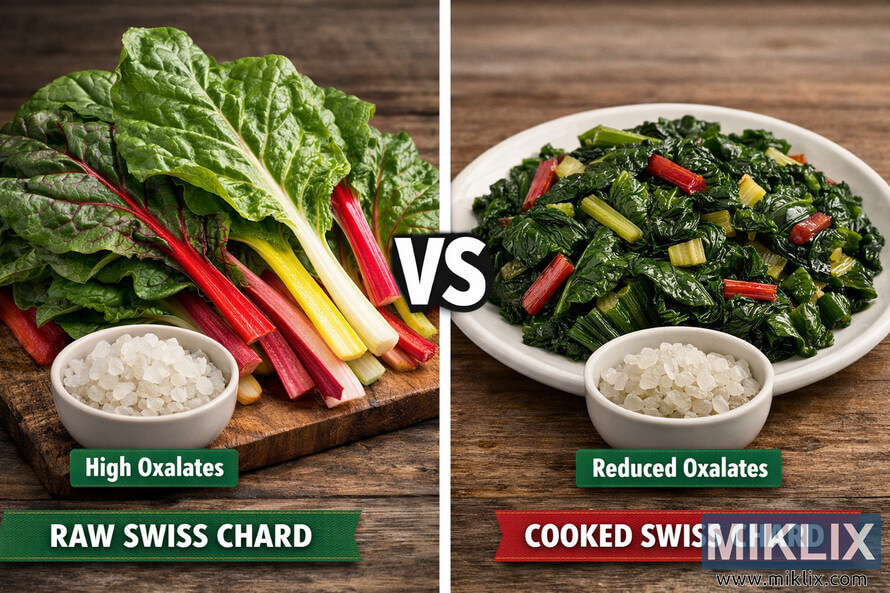
Educational comparison image illustrating raw versus cooked Swiss chard and the reduction of oxalates through cooking, with labeled bowls and clear visual contrast between fresh, vibrant leaves and darker, wilted cooked greens.
Visual Comparison of Raw and Cooked Swiss Chard and Oxalate Reduction
Versions disponibles d'aquesta imatge
Els fitxers d'imatge disponibles per descarregar a continuació estan menys comprimits i tenen una resolució més alta (i, com a resultat, una qualitat més alta) que les imatges incrustades en articles i pàgines d'aquest lloc web, que estan més optimitzades per a la mida del fitxer per tal de reduir el consum d'ample de banda.
Mida normal (1,536 x 1,024)
Mida gran (3,072 x 2,048)
Mida molt gran (4,608 x 3,072)
Mida extra gran (6,144 x 4,096)
Mida còmicament gran (1,048,576 x 699,051)
- Encara s'està carregant... ;-)
Descripció de la imatge
This image presents a clear, side-by-side visual comparison of raw versus cooked Swiss chard, designed to highlight the concept of oxalate reduction through cooking. The composition is divided vertically into two equal halves by a clean white line running down the center of the frame. At the midpoint of this dividing line, the letters "VS" appear in large, bold, white type with a dark outline, immediately signaling a direct comparison between the two states of the same vegetable. The overall layout is simple yet informative, making it easy for viewers to understand the nutritional message at a glance.
On the left side of the image, the focus is on raw Swiss chard. A rustic wooden cutting board occupies most of this half, resting on a slightly blurred wooden surface that serves as the background. Piled on the cutting board is a generous heap of fresh Swiss chard leaves and stems. The leaves are large, vibrant, and richly green, with a slightly crinkled texture that suggests crispness and freshness. Their surfaces catch the light in a subtle way, revealing the natural veins and contours of the foliage. The stems are strikingly colorful, featuring bright reds, sunny yellows, and clean whites. Some stems show a gradient effect, transitioning from intense red or yellow near the base to pale white as they approach the leafy portion, emphasizing the visual appeal of this leafy green.
In front of the cutting board, closer to the viewer, sits a small, round, white ceramic bowl. The bowl is filled with numerous small, translucent, irregularly shaped granules. These granules are meant to represent oxalates in their higher concentration when the Swiss chard is raw. Beneath the bowl, a green label is placed, bearing the text "High Oxalates" in a clear, readable font. This label visually reinforces the idea that raw Swiss chard contains a relatively higher amount of oxalates. Below the cutting board and bowl, along the bottom edge of the left half, a green banner stretches horizontally. On this banner, the words "RAW SWISS CHARD" are written in bold, white, capitalized letters, making it unmistakable which side of the comparison the viewer is observing. The green color of the banner harmonizes with the fresh green leaves and the "High Oxalates" label, creating a cohesive visual theme for the raw side.
On the right side of the image, the emphasis shifts to cooked Swiss chard. Here, a white ceramic plate replaces the wooden cutting board as the central surface. The plate is filled with cooked Swiss chard leaves and stems, arranged in a slightly piled manner that mirrors the abundance seen on the raw side. However, the visual character of the cooked chard is noticeably different. The leaves appear wilted and darker in color, with a deep, glossy green tone that suggests they have been sautéed, steamed, or boiled. The once-crisp texture is now softened, and the leaves cling together more closely, reflecting the transformation that occurs during cooking. The stems, while still showing red and yellow hues, are more muted and subdued compared to their raw counterparts, indicating that heat has altered their appearance and possibly their nutritional profile.
In front of the plate, mirroring the arrangement on the left, there is another small, round, white ceramic bowl. This bowl contains fewer and smaller translucent granules than the one on the raw side. The reduced quantity of granules visually symbolizes the lower level of oxalates present after cooking. Beneath this bowl, a green label reads "Reduced Oxalates," clearly communicating that the cooking process has decreased the oxalate content. Along the bottom edge of the right half, a red banner runs horizontally, bearing the text "COOKED SWISS CHARD" in bold, white, capitalized letters. The red banner contrasts with the green banner on the left, subtly reinforcing the idea of change or transformation between the two states of the vegetable.
The central "VS" text, positioned on the dividing line, serves as a focal point that ties both halves together. Its bold, white letters with a dark outline stand out against the neutral background and the white line, making the comparison explicit and visually engaging. The background across the entire image consists of a rustic wooden surface that is slightly blurred, ensuring that the main elements—the raw and cooked Swiss chard, the bowls of granules, and the labels—remain in sharp focus. The lighting is even and well-balanced, illuminating both sides equally so that no detail is lost in shadow or overexposed highlights.
Overall, the image communicates a clear nutritional message: raw Swiss chard, while visually vibrant and fresh, is associated with higher oxalate content, whereas cooked Swiss chard, though darker and more wilted in appearance, is associated with reduced oxalate levels. The use of bowls filled with translucent granules labeled "High Oxalates" and "Reduced Oxalates" provides a simple visual metaphor for the chemical changes that occur during cooking. The banners at the bottom of each half, along with the central "VS" text, make the comparison easy to understand for viewers who may not be familiar with oxalates or the effects of cooking on leafy greens. The image is both educational and aesthetically pleasing, combining clear labeling, contrasting colors, and thoughtful composition to convey the concept of oxalate reduction in Swiss chard through cooking.
La imatge està relacionada amb: Swiss Chard: Why It Is One of the Healthiest Leafy Greens