
Image: Healthy vs. Diseased Tomato Leaves: A Visual Comparison
Published: December 9, 2025 at 8:37:33 PM UTC
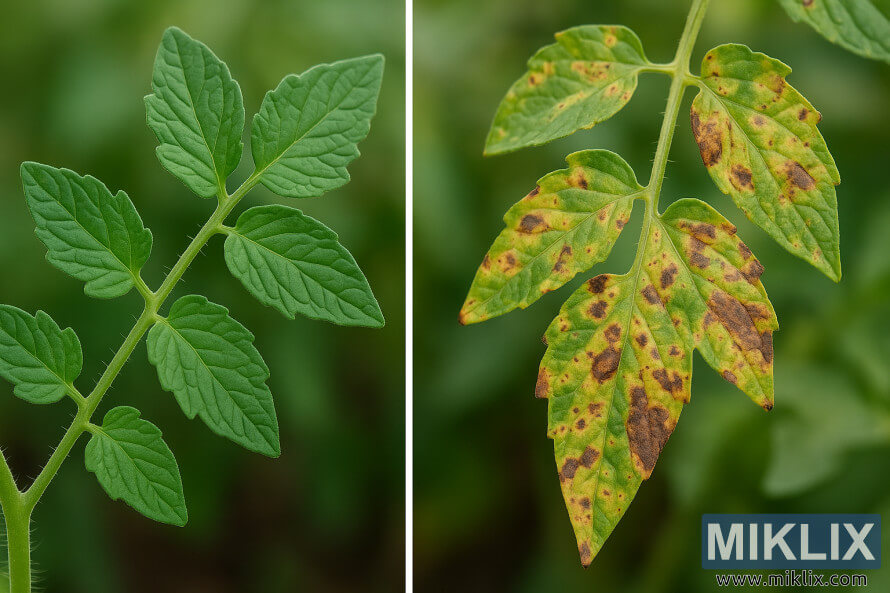
A detailed comparison image showing healthy tomato leaves next to diseased leaves with spotting and discoloration, useful for identifying plant health issues.
Available versions of this image
The image files available for download below are less compressed and higher resolution - and as a result of that, higher quality - than the images embedded in articles and pages on this website, which are more optimized for file size in order to reduce bandwidth consumption.
Regular size (1,536 x 1,024)


Large size (3,072 x 2,048)
Very large size (4,608 x 3,072)
Extra large size (6,144 x 4,096)
Comically large size (1,048,576 x 699,051)
- Still uploading... ;-)
Image description
This image presents a clear, side-by-side comparison of healthy and diseased tomato leaves, offering a highly informative visual reference for gardeners, growers, and anyone interested in diagnosing plant health issues. The photograph is divided vertically into two halves by a clean white line, making the contrast between the healthy and the diseased foliage immediately apparent. On the left side, the healthy tomato leaves are vibrant, uniform in color, and richly green. Their leaflets display smooth, well-defined edges and a firm structure. The veins are evenly distributed and slightly raised, creating a textured surface that highlights the natural vitality of a well-nourished tomato plant. The stems and leaf petioles appear sturdy and have a fine covering of soft, short hairs, characteristic of many tomato varieties. The background behind the healthy leaves is softly blurred in shades of green, suggesting a thriving garden environment without distracting from the leaf details.
In stark contrast, the right side shows tomato leaves suffering from a common foliar disease, illustrated through a range of discolorations, spotting, and tissue damage. The diseased leaves exhibit irregular yellowing across much of their surface, transitioning into areas marked with brown and black lesions. These spots vary in size—from small speckles to larger necrotic patches—and are unevenly distributed across the leaflets. Some lesions have darker centers surrounded by lighter halos, a typical symptom of fungal or bacterial infections that disrupt the leaf’s internal structure. The overall coloration is mottled, combining pale green, yellow, brown, and nearly black tones, conveying the severity of the infection. The leaf edges on the diseased side are slightly curled or wilted, suggesting stress or dehydration resulting from compromised physiological function. The texture also differs noticeably: where the healthy leaves appear firm and turgid, the diseased ones seem thinner and more fragile, with sections showing early signs of leaf tissue breakdown.
Both sets of leaves share the recognizable tomato-leaf shape—pinnately compound with serrated leaflets—but their conditions create a striking visual contrast. The uniform lighting across the entire image ensures that the comparison is not influenced by shadows or highlights, allowing viewers to focus entirely on the morphological and color differences. The blurred green backdrop behind the diseased leaves mirrors that of the healthy side, providing visual consistency and reinforcing that the differences are due to plant health rather than environmental lighting.
Overall, this photograph serves as a practical, high-resolution diagnostic tool. It encapsulates the essential visual cues growers rely on when identifying potential tomato leaf diseases, such as early blight, septoria leaf spot, or other pathogens. By juxtaposing healthy and compromised foliage in a single frame, the image helps viewers quickly recognize early warning signs, better understand disease progression, and make informed decisions about treatment, prevention, and selecting resilient tomato varieties.
The image is related to: A Guide to the Best Tomato Varieties to Grow Yourself