
Image: Proper Pruning Cuts and Branch Angles for Walnut Trees
Published: January 15, 2026 at 9:44:51 PM UTC
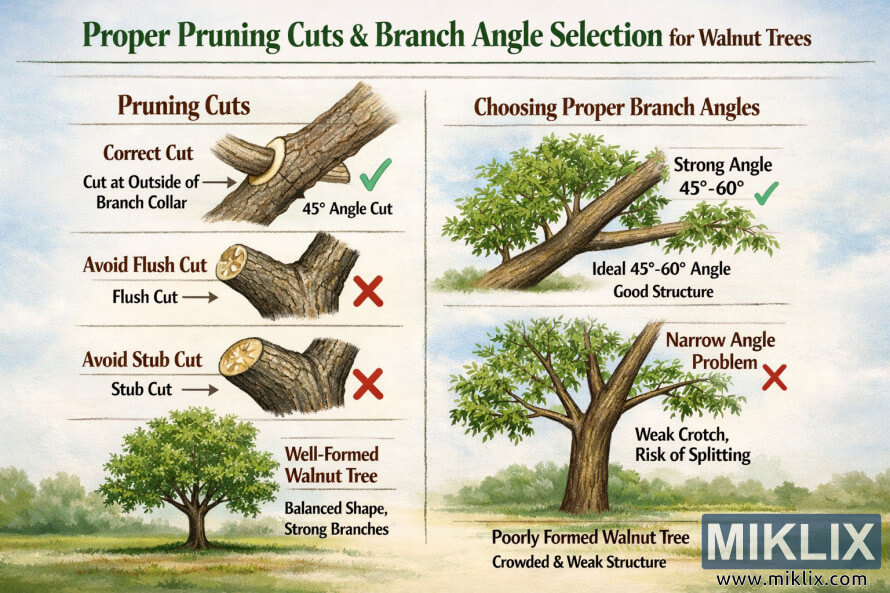
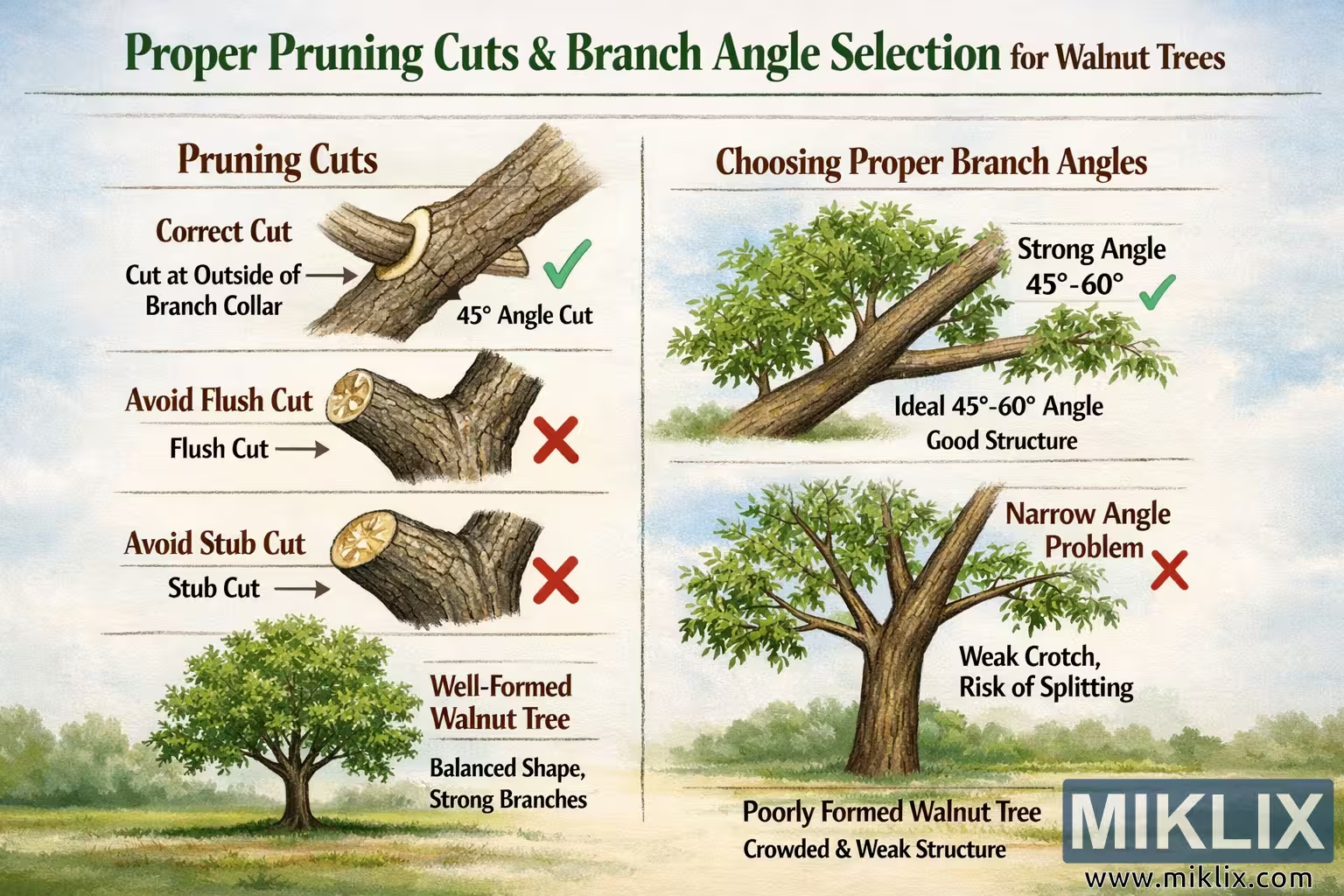
Illustrated guide explaining proper pruning cuts and ideal branch angles for walnut trees, highlighting correct techniques and common mistakes to avoid.
Available versions of this image
The image files available for download below are less compressed and higher resolution - and as a result of that, higher quality - than the images embedded in articles and pages on this website, which are more optimized for file size in order to reduce bandwidth consumption.
Regular size (1,536 x 1,024)
Large size (3,072 x 2,048)
Very large size (4,608 x 3,072)
Extra large size (6,144 x 4,096)
Comically large size (1,048,576 x 699,051)
- Still uploading... ;-)
Image description
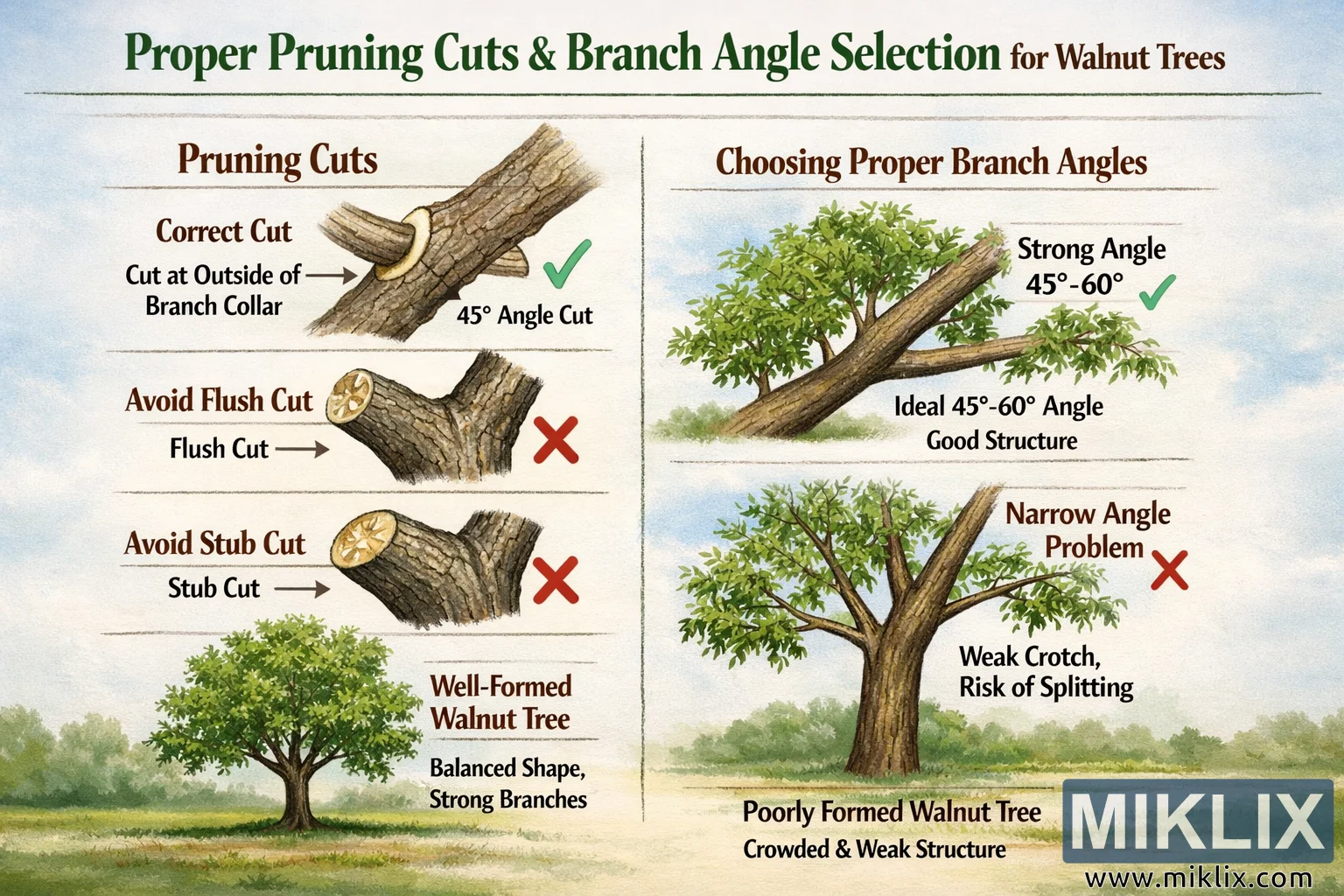
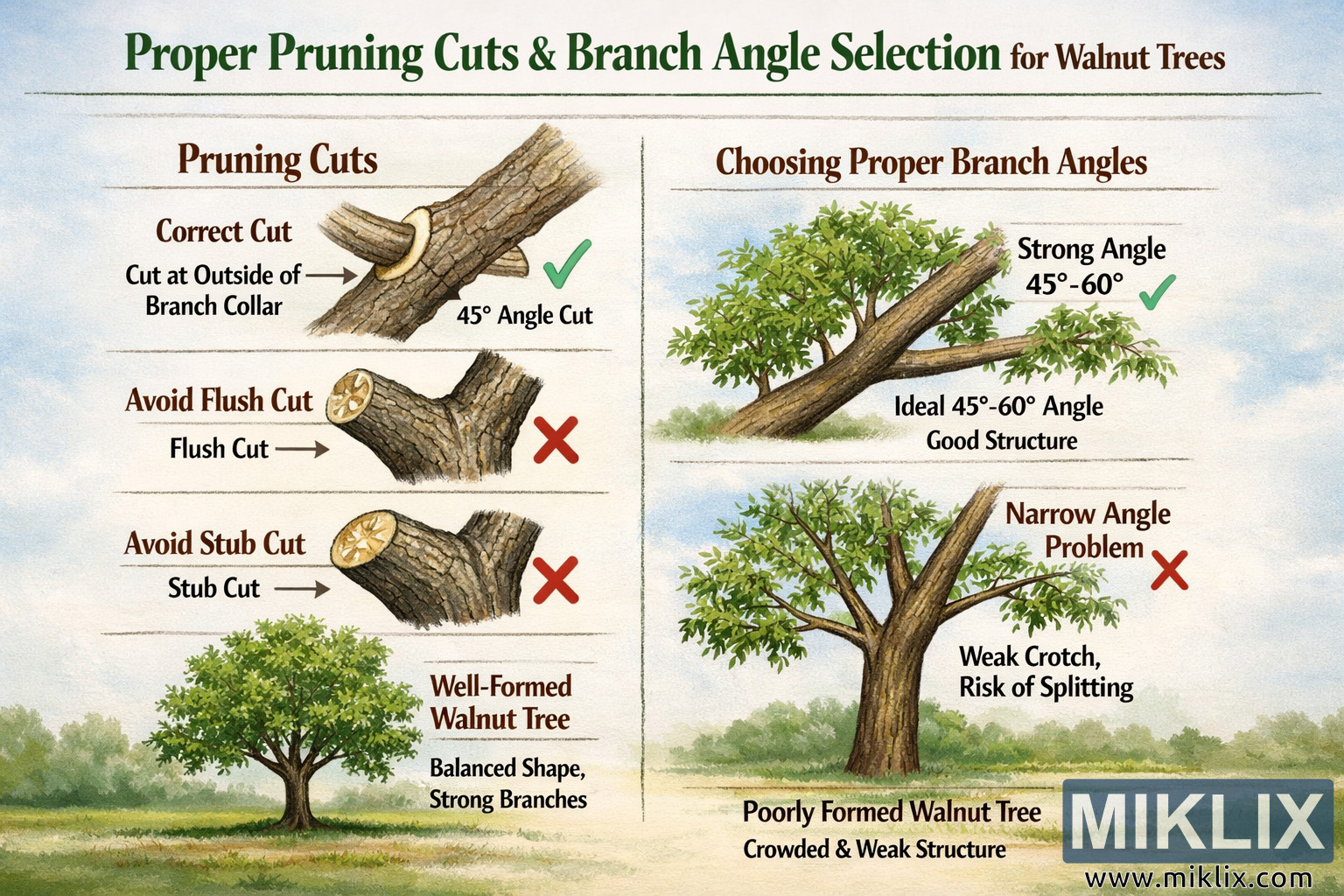
The image is a detailed educational diagram illustrating proper pruning cuts and branch angle selection for walnut trees. It is presented in a horizontal, landscape layout with a soft, natural color palette and a hand-drawn, botanical illustration style. The diagram is divided vertically into two main sections, each clearly labeled to guide the viewer.
At the top center, a large title reads "Proper Pruning Cuts & Branch Angle Selection for Walnut Trees," establishing the instructional purpose of the image. The left half of the diagram is titled "Pruning Cuts" and focuses on how branches should be cut during pruning. At the top of this section, a close-up illustration shows a correct pruning cut made just outside the branch collar. An arrow points to the branch collar, and a green check mark reinforces that this technique is recommended. Text notes that the cut is made at an approximately 45-degree angle, emphasizing both placement and orientation.
Below this, two incorrect pruning examples are shown. The first is labeled "Avoid Flush Cut" and depicts a branch cut too close to the trunk, removing the branch collar. A red X symbol indicates that this method is harmful. The second incorrect example is labeled "Avoid Stub Cut" and shows a branch cut too far from the trunk, leaving a protruding stub. This example is also marked with a red X, signaling that it should be avoided due to poor healing and increased disease risk.
At the bottom of the left section, a small illustration of a well-formed walnut tree is shown. The tree has a balanced canopy and evenly spaced branches, accompanied by text stating "Well-Formed Walnut Tree" and "Balanced Shape, Strong Branches," reinforcing the benefits of correct pruning practices.
The right half of the diagram is titled "Choosing Proper Branch Angles" and focuses on tree structure rather than individual cuts. At the top of this section, a walnut tree branch is shown growing at a wide, stable angle from the trunk. Text highlights a strong angle of 45 to 60 degrees, with a green check mark indicating that this range provides good structure and strength. Additional text explains that this angle is ideal for long-term tree health.
Below, a contrasting example illustrates a walnut tree with very narrow branch angles. The branches form tight crotches where they join the trunk. This illustration is labeled "Narrow Angle Problem" and "Weak Crotch, Risk of Splitting," and it is marked with a red X. At the bottom right, a poorly formed walnut tree is shown with crowded, upright branches, accompanied by the caption "Poorly Formed Walnut Tree" and "Crowded & Weak Structure." Overall, the image clearly contrasts correct and incorrect pruning and training techniques to visually communicate best practices for walnut tree management.
The image is related to: A Complete Guide to Growing Walnuts in Your Own Garden