
Hops in Beer Brewing: Mathon
出版された:
最終更新日 2026年7月22日 13:25:00 UTC
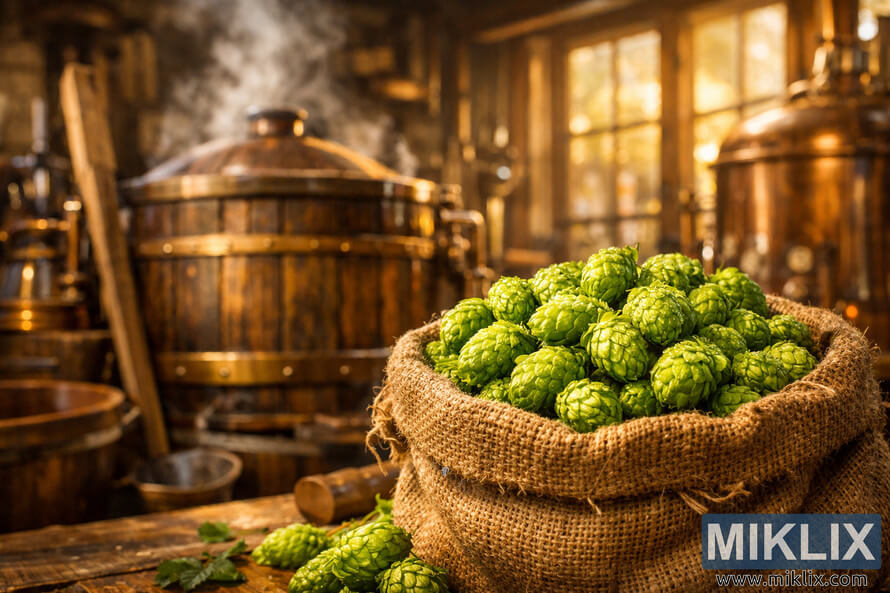
Mathon is a modern hop cultivar that has garnered attention for its aromatic range and reliable agronomics. Brewers are keen on new hop varieties that enhance aroma without compromising performance.
Hops in Beer Brewing: Mathon
画像をクリックまたはタップすると、詳細と高解像度が表示されます。
Key Takeaways
- Mathon hops offer distinctive citrus and floral notes that reward careful handling.
- Brewing Beer with Mathon hops requires attention to timing, storage, and yeast selection.
- Craft brewing Mathon benefits from adjusted water chemistry and mash temperature control.
- Sourcing fresh Mathon hops and controlling oxygen are critical to preserving aroma.
- Recipes scale predictably if hop utilization and sanitation are recalculated for batch size.
Introduction to Mathon hops and why brewers care
Mathon is a modern hop cultivar that has garnered attention for its aromatic range and reliable agronomics. Brewers are keen on new hop varieties that enhance aroma without compromising performance. This introduction explores Mathon's origins, its adoption by U.S. craft brewers, and the sensory traits they value.
Overview of origin and development
Mathon's roots lie in structured European breeding programs and collaborative research institutes. These entities aimed to enhance disease resistance and yield stability. Breeders sought a unique aromatic profile while maintaining strong agronomic traits. The development involved cross-breeding, multi-year field trials, and formal registration before its commercial release.
Why Mathon is gaining attention in the U.S. craft scene
In the U.S., brewers seek new aromatics to differentiate their offerings and create single-hop showcases. Mathon's citrus-tropical-floral mix is particularly appealing for IPAs and pale ales. The trend of importing European varieties or growing them under license in the U.S. has introduced Mathon to early adopters.
Primary sensory attributes brewers look for
- Citrus brightness: lemon and clementine notes that cut through malt.
- Floral top notes: orange blossom and light jasmine that add lift.
- Spicy undertones: mild pepper or clove that add complexity.
- Tropical hints: mango and stone fruit when used late or in dry hop.
Mathon's sensory attributes make it versatile for both bittering and aroma roles. Brewers assess alpha acid range and hop oil composition to determine Mathon's role in a recipe. This could be to drive bitterness, enhance aroma, or achieve a balance between both.
画像をクリックまたはタップすると、詳細と高解像度が表示されます。
Flavor profile and aroma characteristics of Mathon hops
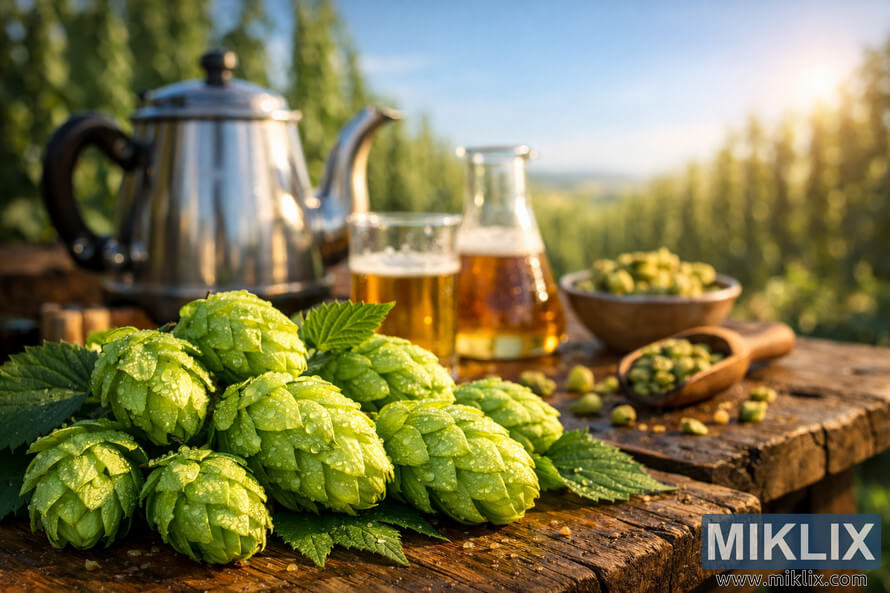
Mathon hops create a complex sensory experience for brewers. They offer a vibrant citrus core, complemented by softer floral and spice notes. The flavor profile of Mathon hops changes based on the brewing stage, oil content, and post-harvest handling of the cones.
Taste notes: citrus, floral, spice, and more
The primary flavors include lemon, grapefruit, and sweet orange. These citrus notes are sharp and zesty in early additions, becoming juicy and peel-like in later stages.
Floral elements, reminiscent of orange blossom and elderflower, emerge in late kettle and dry-hop additions. They enhance the beer's aroma without adding harshness.
Spice adds a subtle complexity, with hints of white pepper and coriander. These notes are particularly pronounced in Belgian-style ales and saisons. Tropical or stone fruit hints may also appear, especially in short-contact dry hops.
Aromatic intensity and hop oil composition
The aroma strength of Mathon hops is influenced by their hop oil composition. They likely contain a mix of monoterpenes and sesquiterpenes. This blend includes myrcene for fruity notes, humulene and caryophyllene for spice, and geraniol and linalool for floral nuances.
High myrcene levels enhance citrus and tropical aromas but diminish with heat and time. Humulene and bergamot-like compounds help preserve floral notes, ensuring aroma retention during whirlpool and dry-hop stages.
How drying, storage, and age affect aroma
Proper kiln drying is crucial for preserving volatile oils. Overdrying can strip away the bright top notes. The goal is to maintain a balance between monoterpenes and more stable terpenes.
Cold storage between 0–4°C in vacuum-sealed or nitrogen-flushed packages slows oil loss and prevents oxidation. Exposure to oxygen accelerates the decline of myrcene and leads to the formation of humulene oxidation products. These changes shift the aroma towards herbal or woody tones.
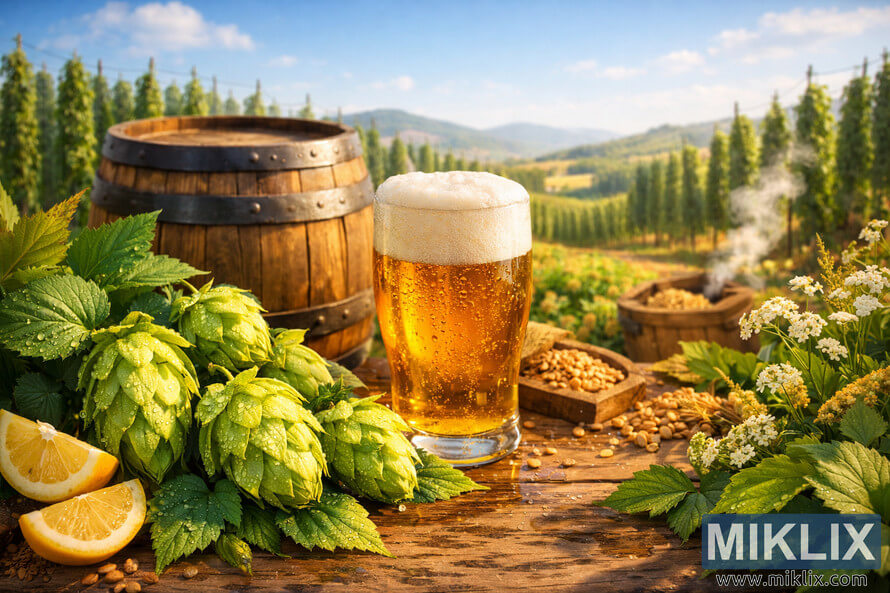
Fresh Mathon hops offer a vivid citrus and high volatile ester profile. Aged hops lose their top-note lift, becoming duller and more herbal with lower aromatic intensity. Brewers aiming to preserve the citrus floral spice hops signature should opt for fresher hops and minimize oxygen exposure.
画像をクリックまたはタップすると、詳細と高解像度が表示されます。
Alpha acids, beta acids, and utilization rates
Exploring the chemistry of hops is crucial for brewers aiming to balance bitterness and aroma. The alpha acid content in Mathon hops serves as a starting point for calculating bittering additions. The exact values can vary based on the grower, season, and supplier's Certificate of Analysis (COA).
Typical alpha acid range for Mathon hops
Mathon hops generally have an alpha acid range of 6–12%. Brewers should refer to the supplier's COA for precise figures. Seasonal changes and specific growing conditions can influence these values within the range.
How alpha and beta acids influence bitterness and stability
Alpha acids, primarily humulone, are responsible for bitterness during the boil. Higher alpha acids allow brewers to achieve target IBUs with less hop material. Despite high alpha acids, the hop's oil composition remains key to its aroma.
Beta acids, on the other hand, contribute minimally to boil bitterness. They slowly oxidize, leading to harsher, aged bitterness. This oxidation also enhances antimicrobial properties, impacting long-term bitterness stability. Proper storage and minimizing oxygen exposure are essential to preserve the hop's profile and prevent off-flavors.
Practical utilization rates for homebrewing vs. commercial brews
- Homebrew kettle bittering: expect roughly 20–30% hop utilization rates depending on wort gravity, boil time, and hop form.
- Pellet hops generally give slightly higher utilization than whole leaf for bittering. Use pellet-specific numbers when running Tinseth or Rager calculations.
- Late-kettle, whirlpool, and dry hop additions should be treated by mass rather than IBU. Homebrew dry hop ranges: 0.5–3.0 oz per 5 gallons (14–85 g per 19 L) based on desired intensity.
- Commercial brewers scale by barrel. Whirlpool contact time and temperature shift effective utilization, so adjust calculations and trial small pilot batches when possible.
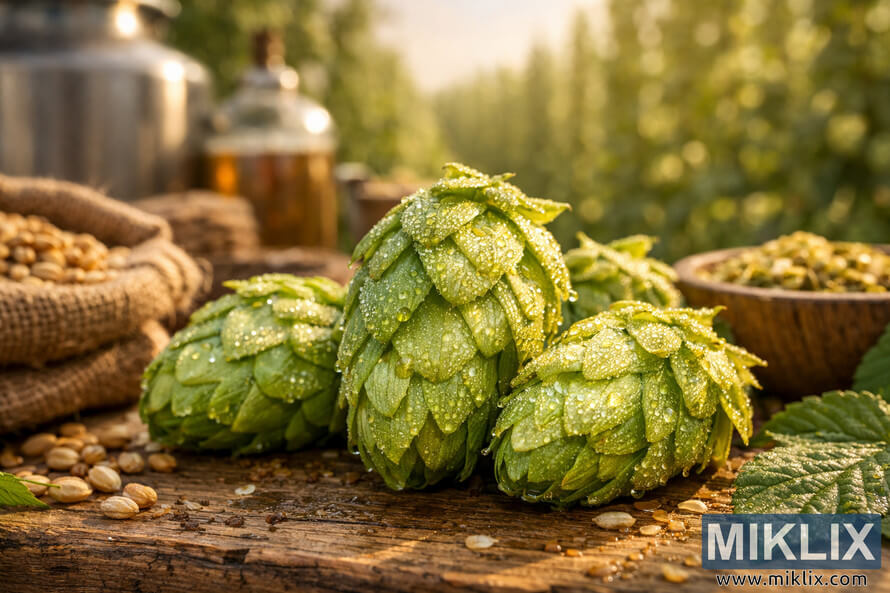
To achieve accurate results, match the batch COA with a chosen formula. Then, refine based on brew house efficiency and sensory feedback. Paying close attention to hop utilization rates and storage will enhance consistency and bitterness stability across batches.
画像をクリックまたはタップすると、詳細と高解像度が表示されます。
Best beer styles to showcase Mathon hops
Mathon hops bring bright citrus and floral notes to a variety of beers. A light, clear malt bill is ideal to highlight these aromatics. Pairing with yeast that adds spice and esters can enhance complexity. Below are practical style ideas and targets to help brewers showcase Mathon effectively.
IPAs and pale ales are perfect for Mathon hops. In IPAs, Mathon enhances late additions and dry hops with citrus and floral notes. For New England IPAs, aim for OG 1.060–1.075 and FG 1.010–1.015. Target perceived bitterness near 40–60 IBU for a NEIPA mouthfeel. Classic American pale ales should have OG 1.045–1.055 and IBUs 30–40 to balance malt and hop clarity.
Single-hop test batches can isolate Mathon's character. Use heavy late kettle and dry-hop additions for a citrus-forward but soft profile. Layer with Citra or Mosaic for tropical lift without losing the varietal signature.
Belgian ales and saisons benefit from Mathon's subtle spice. Mathon saison treatments bring forward peppery and floral accents that play well with Belgian yeast phenolics. Keep hopping moderate at 20–35 IBU to let yeast-driven esters and spice mingle with the hop’s nuance.
Choose saison mash temps around 150–154°F for a balanced body that showcases yeast and hops. Ferment warm with a saison strain to amplify farmhouse funk. For Belgian-style ales, aim for OG 1.048–1.060 depending on desired strength.
Light lagers and pilsners require restraint. Use small late whirlpool additions or hop teas to add a bright citrus lift while preserving a clean malt profile. Mathon pilsner use at low rates keeps the beer crisp without introducing grassy or vegetal notes.
When dry hopping lagers, use minimal contact time and cold temperatures to avoid vegetal extraction. Target OG 1.045–1.055 for classic pilsner range and IBUs 20–30 for a balanced, drinkable finish.
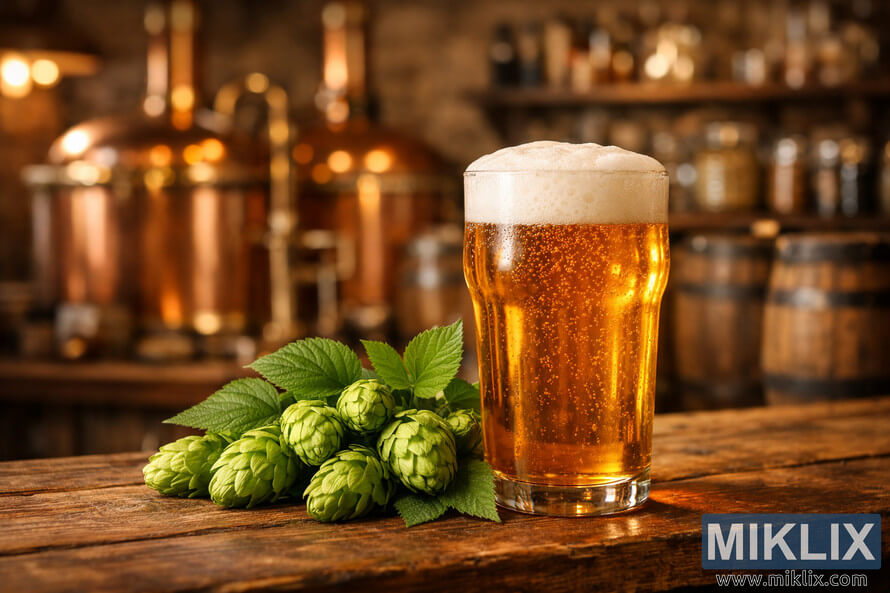
画像をクリックまたはタップすると、詳細と高解像度が表示されます。
Recipe formulation tips when using Mathon hops
Mathon hops introduce bright citrus and floral notes, requiring a clean canvas. Opt for base malts and adjuncts that highlight these aromas. Use minimal crystal malts to prevent dulling the top notes. These tips ensure the hop character shines in your brews.
Choosing malts for Mathon hops
- Begin with neutral pale malts like US two-row or German Pilsner for IPAs and pale ales. This allows Mathon’s citrus and floral qualities to dominate.
- In saisons and farmhouse ales, combine Pilsner or Vienna malt with a small wheat portion. This enhances head and dryness. Use minimal specialty malt to preserve spicy yeast traits and Mathon aroma.
- For NEIPAs, incorporate light dextrins such as Carapils or flaked oats. This boosts mouthfeel without diminishing hop brightness. Avoid heavy crystal malts that obscure hop oils.
Balancing hop body and bitterness
- Adjust original gravity and mash temperatures according to style. For NEIPA, mash at 148–152°F for fuller body and haze retention. For classic pale ales, aim 150–154°F for balanced body and fermentability.
- Set IBUs to match the beer's style while keeping perceived bitterness in check. Use lower late-hop IBUs for aroma dominance with gentle bitterness.
- Consider hop utilization and kettle scheduling to achieve balanced hop body bitterness. Avoid harsh astringency from prolonged boil additions.
Yeast for hop aroma and fermentation choices
- Choose neutral American ale strains like Wyeast 1056 or Safale US-05. This keeps the canvas clean, allowing Mathon hop aroma to dominate.
- Opt for London Ale strains or Conan-style yeasts for fruity esters that complement Mathon's citrus notes.
- For saisons, select strains like Wyeast 3711 for peppery, phenolic interplay that highlights spicy hop facets.
- In lagers, pick clean lager strains like Wyeast 2308 or White Labs WLP830. Plan extended cold conditioning to preserve delicate hop character.
Practical tips for recipe balance
- Keep specialty malts under 10% in hop-forward recipes to avoid masking aroma.
- Use late kettle and whirlpool hops for flavor and dry hop for pure aroma. Adjust contact time to prevent vegetal notes.
- Match carbonation and serving temperature to style to influence perceived bitterness and aroma lift.
Apply these malts for Mathon hops and yeast for hop aroma guidelines alongside Mathon recipe tips. This will help you craft beers with clear aroma, balanced bitterness, and the right body for each style.
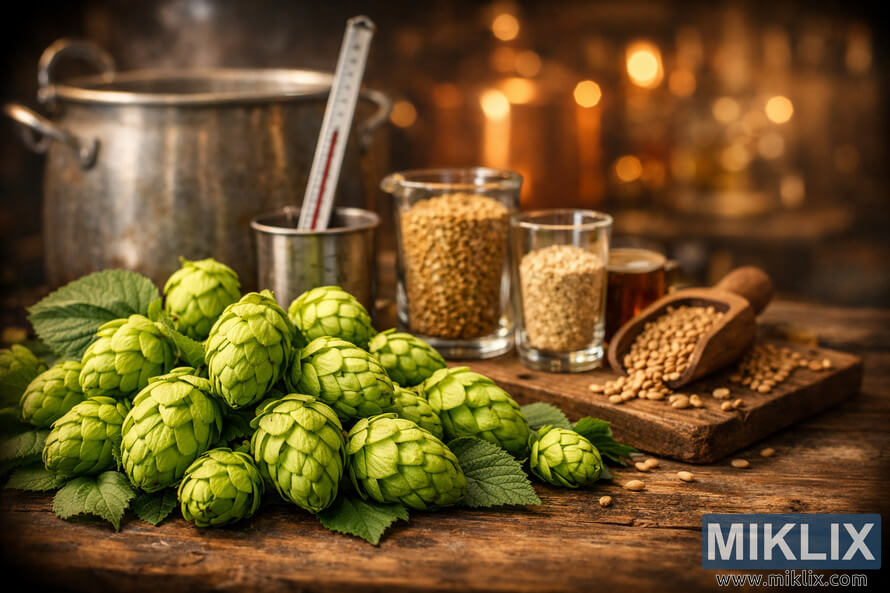
画像をクリックまたはタップすると、詳細と高解像度が表示されます。
Hop timing and additions: bittering, flavor, and aroma
Mathon hops excel as both bittering hops and aromatic contributors. The timing of hop additions is crucial for controlling bitterness, flavor, and volatile oil retention. Below, we outline practical schedules and tactics for optimizing Mathon hop timing in the kettle, whirlpool, and fermenter.
For bittering, use Mathon early to establish the IBU profile. Additions between 60–90 minutes provide clean bitterness and require less weight due to higher utilization. To preserve aroma, use a neutral bittering hop like Magnum or Warrior, reserving Mathon for later additions.
Design a boil schedule that layers character. Use a 60–90 minute addition for base bitterness. Add a smaller dose at 15–20 minutes for flavor and light aroma. This approach allows you to fine-tune bitterness without sacrificing delicate notes.
Late kettle and whirlpool additions extract oils with minimal isomerization. Add hops at 10–20 minutes left in the kettle to enhance mid-boil flavor. For whirlpool work, cool to 170–180°F and steep for 20–60 minutes. Higher temperatures speed extraction but shorten volatile retention, so monitor contact time closely.
Whirlpool Mathon contact of 20–40 minutes often hits the sweet spot for landing bright top-note aromatics without excess vegetal carry. For fuller extraction, try 40–60 minutes, then chill quickly. Use gentle trub separation and avoid reboiling the wort after whirlpool additions to keep oils intact.
Dry hopping Mathon showcases the variety's true potential. Typical contact times range from 24–96 hours, depending on dose and temperature. For a pronounced aroma, aim for 48–72 hours at 60–68°F. Short, warm dry hops favor faster oil release, while longer cold contacts can give more rounded character.
Staged dry hopping stretches aromatic life and reduces grassy extraction. Split the total dry hop charge into two or three additions spaced across fermentation or conditioning. Use closed transfers, CO2 purging, and minimal splashing to limit oxygen uptake during dry hopping Mathon.
- Use Mathon at 60–90 minutes for reliable bittering.
- Add at 10–20 minutes or whirlpool at 170–180°F for aroma.
- Whirlpool Mathon: 20–60 minutes contact; avoid prolonged heat.
- Dry hopping Mathon: 24–96 hours; 48–72 hours at 60–68°F for peak aroma.
- Split dry hop additions and minimize oxygen during transfers.
Dry hopping strategies specifically for Mathon hops
Mathon dry hopping requires precision in timing and dosage. Select quantities based on your brewing style and vessel size. Control the contact time and temperature to enhance citrus and floral notes. Avoid green, grassy flavors.
When selecting dry hop quantities for Mathon, do so with purpose. For a 5-gallon batch, consider these ranges:
- Light: 0.5–1.0 oz (14–28 g)
- Medium: 1.0–2.0 oz (28–57 g)
- Heavy: 2.0–4.0 oz (57–113 g)
For larger batches, scale up accordingly. Commercial batches of 10–15 barrels will see extraction differences. Pellets generally offer stronger extraction than whole cones due to their density.
Quantity guidelines by batch size
In commercial brewing, increase homebrew quantities by batch volume. Then, reduce by 5–10% to account for increased surface area and better mass transfer. Monitor your results to refine your dry hopping quantities for Mathon, ensuring consistent aroma and balance.
Cold soak versus warmed dry hop methods
Cold soak hops at 1–4°C for 3–7 days to extract delicate aromatics gently. This method preserves citrus and floral notes while minimizing harsh vegetal flavors.
For a quicker, more intense aroma, warm dry hop at 50–68°F. This method extracts myrcene rapidly, enhancing fruit and resin flavors. However, keep the contact time short to avoid green notes.
- Cold soak hops: gentle aroma, longer time, lower vegetal risk.
- Warmed dry hop: faster aroma pickup, higher risk if left too long.
Minimizing vegetal character and avoiding oxidation
Limit warm contact to under 96 hours. Use hop bags, stainless cages, or inline filters to manage leaf matter and reduce break material. Purge tanks with CO2 before and after hop additions. Minimize headspace oxygen during transfers to prevent oxidation.
For commercial haze control, consider silica gel fining or centrifugation. These methods prevent extended dry hop contact, keeping Mathon hop aroma vibrant and fresh.
Pairing Mathon hops with other hop varieties
Mathon shines when paired with hops that complement its bright, fruity essence or add resinous depth. Use staggered additions and controlled amounts to maintain a layered, fresh hop character. Below, we outline a guide to blend citrus, tropical, or pine notes with Mathon without overpowering it.
For fruit-forward beers, pair Mathon with Citra, Mosaic, Amarillo, or Nelson Sauvin. Add Mathon mid-boil or in the whirlpool to preserve its floral and citrus notes. Combine it with Citra or Mosaic in late whirlpool and dry hop additions for enhanced citrus tropical aromas.
For beers needing a resinous backbone, choose Columbus, Simcoe, or Chinook. Use these mainly in early bittering or small whirlpool amounts. Ensure resinous hops are secondary to Mathon, supporting its floral and tropical notes rather than overpowering them.
Construct layered hop schedules by dividing additions and varying contact times. A simple example:
- Early bittering: neutral high-alpha like Magnum for clean bitterness.
- Mid-boil: small Mathon addition for flavor depth.
- Whirlpool: Mathon plus Citra for aromatic lift.
- Dry hop: split between Mathon and Mosaic with a short final burst.
Staggered dry hop contact preserves top notes and minimizes grassy flavors. When crafting Mathon hop blends, test small batches to fine-tune ratios. This hands-on approach ensures consistent hop pairing citrus tropical profiles and balanced resinous hop partners across production runs.
Water chemistry and mash adjustments when using Mathon
Mastering water and mash conditions is crucial for showcasing Mathon hops in your beer. Even slight changes in mash pH, mineral content, and temperature can significantly alter hop brightness, mouthfeel, and bitterness. Utilize tools like Bru'n Water or a reliable water report to plan your adjustments before brewing.
Strive for a mash pH between 5.2 and 5.4 to enhance enzymatic conversion and preserve hop aromatics. It's best to measure pH at mash temperature. If the pH exceeds 5.4, use food-grade lactic acid to adjust it. Conversely, if it drops below 5.2, add baking soda in small increments and reassess.
Aim for a finished beer pH of 4.2–4.5 to highlight hop brightness and crisp flavors. A lower pH sharpens bitterness and enhances hop top-notes without adding harshness. Monitor wort pH through tasting and objective measurement to refine future batches.
Adjust the calcium and sulfate to chloride balance to achieve the desired hop character. For a crisper hop bite, increase sulfate and calcium levels. A good starting point for hop-forward ales is 150–300 ppm sulfate with 50–100 ppm chloride. Use gypsum and Epsom to elevate sulfate levels.
For malt-forward beers or New England styles, favor a higher chloride balance to enhance body and fullness. Aim to increase chloride over sulfate to boost mouthfeel and soften hop aromatics. Add calcium chloride to increase chloride without raising alkalinity excessively.
- Consult your water report and add gypsum, calcium chloride, or Epsom as needed.
- Target a sulfate chloride ratio hops balance that matches the style: sulfate-dominant for crisp IPAs, chloride-rich for hazy, soft ales.
- Watch total hardness and alkalinity; use reverse osmosis water when major reshaping is required.
Mash temperature is key in controlling fermentability and body. Use 148–150°F for a more fermentable wort and drier finish that accentuates hop bite. This range is ideal for enhancing hop intensity without adding sweetness.
Raise mash temperature to 152–156°F for a fuller body and thicker mouthfeel, perfect for NEIPA-style beers. A warmer mash temp mutes bitterness while highlighting aromatic complexity.
Match mash temperature to the desired beer profile. For a biting, crisp IPA, choose lower mash temps. For a soft, round character that supports haze and juicy hop character, opt for higher mash temps.
Fermentation management to preserve Mathon hop character
Managing fermentation and post-fermentation handling significantly impacts hop aroma preservation. Maintaining precise temperature control, executing dry hopping at the right time, and gentle conditioning are crucial. These steps ensure the retention of Mathon hops' bright citrus, floral, and spice notes.
Fermentation temperatures and yeast health
Starting with healthy yeast and maintaining a consistent fermentation temperature is key. For a clean ale, aim for 64–68°F with strains like Wyeast 1056 or White Labs WLP001. For fruitier profiles, 69–72°F is suitable, but be cautious of esters that can obscure hop nuances. Lagers require 48–55°F to preserve delicate hop oils.
Proper oxygenation and yeast nutrient supplementation are essential to avoid off-flavors. Employ open-headspace blowoffs or gentle recirculation during early fermentation to safeguard aroma compounds.
Timing of dry hop additions relative to fermentation
Timing your dry hopping is critical for achieving your flavor objectives. Adding hops during high krausen can unlock thiol-like fruitiness and new volatiles through biotransformation.
For preserving the freshest hop aromatics, use a post-fermentation dry hop. This method captures volatile oils with minimal yeast interaction. Both approaches can be effective with Mathon, provided you carefully plan contact time and hop mass.
- Biotransformation: add during active fermentation; expect layered, fermented-fruit notes.
- Post-ferment: add after primary activity ends; expect cleaner, brighter aroma.
- Limit extended contact over 7 days to reduce vegetal character and oxidation risk.
Conditioning, cold crash, and packaging to retain aroma
After dry hopping, condition the beer to allow particulates to settle. Then, cold crash hops between 32–40°F for 24–72 hours to remove trub and hop debris. Cold crashing sharply reduces haze and preserves volatile oils by immobilizing them in the cold beer.
Minimize oxygen exposure during transfers and use CO2 purging when racking to the bright tank or package. Package quickly after dry hop contact ends to preserve hop volatile shelf life.
- Use low oxygen fills for cans or bottles and consider oxygen-scavenging caps for extended shelf life.
- Target minimal headspace or flush with CO2 prior to sealing to protect delicate aromatics.
- Store finished beer cold and away from light to preserve the character of Mathon hops.
Sourcing, storage, and freshness best practices
Securing reliable Mathon hops and maintaining their freshness hinges on the reputation of suppliers and the storage method. Brewers in the United States should opt for vendors with transparent handling protocols and current COAs for alpha acids and oil content. It's crucial to buy Mathon hops US from established distributors that ensure cold-chain control. This protects the hops' aroma and bitterness.
- For quality Mathon hops in the United States, look for established hop suppliers and distributors. Options include Yakima Chief Hops, Hopsdirect, Farmhouse Hops, King Boiler Hop Farm, regional hop merchants, reputable homebrew shops, and specialty online retailers.
- When evaluating Mathon hop suppliers, verify certificates of analysis for alpha acid and oil levels. Ensure the vendor employs refrigerated shipping and documented cold storage.
Proper storage is key to preserving delicate aromatics. Adhere to hop storage best practices to maintain oil integrity and bitterness. Treat fresh hops as perishable produce, limiting exposure to oxygen and light.
- Cold storage and vacuum/oxygen control: store hops vacuum-sealed or nitrogen-flushed in foil bags at 32–40°F (0–4°C) for short term. For long-term storage, transfer sealed bags to a freezer at 0°F (-18°C).
- When repackaging, use oxygen absorbers and minimize bag opening frequency. Store hops in dark conditions to prevent UV-driven degradation.
Identifying aged or degraded hops is crucial to avoid off-flavors. Combine sensory checks with lab data. Hop freshness indicators are essential for making decisions about using or replacing stock.
- Sensory indicators: look for loss of bright citrus or floral notes, a hay-like or papery aroma, muted resin or tropical top notes, and the emergence of cardboard or dry characters.
- Analytical indicators: lower alpha acid readings on the supplier COA compared with original values, and reduced oil concentrations when tested.
- Practical tip: run a small pilot brew when in doubt. For aroma-forward usage, replace hops older than one growing season to preserve expected character.
Scaling recipes: from homebrew to small commercial batches
Scaling a Mathon recipe from a 5-gallon kettle to a 1 bbl pilot system is more than just multiplying numbers. This guide will walk you through the math, process changes, and budget considerations for scaling Mathon recipes for small commercial batches.
First, focus on hop scaling calculations. Convert volumes: 1 barrel equals 31 gallons. So, a 5-gallon recipe multiplied by 6.2 equals the target batch volume. Enter your recipe into software like Brewfather or BeerSmith. Then, update inputs with the lot-specific COA for Mathon hops. Remember, pellets are 1.05–1.15x more effective by weight than whole cones.
- Adjust utilization for kettle geometry. Wider kettles and longer boil contact increase bittering efficiency.
- Consider whirlpool and hop-back changes. Whirlpool efficiency varies with hop mass and vessel shape.
- Recalculate IBUs using measured alpha acids from the supplier COA instead of assumed averages.
Calculating hop quantities and utilization at scale
Run hop scaling calculations per batch and per keg. Use IBU target × batch size ÷ (alpha fraction × utilization) to estimate hop grams. For example, to hit 40 IBUs in 1 bbl with Mathon at 10% alpha and 25% utilization: grams = (40 × 31 × 1.0) ÷ (1000 × 0.10 × 0.25). Validate results with software and adjust for pellet boost.
Remember losses to trub and hop absorption. Commercial hop utilization differs from homebrew numbers. Track actual post-boil gravity and measure IBUs when possible to refine your multiplier for future brews.
Sanitation and process changes when scaling up
Scaling introduces equipment and microbial risks. Install closed-loop dry hop dosing to limit oxygen pickup. Automated hop dosing systems lower human error and keep timing precise across batches.
- Implement hop backs or centrifuges to remove solids before fermentation when clarity and shelf stability matter.
- Ensure CIP routines cover all hop-contact surfaces. Hops leave oils that support biofilms if not cleaned correctly.
- Validate seals, valve actuation, and filtration to avoid contamination and off-flavors when moving from pilot to production.
Cost considerations and yield management
Novel varieties like Mathon can raise input costs. Calculate the cost of Mathon hops per barrel by summing hop purchase price, freight, pellet vs. whole weight adjustments, and expected loss to trub. Divide total hop expense by barrels produced to get a per-bbl hop cost.
Plan for alpha acid variability. Buy using COA-driven contracts and consider blending lots to hit target bitterness without overspending. Track yield metrics: batch-to-batch extract, trub losses, and fermentation retention to improve margins.
- Budget for buffer inventory. Freight and harvest swings affect availability and pricing for Mathon.
- Use scale Mathon recipes testing runs to measure commercial hop utilization empirically before committing large purchases.
- Keep a spreadsheet or ERP entry logging COAs, usage rates, and real costs to refine future purchasing decisions.
Conclusion
Mathon hops conclusion: Mathon offers a versatile aromatic profile, featuring citrus, floral, and spice notes. It's perfect for hop-forward IPAs, saisons, and even delicate lagers when used carefully. Success hinges on monitoring alpha and beta acids, understanding hop oils, and keeping hops fresh through cold storage.
When brewing with Mathon hops, timing and technique are crucial. Prioritize late-kettle and whirlpool additions. Test dry hopping times to prevent vegetal flavors. Adjust water chemistry for brightness and manage fermentation and yeast health to preserve aromas.
Mathon brewing summary: begin with a small batch. Order a test lot from a trusted U.S. supplier and review the COA. Brew a single-hop or simple two-hop pilot. Document your findings, adjust hop rates and schedules as needed, and scale up only after confirming the desired flavor. Use vacuum or inert-gas protection and cold storage to preserve Mathon's aromatic qualities for future brews.
FAQ
What are Mathon hops and where did they originate?
Mathon is a modern hop variety bred in Europe. It was developed for disease resistance and a unique aroma. Now, U.S. craft brewers are interested in its citrus and floral notes. Always check the supplier's COA for batch specifics.
What flavor and aroma characteristics can I expect from Mathon?
Mathon offers bright citrus, floral, and spice notes. Early boil additions bring more bitterness. Late additions and dry hopping preserve the citrus and floral oils.
What is the typical alpha acid range for Mathon and how should I use that information?
Mathon's alpha acid range is about 6–12%. Use your vendor's COA for precise planning. Higher alpha acids mean less hop mass needed for bitterness. Oil content is key for aroma.
How should I schedule Mathon hop additions for best aroma and bitterness?
Use early additions for bitterness. Reserve Mathon for late-kettle, whirlpool, and dry hopping to capture oils. Pairing with a neutral bittering hop preserves its aroma.
What dry hop quantities and techniques work well with Mathon for a 5-gallon batch?
For a 5-gallon batch, use 0.5–4.0 oz of Mathon. Staged or split dry hops extend freshness. Cold-soak or warm dry hop to extract oils.
Which beer styles best showcase Mathon hops?
Mathon is great in hop-forward styles like American IPAs and pale ales. It also complements Belgian ales and saisons. Use it in light lagers for a citrus lift.
What base malts, adjuncts, and yeast strains pair best with Mathon?
Use neutral pale malts to showcase Mathon. For NEIPAs, add oats or Carapils. Yeast: clean American strains for purity, London/Conan for fruitiness, and saison for spice.
How does water chemistry affect perception of Mathon hops?
Mash pH 5.2–5.4 and final beer pH 4.2–4.5 for hop brightness. For a crisper hop character, increase sulfate. Use gypsum and calcium chloride judiciously.
How should I store Mathon hops to preserve aroma and oil content?
Store hops cold and oxygen-free. Vacuum-sealed or nitrogen-flushed bags at 32–40°F slow oil loss. Freeze for longer storage.
How can I tell if Mathon hops have degraded and are no longer suitable for aroma use?
Degraded hops lose citrus and floral notes, smelling hay-like. Analytically, they show lower alpha acids and reduced oils. Avoid old hops for aroma-sensitive beers.
What are practical utilization rates for Mathon in homebrews versus commercial brews?
Homebrew kettle boil utilization is 20–30%. Pellets yield slightly higher utilization than whole leaf. Commercial vessels require software scaling due to geometry and whirlpool efficiency.
How should I approach dry hopping during active fermentation versus post-fermentation with Mathon?
Add during high krausen for thiol-like complexity or post-fermentation for fresh citrus and floral oils. Choose based on desired flavor profile and control oxygen exposure.
What hop pairings work best with Mathon for layered profiles?
Pair Mathon with Citra, Mosaic, Amarillo, or Nelson Sauvin for citrus/tropical layers. Use Columbus, Simcoe, or Chinook for resinous backbone. A sample schedule includes neutral bittering hop, mid-boil Mathon, whirlpool Mathon + Citra, and split dry hop Mathon + Mosaic.
How do I scale Mathon hop usage from a 5-gallon batch to a 10–15 barrel commercial batch?
Scale by volume and adjust for kettle geometry and whirlpool efficiency. Use brewing software or spreadsheets with the supplier COA. Consider hop dosing systems, hop backs, and closed dry-hop systems for commercial operations.
Where can U.S. brewers buy quality Mathon hops and what should they check when purchasing?
Buy from reputable suppliers like Yakima Chief Hops, HopsDirect, or specialty hop merchants. Check the supplier COA for alpha acid and oil content, verify cold-chain handling, and confirm packaging. For small pilots, request sample lots to evaluate sensory performance.
What sanitation and process changes should small commercial brewers consider when working with Mathon hops at scale?
Adopt closed-loop dosing and CO2-purged transfers to limit oxygen pickup. Use hop dosing automation, hop backs or centrifuges to remove solids, and robust CIP procedures for all hop-contact equipment. Monitor alpha acid variability and blend COAs to maintain consistent bitterness and aroma across batches.
How can I minimize vegetal character and oxidation during dry hopping with Mathon?
Minimize contact time at warm temperatures, use split additions, and consider cold-soak methods for gentler extraction. Use hop bags or filters to limit particulate release and purge vessels with CO2 before and after dry hopping. Reduce headspace oxygen during transfers and package under CO2 to preserve volatile aromas.
What are the cost considerations when using a novel hop like Mathon in commercial production?
Account for higher raw hop cost, freight and cold-chain premiums, pellet vs. whole pricing differences, and hop loss to trub. Calculate hop cost per barrel using current COA values and expected utilization. Plan for batch-to-batch variability and consider blending or forward contracts with suppliers to stabilize cost and supply.
さらに読む
この投稿が気に入った場合は、次の提案も気に入るかもしれません: