
Obraz: Side-by-Side Botanical Comparison of German and Roman Chamomile Flowers
Opublikowano:
Ostatnia aktualizacja: 14 lipca 2026 20:26:19 UTC
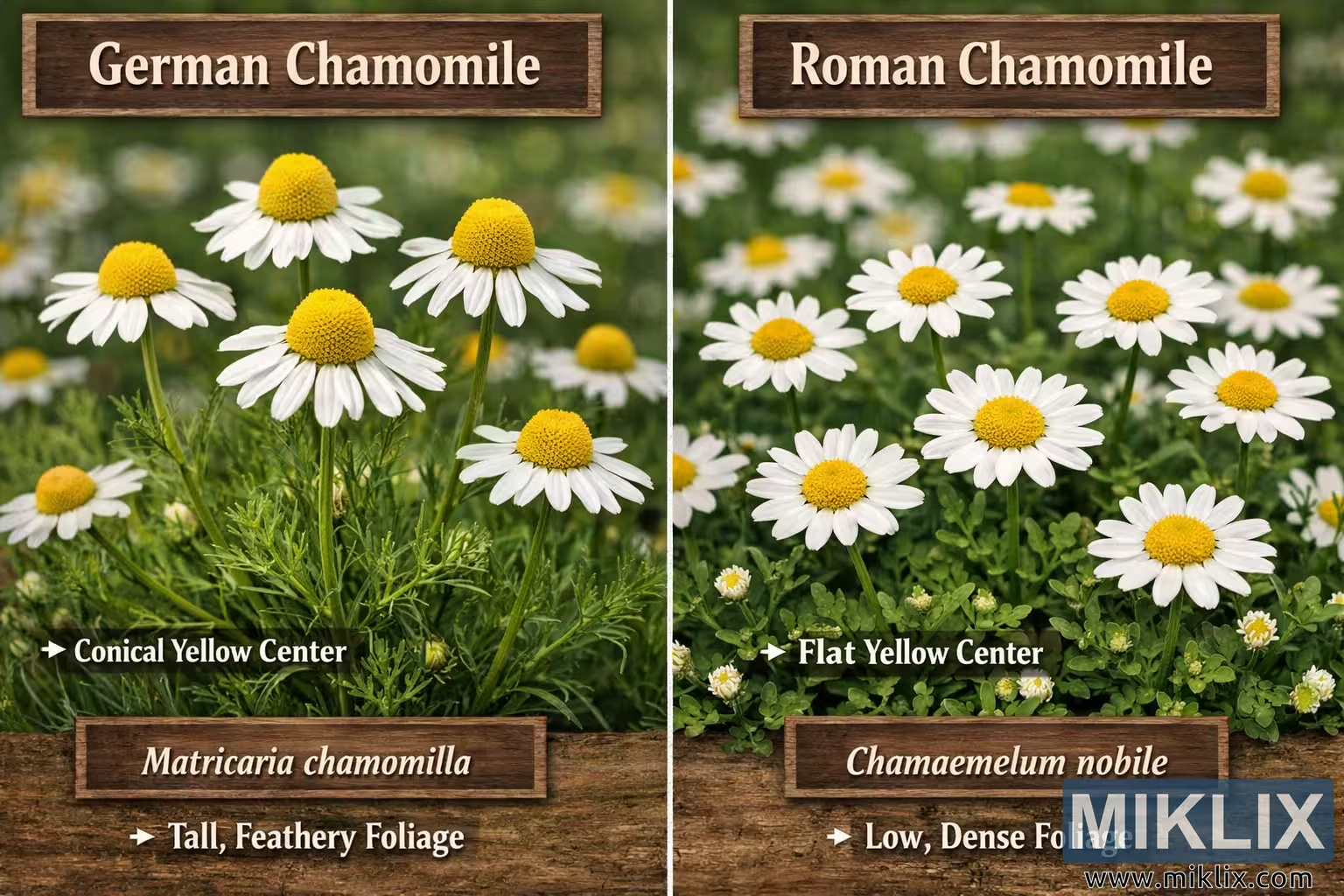
High-resolution, side-by-side botanical comparison of German Chamomile (Matricaria chamomilla) and Roman Chamomile (Chamaemelum nobile). The image shows German Chamomile on the left with conical yellow centers, drooping white petals, and tall, feathery foliage, contrasted with Roman Chamomile on the right featuring flat yellow centers, rounded white petals, and low, dense foliage. Wooden signs, scientific labels, and descriptive text highlight the key differences between the two chamomile species, making this image an ideal visual reference for gardening, herbal studies, and plant identification.
Side-by-Side Botanical Comparison of German and Roman Chamomile Flowers
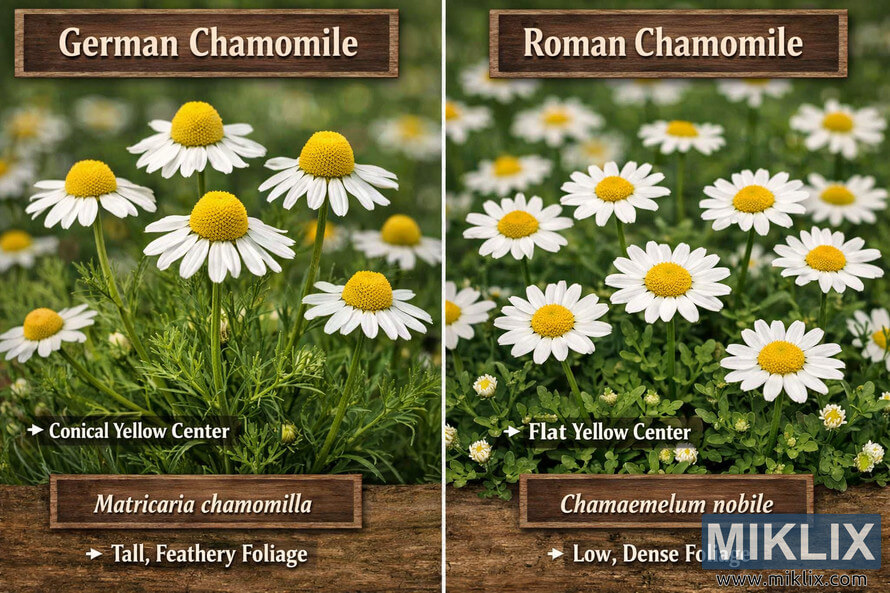
Dostępne wersje tego obrazu
Pliki graficzne dostępne do pobrania poniżej są mniej skompresowane i mają wyższą rozdzielczość - a w rezultacie wyższą jakość - niż obrazy osadzone w artykułach i stronach na tej stronie, które są bardziej zoptymalizowane pod kątem rozmiaru pliku w celu zmniejszenia zużycia przepustowości.
Rozmiar regularny (1,536 x 1,024)
Duży rozmiar (3,072 x 2,048)
Bardzo duży rozmiar (4,608 x 3,072)
Bardzo duży rozmiar (6,144 x 4,096)
Komicznie duży rozmiar (1,048,576 x 699,051)
- Wciąż wgrywam... ;-)
Opis obrazu
This image presents a carefully composed, landscape-oriented botanical comparison of German Chamomile and Roman Chamomile, arranged side by side to highlight their visual and structural differences. The photograph is divided vertically down the center by a subtle split line, creating two distinct sections: the left side dedicated to German Chamomile and the right side dedicated to Roman Chamomile. Both sections share a similar layout, with wooden signs at the top, close-up views of the flowers in the middle, and descriptive labels near the bottom, all set against a softly blurred, natural green background that suggests a garden or meadow environment.
On the left side of the image, the German Chamomile section is introduced by a slightly weathered wooden sign at the top. The sign has a warm, natural brown tone, with visible wood grain and gentle wear that gives it a rustic, organic feel. Centered on the sign, the words "German Chamomile" appear in cream-colored, bold, title-case letters. The font is clean and legible, with a subtle softness that complements the natural theme of the image. Behind the sign, the background is a smooth blur of green hues, suggesting foliage and grass without distracting from the main subject.
Below the sign, the viewer’s attention is drawn to a close-up cluster of German Chamomile flowers. These blossoms are characterized by their bright yellow, raised, conical centers, which stand out prominently against the surrounding white petals. The centers are slightly elongated and dome-shaped, giving them a distinctive, almost button-like appearance. The petals are slender, delicate, and pure white, radiating outward from the yellow center before gently drooping downward. This drooping effect creates a sense of movement and softness, as if the petals are lightly bowing under their own weight or responding to a gentle breeze.
The foliage beneath the German Chamomile flowers is fine, feathery, and airy. The leaves are composed of many thin segments, creating a lace-like texture that appears light and almost cloud-like. This feathery foliage contributes to the overall impression of height and delicacy. Near the bottom of the left section, a small brownish label displays the botanical name "Matricaria chamomilla" in smaller, beige text. The font is simple and understated, emphasizing scientific clarity rather than decorative flair. Just below or adjacent to the foliage, another label reads "Tall, Feathery Foliage," reinforcing the visual impression of the plant’s upright growth habit and light, finely divided leaves. An additional descriptive label, "Conical Yellow Center," appears with an arrow pointing upward toward the flower heads, clearly indicating the characteristic raised shape of the German Chamomile’s central disk.
On the right side of the image, the Roman Chamomile section mirrors the overall structure of the left side while showcasing distinct botanical features. At the top, another slightly weathered wooden sign is displayed, similar in style and tone to the German Chamomile sign. It has the same warm brown color and visible wood grain, maintaining visual consistency across the image. The text "Roman Chamomile" is written in cream-colored, bold, title-case letters, matching the font and style used on the left side. This parallel design helps the viewer immediately understand that the two sections are meant to be compared.
Beneath the Roman Chamomile sign, a close-up view of Roman Chamomile flowers fills the frame. These blossoms have flat, bright yellow centers rather than raised, conical ones. The central disk appears more level and even, creating a subtle but important contrast with the German Chamomile flowers. Surrounding the flat yellow centers are pure white petals that are slightly shorter and more rounded than those of the German Chamomile. The petals radiate outward in a neat, orderly fashion, forming a more compact and symmetrical flower head. This difference in petal shape and center structure is one of the key visual distinctions highlighted by the image.
The foliage in the Roman Chamomile section is low, dense, and more compact compared to the feathery foliage on the left. The leaves form a thicker, ground-hugging layer of greenery, suggesting a plant that spreads horizontally rather than growing tall. The texture of the foliage appears more solid and bushy, with less of the airy, finely divided look seen in German Chamomile. Near the bottom of the right section, a brownish label displays the botanical name "Chamaemelum nobile" in smaller, beige text, mirroring the scientific labeling style used for the German Chamomile. Another label reads "Low, Dense Foliage," emphasizing the plant’s growth habit and the visual impression of a compact, carpet-like greenery. A further descriptive label, "Flat Yellow Center," is accompanied by an arrow pointing upward toward the Roman Chamomile flowers, clearly indicating the defining feature of their central disk.
In the center of the image, the vertical split line subtly divides the two sections without being overly bold or distracting. It serves as a visual cue that the viewer is meant to compare the left and right sides, encouraging a side-by-side examination of the differences in flower structure, petal shape, and foliage type. The lighting across the entire image is even and natural, with soft highlights on the petals and gentle shadows in the foliage. This balanced lighting ensures that both chamomile types are clearly visible and that their details are easy to distinguish.
The color palette of the image is dominated by natural tones: bright yellow centers, pure white petals, and rich green foliage, all set against the muted browns of the wooden signs and labels. The blurred green background enhances the sense of depth and places the flowers in a realistic outdoor context, while the high resolution of the photograph allows fine details—such as the texture of the petals, the structure of the flower centers, and the intricacy of the leaves—to be seen clearly. Overall, the image functions as both an aesthetically pleasing botanical photograph and an educational visual aid, making it easy to understand and remember the key differences between German Chamomile (Matricaria chamomilla) and Roman Chamomile (Chamaemelum nobile).
Obraz jest powiązany z: Chamomile Health Benefits: Natural Wellness From an Ancient Herb