
Fermenting Beer with Wyeast 1768-PC English Special Bitter Yeast
Опубликовано:
Последнее обновление: 27 мая 2026 г. в 15:39:38 UTC
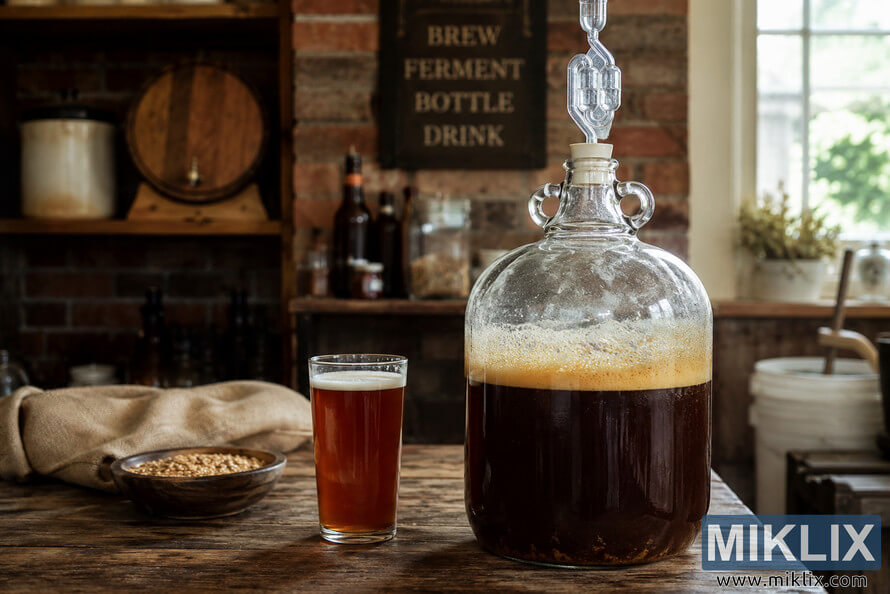
Wyeast 1768-PC is a cultured English ale strain known for its predictable fermentation and classic British character. It's favored by brewers for preserving malt depth while introducing gentle fruit notes. This introduction will cover the English Special Bitter yeast characteristics and how they influence traditional recipes.
Fermenting Beer with Wyeast 1768-PC English Special Bitter Yeast
Нажмите или коснитесь изображения, чтобы получить дополнительную информацию и более высокое разрешение.
Key Takeaways
- Wyeast 1768-PC English Special Bitter Yeast delivers classic English ale esters with dependable attenuation.
- Proper starters and pitch rates improve consistency when fermenting with Wyeast 1768.
- Temperature control is essential to manage esters and prevent off-flavors in Wyeast 1768 fermentation.
- This English Special Bitter yeast review highlights its strengths for malt-forward bitters and session ales.
- Follow lab specs, nutrient practices, and conditioning windows for best results with Wyeast 1768-PC.
Introduction to Wyeast 1768-PC English Special Bitter Yeast
This strain is notable for its balance of moderate attenuation and medium to high flocculation. It produces restrained esters that taste like pear and apple, keeping the malt in the forefront. However, stress or high temperatures can bring out mild phenolic spice, making temperature control crucial.
The best beer styles for this yeast include English Special Bitter, ordinary bitter, English pale ale, best bitter, mild, and select brown ales. These styles benefit from the yeast's clean finish and modest alcohol lift, making it ideal for sessionable beers.
The Wyeast 1768 flavor profile is characterized by soft fruit esters, bready malt aroma, and low sulfur. The finish is slightly malty with a restrained dryness, supporting hop restraint over dominance. This makes the strain valuable for American craft brewers aiming to recreate authentic English character in malt-focused recipes.
Wyeast 1768-PC is a liquid culture from Wyeast Laboratories, tracing back to traditional English brewery strains. It's prized for its balance of malt-forward character and restrained fruit esters. This makes it perfect for ESB, bitter, and classic British ales. Always check the manufacturer's latest numbers before brewing.
Strain specifics and original source
This strain has documented roots in regional UK breweries. It's provided as a packaged liquid culture. Typical Wyeast 1768 lab specs list attenuation around 68–75% with medium to high flocculation. Labs report a moderate fermentation temperature window, ensuring reliable performance in both household and commercial systems.
Why brewers choose this exact strain
Brewers choose this culture for its predictable attenuation and solid flocculation. It clears beer without aggressive fining. It reproduces classic English esters while keeping malt balance in the foreground. This is ideal for recipes that call for malt complexity. The yeast tolerates normal cellar temperature swings, making it practical for both homebrewers and professional breweries.
How it compares to similar English ale strains
In a direct English ale yeast comparison, Wyeast 1768 tends to produce a cleaner, more reserved ester profile than Wyeast 1968 London ESB. Compared with American strains such as Wyeast 1056 or White Labs WLP001, 1768 emphasizes malt and rounded fruit notes rather than a neutral finish. Versus Wyeast 1098 British Ale, differences show up in ester intensity and final clarity; 1768 often gives a truer ESB character when that style is the target.
Нажмите или коснитесь изображения, чтобы получить дополнительную информацию и более высокое разрешение.
Preparing a Healthy Starter for English ale fermentation
Creating a vigorous starter is crucial for a clean, reliable fermentation with Wyeast 1768. Brewers often use a starter for high-gravity beers, large batches, or older yeast packs. It ensures the right cell count and prevents slow fermentations, especially in extract or adjunct-heavy worts.
When a starter is recommended
Use a starter for worts above 1.050 gravity, large batches, or older yeast packages. Starters are essential for extract and adjunct recipes lacking oxygen and nutrients. They revive vigor and viability in bottled or slanted cultures.
Step-by-step starter recipe and dimensions
Follow this simple starter method for predictable growth and healthy cells.
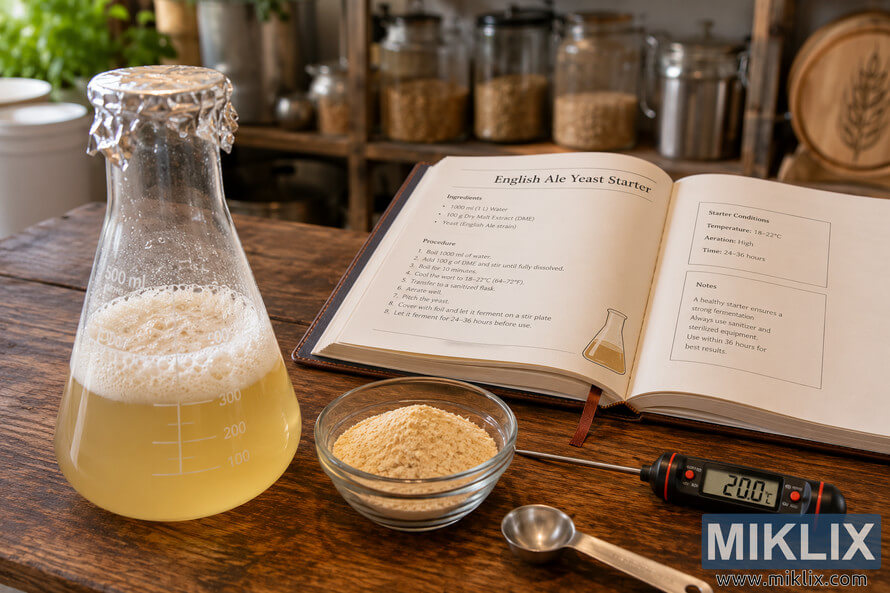
- Ratio: 100–200 mL sterile water per gram DME for roughly 1.030 SG. Adjust to taste within that range.
- Example for a 5-gallon 1.050–1.060 wort: prepare a 1.5–2.0 L starter. Use about 200 g DME in 2 L water for ~1.040 SG as a reference.
- Boil the DME wort for 10 minutes to sanitize, then cool quickly to pitching temperature.
- Pour cooled wort into a sanitized Erlenmeyer flask or a Mason jar. Use a sanitized foam stopper, airlock, or loose bung.
- Pitch yeast into the vessel, swirl to wet, and place on a stir plate if available. If not, shake vigorously several times per day.
- For step-up starters, double the volume once when the first starter shows strong activity to reach higher cell counts from a small pack.
Dimensions and equipment
Choose an Erlenmeyer flask or a sanitized Mason jar with enough headspace for foam. A 2 L flask is ideal for most 5-gallon ales. A stir plate speeds growth and keeps yeast suspended. Always maintain sanitation with a foam stopper or airlock to limit contamination.
Signs your starter is strong and ready
Look for lively activity within 12–36 hours at typical cellar temperatures. Expect krausen or foam early, followed by trub forming at 24–72 hours. A clear beer layer above the yeast bed after a cold crash signals readiness.
- Stir-plate starters show a milky suspension when active.
- An increase in yeasty aroma and reduced bubbling after peak activity are good signs.
- Cold crash the starter, decant excess liquid if needed, and pitch the yeast slurry to the wort volume required.
Safety, viability, and measurement tips
Avoid overpitching into very low-gravity worts. Check package dates and storage history. Use a hemocytometer, or calculators like Mr. Malty and Brewer's Friend to estimate cell counts when precision matters. Proper oxygenation of the wort and correct starter scale ensure strong fermentations.
Нажмите или коснитесь изображения, чтобы получить дополнительную информацию и более высокое разрешение.
Pitching Rates and Cell Count for Optimal Fermentation
Optimal fermentation starts with the right pitch. This guide covers the ale yeast cell count targets, scaling pitch rate with wort gravity, and tips for homebrewers using Wyeast 1768 or similar English ale strains.
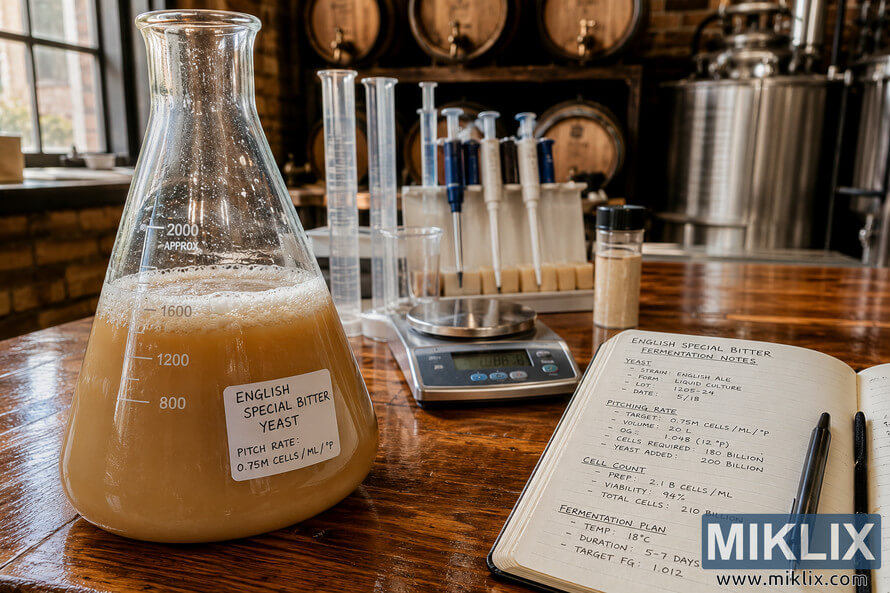
For many ales, the baseline is 0.75–1.5 million viable cells per milliliter per °P. For a typical 1.050 (about 12.5 °P) beer, aim for 0.75–1.0 million cells per mL. Use online calculators like Brewer's Friend or MrMalty to find the total cell target for your batch size.
For higher gravity worts, increase the ale yeast cell count. Above 1.065, aim for 1.5–2.0 million cells per mL per °P. For session-strength beers near 1.040, use the lower end. Match pitch adjustments with proper oxygenation and nutrient additions for a healthy fermentation.
Decide between rehydrating or building a starter based on the yeast to pitch for ESB and batch volume. A single small liquid pack may suffice for a 1.040 five-gallon brew. For larger volumes or older Wyeast 1768 packs, plan a starter to reach your cell target.
- Check manufacture date and storage; lower viability means a larger starter.
- Warm the starter to the wort temperature before pitching to avoid thermal shock.
- Oxygenate wort: air is adequate up to about 12°P, pure oxygen recommended above that.
- Pour yeast gently after oxygenation to minimize unwanted oxygen pickup.
- Sanitize all equipment that contacts the starter or wort.
Practical homebrew workflow: calculate the target ale yeast cell count, choose starter volume or rehydration method, oxygenate appropriately, and pitch at matched temperatures. These steps ensure Wyeast 1768 pitching rate meets expectations for attenuation and flavor in English-style bitters.
Нажмите или коснитесь изображения, чтобы получить дополнительную информацию и более высокое разрешение.
Temperature Ranges and Fermentation Control
Mastering the Wyeast 1768 fermentation temp is key to a true-to-style beer. Aim for a consistent temperature range with minimal daily fluctuations. A stable environment allows the yeast to showcase the English bitter's character without excessive fruitiness.
For primary fermentation, target a temperature of 64–68°F (18–20°C) to minimize esters and highlight the classic English profile. Some brewers might allow the temperature to rise to 70°F (21°C) for a fruitier taste. Always refer to the latest Wyeast technical sheet for precise guidelines, taking into account batch size.
Managing temperature swings and off-flavors
Rapid temperature increases can lead to fusel alcohols and solvent-like flavors. It's crucial to keep temperature changes gradual and within a few degrees. A small diurnal variation aids in conditioning, but large swings can introduce phenolic or spicy off-flavors. To prevent ester off-flavors, ensure the yeast operates within its recommended temperature range and avoid sudden spikes during peak activity.
Techniques for temperature control at home
- Insulated fermentation jackets or purpose-made jackets for basic passive control.
- Swamp cooler with a temperature-regulated aquarium heater or chiller for modest budgets.
- Chest freezer or refrigerator paired with an Inkbird or Johnson temperature controller for precise setpoints.
- Glycol chillers for multi-fermenter or commercial setups requiring tight control.
- Use a thermowell or probe to read actual wort temperature, not air temperature, for accurate feedback.
Practical tips
Gradually increase the temperature 2–3°F towards the end of active fermentation for a diacetyl rest. Use heating belts or tape under controller supervision. Monitor both fermenter temperature and gravity to gauge progress, rather than relying solely on time. Thoughtful temperature control leads to cleaner finishes and a more predictable British character.
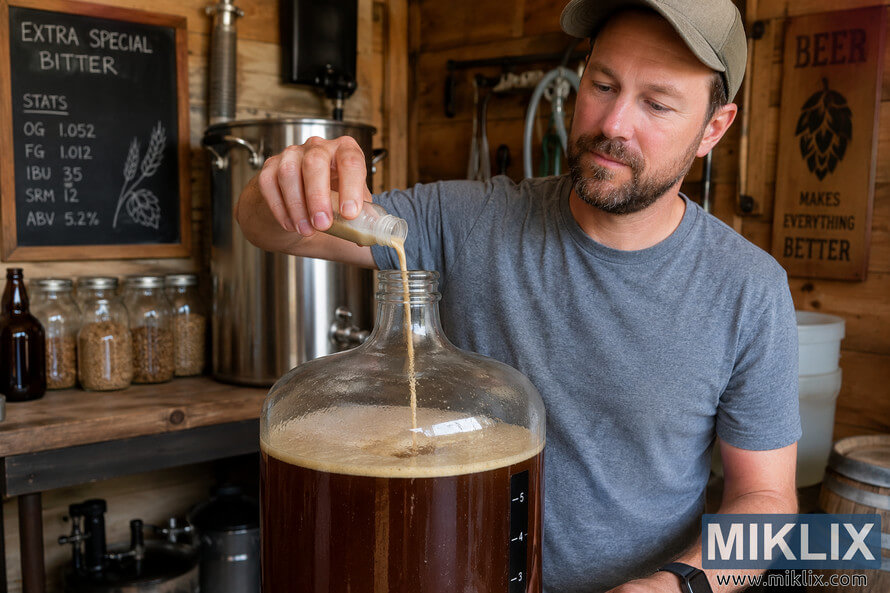
Нажмите или коснитесь изображения, чтобы получить дополнительную информацию и более высокое разрешение.
Attenuation, Flocculation, and Mouthfeel Expectations
Wyeast 1768 is celebrated for its reliable attenuation and clean finish, perfect for English bitters. Its attenuation ranges from moderate to high, influenced by mash profile, fermentation temperature, and oxygen levels. Monitoring gravity closely is essential to gauge its performance in your brew.
Typically, Wyeast 1768 achieves attenuation in the high 60s to low 70s. However, factors like original gravity and mash efficiency can alter these results. To achieve a drier beer, slightly increase the fermentation temperature or extend the active fermentation period.
Flocculation significantly affects clarity and conditioning. Wyeast 1768 exhibits medium-to-high flocculation, leading to a solid yeast cake and quicker clearing. Yet, be mindful: stressed fermentations or underpitching can result in premature drop-out and a sluggish finish.
Consider these points about yeast flocculation impact:
- Healthy pitching and good aeration reduce the risk of early flocculation.
- Extended conditioning and cold storage help yeast settle and clarify the beer.
- Racking to a bright tank allows the beer to separate from the compact yeast cake.
Mouthfeel is influenced by yeast attenuation and the malt bill. Moderate attenuation creates a balanced body, characteristic of traditional ESBs. Adjusting crystal malts or adding dextrin malts can enhance mouthfeel or residual sweetness.
For targeted mouthfeel ESB outcomes, follow these steps:
- Set mash temperature to control fermentable sugars and dextrins.
- Pitch an adequate cell count and oxygenate wort to ensure steady attenuation.
- Allow proper conditioning time so flavors integrate and body stabilizes.
Understanding Wyeast 1768 attenuation, yeast flocculation impact, and mouthfeel ESB allows brewers to refine their recipes and processes. Small adjustments in mash or fermentation can significantly alter clarity, body, and perceived dryness.
Fermentation Timeline and Stages for English Bitter Ales
Grasping the ESB fermentation timeline is crucial for setting milestones from krausen to packaging. A healthy pitch of Wyeast 1768 or a robust starter usually shows visible activity within 12–48 hours. Most gravity drop occurs in the first 3–7 days for standard-strength English bitters when cell counts are adequate.
- First activity: bubbling and surface foam within 12–48 hours after pitching.
- Peak krausen: cresting indicates the most vigorous yeast activity and CO2 production.
- Krausen decline: when foam falls and yeast begins to settle, gravity should show a large portion of the drop.
- Stable gravity: take two hydrometer or refractometer readings 48 hours apart before deciding on the next step.
When to rack, dry-hop, or condition
- When to transfer beer: move to a secondary only if you need to clarify quickly or add adjuncts like fruits or large amounts of dry hops.
- Dry-hop timing: add dry hops late in fermentation or after racking to preserve delicate English hop aroma and limit biotransformation.
- Many brewers leave beer on the yeast until packaging to reduce oxygen exposure and risk of infection.
Carbonation and bottle/keg timing
- Confirm final gravity with two consistent readings before priming for bottles or kegging.
- Bottle-conditioning: allow bottles several weeks at room temperature to carbonate, then cold condition to clear.
- Kegging: force-carbonate after beer is clear and gravity is stable.
- Recommended conditioning ESB: plan 2–4 weeks for initial integration, with 4–8 weeks for fuller maturation and clarity.
Small routine checks keep the brew on track. Log gravity readings and visual cues during the ESB fermentation timeline. This way, you can judge when actions like racking or conditioning ESB are truly necessary.
Yeast Nutrition and Oxygenation Practices
Healthy fermentation begins with proper yeast care. Worts from extracts or high gravities often lack essential nutrients. Focusing on yeast nutrition, like Wyeast 1768, ensures ales ferment well and avoids sluggish activity.
Nutrient needs during high-gravity or extract brews
Extract worts often lack free amino nitrogen and trace minerals. For beers over 1.060 OG, add a commercial yeast nutrient. This nutrient contains diammonium phosphate, vitamins, and trace minerals, crucial for Wyeast 1768's health and ale character.
Proper wort aeration and oxygenation methods
Basic gravities benefit from vigorous aeration, such as shaking or using an aquarium pump. For higher gravities, pure oxygen with a diffusion stone is best. Aim for 8–12 ppm O2 at pitching time. Oxygenate only before yeast activity to avoid beer oxidation. These methods provide Wyeast 1768 with the necessary boost.
Preventing sluggish fermentations
To avoid stuck fermentation, ensure a high cell count with a proper starter or multiple yeast packs. Match the pitching temperature to the yeast's preference and add nutrients as advised. If fermentation is slow, consider adding an active starter or aerated wort and slightly increase the temperature. Use commercial nutrients to supplement missing micronutrients, avoiding random mineral dosing.
- For extract or high-gravity batches, double-check nutrient dosing at pitch.
- Use oxygenation methods for ale suited to your gravity: splash for ordinary beers, pure O2 for big worts.
- Monitor early activity; intervene with an active starter before contamination risk rises.
Managing Esters and Phenolics for Authentic English Character
To achieve classic English notes with Wyeast 1768, it's crucial to manage fermentation inputs and maintain yeast health. Small adjustments in temperature, pitch rate, and oxygen levels can significantly impact ester levels. Thoughtful recipe choices are essential to create English character without unwanted phenolics.
Several factors influence ester production. These include fermentation temperature, pitching rate, oxygenation, yeast health, and wort gravity. Warmer fermentations and underpitching tend to increase fruity esters. However, strong, healthy yeast pitched at the right rate can produce balanced esters typical of English ales.
- Keep primary fermentation steady in the mid-60s°F for a classic ESB profile.
- Raise to upper 60s–low 70s°F only if you want more pronounced fruitiness.
- Avoid large temperature swings that can create harsh off-flavors or phenolics.
To reduce phenolics in ale, maintain sanitary practices, use fresh yeast, and avoid oxygen exposure after fermentation begins. Proper pitching and oxygenation at the start limit stress on the culture. Stressed yeast can produce clove-like phenolics that clash with English esters.
Temperature and yeast health balance is key. Pitch a healthy starter sized for your gravity. Target the lower end of Wyeast 1768’s range for restraint, or nudge temps up slightly for more ester expression. A brief diacetyl rest near the end cleans up buttery off-notes without erasing English character.
- Recipe tip: Use Maris Otter or traditional English pale malts to showcase yeast-derived fruit and malt sweetness.
- Mash low (148–152°F) for a drier finish or higher (154–158°F) for fuller body depending on desired mouthfeel.
- Hop selection: Choose moderate additions of East Kent Goldings or Fuggles to complement esters without masking them.
Steps to control esters Wyeast 1768 favors include steady temps, correct oxygenation at pitching, and consistent sanitation. Monitor gravity and avoid long lag times before activity. These practices help create English character while keeping phenolic notes in check.
Common Fermentation Issues and Troubleshooting
Even small batches can face significant challenges. This guide aims to help you tackle issues with Wyeast 1768, such as stalled fermentation, off-flavors, or slow final gravity. It's crucial to perform thorough checks before taking any corrective actions.
Indicators of a stalled or slow fermentation include a prolonged lag time, minimal gravity drop, and the absence of krausen or bubbles. First, ensure the wort temperature, original gravity, pitch rate, and yeast viability are within the correct range. Take gravity readings over two to three days to confirm a true stall.
Here's a quick checklist to help identify the cause:
- Confirm fermentation temperature is in-spec for English ale yeast.
- Measure original gravity to ensure expected sugar load.
- Review pitching volume and starter health.
- Smell for obvious infection signs before repitching.
To address stuck fermentation, try gently warming the fermentation area to the high end of the yeast’s range. Gently rouse the yeast by swirling or stirring with sanitized equipment. If oxygenation is needed, add a small, controlled dose of pure oxygen only before vigorous activity restarts. Boosting nutrition with a measured yeast nutrient can also help finish a sluggish ferment.
Off-flavor solutions begin with prevention: proper aeration, correct fermentation temperatures, and healthy yeast. Sulfur notes are often transient and fade with conditioning. Allow extra conditioning time and cold conditioning if needed. If solvent or fusel alcohols appear, check for excessive fermentation temperatures or underpitching.
If environmental tweaks fail and gravity remains stuck, prepare a vigorous starter of Wyeast 1768 or a compatible English ale strain and repitch. Add nutrient and oxygenate cautiously when repitching. Document gravity readings and sanitation practices before repitching to rule out infection as the root cause.
Preventive measures can prevent most problems. Use fresh Wyeast 1768 packs, store them cold, and hit recommended pitching rates. Good yeast handling and timely aeration greatly reduce the need for rescue steps later.
Recipe Building with Wyeast 1768 for Best Results
Creating an ESB recipe with Wyeast 1768 requires a balanced approach. Begin with a robust base malt that showcases biscuity and bready flavors. The yeast's classic English character should then shine through. It's crucial to keep additions minimal, allowing malt and yeast to take center stage.
Opt for base malts like Maris Otter, English pale malt, or Golden Promise. Incorporate a small amount of crystal malt, in the 10–20L range, for color and a hint of caramel sweetness. For a fuller body and better head retention, consider adding dextrin malt or flaked barley.
Target a single infusion mash temperature of 152°F for balanced fermentability. Elevating the mash temperature to 154–156°F can enhance final gravity and mouthfeel, ideal for a richer body. Ensure consistent efficiency by adjusting sparge and mash thickness.
- Maris Otter or English pale malt: 80–90% of the malt bill ESB.
- Crystal 10–20L: 5–10% for color and sweetness.
- Dextrin malt or flaked barley: 1–4% for head and body.
Choose traditional English hops like East Kent Goldings, Fuggle, Northdown, or Challenger. Aim for a moderate bitterness of 25–40 IBU, depending on the original gravity. Late hop additions should be light to preserve the nuances of malt and yeast.
- Early bittering: enough to reach target IBUs.
- Flavor additions: small and restrained.
- Finish aroma: minimal, a gentle floral or earthy touch.
Before brewing, assess your water's profile. Many classic English ales thrive in soft to moderately hard water with balanced bicarbonate levels. A higher chloride-to-sulfate ratio enhances malt body perception.
Utilize a water calculator to make precise adjustments. Add calcium chloride to enhance mouthfeel or gypsum to lift hop definition if your water is very soft. Keep an eye on carbonate levels to maintain a mash pH of 5.2–5.6 for optimal extraction.
When crafting an ESB recipe for Wyeast 1768, focus on simplicity and authenticity. A well-balanced malt bill, classic English hops, and the appropriate water profile will allow the yeast to showcase its signature flavors without interference.
Comparing Wyeast 1768 to Other English and American Strains
Choosing the right yeast can transform a beer more than any single hop or malt. This guide aims to help brewers compare Wyeast 1768 vs 1968. It also explores the differences between English and American ale yeasts. This way, brewers can select the perfect yeast for their recipes.
Wyeast 1768 typically offers moderate attenuation and restrained fruity esters. This results in a clear malt-forward profile and a balanced finish. On the other hand, Wyeast 1968 is fruitier, often providing a fuller mouthfeel and a more pronounced English character.
American strains, such as White Labs WLP001 or Wyeast 1056, produce a very clean fermentation. These strains minimize esters, allowing hops and adjuncts to take center stage.
When to pick 1768 vs other English strains
Opt for Wyeast 1768 for classic ESB, bitters, and malt-forward English ales. It offers a traditional balance of fruit and malt. Choose Wyeast 1968 for bolder English esters and a rounder body.
For a drier, cleaner finish, consider a modern American or hybrid strain.
How hybrid or American strains differ in character
Hybrid strains blend English and neutral American profiles. They reduce ester intensity without losing subtle yeast character. This makes them ideal for recipes needing yeast note but more fermentative clarity.
American ale yeasts create a neutral canvas for hop-forward styles. They are perfect when you want hops, citrus, or pine to dominate the aroma and taste.
- Test small batches with different yeasts to judge ester intensity and finish.
- Note clarity and flocculation differences after conditioning.
- Adjust mash, pitch rate, and temp to refine the yeast’s expression.
Packaging, Conditioning, and Serving Recommendations
Packaging and conditioning are crucial for a great ESB. Ensure the beer is shielded from oxygen during bottling or kegging. Use CO2 to purge kegs and employ oxygen-scavenging caps or precise priming for bottles. This approach preserves the malt character, balances esters, and achieves the desired carbonation and clarity.
Optimal conditioning times for clarity and maturation
Condition the beer at cellar temperatures of 50–60°F for 2–4 weeks. This allows flavors to blend and bitterness to soften. For an additional polish, cold-condition near freezing for 1–2 weeks. Bottle-conditioned batches benefit from an extra week at cellar temperature for full carbonation and yeast integration.
Carbonation levels for style authenticity
English bitters prefer a modest carbonation. Aim for 1.8–2.4 volumes CO2 for ESB and most bitters. This enhances malt depth and mouthfeel. Bottle-conditioned beers should target 1.5–2.2 volumes for a more traditional feel. Accurate priming is key to avoid overcarbonation and align carbonation levels with the beer's body.
Serving temperature and glassware tips
Serve ESB at a slightly cooler temperature than cellar, around 50–55°F (10–13°C). This temperature range accentuates malt complexity while controlling esters. Opt for a nonic pint or English pub glass for casual pours. For a greater aroma focus, a tulip glass is ideal to trap bouquet and support head retention.
- Pour gently to manage head and deliver aroma.
- Avoid ice-cold service; excessive chill mutes malt and subtle esters.
- When kegging, set carbonation to match targeted volumes and allow 24–48 hours to settle before serving.
Storage, Handling, and Shelf Life of Wyeast 1768-PC
Proper storage and handling are crucial for maintaining yeast viability. Store Wyeast 1768 in a refrigerator at 34–40°F (1–4°C) from purchase to pitching. Freezing is to be avoided, and heat exposure during transit should be minimized. For long-term storage, slants kept under lab conditions are superior to loose cakes in a fridge.
Before use, gently swirl or shake liquid packs to resuspend yeast. Sanitize any surfaces and tools that touch the pack. Ensure the cold chain is maintained from the retailer to your brew space. Purchase from reputable homebrew shops that keep their stock refrigerated to preserve Wyeast shelf life.
Be vigilant for signs of weakened or dead yeast. A starter showing no activity, lag times over 72 hours, a weak krausen, or incomplete attenuation indicate low viability. Off-odors in the starter, such as sour or solvent notes, may signal contamination rather than age-related decline.
- If a pack is near or past its best-before date, build a starter to increase cell count and test vigor before pitching into your main wort.
- When in doubt about older packs, create a small test starter and monitor for robust bubbling and foaming within 24–48 hours.
- For longer storage of cultures, use yeast slants kept under professional lab conditions to minimize viability loss over months.
Handle packs with care. Avoid direct sunlight and warm environments. Follow the manufacturer “smile” date or best-before on Wyeast packs. Rotate stock to use older packs first. These steps ensure yeast viability and extend Wyeast shelf life for healthy fermentations.
Conclusion
Wyeast 1768-PC English Special Bitter Yeast stands out as a dependable, malt-friendly strain. It brings out the classic ESB character. This review highlights its soft fruity esters, solid flocculation, and moderate attenuation. Brewers must follow proper pitching and fermentation practices for these results.
To achieve consistent results, start with a healthy yeast starter for larger or higher-gravity batches. Aim for a steady fermentation temperature around mid-60s°F. Use English malts and traditional British hops to enhance the yeast's profile. This approach will help you achieve the true essence of ESB.
Before scaling up, test the strain in smaller batches. Also, refer to the latest Wyeast technical data. Prioritize yeast health by ensuring proper storage, accurate pitching rates, and adequate oxygenation. This will help you avoid risks and achieve authentic English ale results every time.

Нажмите или коснитесь изображения, чтобы получить дополнительную информацию и более высокое разрешение.
FAQ
What character does Wyeast 1768-PC English Special Bitter yeast impart to beer?
Wyeast 1768-PC yeast creates a classic English ale profile. It offers soft fruity esters like pear and apple, along with bready/toasty malt notes. The yeast also produces restrained phenolics when fermented within the recommended range.
It emphasizes malt character and delivers a slightly malty finish. The yeast has moderate attenuation and medium-to-high flocculation. This makes it perfect for ESB, ordinary bitter, and English pale ales.
What fermentation temperature range should I use for 1768 to achieve authentic ESB character?
For authentic ESB character, aim for mid-60s°F (about 64–68°F or 18–20°C). This temperature range keeps esters restrained and highlights malt balance. Some brewers might push to ~70°F (21°C) for a fruitier profile.
However, avoid rapid temperature swings to reduce fusels and solvent off-flavors. Use a probe in the wort and a temperature controller for best results.
Do I need to make a starter for Wyeast 1768, and how large should it be?
A starter is recommended for large batches (5+ gallons), high-gravity worts, or older packs. For a typical 5-gallon 1.050–1.060 wort, a 1.5–2.0 L starter is appropriate.
Use roughly 100–200 mL water per 1 g DME for a starter SG around 1.035–1.040. A stir plate shortens lag time and improves viability.
What pitching rate should I target for ales with Wyeast 1768?
Use about 0.75–1.5 million viable cells per mL per °P as a guideline. For a 1.050 (12.5°P) ale, pitch toward the 0.75–1.0 million cells/mL range. Increase to ~1.5–2.0 million cells/mL/°P for higher gravities (1.065+).
When in doubt, build a starter or combine packages to reach the target cell count.
How should I oxygenate wort when pitching 1768?
For standard gravities, vigorous splashing or shaking can suffice. For worts over ~12°P, use pure oxygen with a diffusion stone to reach ~8–12 ppm O2 immediately before pitching. Avoid oxygenating after active fermentation begins to prevent oxidation.
What attenuation and mouthfeel can I expect from this strain?
Typical attenuation for 1768 falls in the mid-to-high 60s to low 70s percent range (consult current Wyeast datasheet for exact figures). Expect a balanced body—neither overly thin nor overly full—producing a slightly malty finish. Mash profile and ferment temps will affect final dryness and mouthfeel.
How quickly does fermentation progress with Wyeast 1768?
With adequate pitch and oxygenation, you should see activity within 12–48 hours. Most gravity drop for standard-strength ales typically occurs within 3–7 days. Always confirm with two stable gravity readings 48 hours apart before packaging.
When should I rack, dry-hop, or transfer beer fermented with 1768?
Many brewers leave beer on the yeast until packaging. Rack only if clarifying, adding adjuncts, or reducing yeast contact. If dry-hopping, add late in fermentation or after racking to preserve subtle hop aroma.
Condition for at least 2–4 weeks for ESB to let flavors integrate.
How do I manage esters and avoid excessive phenolics with this strain?
Control fermentation temperature (lower mid-60s°F for restraint), pitch adequate viable yeast, and oxygenate properly. Use high-quality English base malts like Maris Otter and moderate hopping. Avoid underpitching and large temp swings, both of which increase ester and phenolic production.
What are common issues with Wyeast 1768 and how do I troubleshoot them?
Slow or stalled fermentations stem from low viability, underpitching, poor oxygenation, or low nutrients. Check wort temp and OG, and build a vigorous starter if needed. Off-flavors like fusels often come from high temps or underpitching; sulfur is usually transient and can clear with conditioning.
If stuck, consider repitching a healthy starter of the same or compatible strain after ruling out infection.
Which malt and hop choices best complement 1768 in a recipe?
Use English base malts—Maris Otter, English pale malt, or Golden Promise—to accentuate biscuity and bready notes. Add 5–15% crystal (10–20L) for color and caramel balance. Choose English hops such as East Kent Goldings, Fuggles, Challenger, or Northdown and keep bitterness moderate (IBUs roughly 25–40) so malt and yeast character remain central.
How should I carbonate and serve beers made with Wyeast 1768?
Carbonation for ESB and bitters is modest—target about 1.8–2.4 volumes CO2. Serve at 50–55°F (10–13°C) in a nonic pint or English pub glass to highlight malt complexity and restrained esters. Minimize oxygen pickup during packaging and cold-condition when possible for improved clarity.
How do I store Wyeast 1768 packs to preserve viability?
Store refrigerated at 34–40°F (1–4°C) and use before the pack's best-before date. Keep the cold chain when buying from suppliers like MoreBeer or Northern Brewer. Do not freeze. If packs are older, build a starter to verify vigor before pitching.
How does 1768 compare to other English strains like Wyeast 1968 or American strains like US-05?
Compared to 1968, 1768 tends to be slightly cleaner with more restrained esters while still delivering classic English character. Against American strains such as US-05 or Wyeast 1056, 1768 is decidedly less neutral—producing fruitier esters and emphasizing malt flavor rather than hop-forward, clean profiles.
Are there special water or mash adjustments for brewing with Wyeast 1768?
Aim for a water profile that favors malt richness—moderate hardness and a higher chloride-to-sulfate ratio will enhance body and mouthfeel. Mash at ~152°F for balanced fermentability; lower mash temps (148–152°F) encourage drier finish, while higher temps (154–158°F) preserve more body.
When should I consider repitching or using a different yeast strain?
Repitch when a pack tests weak in a starter or when fermentation stalls and environmental fixes fail. Choose a different strain when the recipe calls for a much cleaner fermentation (e.g., American ale strains for hop-forward beers) or when you want a markedly different ester profile. Always document readings and sanitation before repitching to isolate causes.
Дополнительное чтение
Если вам понравился этот пост, вам также могут понравиться эти предложения:
- Ферментация пива с дрожжами Mangrove Jack's M15 Empire Ale
- Сбраживание пива с использованием дрожжей Wyeast 2487-PC Hella Bock Lager.
- Брожение пива с использованием дрожжей Wyeast 3711 French Saison.