
Fermenting Beer with White Labs WLP002 English Ale Yeast
Опубліковано:
Останнє оновлення: 13 травня 2026 р. о 16:21:01 UTC
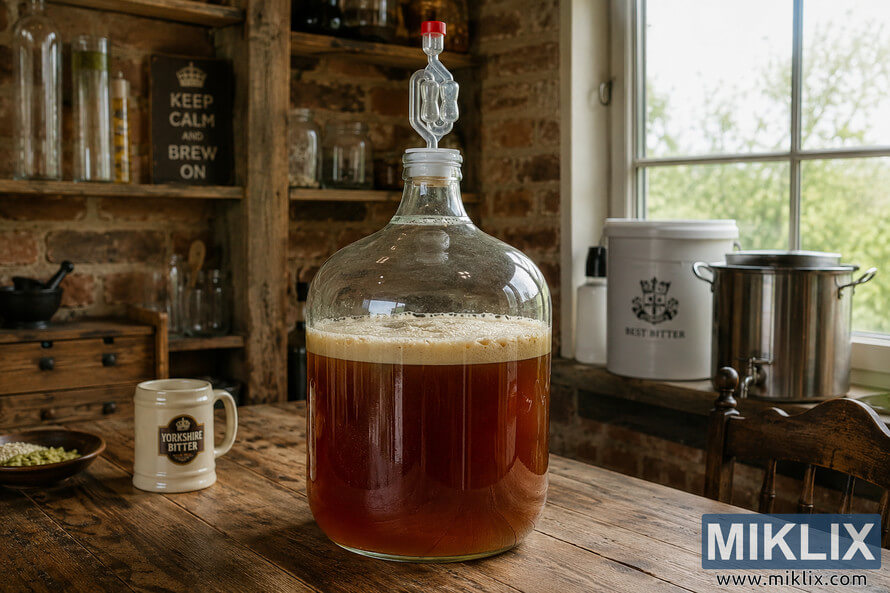
White Labs WLP002 English Ale Yeast is a classic liquid strain for brewers aiming at a full-bodied, traditional English profile. The yeast datasheets from White Labs describe WLP002 as having mild ester production and solid flocculation. This aids in beer clarity while maintaining a rounded mouthfeel. It's favored by brewers for bitters, ESBs, and darker English ales, offering gentle fruit notes without overpowering hops.
Fermenting Beer with White Labs WLP002 English Ale Yeast
Натисніть або торкніться зображення, щоб отримати більше інформації та вищу роздільну здатність.
Homebrew testing and brewery notes indicate that fermenting with WLP002 results in soft fruity esters. These esters often lean towards pear or stone-fruit at warmer fermentation temperatures. They complement malt-forward recipes, enhancing the beer's smooth mid-palate. Reviews also highlight WLP002's reliable attenuation and predictable performance when handled and stored correctly.
Key Takeaways
- WLP002 is a classic English ale strain known for mild esters and good flocculation.
- Fermenting with WLP002 yields a rounded mouthfeel that suits bitters and ESBs.
- Soft pear and stone-fruit esters can appear at warmer fermentation temperatures.
- White Labs yeast is sold refrigerated in vials and pouches—store cold before use.
- Proper pitching rate or a starter improves reliability and final beer quality.
Why Choose White Labs WLP002 English Ale Yeast for Your Ales
White Labs WLP002 is a reliable choice for those aiming at traditional British ales. It's favored for its ability to enhance malt and hop flavors without overpowering them. The yeast's flavor profile includes subtle fruit and bready notes, perfect for classic recipes.
Flavor profile and typical esters
WLP002 produces mild esters reminiscent of pear, apple, and light stone fruit. These esters are more pronounced as fermentation temperatures increase. Beneath the fruit, a faint bready or biscuit aroma emerges, adding depth to the beer's aroma.
Mouthfeel and body contributions
This yeast strain contributes to a medium to full body in the finished beer. It enhances malt fullness, creating a smooth, rounded palate. A moderate attenuation level ensures a touch of residual sweetness, making malty styles more substantial.
Styles that benefit most from this strain
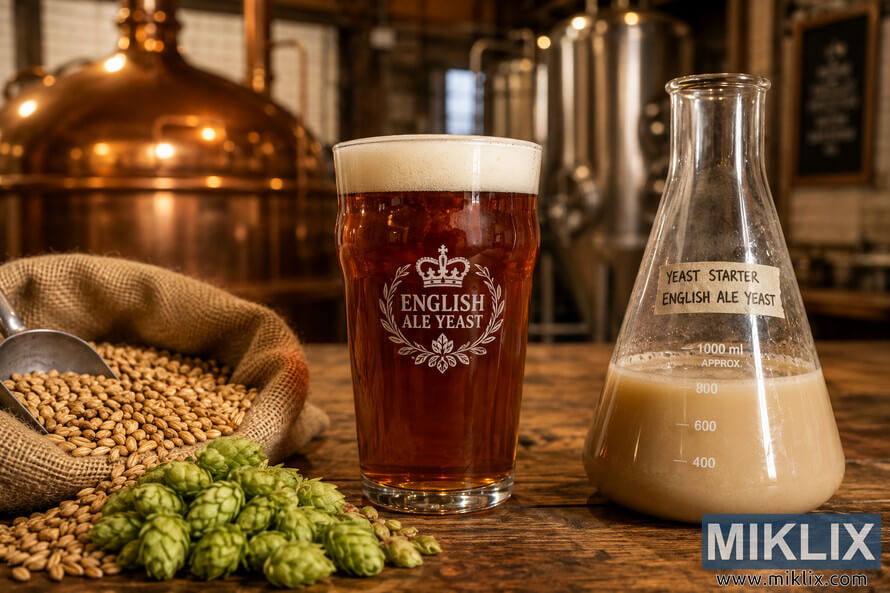
WLP002 excels in English Bitter, ESB, English Pale Ale, Brown Ale, Mild, and cask-conditioned beers. It also suits porters and darker malty ales, where it supports malt and hop flavors without dominating them.
Натисніть або торкніться зображення, щоб отримати більше інформації та вищу роздільну здатність.
Overview of White Labs WLP002 English Ale Yeast
WLP002 is a classic English ale strain from White Labs, ideal for malt-forward, sessionable beers. It's chosen for its reliable performance and clean, restrained ester profile. Below, we delve into its origin, fermentation behavior, and where to find quality liquid yeast for both home and professional use.
Strain origin and lineage
The origin of WLP002 traces back to traditional British brewery strains maintained by White Labs. It reflects selections from English breweries that valued balance over aggressive fruitiness. This heritage ensures the yeast produces subtle esters that complement English malts and classic ale recipes.
Attenuation and flocculation characteristics
Yeast attenuation for WLP002 typically ranges from medium to moderately high, often around 70–75% on technical sheets. Final gravity varies based on wort composition and fermentation temperature. So, expect some variation in attenuation from batch to batch.
Flocculation is high to very high with this strain. Strong flocculation leads to good yeast drop-out, making beers clear after conditioning. It's particularly beneficial for casking or bottle conditioning where clean yeast separation is crucial.
Commercial and homebrew availability
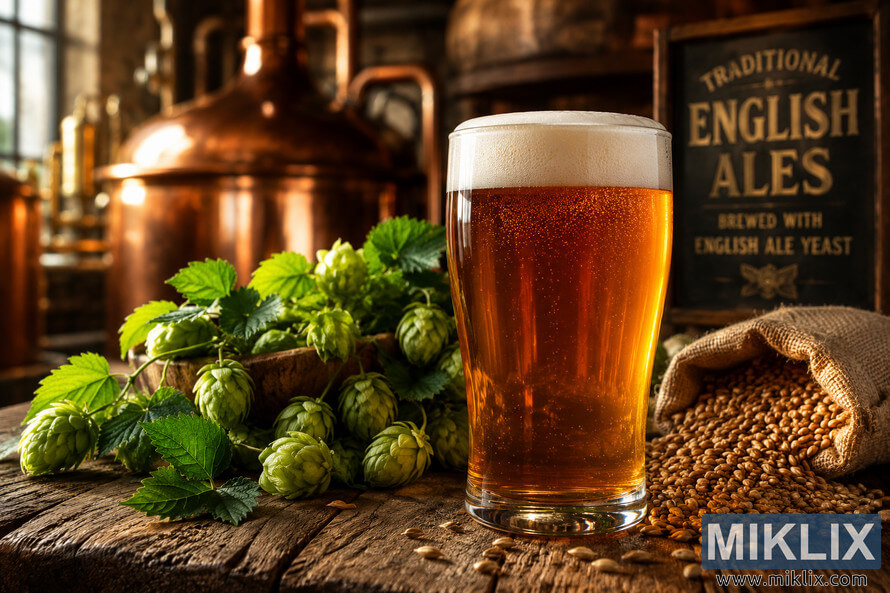
White Labs makes WLP002 widely available across the United States. It's sold as liquid yeast through local homebrew shops and many online retailers. Brewers should always check packaging dates and refrigerate promptly to maintain viability.
- Available as a pure culture for both hobbyists and professional breweries
- Commonly stocked in vials and larger packs for higher-volume brewing
- Best used fresh; viability drops with prolonged storage even under refrigeration
Натисніть або торкніться зображення, щоб отримати більше інформації та вищу роздільну здатність.
Creating a Yeast Starter for WLP002
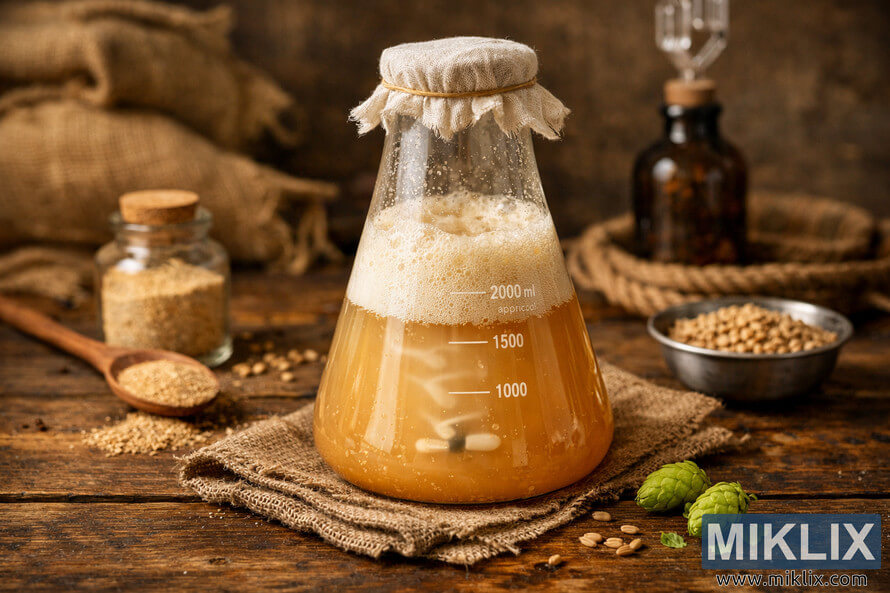
Having a healthy starter before pitching WLP002 is crucial for fermentation success. A brief prep step, a reliable calculator, and gentle handling are key to growing the necessary cell count.
Calculating starter size by wort gravity and pitch rate
Begin with a pitch calculator like Mr. Malty or Brewers Friend to find the target cell count for your batch. For a 5-gallon (19 L) ale at about 1.050 OG, aim for roughly 0.75–1.0 million cells per mL per degree Plato.
Higher gravities require larger starters. For beers at 1.060 or above, increase starter volume or do a stepped build. White Labs advises making a starter for liquid packs beyond their freshness window and when brewing stronger ales.
Starter timeline and shaking/oxygenation tips
Prepare starter wort at 1.030–1.040 gravity, boil to sanitize, then cool and pitch. Small starters often finish growth within 24–48 hours. Large starters may take up to 72 hours.
Shake or swirl the flask vigorously once or twice daily for oxygenation if you lack a stir plate. A stir plate can shorten the timeline and give denser growth. Stop aggressive oxygenation once visible growth slows to avoid stressing cells.
Storage and harvesting of starter yeast
When growth is complete, cold-crash the starter in a refrigerator to settle the yeast. Decant the clear starter wort and either pitch the slurry or harvest into sanitized jars for short-term storage.
- Label jars with strain, date, and repitch count.
- Store harvested yeast refrigerated and use within recommended repitch cycles.
- Keep track of viability; treat harvested yeast as a perishable ingredient.
Good yeast starter calculation and careful making yeast starters help you hit target cell counts. When you harvest starter yeast cleanly, you preserve vigor for future batches and reduce waste.
Натисніть або торкніться зображення, щоб отримати більше інформації та вищу роздільну здатність.
Pitching Rates and Best Practices
Effective pitching is crucial for a balanced fermentation with WLP002. It's important to match yeast quantity and temperature to your recipe. This controls the ester profile and attenuation. Use cell counts and temperature guidance as practical tools, not strict rules.
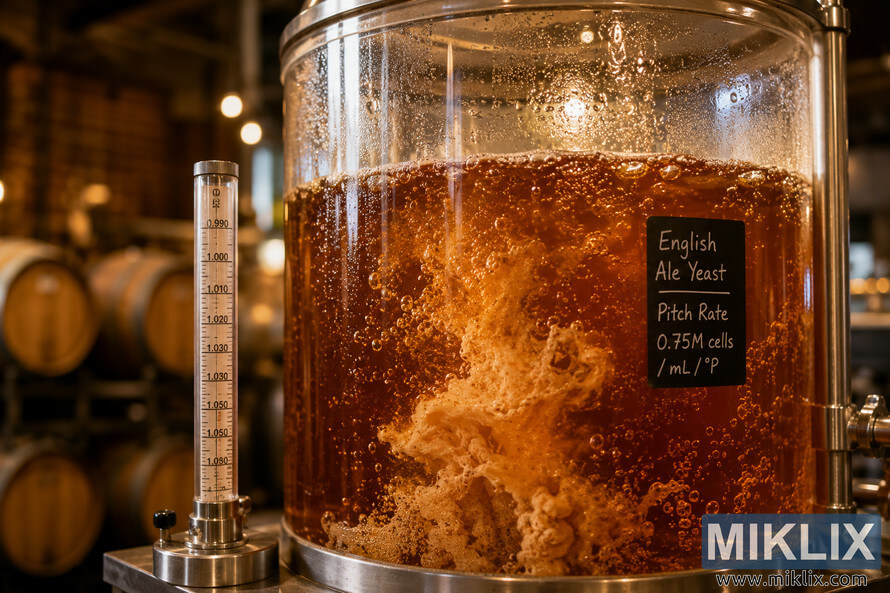
Recommended ale cell counts vary based on wort gravity and desired character. Aim for roughly 0.75–1.5 million viable cells per mL per °P for most ales. For a 5-gallon batch at 1.050, that's about 150–250 billion cells. Adjust these numbers with a yeast calculator, considering pack age and viability before pitching.
When preparing your starter or slurries, follow a checklist. Confirm viability, calculate required cells, and scale the starter size to reach the target ale cell counts. For older packs, increase starter size to compensate for lower viability.
Underpitching effects can manifest quickly. Expect longer lag time, stressed fermentation, and higher ester and fusel production. You may also see diacetyl or other off-flavors from a slow or uneven start.
Overpitching has its trade-offs. Excess yeast can mute typical English ester character and yield a thinner mouthfeel. In extreme cases, overpitching alters attenuation and aroma balance, leaving the beer less lively.
- When you want more esters, lean to the lower end of the ale cell counts range.
- For consistent attenuation and cleaner profiles, aim near the midpoint of the range.
- For lag-sensitive beers or high gravity, increase cells to avoid stress.
Pitching temp is crucial for WLP002 performance. Aim to introduce yeast into wort near mid-60s°F (18–20°C) for balanced ester expression. Warm pitching will shorten lag time and boost esters. Cold pitching slows the start and reduces ester formation.
Acclimate yeast if your starter and wort differ in temperature. Pour or step-wise temper the starter into the wort to avoid shocking cells. Gentle aeration or oxygenation before pitching helps a strong start, especially when targeting higher ale cell counts.
Use this practical approach: calculate cell needs, confirm viability, temper the yeast to pitching temp, and choose cell counts that match the flavor goals of the beer. Small adjustments to WLP002 pitching rate and pitching temp give brewers control over ester profile and fermentation health.
Натисніть або торкніться зображення, щоб отримати більше інформації та вищу роздільну здатність.
Fermentation Temperature Management
Temperature control during primary fermentation is crucial for flavor, attenuation, and beer balance. White Labs WLP002 yeast responds well to temperature changes. Therefore, it's essential to plan your temperature strategy before pitching the yeast. Use a reliable thermometer and aim for consistent conditions to maintain flavor consistency.
Ideal temperature range for WLP002
- Target range: mid-60s to low 70s°F (about 64–70°F / 18–21°C) for a balanced ester profile.
- Cooler temps produce cleaner, malt-forward beers with restrained esters.
- Warmer temps increase fruity esters and can raise attenuation, but risk fusel alcohols if pushed too high.
Temperature control methods for homebrewers
- Chest freezers with a PID controller give precise control and work well for single fermenters.
- Dedicated fermentation chambers or converted fridges provide stable environments for multiple vessels.
- Swamp coolers paired with an aquarium thermostat offer a low-cost way to control fermentation temp.
- Insulated fermentation jackets and heated wraps help reduce diurnal swings when ambient temps vary.
- Glycol systems suit commercial setups that need tight control across several fermenters.
How temperature affects ester production and attenuation
- Higher temps speed yeast metabolism, increasing ester production temperature effects and often boosting attenuation.
- Lower temps slow activity, yielding fewer esters and sometimes leaving more residual sugar.
- Rapid temperature swings stress yeast and can create off-flavors or stuck fermentations.
- To minimize risk, raise or lower temps gradually and monitor gravity to confirm expected attenuation.
Primary Fermentation Timeline and Signs of Activity
The WLP002 fermentation timeline is influenced by several factors, including pitch rate, starter use, and temperature control. A short lag phase of 12–48 hours is expected. Visible signs of activity, such as bubbling airlock action, rising krausen, and increased yeast activity, typically appear within 24–72 hours.
Primary fermentation for most English ales lasts 3–7 days. Beers with higher gravity or cooler temperatures may experience a longer vigorous phase. Monitoring these stages is crucial for planning transfers and conditioning.
Gravity tracking is essential for confirming fermentation progress, rather than relying solely on visual cues. Record an accurate Original Gravity (OG) before pitching. Take sanitized hydrometer or refractometer readings at regular intervals. Two or three consistent readings over 24–48 hours that show no change indicate fermentation has plateaued.
- Take gravity readings in the same vessel and temperature range when possible.
- Correct refractometer values for alcohol if you use one after fermentation begins.
- Log readings with date and temperature for clear trend analysis.
Early signs of fermentation include foam formation, krausen development, a yeasty aroma, and steady gravity decline. These signs are reliable indicators of healthy yeast activity and attenuation.
Recognizing a stuck fermentation early is crucial to avoid loss of time and flavor. If gravity shows no meaningful drop 48–72 hours after the expected active phase, treat it as a potential stuck fermentation. Persistent krausen without gravity change or a very slow decline are other red flags.
- Check pitch rate and yeast viability; repitch with a healthy starter if necessary.
- Confirm temperature is within WLP002’s ideal range and raise it gently if too low.
- Rouse the yeast by gently swirling the fermenter, but avoid oxygenating after initial stages.
- Consider adding yeast nutrient early in fermentation or a stress-tolerant strain for rescue pitches.
Addressing causes quickly is vital to protect flavor and finish. Good gravity tracking and attention to early signs of fermentation will keep most ales on schedule and reduce the risk of a true stuck fermentation.
Managing Off-Flavors and Troubleshooting
Small batches of English ale can reveal off-flavors that obscure the yeast's character and the malt's balance. This guide covers common faults, prevention steps during mash, boil, and fermentation, and how to fix issues if they arise. Remember, WLP002 off-flavors and ale troubleshooting are crucial when tasting and adjusting your brewing process.
Common off-flavors with English ale strains
English strains can produce diacetyl, which smells buttery. Too many esters can make a beer overly fruity. Phenolics, with their clove or medicinal notes, indicate contamination or wild yeast. High fermentation temperatures or stressed yeast can lead to fusel alcohols, tasting like solvents. DMS can appear if the boil lacks vigor.
Prevention strategies during mash, boil, and fermentation
- Maintain a strong rolling boil to reduce DMS precursors and protect malt flavor.
- Pitch adequate cell counts and oxygenate wort before pitching to avoid stressed yeast and fusel alcohols.
- Control fermentation temperature in the recommended WLP002 range to limit excessive esters and sulfur production.
- Cool wort quickly and follow strict sanitation to prevent contamination that causes phenolics.
Remediation steps if off-flavors appear
- If diacetyl is detected, give the beer a warm diacetyl rest by raising the temperature a few degrees for 24–72 hours to let yeast reabsorb the compound.
- For slow or stuck fermentations tied to off-flavors, rouse the yeast, gently raise temperature, or repitch a healthy ale strain to finish attenuation.
- If phenolics or infection-related sulfur notes persist, isolate the batch. Avoid blending with clean beer and improve sanitation for future brews.
- When sulfur aromas show early, allow time for conditioning; many sulfur compounds dissipate with age and mild aeration during transfers.
Use systematic ale troubleshooting when diagnosing faults: taste, check gravity, review process logs, and make one change at a time. This method helps prevent repeat WLP002 off-flavors and ensures your English ales remain true to style.
Secondary Conditioning and Maturation
Once fermentation slows, the path to the beer's final form is set. WLP002 conditioning can proceed in two ways: either by leaving the beer in the primary for bulk aging or by transferring it for secondary fermentation. Each method impacts oxygen exposure, clarity, and flavor development.
When to transfer to secondary vs. bulk aging
For most English ales using WLP002, bulk aging in the primary vessel is often the simplest path. This method reduces handling and limits oxygen pickup during transfers. Use a secondary when you plan long-term cellaring, want to add fruit or oak, or need to isolate beer from heavy trub before packaging.
Timeframes for conditioning different ale styles
Conditioning windows vary by style and gravity. Session bitters and pale ales typically benefit from 1–3 weeks of conditioning after the primary phase. Stronger ESBs, porters, and brown ales usually need 3–6 weeks for flavors to meld. High-gravity ales and beers with adjuncts may require several months of aging. Cask-conditioned beers follow a different timetable and often see shorter cellaring with active yeast present.
Impact on clarity and flavor development
Extended conditioning with WLP002 supports yeast cleanup of off-flavors like diacetyl and sulfur notes. The strain’s flocculation aids in natural clarification, but time plus a cold-crash will improve drop-out. Each transfer raises oxidation risk, so minimize splashing and use closed transfers to protect delicate esters formed during ale maturation times.
- Bulk aging: reduces oxygen exposure, suits short to mid-term conditioning.
- Secondary transfer: useful for adjunct additions and long-term storage.
- Cold-conditioning and gentle racking help clarity without stripping aroma.
Carbonation and Packaging Considerations
Deciding on carbonation and packaging methods for ales fermented with WLP002 impacts mouthfeel, clarity, and shelf life. WLP002's carbonation is predictable due to its flocculation. Select a method that aligns with your equipment, schedule, and desired bottle or keg character.
Consider natural bottle conditioning versus kegging based on desired texture and risk level. Bottle priming yields a softer, creamier head, enhancing cask-like mouthfeel. WLP002's yeast profile supports reliable bottle priming, provided bottles are kept at consistent temperatures during conditioning.
For quicker, more controlled carbonation, opt for force carbonation. Kegging allows precise PSI settings and rapid stabilization of carbonation. It also minimizes oxygen exposure and contamination risks. Many brewers choose force carbonation for draft service or consistent carbonation levels.
- When bottle priming: sanitize caps and bottles, measure priming sugar precisely, and allow two weeks at 65–75°F for conditioning.
- When you force carbonate: chill beer first, set regulator to target PSI, and monitor volumes until stable.
- Use a measured priming calculator or CO2 chart to match style expectations.
Target carbonation volumes by style to align with tradition and balance. Classic English bitters and ESBs typically have lower carbonation, around 1.5–2.2 volumes. Brown ales and porters prefer moderate carbonation, roughly 1.8–2.4 volumes. Modern English-style or hybrid ales might aim for 2.4–2.6 volumes for a more lively profile.
Adjust priming sugar or keg PSI to achieve these ranges accurately. Cold-conditioning before final packaging enhances CO2 absorption and stabilizes head retention after carbonation.
Preserve delicate yeast-derived flavors with careful packaging practices. Minimize oxygen pickup during transfers by purging kegs with CO2 and using counter-pressure bottle fillers when bottling. Sanitize all surfaces that contact beer to preserve WLP002's subtle esters.
- Cold-condition after carbonation to let flavors marry and reduce yeast haze.
- Store packaged beer at stable, cool temperatures to slow flavor changes.
- Choose quality bottles, caps, or kegs and monitor seals to prevent gas loss or oxygen ingress.
By following these steps, WLP002 carbonation will deliver the desired mouthfeel, whether through bottle priming or force carbonation. Thoughtful packaging ensures the yeast's contribution remains clear and enjoyable for drinkers.
Recipe Ideas and Pairings for WLP002 Ales
WLP002 imparts a classic English character, ideal for malt-forward recipes and balanced hop choices. Below are practical ideas for brewing and serving ales that showcase this strain's strengths.
Consider brewing English Bitter or Pale Ale, Extra Special Bitter (ESB), Brown Ale, Mild, Porter, and English-style Amber Ale. These recipes highlight WLP002’s mild esters and its ability to enhance malt depth. This is done without overwhelming hop aromatics.
- English Bitter/Pale Ale — single- or two-malt base using Maris Otter for biscuit and bread notes.
- ESB — richer malt bill with light crystal and a touch of amber malt for caramel backbone.
- Brown Ale and Porter — increase specialty malts for nutty and chocolate layers that match the yeast’s round mouthfeel.
Choose malt and hop pairings that support the yeast’s profile. Use English malts such as Maris Otter, Golden Promise, and crystal malts. These build caramel, biscuit, and toffee flavors.
- Traditional malt and hop pairings: pair Maris Otter with East Kent Goldings or Fuggles for classic balance.
- For amber and brown styles: add caraamber or crystal 60–80L and use Challenger for structure.
- Modern twists: a restrained addition of American Cascade or New Zealand Motueka keeps the yeast in front while adding bright lift.
Food pairings for ales brewed with WLP002 favor hearty, savory dishes. Think roasted meats, beef stew, and Sunday roast. The malt sweetness complements rich sauces.
- Cheeses: sharp cheddar and aged gouda pair well with malt-driven ales.
- Pub fare: meat pies, sausages, and grilled fare match the beer’s body and savory notes.
- Sweet contrasts: porter and brown ale pair nicely with chocolate desserts or sticky toffee pudding.
When drafting WLP002 recipes, keep the yeast’s strengths in mind. Let malt character lead, choose hops that support rather than dominate, and match servings with robust food pairings. This will produce memorable results.
Comparing WLP002 to Similar English Ale Strains
Choosing the right yeast is crucial for flavor, mouthfeel, and fermentation. This comparison examines WLP002 against other White Labs strains, Wyeast liquid cultures, and popular dry English options. It aims to assist in selecting yeast for traditional ales.
Differences vs. other White Labs strains
WLP002 produces rounded English esters and a fuller body, unlike White Labs WLP001 California Ale. WLP001 offers a cleaner, more neutral profile, ideal for American ales. WLP004 British Ale is closer to WLP002 in ester character but may differ in attenuation and flocculation. Brewers should refer to datasheets for exact temperature ranges and attenuation numbers before making their yeast selection.
How WLP002 compares to Wyeast and dry English strains
Wyeast English strains, such as 1968 London ESB, often yield similar malt-forward, fruity notes. Expect slight variations in ester balance and flocculation due to different culture methods. In a dry English yeast comparison, strains like Safale S-04 offer faster flocculation and greater convenience. Liquid WLP002 can provide subtle live-culture nuances that many brewers seek for traditional English character.
When to choose WLP002 over alternatives
Choose WLP002 for classic English ale traits: rounded esters, fuller mouthfeel, and gentle attenuation. This is ideal for cask- or bottle-conditioned beers. Opt for WLP001 for a cleaner backbone or a dry strain for ease, cost savings, and rapid flocculation. Consider your recipe goals, conditioning method, and desired ester profile during yeast selection.
Storage, Reuse, and Harvesting Techniques
Proper handling after fermentation allows for the reuse of WLP002 yeast. A straightforward process ensures yeast viability, enhancing outcomes in subsequent brews.
How to harvest yeast from a fermentation
- Cold-crash the fermenter for 24–72 hours to help solids settle.
- Sanitize jars, spoons, and racking gear before touching the trub and yeast cake.
- Decant clear beer off the top, then scoop the dense creamy layer into containers.
- Separate heavy trub by letting the slurry sit briefly; pour off the top yeast cream or wash with sterile wort if you need a cleaner slurry.
- Label jars with strain name, pitch date, final gravity, and original batch details to track performance over time.
Storing harvested yeast and viability expectations
- Place harvested yeast in airtight, sanitized containers and refrigerate immediately to slow metabolism.
- Use the slurry within two to six weeks for best results; viability drops steadily with time.
- When storage extends beyond a week, plan to make a starter to rebuild cell counts and ensure healthy fermentation.
- Assess yeast viability with methylene blue or a microscope if you can; otherwise assume lower viability after longer storage and compensate with a larger starter.
How many repitches before performance declines
- For English ales, a practical guideline is to repitch yeast three to five times before expecting noticeable declines.
- Watch for longer lag times, reduced attenuation, or off-flavor changes as signs to retire the culture.
- If sensory or fermentation metrics shift, refresh your culture with a fresh White Labs pack or build a new starter from a trusted source.
- Keep batch notes and viability observations to decide when to stop and when to repitch yeast safely.
Safety, Sanitation, and Lab Practices for Homebrewers
Good lab habits are crucial for protecting your batch and health. By following basic steps, you can keep yeast healthy, prevent infections, and maintain a consistent homebrew routine. The checklist below outlines simple actions that significantly enhance yeast sanitation and culturing safety.
Before making or handling starter wort, sanitize all vessels and tools. Use iodophor or Star San for fermenters, airlocks, spoons, and measuring tools. Boil the starter wort, cool it in a sanitized container, and work over a clean surface to minimize contamination risks.
- Sanitize hands and surfaces; wear clean gloves or wash thoroughly.
- Use covered, sterile containers for starters and harvested yeast.
- Avoid cross-contamination by dedicating tools to a single strain when possible.
Store yeast and slurries in the refrigerator and label each container with strain and date. Do not culture in a general living area where dust and mold can settle. For safe culturing, consider dedicated starter equipment and sterile transfer tools to keep contamination low.
- Refrigerate fresh packs and harvested slurry at 34–40°F for short-term storage.
- Dispose of spent starter wort responsibly; do not drink it and do not pour it where wild microbes can spread.
- For advanced culturing, adopt clean-room practices such as flame-sterilized loops or filtered airboxes.
Spotting contamination signs early limits losses. Visual cues include odd-colored films, slimy growths, or a pellicle on top of the liquid. Smells like a sour, phenolic, or acetone-like odor point to infection rather than yeast activity.
- If you suspect contamination, isolate the vessel immediately.
- Discard infected beer and yeast; do not try to salvage obvious infections.
- For borderline cases, pitching a robust, healthy yeast can sometimes outcompete minor invaders, but use caution.
After an infection, deep-clean and sanitize all equipment before the next batch. Record the incident and review your homebrew lab practices to prevent a repeat. Regular attention to yeast sanitation, clear labeling, and careful culturing safety preserves batch quality and reduces waste.
Conclusion
The White Labs WLP002 English Ale Yeast review underscores its reliability for traditional English ales. It offers mild fruity esters, a full mouthfeel, and strong flocculation. These traits are perfect for cask-conditioned beers and pub-style bitters. The WLP002 summary also highlights its classic character and consistent performance in malt-forward recipes.
To achieve the best results, follow the best practices WLP002 recommends. Prepare a starter for high-gravity worts, pitch at recommended cell counts, and manage fermentation temperature. This will help shape ester production. Proper sanitation, fresh White Labs packs, and careful storage are also crucial to preserve yeast viability and reduce contamination risk.
WLP002 is widely available from White Labs and major U.S. homebrew retailers. This makes it accessible for both homebrewers and professional brewers. Monitor fermentation with gravity readings, adjust techniques for the style you want, and use the guidance above. This will help you get predictable, flavorful ales from this trusted English ale strain.
Натисніть або торкніться зображення, щоб отримати більше інформації та вищу роздільну здатність.
FAQ
What flavor profile can I expect from White Labs WLP002 English Ale Yeast?
WLP002 offers a classic English ale taste: mild, rounded esters with soft fruit notes, often described as pear or apple. It also has a subtle bready or biscuit nuance. At mid-60s°F, it stays restrained and malty. Warmer fermentations (upper 60s–low 70s°F) increase fruity esters.
The strain contributes to a fuller mouthfeel and a smooth malt-forward finish.
Which beer styles benefit most from WLP002?
WLP002 is ideal for traditional English styles: Bitter, Extra Special Bitter (ESB), English Pale Ale, Brown Ale, Mild, Porter, and cask-conditioned ales. It pairs well with malt-focused recipes using Maris Otter, Golden Promise, crystal malts, and English hops such as East Kent Goldings and Fuggles.
Is WLP002 sold as liquid yeast and how should it be stored?
Yes. White Labs sells WLP002 as a liquid culture in vials or pouches through U.S. homebrew shops and online retailers. Store refrigerated and use when fresh for best viability. If the pack is older or you’re brewing higher gravity beers, plan to build a starter to raise viable cell count.
When should I make a starter versus rehydrating or directly pitching?
For liquid WLP002, a starter is recommended when wort gravity is above average (1.060+) or when the yeast pack has aged or will sit more than ~48 hours before use. For typical 1.050 ales with a very fresh pack, direct pitch can be acceptable. Rehydration is more commonly discussed with dry yeasts; if you do rehydrate liquid yeast, follow gentle acclimation steps.
How do I rehydrate WLP002 safely?
Warm the refrigerated pack to room temperature, sanitize your area, and prepare sterile water at roughly 95–104°F. Add yeast to the water slowly (not the other way around) and let it hydrate 15–20 minutes. Gradually add small portions of wort over 10–15 minutes to acclimate temperature and osmotic conditions, then pitch into aerated wort. Avoid thermal or osmotic shock and do not vigorously agitate.
How large should a starter be for a 5-gallon, 1.050 ale?
Use a yeast calculator like Mr. Malty or Brewer’s Friend. As a rule of thumb, target about 0.75–1.0 million viable cells per mL per °P for ales. For a standard 5-gallon (19 L) 1.050 ale this typically translates to a modest starter—often 1–2 liters at ~1.030 gravity—depending on pack age and desired pitch rate.
What are recommended pitching rates and what happens if I underpitch or overpitch?
Aim for roughly 0.75–1.5 million viable cells per mL per °P for ales. Underpitching can lengthen lag time, raise ester and fusel production, and risk stressed fermentations. Overpitching mutes ester expression, can thin mouthfeel, and may change attenuation. Adjust pitch based on pack viability and beer gravity.
What fermentation temperature range suits WLP002?
The typical range is about 64–70°F (18–21°C). Mid-60s yield restrained, balanced esters. Going warmer increases fruitiness and can boost attenuation but also raises the risk of fusels. Consistent temperature control is more important than chasing a single setpoint—avoid large swings.
How quickly will fermentation start and how long does primary fermentation last?
Expect a lag phase of roughly 12–48 hours depending on pitch rate and starter use. Vigorous activity commonly appears within 24–72 hours. Primary fermentation for standard ales usually runs 3–7 days before tapering, with conditioning continuing afterward.
How should I track fermentation progress and recognize a stuck ferment?
Take sanitized gravity readings with a hydrometer or calibrated refractometer. When gravity readings plateau across 24–48 hours, fermentation is done. A stuck ferment shows no gravity change when activity is expected, prolonged krausen without drop, or very slow gravity decline. Check pitch rate, oxygenation, nutrients, and temperature; rouse yeast, gently raise temperature, or repitch healthy yeast if needed.
What common off-flavors could appear and how do I prevent them?
With English strains you may see diacetyl (buttery), excessive esters, fusel alcohols, phenolics from contamination, or DMS from poor boil practices. Prevent these by pitching adequate cells, oxygenating wort at pitch, maintaining proper fermentation temperature, ensuring strong boil and fast cooling, and practicing strict sanitation.
If I detect diacetyl, what can I do?
Perform a diacetyl rest: raise fermentation temperature a few degrees toward the high end of the yeast’s range and allow the yeast to reabsorb diacetyl. Give the beer additional conditioning time; WLP002’s active yeast and good flocculation usually clean up diacetyl given time.
When should I transfer to secondary or bulk age in primary?
For most WLP002 ales, bulk aging in primary is sufficient and reduces oxygen exposure. Transfer to secondary only when you need to add adjuncts, perform long-term aging, or clarify prior to packaging. Many session ales condition 1–3 weeks, while ESBs, porters, and brown ales benefit from 3–6 weeks of conditioning.
What carbonation levels suit English ales fermented with WLP002?
Traditional English ales tend toward lower carbonation: roughly 1.5–2.2 volumes CO2 for bitters and ESBs. Brown ales and porters often land around 1.8–2.4. Bottle priming with WLP002 generally conditions well, while force carbonation allows tighter control and reduces infection risk.
How does WLP002 compare to other English strains like Safale S‑04 or Wyeast 1968?
WLP002 produces classic liquid yeast nuance with rounded esters and fuller mouthfeel. Safale S‑04 (dry) and Wyeast 1968 have similar English profiles but differ in attenuation, flocculation speed, and ester balance. Dry strains are more convenient and fast-flocculating; WLP002 often offers subtle live-culture complexities favored by many brewers.
Can I harvest and reuse WLP002 slurry? How long is harvested yeast viable?
Yes. After cold-crashing, decant beer and collect the yeast/trub layer into sanitized containers. Refrigerated harvested slurry is best used within 2–6 weeks and should be rebuilt with a starter before pitching, especially after storage. Typical repitch limits are 3–5 generations for ale strains before monitoring for degraded performance.
What sanitation and lab practices should I follow when making starters or harvesting yeast?
Sanitize all equipment with iodophor or Star San, boil starter wort to sterilize, cool in a sanitized vessel, use clean hands and surfaces, and store harvested yeast in sanitized, labeled jars. Work carefully to avoid cross-contamination; if contamination is suspected, isolate and discard affected materials and sanitize thoroughly.
What are practical recipe and pairing ideas for beers fermented with WLP002?
Brew classic English Bitter or ESB with Maris Otter and East Kent Goldings for authentic character. Brown ales and porters benefit from medium crystal malts and subtle roast. Food pairings include roasted meats, stews, aged cheddar, and chocolate desserts—styles that match WLP002’s malt richness and moderate carbonation.
How should I package WLP002 beers to preserve yeast character?
Minimize oxygen pickup during transfer and packaging. Use purged kegs or counter-pressure filling for bottles where possible. For bottle conditioning, calculate priming sugar for target volumes and allow adequate conditioning time. Cold-condition after carbonation to help clarity and stabilize flavors.
Where can I buy authentic WLP002 and how do I verify freshness?
Purchase WLP002 from White Labs authorized retailers, local homebrew shops, or reputable online stores. Check expiration or manufacture dates on the pack, store refrigerated until use, and consider building a starter for older packs. Buying from established suppliers like Midwest Supplies, MoreBeer, or local brew shops helps ensure proper handling.
Додаткова література
Якщо вам сподобався цей пост, вам також можуть сподобатися ці пропозиції:
- Бродіння пива з дріжджами Lallemand WildBrew Philly Sour
- Бродіння пива з дріжджами Fermentis SafAle BE-134
- Бродіння пива з дріжджами White Labs WLP008 East Coast Ale