
图像: Homebrew Lager Fermentation Basics in a Cozy Brewing Space
已出版:
最后更新 2026年5月23日 UTC 16:26:18
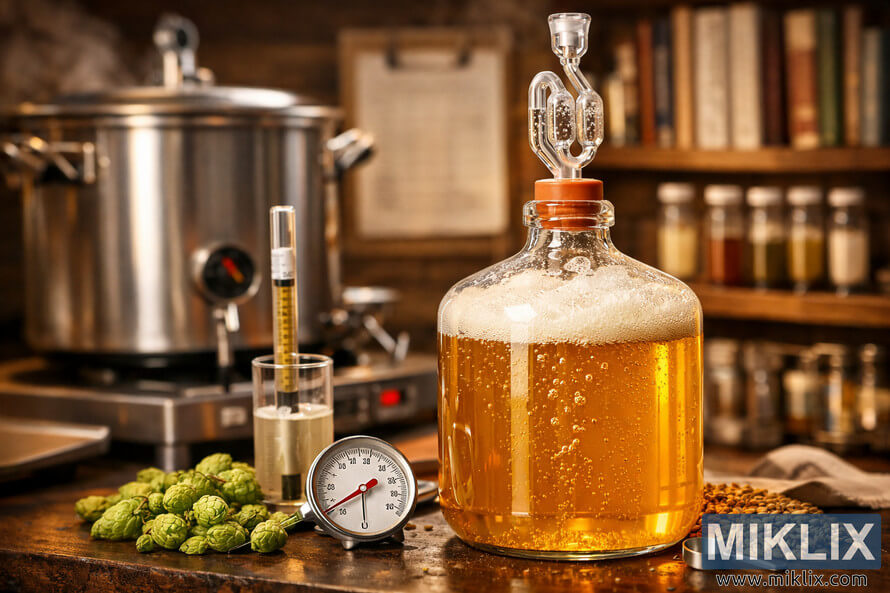
A warm, detailed illustration of a homebrew lager fermentation setup, featuring a glass carboy with golden lager, an airlock releasing bubbles, a hydrometer, thermometer, and brewing kettle on a countertop, plus hops, malt, and yeast vials in a cozy, book-lined brewing space. The shallow depth of field and soft lighting emphasize the fermentation process while conveying an inviting, educational atmosphere that highlights the craft and science of lager brewing.
Homebrew Lager Fermentation Basics in a Cozy Brewing Space
该图片的可用版本
与本网站文章和网页中嵌入的图片相比,以下可供下载的图片文件压缩程度更低,分辨率更高,因此质量也更高。
正常尺寸 (1,536 x 1,024)
大尺寸 (3,072 x 2,048)
尺寸非常大 (4,608 x 3,072)
超大尺寸 (6,144 x 4,096)
夸张的大尺寸 (1,048,576 x 699,051)
- 仍在上传......;-)
图片说明
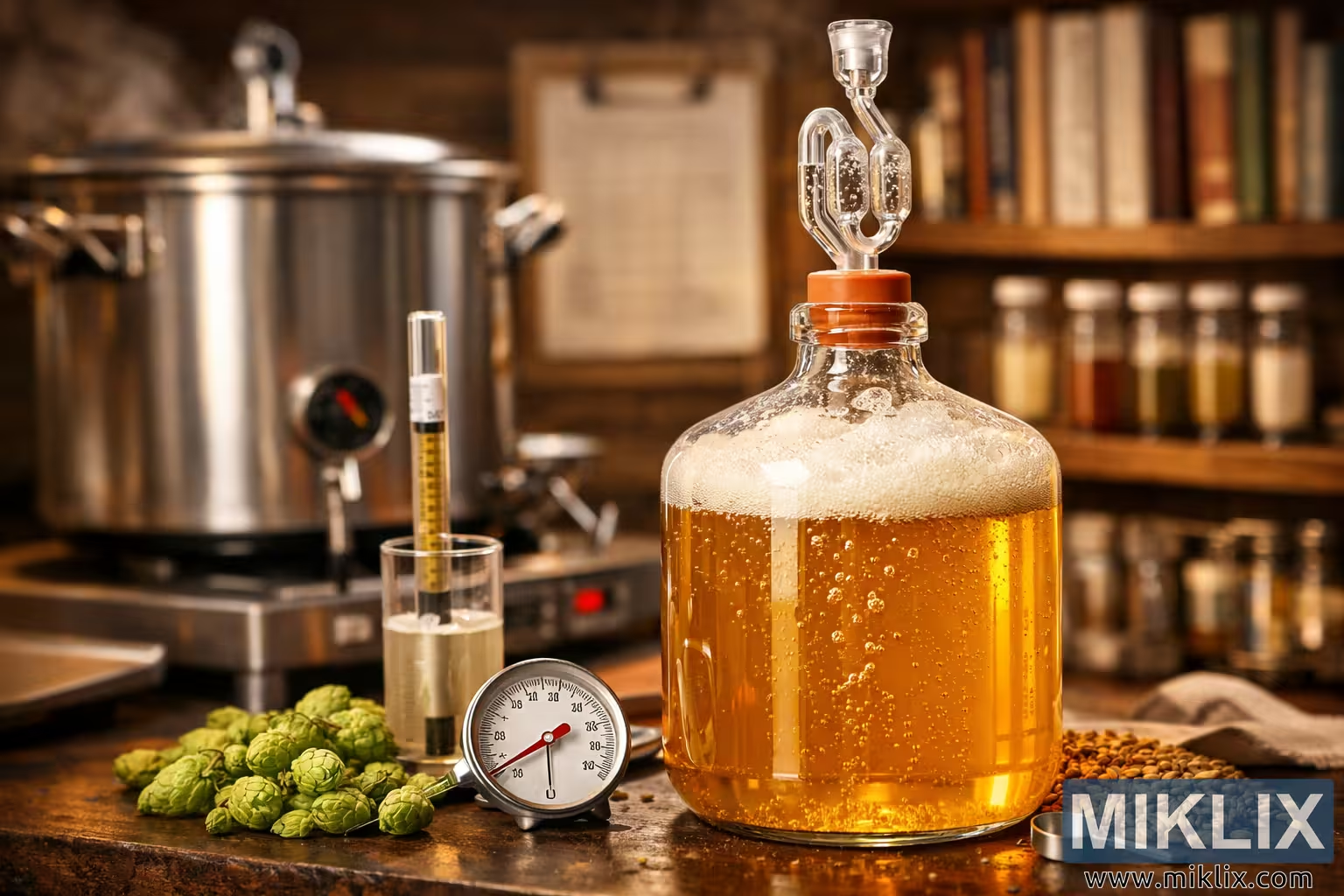
The image presents a richly detailed, photo-style illustration of a homebrewing scene that focuses on the fundamentals of lager fermentation. The composition is in landscape orientation and uses a shallow depth of field to draw the viewer’s attention to the central fermentation vessel, while the surrounding equipment and background elements softly recede into a warm blur. In the very foreground, occupying the visual center of the frame, stands a large glass carboy resting on a smooth countertop. The carboy is filled with a brilliantly clear golden lager, its color reminiscent of sunlit straw or pale amber. Near the top of the liquid, a frothy white krausen ring clings to the inner glass, indicating active fermentation and giving a sense of motion and life inside the vessel.
Seated firmly in the neck of the carboy is an orange rubber stopper, from which an S-shaped plastic airlock rises vertically. The airlock is partially filled with clear water, and within its curved channels, small bubbles are captured mid-ascent. These bubbles are a subtle but important detail, visually communicating the release of carbon dioxide as the yeast ferments the wort into lager. The glass of the carboy reflects the ambient light in soft highlights, and faint condensation or smudges on the surface add to the realism, suggesting that this is a working piece of equipment rather than a pristine display object.
To the left of the carboy, still in the sharply focused foreground and middle ground, stands a tall, transparent test jar containing a pale, straw-colored liquid. Inside the jar, a hydrometer floats upright, its slender glass stem protruding above the surface. The hydrometer’s scale is visible, with fine black markings and numbers that hint at specific gravity readings. This instrument subtly reinforces the educational aspect of the scene, reminding the viewer that measuring gravity is a key step in understanding fermentation progress and alcohol content. In front of the hydrometer, closer to the viewer, lies a stainless steel dial thermometer resting on the countertop. The thermometer has a white face with clear black markings and a red needle pointing to a temperature around 50°F (10°C), an ideal range for lager fermentation. The metal casing of the thermometer catches the warm light, producing gentle reflections that harmonize with the metallic surfaces elsewhere in the image.
Slightly further to the left, still within the middle ground but beginning to soften in focus, sits a stainless steel brewing kettle on the same countertop. The kettle is sturdy and functional, with a smooth brushed-metal finish. Attached to its side is a thermometer probe, reinforcing the importance of precise temperature control in lager brewing. The kettle’s lid may be partially visible or implied, and subtle reflections on its curved surface echo the golden tones of the lager and the warm lighting of the room. The arrangement of the carboy, hydrometer, thermometer, and kettle forms a gentle arc across the frame, guiding the viewer’s eye from one essential tool to the next.
Scattered around the base of the carboy are key brewing ingredients that add both texture and narrative depth. On one side, a small pile of fresh green hop cones rests on the countertop. Their layered petals and slightly irregular shapes are rendered with care, suggesting their aromatic, resinous character. On the other side, a mound of pale malted barley grains is spread out, each kernel catching the light with a soft, matte sheen. Near the malt lies a small stainless steel measuring spoon, hinting at the careful weighing and measuring that precede every batch of beer. These ingredients ground the scene in the raw materials of brewing, connecting the finished golden liquid in the carboy back to its agricultural origins.
In the background, the image transitions into a cozy, softly blurred brewing space that feels both professional and approachable. Wooden shelves line the wall, their warm brown tones complementing the golden hues of the lager and the earthy colors of the hops and malt. On these shelves, a row of brewing books stands upright, their spines in muted, non-branded colors. The titles are not legible, but their presence suggests a wealth of knowledge and experimentation. Interspersed among the books are several small glass vials filled with yeast cultures. Each vial contains liquid of slightly different shades—pale yellow, light amber, or faintly cloudy—hinting at different yeast strains or stages of preparation. The vials are neatly arranged, reinforcing the sense of an organized, thoughtful brewer at work.
Also in the background, partially visible behind the kettle, a clipboard with a brewing chart or log sheet hangs on the wall. The details of the chart are intentionally indistinct due to the depth of field, but its presence implies careful record-keeping: tracking temperatures, gravity readings, fermentation timelines, and other critical data. The wall itself is bathed in warm, soft lighting that seems to emanate from an unseen source above or to the side, casting gentle shadows and giving the entire space a welcoming glow.
The overall lighting of the scene is warm and inviting, with a subtle golden tint that enhances the color of the lager and the wood. Highlights on the glass carboy, metal instruments, and polished countertop are controlled and not overly harsh, contributing to a calm, contemplative atmosphere. The shallow depth of field is a key compositional element: the carboy, hydrometer, and thermometer are rendered in crisp detail, while the kettle, shelves, books, yeast vials, and clipboard gradually blur into a soft background. This visual hierarchy mirrors the conceptual focus of the image—understanding the fermentation process—while still situating it within a broader, lived-in brewing environment.
The mood of the illustration is both educational and artisanal. It feels like a snapshot from the workspace of a dedicated homebrewer who takes pride in both the science and the craft of lager brewing. Every object in the frame serves a purpose: the carboy and airlock demonstrate active fermentation; the hydrometer and thermometer represent measurement and control; the kettle, hops, and malt evoke the earlier stages of brewing; and the books, yeast vials, and chart suggest ongoing learning and refinement. The absence of any visible brands or logos keeps the focus on the process itself rather than on commercial products, making the scene universally relatable to anyone interested in brewing. Overall, the image captures the essence of lager fermentation in a way that is visually engaging, technically informative, and warmly human.
图片与此有关: Fermenting Beer with White Labs WLP840 American Lager Yeast