
影像: Water Chemistry Testing Equipment for Hop Brewing
已發佈:
最後更新: 2026年9月14日 晚上8:35:40 [UTC]
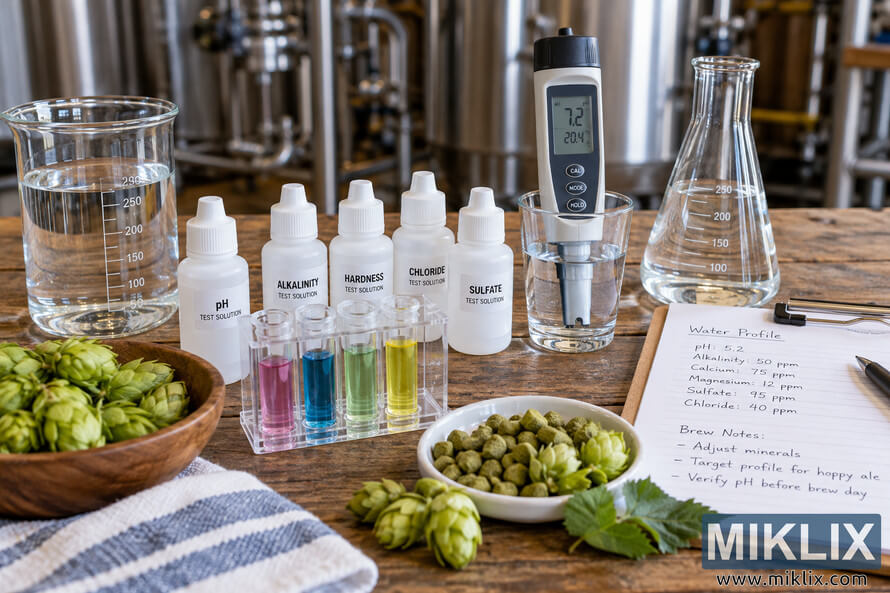
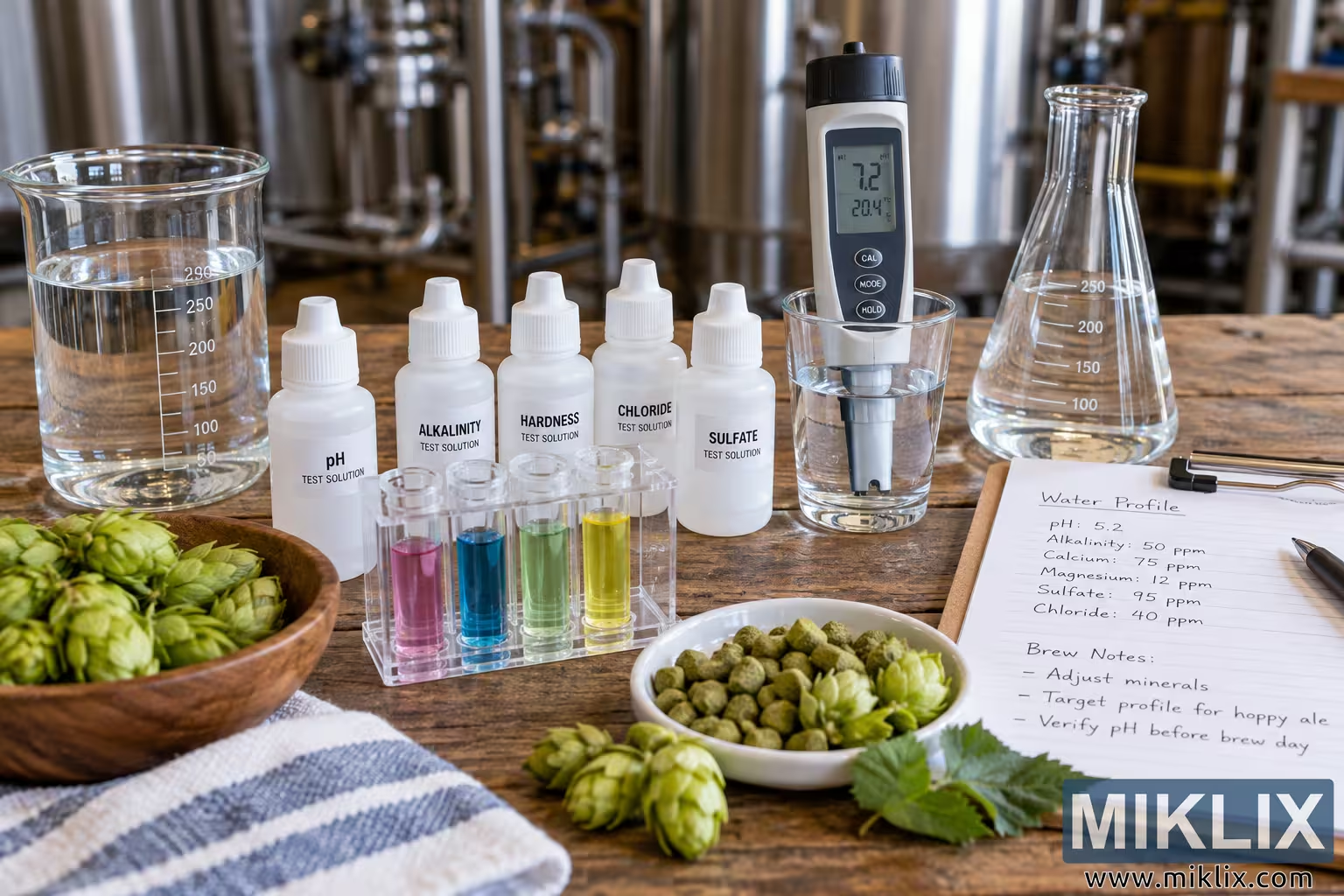
Water chemistry testing equipment for hop brewing, featuring a digital meter, laboratory glassware, test solutions, water-profile notes, fresh hops and hop pellets in a craft brewery setting.
Water Chemistry Testing Equipment for Hop Brewing
此圖片的可用版本
以下可供下載的圖片檔案壓縮程度較低,解析度也較高 - 因此品質也較高 - 相較於本網站文章和網頁中內嵌的圖片,這些圖片的檔案大小經過優化,以減少頻寬消耗。
一般尺寸 (1,536 x 1,024)
大尺寸 (3,072 x 2,048)
非常大的尺寸 (4,608 x 3,072)
超大尺寸 (6,144 x 4,096)
超大尺寸 (1,048,576 x 699,051)
- 仍在上傳中... ;-)
圖片說明
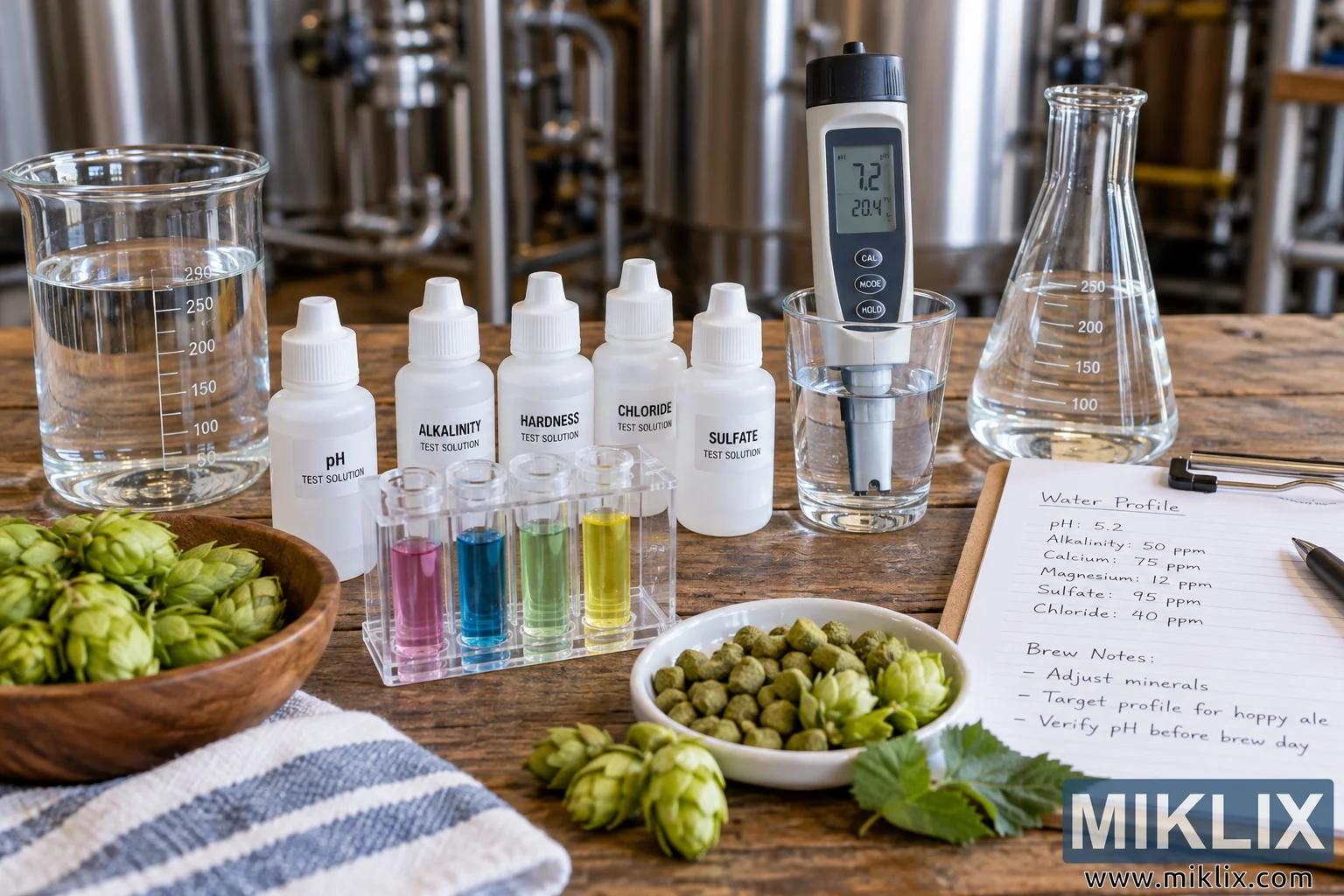
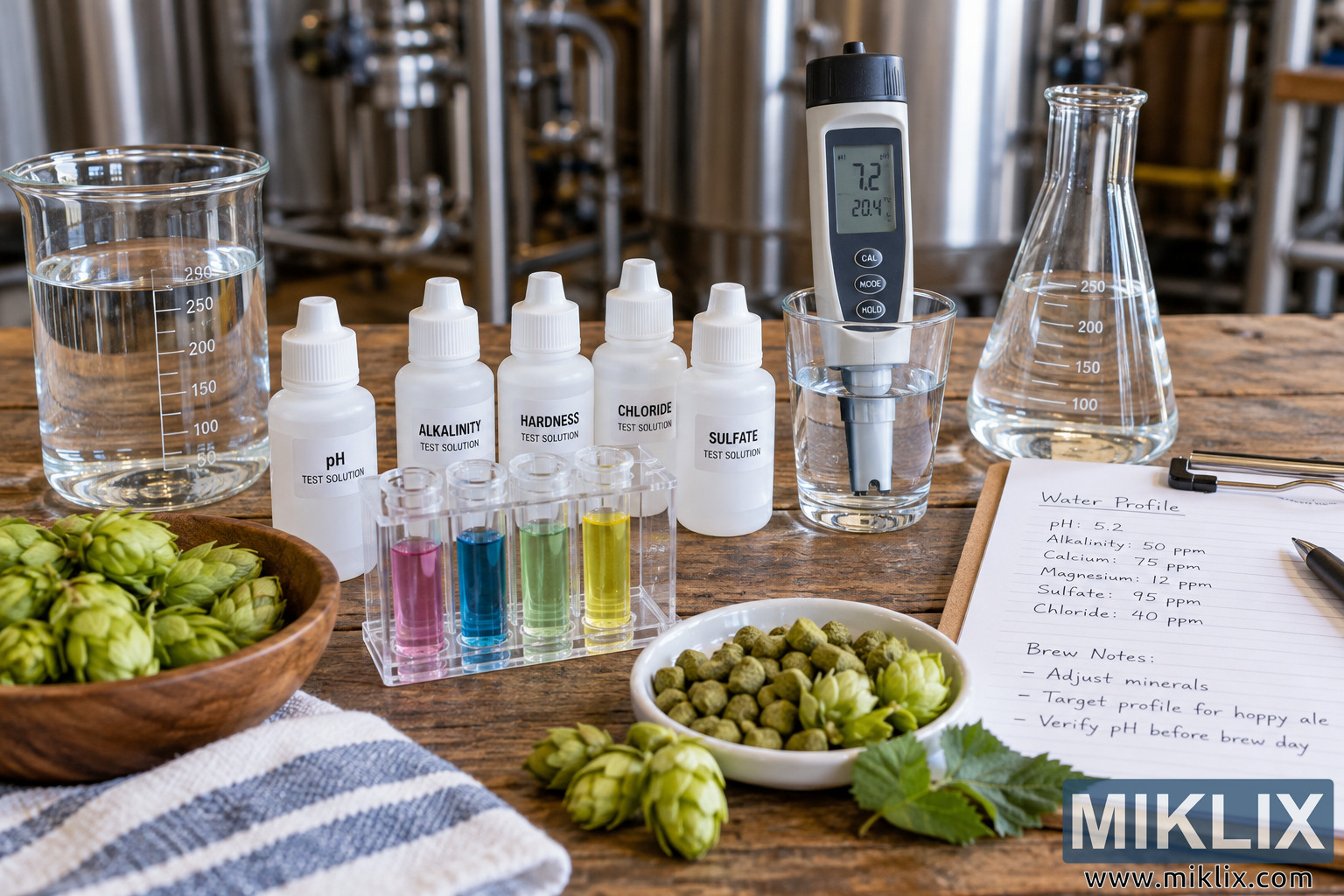
A high-resolution, landscape-oriented photograph presents a carefully arranged collection of water chemistry testing equipment in a small craft brewing environment, with hops and brewing infrastructure providing immediate visual context. The scene is staged on a broad, weathered wooden workbench whose warm brown surface and visible grain create a rustic contrast with the clean laboratory glassware and stainless-steel brewing equipment. In the softly blurred background, large cylindrical stainless-steel vessels, pipes, valves, fittings, and other brewery hardware suggest a professional or advanced small-scale brewing facility. The shallow depth of field keeps this industrial background recognizable without allowing it to compete with the water-testing equipment in the foreground. On the left side of the workbench stands a large transparent glass beaker filled with clear water. White graduated markings are visible on its side, making it immediately identifiable as laboratory measuring equipment. In front of and beside the beaker is a row of small, plain white reagent bottles with pointed dispensing caps. Their simple black labels identify common brewing-water measurements and test solutions, including pH, alkalinity, hardness, chloride, and sulfate. The containers are deliberately generic and display no manufacturer names, logos, trademarks, or other branding. Near the center foreground is a clear plastic test-tube rack containing several small transparent tubes filled with vividly colored testing liquids. The liquids include pink, blue, pale green, and yellow samples, visually communicating the color-changing reactions commonly associated with chemical water analysis. The transparent rack and tubes catch highlights from the ambient lighting, giving the laboratory components a clean and precise appearance. Slightly behind the test tubes, a compact handheld digital water meter is positioned vertically in a clear glass containing water. Its probe extends into the liquid, while the electronic display remains clearly visible above the rim. The meter has a neutral black-and-light-gray housing with generic control buttons and no visible brand identity. The screen displays numerical readings, reinforcing the impression of active pH or water-quality measurement. To the right is a large transparent conical laboratory flask containing a small quantity of clear liquid. White volume graduations on the flask complement the markings on the larger beaker and strengthen the scientific, measurement-focused character of the composition. A clipboard occupies the lower-right portion of the scene. Attached to it is a lined sheet headed with the handwritten words 'Water Profile.' Beneath the heading are handwritten chemistry values for parameters relevant to brewing water, including pH, alkalinity, calcium, magnesium, sulfate, and chloride. Additional brew notes refer to adjusting minerals, targeting a profile suitable for a hoppy ale, and verifying pH before brewing. A dark pen rests along the right side of the clipboard, suggesting that measurements are being recorded as part of a practical brewing-water evaluation process. The image also incorporates several visual references to hops. At the lower left, a wooden bowl is generously filled with fresh green hop cones. More hop cones are scattered naturally across the workbench near the center and lower edge of the frame. A small white bowl near the clipboard contains green hop pellets together with a few whole hop cones, linking processed brewing ingredients with their fresh botanical form. Green hop leaves and stems lie nearby, adding texture and organic color. A folded white kitchen or brewery towel with dark horizontal stripes occupies the front-left corner, contributing to the practical working-brewery atmosphere. The composition balances laboratory precision with traditional craft-brewing aesthetics. Transparent glass, white reagent bottles, colored test solutions, the digital meter, and handwritten analytical notes represent the technical side of brewing, while the rough timber surface, fresh hops, hop pellets, and softly rendered stainless brewing tanks establish the artisanal production setting. Lighting is bright but natural-looking, with soft reflections across the glassware and metallic equipment and gentle shadows beneath the objects. The overall palette combines warm wood tones, neutral whites and silvers, transparent glass, and fresh botanical greens, punctuated by the pink, blue, green, and yellow test liquids. The viewpoint is approximately at workbench height and slightly elevated, allowing the viewer to see both the equipment and the contents of bowls, glasses, and test tubes. Objects are arranged in a coherent working layout rather than appearing as isolated scientific instruments. The photograph communicates the idea of testing and adjusting brewing water chemistry before or during the preparation of a hop-forward beer. It emphasizes pH measurement, mineral composition, laboratory-style analysis, record keeping, and hop ingredients without depicting any commercial products or actual brands. The resulting scene feels clean, technically credible, approachable, and distinctly connected to craft brewing, making it suitable as an editorial, educational, website, or informational image illustrating brewing-water analysis and the role of water chemistry in hop-focused beer production.