
影像: Laboratory Analysis of Cekin Hops for Alpha Acids and Essential Oils
已發佈:
最後更新: 2026年9月19日 上午10:22:17 [UTC]
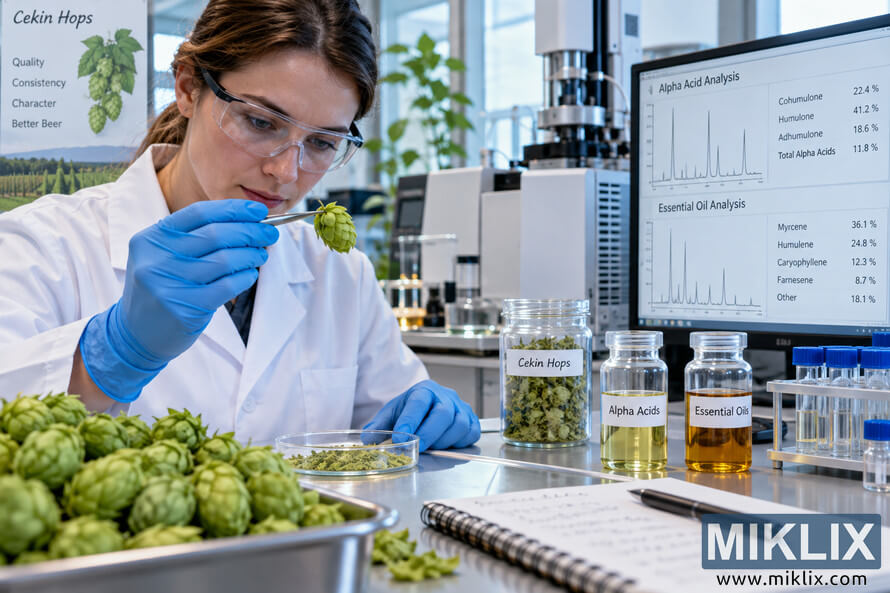
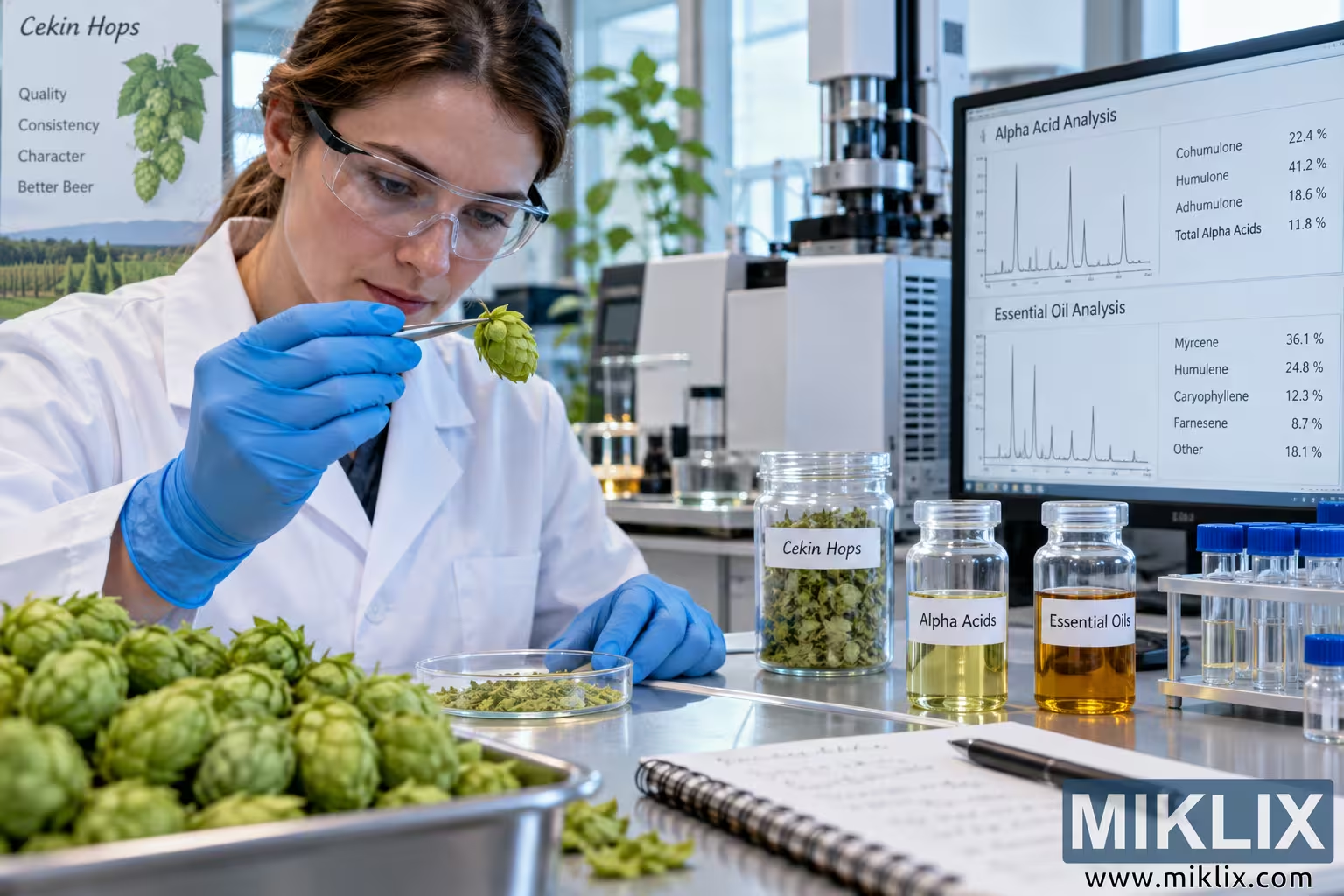
Laboratory analysis of Cekin hops showing a scientist examining hop samples while analytical equipment tests alpha acids and essential oils for chemical composition and quality.
Laboratory Analysis of Cekin Hops for Alpha Acids and Essential Oils
此圖片的可用版本
以下可供下載的圖片檔案壓縮程度較低,解析度也較高 - 因此品質也較高 - 相較於本網站文章和網頁中內嵌的圖片,這些圖片的檔案大小經過優化,以減少頻寬消耗。
一般尺寸 (1,536 x 1,024)
大尺寸 (3,072 x 2,048)
非常大的尺寸 (4,608 x 3,072)
超大尺寸 (6,144 x 4,096)
超大尺寸 (1,048,576 x 699,051)
- 仍在上傳中... ;-)
圖片說明
A wide, landscape-oriented photorealistic image depicts a modern laboratory dedicated to the scientific analysis and quality assessment of Cekin hops. The scene combines fresh agricultural material with precise analytical equipment, visually connecting harvested hop cones with laboratory measurements of alpha acids and essential oils. The laboratory is bright, clean, and contemporary, with abundant natural-looking daylight entering through large windows and reflecting from white, metallic, and glass surfaces. The overall atmosphere communicates scientific accuracy, agricultural research, quality control, and professional brewing-related analysis.
On the left side of the image, a female laboratory scientist is shown concentrating closely on a single fresh green hop cone. She wears a clean white laboratory coat, transparent protective safety glasses, and bright blue disposable laboratory gloves. Her brown hair is pulled back, keeping it safely away from the sample and her working area. With one gloved hand, she carefully holds a pair of metal tweezers or forceps, using them to grasp the hop cone near its stem. Her posture and facial expression convey concentration and attention to detail as she visually inspects the structure and condition of the sample. Her other gloved hand rests near a clear petri dish containing pieces of hop material, suggesting that the cones are being prepared, separated, or examined as part of the analytical procedure.
The foreground is dominated by a large metal tray filled with numerous fresh green hop cones. Their layered, overlapping bracts are clearly visible, giving the hops a natural, textured appearance and establishing them immediately as the principal subject of the laboratory investigation. Additional fragments of hop material are scattered near the petri dish and across the stainless-steel work surface. This creates a believable transition between intact agricultural samples and the smaller prepared specimens used for laboratory testing. The vivid green of the hops contrasts strongly with the neutral white laboratory coat, metallic bench, transparent glassware, and pale laboratory environment.
Near the center of the laboratory bench is a transparent glass jar containing dried or processed pieces of hop material. Its simple label identifies the sample as Cekin hops. Next to it are two additional transparent laboratory containers holding differently colored liquids. One contains a pale yellow-green liquid associated with alpha-acid analysis, while the other contains a deeper golden or amber-colored liquid associated with essential-oil analysis. The arrangement visually separates the two major analytical targets and makes the scientific purpose of the scene easy to understand. A rack of small capped laboratory tubes stands farther to the right, reinforcing the impression that multiple samples, extracts, standards, or fractions are being processed as part of a systematic testing workflow.
A large computer monitor occupies much of the right side of the composition. The screen displays analytical results organized into two principal sections: alpha-acid analysis and essential-oil analysis. Both sections include chromatogram-style graphs consisting of multiple narrow peaks, representing the separation and measurement of chemical components in the hop samples. The alpha-acid section lists several relevant hop-acid components and a total alpha-acid result, while the essential-oil section presents several characteristic aromatic compounds and their relative proportions. The scientific charts and numerical readouts make the laboratory context explicit and suggest the use of chromatography or comparable analytical instrumentation to determine the chemical profile of the hops.
Behind the scientist and monitor is substantial laboratory instrumentation with white housings, metallic fittings, tubing, sample areas, and vertically arranged components. The equipment has the appearance of sophisticated analytical machinery suitable for chemical separation, detection, extraction, or compositional testing. Smaller bottles and pieces of glassware are positioned around the instruments. No commercial manufacturer branding is visible, keeping the laboratory environment generic and focused entirely on the scientific process rather than a particular equipment supplier.
In the background on the left is an informational display featuring an illustration of hop plants and a photograph or graphic representation of a cultivated hop field. The display references Cekin hops and emphasizes qualities associated with hop evaluation and brewing performance. Its agricultural imagery provides contextual continuity between the crop in the field and the samples being analyzed in the laboratory. Green plants are also visible elsewhere in the bright background, adding a subtle botanical element to the otherwise highly controlled scientific environment.
At the bottom right of the image, an open spiral-bound laboratory notebook lies on the workbench with handwritten research notes visible across its pages. A dark pen rests diagonally on top of the notebook. Although the individual handwritten entries are not intended to be read in detail, their presence suggests active documentation of sample preparation, observations, measurements, or analytical results. Together with the petri dish, forceps, sample jars, test tubes, analytical instruments, and computer-generated chromatograms, the notebook helps create the impression of a complete professional laboratory workflow rather than a staged display of isolated scientific objects.
Compositionally, the image guides the viewer from the raw hops in the foreground to the scientist performing a close physical inspection, then toward the prepared samples and finally to the computer monitor displaying quantitative chemical results. This progression visually represents the analytical journey from agricultural raw material to laboratory sample preparation and instrumental measurement. The shallow but controlled depth of field keeps the scientist, hop cone, sample containers, and analytical display prominent while preserving enough background detail to establish the sophisticated laboratory setting.
The image specifically communicates laboratory analysis of Cekin hops with emphasis on two important categories of hop chemistry: alpha acids and essential oils. Alpha-acid testing is represented through prepared liquid samples, chromatographic data, component measurements, and a summarized analytical result. Essential-oil testing is represented through a separate extract, chromatographic profile, and measurements of characteristic aromatic constituents. These visual elements connect the physical appearance of the hop cones with their measurable chemical characteristics, illustrating how laboratory testing can be used to assess composition, consistency, quality, and potential brewing properties.
The photographic style is crisp, realistic, and highly detailed, with natural skin tones, convincing laboratory materials, reflective stainless steel, transparent glass, realistic liquids, and carefully rendered hop cones. The lighting is bright without appearing harsh, giving the laboratory a clean and trustworthy appearance. The scientist's focused expression and careful handling of the sample create a sense of precision and expertise. Overall, the image presents Cekin hop analysis as a rigorous scientific process that combines botanical inspection, sample preparation, chemical extraction, instrumental analysis, computerized data interpretation, and laboratory documentation in a professional quality-control environment.