
Image: FNV-1a 64-bit Hash Algorithm – Conceptual Flow Diagram
Published: January 9, 2026 at 9:26:51 PM UTC
Last updated: January 9, 2026 at 9:27:02 PM UTC
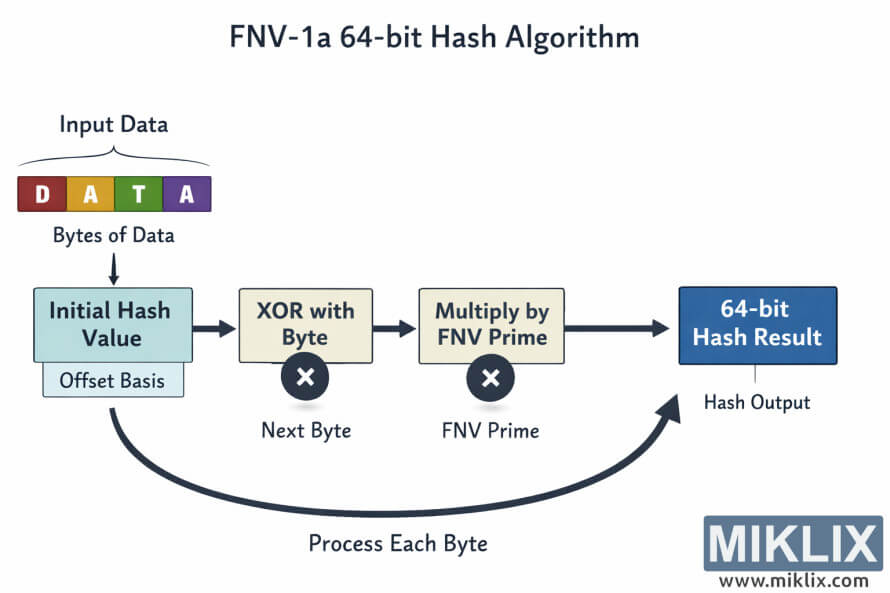
Clean landscape infographic explaining the high-level flow of the FNV-1a 64-bit hash algorithm, from input bytes through a simple processing loop to final hash output.
Available versions of this image
The image files available for download below are less compressed and higher resolution - and as a result of that, higher quality - than the images embedded in articles and pages on this website, which are more optimized for file size in order to reduce bandwidth consumption.
Regular size (1,536 x 1,024)


Large size (3,072 x 2,048)
Very large size (4,608 x 3,072)
Extra large size (6,144 x 4,096)
Comically large size (1,048,576 x 699,051)
- Still uploading... ;-)
Image description
The image is a wide, landscape-oriented educational infographic that explains the flow of the FNV-1a 64-bit hash algorithm at a conceptual level. It uses a clean white background with soft pastel blues and greens, rounded rectangles, and simple arrows to guide the reader from left to right. On the far left, a vertical stack of small rectangles labeled "Input bytes" represents a stream of incoming data. These byte blocks are slightly offset to suggest that the algorithm processes data one piece at a time. An arrow leads from this stack into a larger rounded box labeled "Hash state" or "Current state," indicating that a running internal value is being updated.
From this state box, the diagram enters a looped flow. The loop is drawn with a curved arrow that wraps around two central boxes, visually reinforcing the idea of repetition for each input byte. The first central box is labeled "XOR with state" and shows a small byte icon merging into the state box, suggesting a combination operation without naming any concrete constants or bit patterns. The second box is labeled "Multiply state" and is connected directly after the XOR box, illustrating the second conceptual step that transforms the state further. The two boxes are aligned horizontally, with arrows between them, and the loop arrow arcs from the multiply box back toward the input-processing path, making it clear that these two steps repeat for every byte.
To the right of the loop, a bold arrow labeled "After all bytes" points toward a final large rectangle labeled "64-bit hash output." This output box is visually distinct, slightly darker than the others, to emphasize that it is the end product of the algorithm. Inside the box is only the text label; there are no numbers or bit diagrams, keeping the content general and resistant to inaccuracies.
Throughout the infographic, small icons such as simplified byte symbols and circular arrows are used to add clarity without clutter. The typography is large and friendly, designed for learners, and every label is phrased in plain language rather than mathematical notation. There are no references to specific constants, offsets, primes, or exact operations beyond the high-level names "XOR" and "Multiply," ensuring the diagram remains broadly correct even as implementations vary.
Overall, the composition reads naturally from left to right: data enters as bytes, is combined with a running state, repeatedly transformed in a two-step loop, and finally emitted as a 64-bit hash value. The visual style is modern and approachable, making the algorithm feel less intimidating while still conveying the essential structure of the FNV-1a process.
The image is related to: Fowler-Noll-Vo FNV1a-64 Hash Code Calculator