
Image: SHA-512/256 Hash Algorithm Overview
Published: January 10, 2026 at 7:25:09 PM UTC
Last updated: January 10, 2026 at 7:25:31 PM UTC
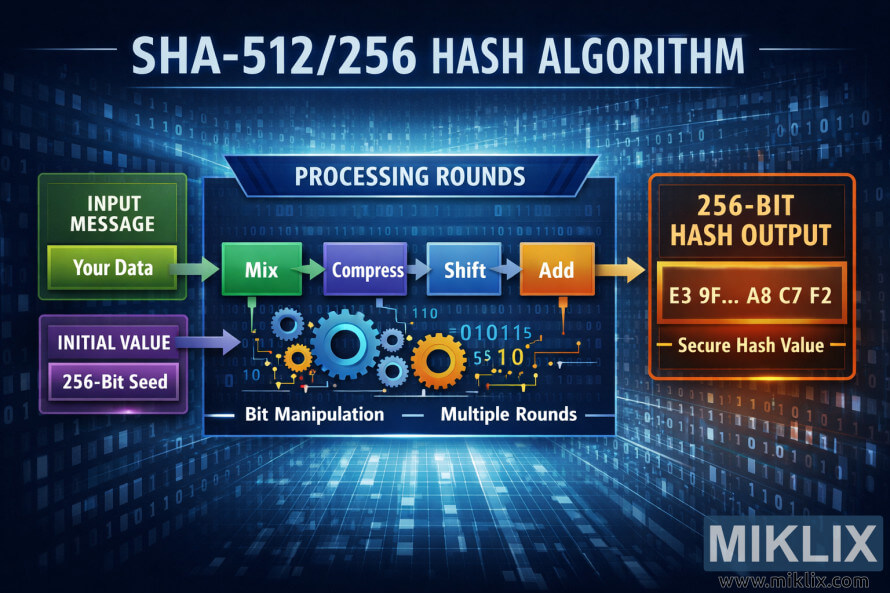
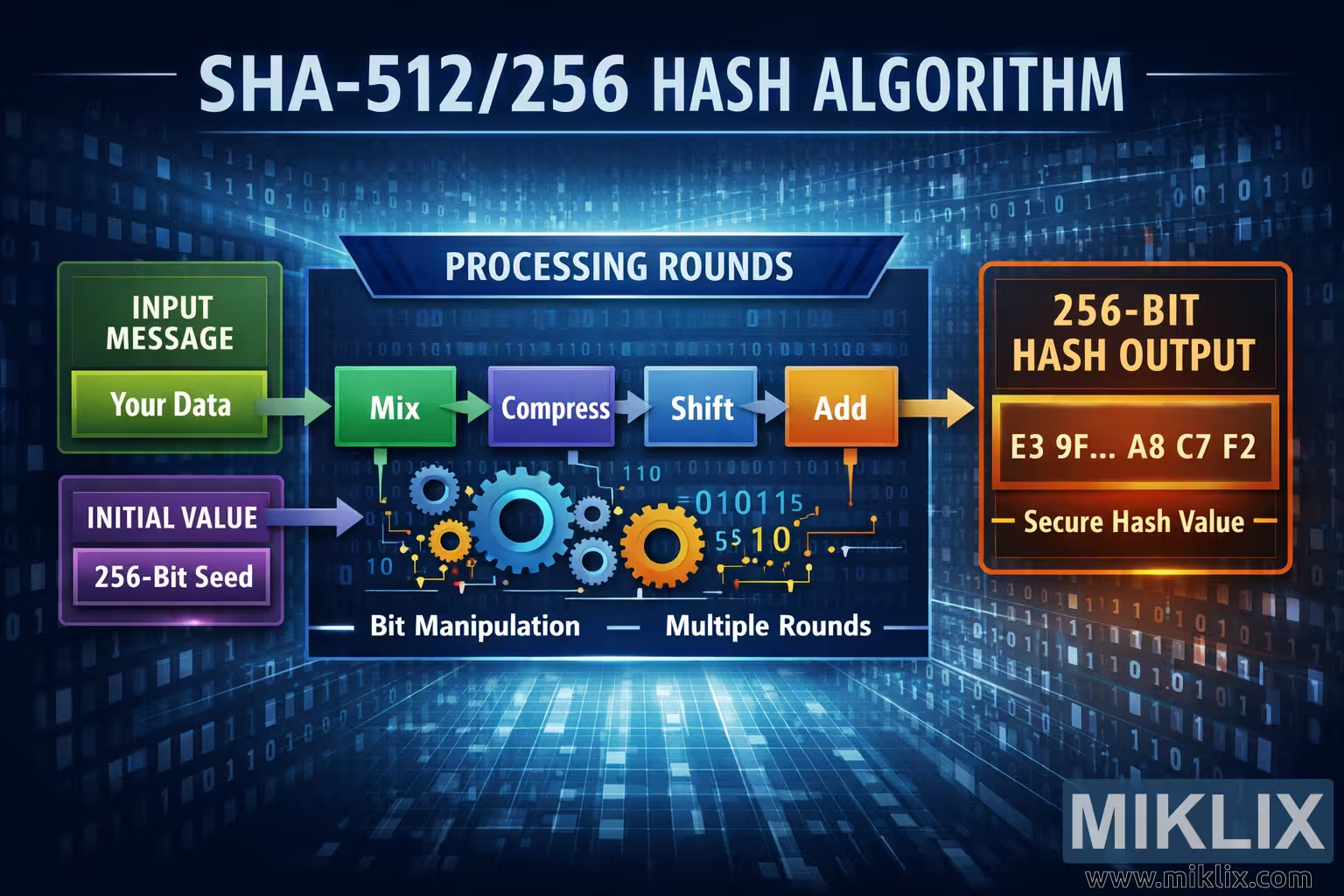
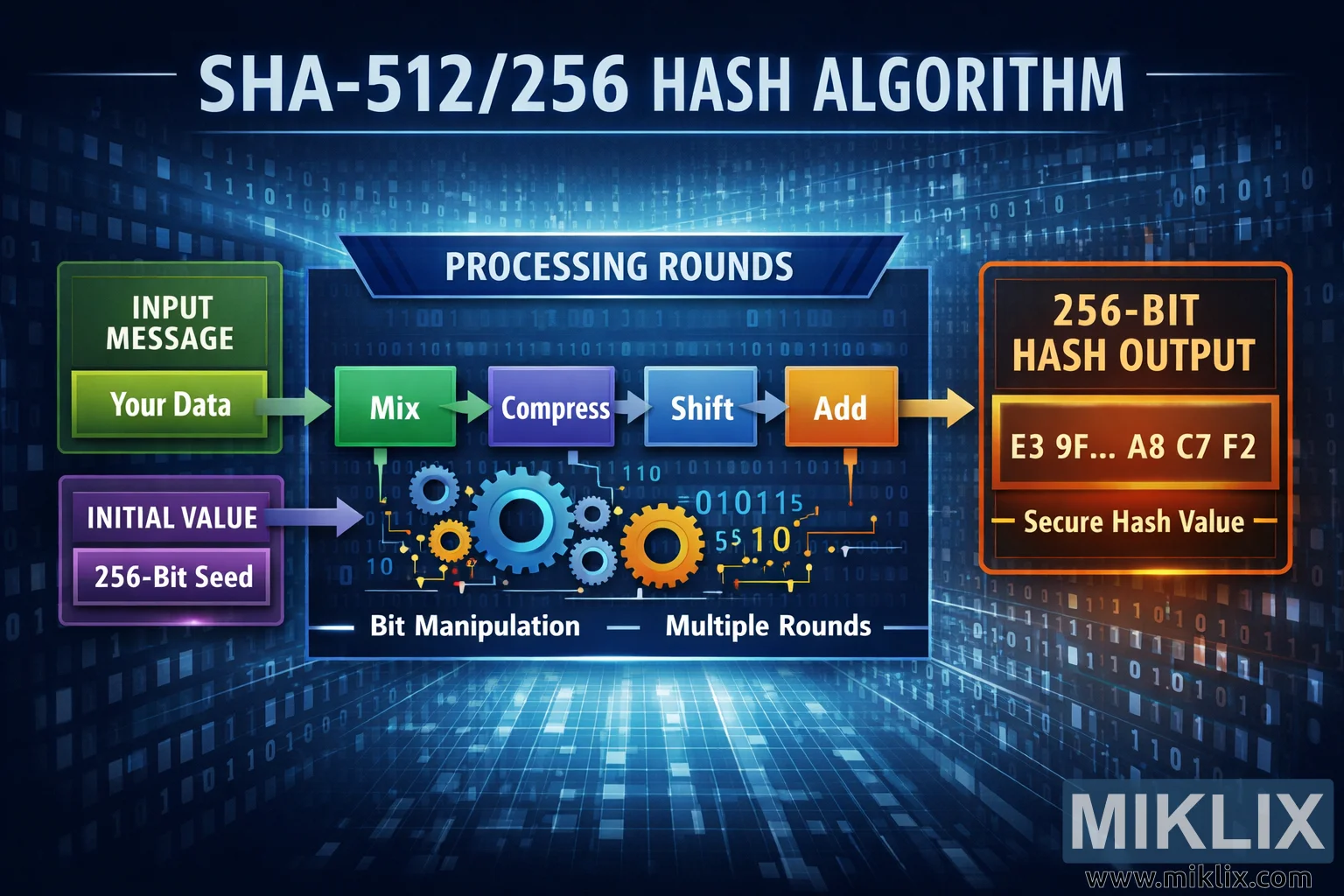
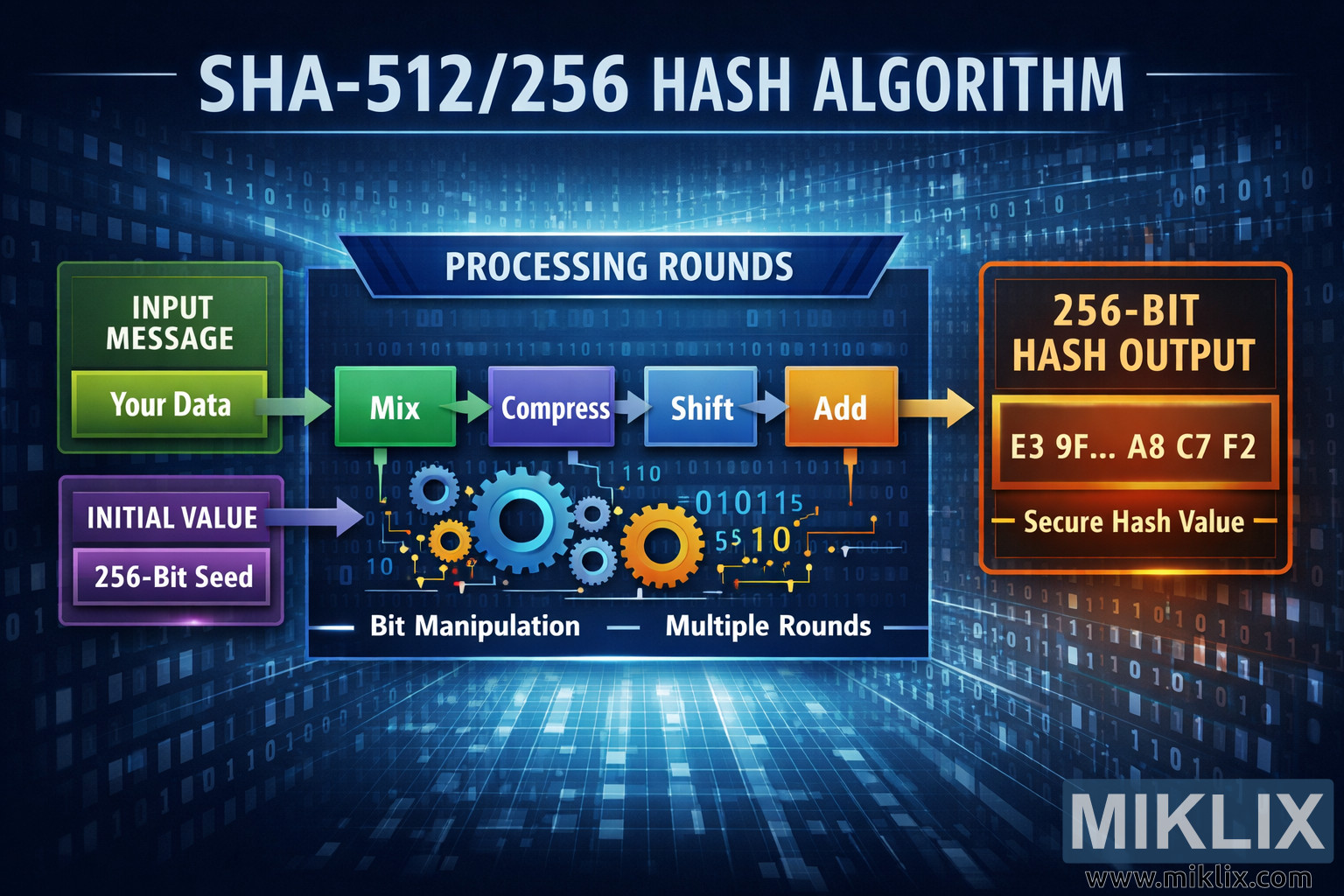
Visual overview of the SHA-512/256 hash algorithm, illustrating how input data passes through multiple processing stages to produce a 256-bit secure hash value.
Available versions of this image
The image files available for download below are less compressed and higher resolution - and as a result of that, higher quality - than the images embedded in articles and pages on this website, which are more optimized for file size in order to reduce bandwidth consumption.
Regular size (1,536 x 1,024)
Large size (3,072 x 2,048)
Very large size (4,608 x 3,072)
Extra large size (6,144 x 4,096)
Comically large size (1,048,576 x 699,051)
- Still uploading... ;-)
Image description
The image is a wide, landscape-oriented infographic that explains the concept of the SHA-512/256 hash algorithm in a friendly, non-technical way. At the very top, a large headline reads \"SHA-512/256 HASH ALGORITHM\" in bold, glowing white letters against a dark blue, digital background filled with softly blurred binary digits. The overall color palette is cool blues and teals, with accent colors of green, purple, and orange to distinguish stages of the process.
On the left side of the graphic there are two stacked panels representing inputs. The upper green panel is labeled \"INPUT MESSAGE\" with a smaller inner box that says \"Your Data\", suggesting that any file or text can be provided to the algorithm. Below it, a purple panel is labeled \"INITIAL VALUE\" with the sub-label \"256-Bit Seed\", representing a starting state for the hashing process. Both panels have arrows pointing toward the center of the image, indicating the flow of information into the algorithm.
In the center is a large banner labeled \"PROCESSING ROUNDS\". Beneath this banner is a horizontal pipeline made of four colorful blocks connected by arrows. The blocks are labeled, from left to right, \"Mix\", \"Compress\", \"Shift\", and \"Add\". These labels are intentionally high-level and abstract, designed to convey the idea of repeated transformations without committing to precise technical details. Underneath these blocks are stylized gears in blue and gold, along with scattered binary digits, visually reinforcing the idea of internal computation and bit manipulation. A small caption below the gears reads \"Bit Manipulation — Multiple Rounds\", emphasizing that the data is transformed many times before the final result appears.
On the right side of the infographic is the output area, shown as a glowing orange and black panel. It is labeled \"256-BIT HASH OUTPUT\" and contains a short, fictional hexadecimal string such as \"E3 9F… A8 C7 F2\" to illustrate the format of a hash without implying any real value. Beneath this example output is the subtitle \"Secure Hash Value\", making it clear that the result is a fixed-length cryptographic digest.
The background across the entire image is a futuristic corridor of light and floating binary code, giving the impression of data flowing through a digital system. The composition clearly guides the viewer’s eye from left to right: starting with the input message and initial value, moving through the central processing rounds, and ending with the 256-bit hash output. Overall, the image serves as an approachable conceptual visualization of how SHA-512/256 takes data, processes it through multiple abstract steps, and produces a fixed-length secure hash.
The image is related to: SHA-512/256 Hash Code Calculator