
Fermenting Beer with White Labs WLP080 Cream Ale Yeast Blend
Published: November 30, 2025 at 9:51:29 PM UTC
This article is a detailed review for homebrewers seeking practical advice on using WLP080 for fermenting ale. White Labs touts the WLP080 Cream Ale Yeast Blend as a Vault strain, blending ale and lager genetics for a classic cream ale profile.

Click or tap the image for more information and higher resolutions.
Key Takeaways
- WLP080 review focuses on performance and real-batch reports to guide practical decisions.
- White Labs WLP080 Cream Ale Yeast Blend pairs ale and lager traits for a neutral profile.
- Expect moderate attenuation and variable sulfur production during early fermentation.
- Pitching rate and starter strategy influence lag time and final clarity.
- Temperature control is a primary lever for desired esters and clean finish.
Overview of White Labs WLP080 Cream Ale Yeast Blend
The White Labs cream ale description is straightforward. It's a blend of ale and lager strains. This combination creates a classic cream ale body. It has light fruity esters from the ale and a clean, pilsner-like character from the lager.
WLP080 specs from White Labs highlight its capabilities. It has an attenuation of 75–80%, medium flocculation, and can tolerate alcohol from 8% to 12%. The recommended fermentation temperature is 65°–70°F (18°–21°C). The strain also tests STA1 negative.
Availability and packaging are key yeast blend details. Brewers can find WLP080 in Pure Pitch Next Gen packs, classic 35 mL vials, and as Vault strains. Product pages often include Q&A and customer reviews, providing insights from real use.
Lab notes and user experiences reveal a subtle sulfur presence during primary fermentation. This trait fades with time and conditioning. It influences expectations when using this blend in styles like American Lager, Blonde Ale, Kölsch, and Pale Lager as well as Cream Ale.
Practical yeast blend details highlight its versatility. WLP080 specs guide brewers in planning pitching rates, starters, and temperature control. This helps to emphasize clean lager notes while allowing mild ale fruitiness to shine through.
Why Choose a Cream Ale Yeast Blend for Homebrewing
Homebrewers opt for White Labs WLP080 for a clean, approachable beer with a hint of fruit. The question of why use WLP080 is pertinent for those aiming at a crisp cream ale without the need for full lagering. This blend combines ale fermentation's vigor with lager-like clarity, resulting in a beer that feels lighter than many ales.
The cream ale yeast benefits include a restrained ester profile, ideal for light malt bills and adjuncts like corn or flaked maize. Brewers enjoy a subtle fruity backbone with a finish that mirrors pilsner-like crispness. This balance ensures a modest hop bite, allowing delicate malt flavors to take center stage.
Blend advantages emerge during fermentation and conditioning. Fermenting in the lower ale range can achieve a lager-like effect without months of cold storage. This is particularly beneficial for hobbyists without a dedicated lager fridge, yet still desiring a clean, refined beer.
However, it's crucial to note the variability with blends. Different strains may take over at different stages, affecting attenuation and aroma. White Labs mentions a faint sulfur presence in primary fermentation, which usually fades with conditioning, leaving a crisp profile.
For brewers considering their options, the blend's modest fruitiness, clean finish, and manageable fermentation requirements make it appealing. It offers the cream ale yeast benefits and blend advantages, answering the question of why use WLP080 for a reliable, easy-drinking brew.
Pitching Rates and Starter Recommendations
White Labs offers WLP080 in classic 35 mL packs and in Pure Pitch packs for brewers who want higher cell counts. For small batches started warm, a single 35 mL pack often suffices when you maintain wort temperature above about 61°F for the first 24 hours.
White Labs pitch advice is to raise the pitch rate for cooler ferments. Yeast divides more slowly at low temperatures, so doubling the pitch or using a Pure Pitch pack is recommended when you plan to ferment under roughly 61°F.
Many homebrewers report that a starter for WLP080 helps full-size batches. If you brew five gallons, consider a modest starter to ensure a healthy cell count and avoid extended lag. A starter also helps blended strains establish balanced populations.
Practical experience shows that for three-gallon batches some brewers skip a starter when they can hold the ferment at mid-60s°F. Holding a steady 65°F for 48–72 hours gives the culture time to grow and settle into fermentation without a large starter.
- Start warm for growth: aim above 61°F for the first day if using a single pack.
- Cold starts need more cells: double pitch or choose Pure Pitch packs for under 61°F.
- Full-size batches benefit from a decent starter for consistent attenuation.
Keep in mind that WLP080 is a blend. If one strain lags, fermentation can look two-staged as strains take turns dominating. Managing WLP080 pitching rate and using a starter for WLP080 when needed reduces that risk and promotes a clean, timely fermentation.
Optimal Fermentation Temperature Strategy
White Labs recommends a target temperature range of 65°–70°F for WLP080 fermentation. This range is ideal for achieving balanced ester production and steady attenuation in styles like Cream Ale. It's crucial to maintain this temperature range during the active fermentation phase to prevent stalled batches.
To start fermentation effectively, warm the environment enough to build yeast mass. If you aim to ferment below 65°F for a cleaner, lager-like profile, begin fermentation above 61°F for the first 24 hours. A brief warm start can help reduce lag and promote a healthy fermentation start.
Employ simple temperature control methods. Keep the fermenter in the mid-60s during the most active fermentation period. If fermentation slows down early, slightly increase the temperature to the mid-to-upper 60s for a diacetyl rest and to complete attenuation.
For those aiming for crispness, lower the temperature after active fermentation starts. Lower temperatures can lead to tighter flavors, but be cautious of sluggish yeast. Prolonged time at low temperatures may necessitate a later warm-up to ensure complete fermentation.
- Pitch at about 65°F to balance vigor and character.
- If fermenting below 65°F, increase pitch rate or ensure a 24-hour warm start to avoid long lag.
- Maintain temperature control with a fridge, heat belt, or controller to keep the mid-60s steady.
Regularly check fermentation progress with gravity readings and adjust as necessary. Effective temperature control, combined with a thoughtful start, ensures consistent results with WLP080 fermentation temperature. This approach allows you to fine-tune the style from ale-like to lager-like without compromising attenuation.
Handling Lag Phase and Slow Starts
WLP080 lag phase often occurs when wort is pitched cold. Brewers notice signs of life 18–24 hours after pitching at about 60°F. This initial pause can be concerning for new brewers, but it's a common occurrence with cold starts.
White Labs explains that yeast growth slows below 61°F. For slow fermentation or cold room starts, raise the pitch temperature above 61°F for the first 24 hours. This helps build cell count. After the first day, you can lower the temperature to the desired range for a cooler profile.
Practical steps can help manage yeast lag. Increase your pitch size or make a starter for larger batches. For near-lager cold starts, consider a double pitch to shorten the initial lag. Pitching at the low end of the ale range, around 65°F, and maintaining that temperature for 48–72 hours aids in establishing activity.
If activity stalls, a gentle warm-up can restart fermentation. Move the fermenter to a few degrees warmer or use a brew belt for short bursts. Avoid wild temperature swings, as they stress yeast and can lead to off-flavors.
Blended strains in WLP080 can exhibit staggered activity. One strain may start quickly, followed by a second strain later. This pattern can resemble a second burst rather than continuous slow fermentation. Therefore, allow time before re-pitching.
- Increase pitch size for cold starts.
- Use a starter for big batches.
- Hold 65°F for the first 48–72 hours.
- Gently warm if fermentation stalls.
Cold start yeast tips include maintaining steady temperatures and patience. Monitor gravity rather than airlock activity to gauge progress. With careful control and proper pitch, lag and slow fermentation rarely spoil a batch.
Flavor Profile Expectations and Off-Flavors
The WLP080 flavor profile is light and inviting. It offers a clean pilsner base with a fruity twist from the ale side. The mild bitterness enhances the soft malt and lemony notes, especially when paired with Saaz hops.
During fermentation, a brief sulfur production is normal. This might smell like rotten eggs but disappears with conditioning. Most brewers find it gone after a few weeks in the cold.
Diacetyl can appear if fermentation is slow or temperatures are low. A diacetyl rest can help by encouraging yeast to reabsorb buttery compounds. Homebrewers often find that minimal diacetyl fades with standard conditioning.
Controlling off-flavors involves proper yeast pitching and steady fermentation. Adequate yeast and nutrients prevent slow finishes and off-flavors. If diacetyl is detected, a short warm period and extra conditioning usually fix it.
- Typical positive traits: clean lager character, light fruit esters, crushable cream ale flavor notes.
- Common transient off-flavors: faint sulfur production during primary, occasional low-level diacetyl that usually declines with time.
- Management steps: ensure adequate pitch, monitor fermentation activity, perform a diacetyl rest when needed, allow several weeks of conditioning.
User reports consistently describe a crisp, drinkable outcome. When managed properly, WLP080 rewards with a balanced, mild profile. It highlights traditional cream ale flavor notes without masking malt or hop detail.

Click or tap the image for more information and higher resolutions.
Attenuation and Final Gravity Guidance
White Labs indicates WLP080 attenuation at 75%–80%. This range is suitable for a typical cream ale with OG between 1.045 and 1.055. It results in a clean, moderately dry beer. The expected WLP080 final gravity will match the lab's prediction, provided proper pitching and temperature control.
However, real-world batches can show variations. A reported brew, starting at OG 1.051, reached FG 1.008 after adding 4% dextrose. This resulted in about 84% apparent attenuation, considering the simple sugar. The batch took around 15 days, with the last week at 58°F to refine flavors.
Adjuncts significantly influence outcomes. Adding corn, flaked maize, or dextrose increases apparent attenuation and lightens the beer's body. This lowers the expected FG compared to an all-malt recipe. It's crucial to track the recipe's composition when predicting WLP080 final gravity.
- Monitor gravity regularly with a hydrometer or electronic probe.
- Allow extra time for blended strains to finish; they can be slower but will reach target attenuation if healthy and rested.
- Perform a diacetyl rest and a short conditioning period to ensure stable expected FG before packaging.
Good fermentation performance relies on pitch size, oxygenation, and temperature schedule. If measurements stall, check yeast health and consider a gentle warm-up or a repitch. Consistent monitoring ensures predictable WLP080 attenuation and fermentation performance for homebrewers.
Flocculation and Clarity Management
White Labs rates WLP080 flocculation as medium. Brewers often observe decent settling, but the trub can appear loose and fluffy. This is different from the rock-hard trub seen with other yeast strains. Expect some suspended yeast at the start.
Cold conditioning is beneficial. A two-week chill typically pulls more yeast out of suspension. This improves the beer's clarity, achieving a lager-like finish without the full lager schedule. Gentle temperature drops also help, allowing particles to settle more effectively.
Finings can speed up the clearing process when time is of the essence. Whirlfloc tablets, silica gel, or Irish moss added near the end of the boil or early in cold conditioning can help. Moderate amounts are suitable for WLP080's medium settling behavior.
Allowing time in keg or bottle can further refine the clarity. Many homebrewers find clearer hydrometer samples taken from the bottom of the fermenter. Even if the beer isn't perfectly clear immediately, patience often leads to clarity that rivals lagers.
- Allow adequate cold conditioning after primary fermentation.
- Consider moderate finings for faster results.
- Avoid overly vigorous rousing when transferring to prevent resuspension.
- Expect initial haze, then steady clearing over days to weeks.
Strain Composition, Myths, and Manufacturer Transparency
White Labs has been tight-lipped about the WLP080 strain composition. When asked directly, they stated it's a proprietary blend and refused to disclose the exact strain IDs.
This secrecy has sparked a flurry of yeast blend rumors online. Brewers and enthusiasts have tossed around names like WLP001, WLP029, WLP800, and WLP830. The genetic reclassification of WLP029 and WLP800 has only added to the confusion.
Some speculate that the classification of ale and lager species has been mixed up. This is based on genomic studies that show WLP029 has ties to Saccharomyces pastorianus and WLP800 to Saccharomyces cerevisiae. White Labs has countered these claims, saying the blend is not what many thought. They've shifted focus to pitching and temperature advice, rather than confirming the exact strains.
For brewers, the exact strains behind WLP080 are less important than its performance. View WLP080 as a commercial blend crafted to deliver a specific taste, attenuation, and manageable sulfur notes. This is achievable when fermented within the recommended temperature range.
Here are the key takeaways for fermentation planning:
- Follow White Labs' guidance on handling and pitch rate, rather than fixating on a definitive strain list.
- Manage fermentation based on documented behavior: expected attenuation, flocculation tendencies, and the potential for transient sulfur.
- Use yeast blend rumors as context, not as a substitute for trial batches and measured results in your own system.

Click or tap the image for more information and higher resolutions.
Style Applications Beyond Cream Ale
WLP080 styles excel in light, clean beers, where balance is key. White Labs suggests using it for American Lager, Blonde Ale, Cream Ale, Kölsch, and Pale Lager. This versatility allows for lager-like crispness with a hint of ale fruitiness.
To achieve lager-like results, maintain cool and steady fermentation temperatures. Lower temperatures minimize esters, resulting in a neutral profile ideal for pale lagers and American Lagers. A prolonged cold conditioning phase can help eliminate any faint sulfur notes that may arise during primary fermentation.
Raising the fermentation temperature slightly can yield a softer, fruitier beer. This method is particularly effective for blonde ales and Kölschs. The yeast will introduce subtle esters that enhance the beer's light malt and delicate hop flavors.
Homebrewers aiming for hybrid beers will find WLP080 invaluable. It allows for crafting sessionable beers with a crisp finish and a touch of ale character, even on ale equipment. Experiment with pitch rate and temperature to achieve the desired balance.
- Blonde ale: aim for cleaner esters and modest attenuation.
- Kölsch: ferment cool, condition cold, preserve delicate fruit notes.
- Pale lager: push for lager-like cleanliness with extended cold aging.
Remember to factor in conditioning time when brewing with this blend. Subtle sulfur notes during primary fermentation often dissipate with weeks of lagering or cold conditioning. Always taste before bottling or kegging to ensure the flavor aligns with your desired WLP080 styles.
Practical Brew Day and Fermentation Workflow
Begin your brew day with a well-defined recipe and a straightforward grist. Cream ale brewing often employs a high proportion of 2-row or Pilsner malt. Flaked maize or corn and about 4% dextrose are added to lighten the body. A low-IBU hop schedule, using Saaz or other noble varieties, is preferred to maintain a balanced bitterness.
Before chilling the wort, determine your pitch size. For full-volume batches, consider starting a starter or using larger White Labs paks for optimal performance. If fermenting at or below 61°F, increase the cell count to ensure yeast can handle cold starts without a prolonged lag. Sanitize your equipment and oxygenate the wort to support healthy yeast growth during the critical early fermentation hours.
The pitching strategy significantly impacts aroma and attenuation. Many brewers pitch WLP080 brew day yeast at about 65°F, maintaining that temperature for 48–72 hours. Once krausen forms and gravity starts to drop, allow the beer to rest or gently lower the temperature for a crisper finish. If diacetyl appears, briefly raise the temperature for a diacetyl rest to encourage cleanup.
Monitoring fermentation is key. Use a hydrometer reading or a digital probe for objective checkpoints throughout primary and any secondary activity. Blended strains may show sequential action, leading to an initial vigorous krausen and possible later upticks as different yeast components finish fermentation.
Conditioning is crucial for refining the profile and improving clarity. Cold condition beers for about two weeks and consider using clarifying agents like Whirlfloc before packaging. Proper conditioning reduces transient sulfur or diacetyl notes, resulting in a bright, drinkable beer.
- Pre-pitch checklist: check pitch rate, oxygenation, and sanitation.
- Early fermentation: hold steady temperature for first 48–72 hours.
- Monitoring: track gravity daily until it stabilizes.
- Conditioning: two weeks cold lagering and optional finings.
Troubleshooting Common Issues with WLP080
Slow starts and long lag phases often stem from cold pitch temperatures or insufficient yeast. To fix sluggish fermentation, start fermentation at or above 61°F for the first 24 hours. Use a larger starter when possible or gently warm the fermenter to re-energize the yeast.
Sulfur notes during primary fermentation are documented by White Labs and reported by brewers. These aromas tend to fade with conditioning. If sulfur persists, extend conditioning time or try a bright lager-style cold crash to help the compounds drop out. Avoid unnecessary oxygen exposure while beer conditions.
Diacetyl can appear when fermentation stays too cool. White Labs tests reveal higher diacetyl at lower temperatures. If you detect buttery diacetyl, raise the temperature briefly for a diacetyl rest. This allows yeast to reabsorb the compound before packaging.
Blended strains in WLP080 may display variable performance where one strain slows while another continues. Monitor gravity readings rather than clock time. Patience prevents premature bottling or kegging when blends finish in stages. This advice addresses many common WLP080 issues reported by homebrewers.
Medium flocculation can produce looser sediment and hazy beer. Improve clarity with a combination of cold crashing, finings like isinglass or gelatin, and simple time on the lagering rack. These steps resolve clarity concerns without stressing yeast.
- Check pitch temperature and starter size for sluggish fermentation fixes.
- Allow extra conditioning time to clear sulfur and stabilize flavors.
- Perform a short diacetyl rest if buttery notes appear.
- Trust gravity readings when blends behave unpredictably.
- Use cold crash and finings to combat poor clarity.
When troubleshooting, keep detailed notes on mash profile, oxygenation, and yeast handling. Consistent records make WLP080 troubleshooting simpler and reduce repeat WLP080 issues in future batches.
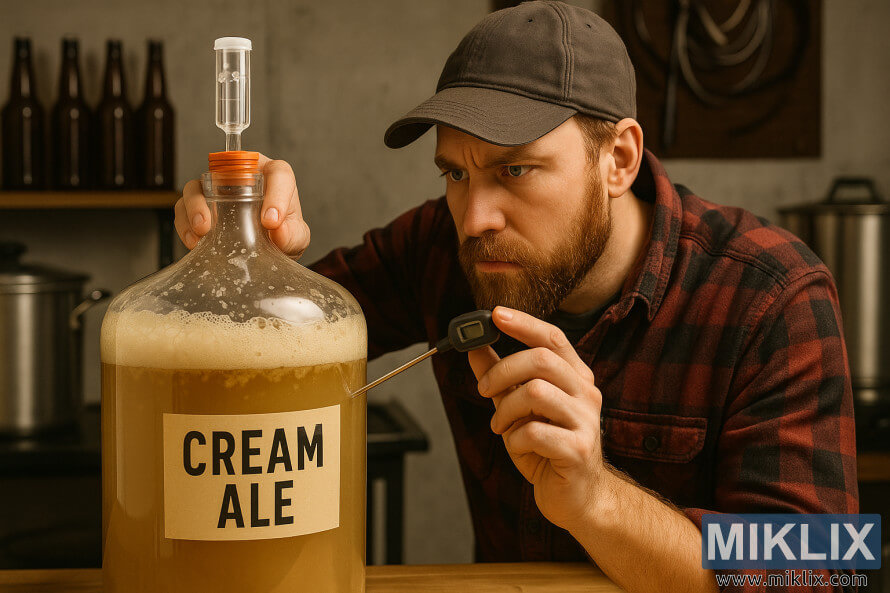
Click or tap the image for more information and higher resolutions.
Real-World User Notes and Case Studies
A homebrewer's 3-gallon cream ale was made with Pilsner malt and flaked maize. It was hopped with Magnum for bitterness and Saaz for flavor. The original gravity was near 1.050–1.051. The brewer then pitched White Labs WLP080 at 65°F, later cooling the fermentation chamber to 60°F.
Activity began slowly around 18–24 hours, then krausen formation became steady. A warm period up to 65°F mid-ferment followed, leading to a vigorous finish. The final gravity was 1.008 after 15 days, with the last seven days at 58°F.
The beer was described as clean and crisp, with a strong Saaz hop character. A faint sulfur note appeared during primary fermentation but faded over time. After two weeks of cold conditioning and a half dose of Whirlfloc, the beer became clear.
Community discussions mirrored this fermentation report. Many users noted a secondary surge in activity, suggesting a second strain becoming dominant. Forum threads explored the strain composition and tweaks to avoid extended lag or excessive sulfur.
The brewer kegged and carbonated the batch. Drinkers found it "lager-like" and highly drinkable. The brewer ranked it among their best efforts, showing WLP080 can produce professional-quality cream ale with proper temperature control and pitching.
- Recipe context: Pilsner malt + flaked maize; hops: Magnum, Saaz.
- Fermentation timeline: pitch at 65°F, lower to 60°F, warm to 65°F mid-ferment, finish at 58°F cold conditioning.
- Outcomes: FG 1.008 at day 15, clear after cold and clarifier, faint sulfur fading during conditioning.
These WLP080 user notes and the single case study provide practical insights. Brewers can apply these observations to their own brewing, shaping pitching schedules, temperature ramps, and conditioning plans for consistent results.
Measuring and Monitoring Fermentation Performance
Accurate measurement is key for brewers to track yeast behavior and achieve clean finishes. A hydrometer is ideal for spot checks, while a digital probe like Tilt offers continuous gravity tracking. Regular readings provide clear insights into lag, acceleration, and completion phases.
Establish benchmarks before brewing. White Labs indicates WLP080 attenuation at 75–80 percent. An example batch, moving from OG 1.051 to FG 1.008, demonstrates the expected finish with proper pitch and oxygenation. Compare your hydrometer readings to the Tilt curve to confirm true attenuation.
- Take a gravity reading at 12–24 hour intervals during active fermentation to watch the slope of the fermentation profiles.
- Use the Tilt for real-time gravity tracking in the fermenter and cross-check with a hydrometer sample to verify accuracy.
- Record temperature alongside gravity so you can correlate surges or stalls with thermal changes.
Be vigilant for signs needing intervention. If no activity within 48 hours after pitching at the recommended temperature range, check oxygenation and pitch size. A stalled gravity with a fallen krausen may respond to a gentle warm step or a short diacetyl rest to coax yeast back to work.
Blended yeasts exhibit complex behavior. A second fermentation surge on the Tilt often indicates sequential strain activity within the blend. Allow gravity to stabilize for several days before transferring or packaging to avoid premature bottling and off-flavors.
Use data to guide decisions rather than guesswork. Consistent gravity tracking and matched hydrometer checks build reliable fermentation profiles for future batches. This practice sharpens your ability to spot underperformance and repeat strong results with WLP080.

Click or tap the image for more information and higher resolutions.
Packaging, Conditioning, and Carbonation Recommendations
Wait until your beer reaches a stable final gravity before packaging. Check the gravity twice daily or use a hydrometer over 48–72 hours to confirm stability. This prevents bottling or kegging too early, which can lead to overcarbonation or off-flavors.
Cold conditioning is crucial for clarity and reducing sulfur notes. Users and White Labs recommend at least two weeks of cold conditioning. If diacetyl is present or clarity is still lacking, extend to three or four weeks.
Utilize fining aids to enhance clarity. Add Whirlfloc or Irish moss late in the boil. For kegging, cold crash before transfer to remove extra yeast and trub. When bottling with WLP080, transfer gently to avoid cloudy bottles and excess yeast in the cap.
Before packaging, follow a checklist:
- Confirm stable final gravity over multiple days.
- Cold crash to encourage sedimentation.
- Decant or rack carefully to leave trub and dead yeast behind.
- For kegs, purge with CO2 before filling to limit oxygen exposure.
Set carbonation for a lively, crisp level. Aim for 2.4–2.8 volumes CO2 when kegging for a bright, lager-like finish. For bottle conditioning, calculate priming sugar to reach similar volumes, adjusting for temperature and bottle headspace.
If force-carbonating, start with moderate pressure and chill the keg. Then, gradually raise CO2 to target volumes. This method minimizes foaming and preserves the soft profile of the cream ale.
When bottling with WLP080 packaging in mind, sanitize thoroughly and use consistent priming. Store conditioned bottles at cellar temperature for two weeks, then chill. Cold storage helps clear suspended particles and tones down transient sulfur or diacetyl.
Conclusion
White Labs WLP080 Cream Ale Yeast Blend offers a perfect mix of mild ale esters and clean lager-like characteristics. This summary outlines its official specs: 75–80% attenuation, medium flocculation, and a 65°–70°F ferment range. It also has medium–high alcohol tolerance. Brewers aiming for a crisp, drinkable cream ale will find this blend consistently meets their expectations.
From a practical standpoint, pitching at or just above 61–65°F for the first 24–72 hours is recommended. Using an adequate pitch rate or a starter is crucial when fermenting cooler. Allowing conditioning time is also essential to clear transient sulfur or diacetyl. These steps ensure a cleaner profile without the need for full lagering, simplifying packaging and carbonation.
Keep in mind that the blend composition is not fully disclosed, leading to some variability. This variability is why fermentation behavior can vary and batch-to-batch differences occur. To manage these outcomes, monitor gravity, adjust pitch size, and give the beer time to condition. Overall, WLP080 is a top choice for cream ale, offering straightforward fermentation for a refreshing, clear beer.
Further Reading
If you enjoyed this post, you may also like these suggestions:
- Fermenting Beer with Wyeast 2105-PC Rocky Mountain Lager Yeast
- Fermenting Beer with Fermentis SafLager S-23 Yeast
- Fermenting Beer with Lallemand LalBrew Voss Kveik Yeast