
Hops in Beer Brewing: Summit
Published: January 6, 2026 at 4:33:19 PM UTC
Summit is a high-alpha American hop known for intense bittering and bold aroma. It delivers notes of tangerine, orange, grapefruit, resin, and onion/garlic when overused, making it popular in IPAs and double IPAs.
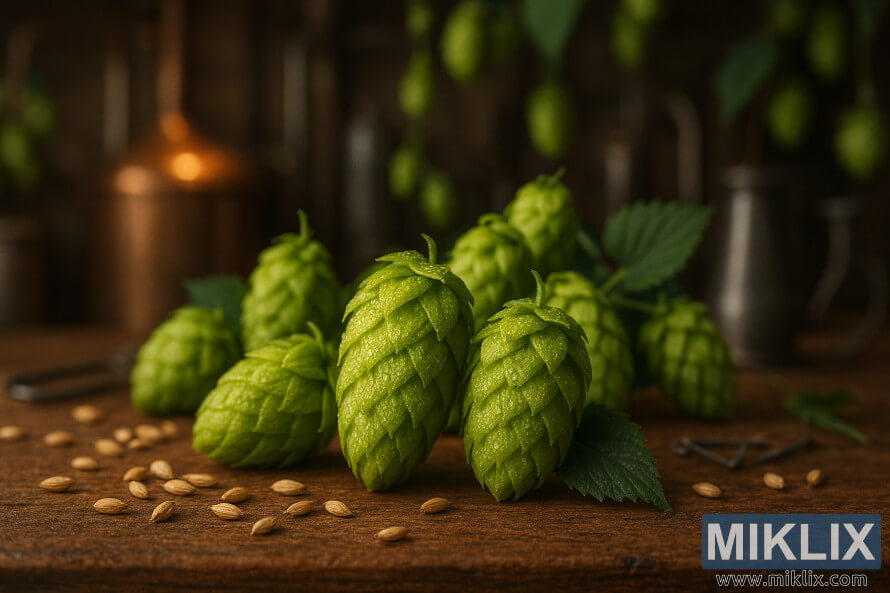
Click or tap the image for more information and higher resolutions.
Released in 2003 by the American Dwarf Hop Association, Summit is a semi-dwarf, super-high alpha hop variety. It's renowned among brewers for its potent bittering power and efficiency in large brewhouses. Its lineage, tracing back to Lexus crossed with a male related to Zeus, Nugget, and other USDA males, contributes to its high alpha acid content and citrusy flavor.
The origin of Summit hops is in Yakima Valley, Washington. Breeders there aimed to reduce hop weight while maintaining high IBUs. This approach makes Summit hops a practical choice for brewers seeking strong alpha contributions without the need for large quantities of leaf hops.
Summit's alpha acid levels are notably higher than many aroma hops. This categorizes Summit as a primary bittering hop, with its citrus and stone-fruit notes playing a secondary aromatic role in specific recipes. Retailers offering Summit often provide secure payment options like Visa, Mastercard, PayPal, and Apple Pay. However, these details do not impact the hop's performance in brewing.
Key Takeaways
- Summit is a high-alpha, semi-dwarf variety released in 2003 by the American Dwarf Hop Association.
- Summit hop origin is Yakima Valley, developed to reduce hop weight while keeping IBUs high.
- Summit hops are primarily used for bittering thanks to strong Summit alpha acid levels.
- Genetics include Lexus and lines related to Zeus and Nugget, yielding citrusy secondary notes.
- Well suited to large brewhouses and efficient bittering in commercial and homebrew setups.
Overview of Summit hops and their origin
Released in 2003, Summit hops were developed by the American Dwarf Hop Association. They carry the international code SUM and cultivar ID AD24-002. Growers in the Yakima Valley quickly adopted it for its semi-dwarf habit. This habit is ideal for denser planting and mechanized harvest.
The Summit hop's genealogy is a complex cross. One parent is Lexus, and the other is a mix of Zeus, Nugget, and USDA male lines. This blend aimed to increase alpha acids while keeping aroma traits useful.
In the Yakima Valley, the focus was on high alpha yields. This allowed brewers to reduce hop mass per batch. The breeding process, starting with Nugget, aimed to create a "super-alpha" variety. This variety excels in bittering efficiency and crop consistency.
The American Dwarf Hop Association owns the trademark for Summit hops. They also maintain propagation records. This ensures growers and brewers can verify authenticity and track performance globally.
Key brewing characteristics of Summit hops
Summit is highly valued for its bittering properties. Brewers use Summit when they need a strong alpha acid punch to boost IBUs with minimal additions. Its primary role in the kettle is to deliver efficient bitterness, not forward aroma.
As a super-alpha variety, Summit offers practical advantages. The benefits include lower hop weight per batch, less vegetal matter in the boil, reduced freezer space needs, and lighter handling. These advantages are beneficial for both homebrewers and commercial breweries.
Summit exhibits reliable agronomic traits. Growers find it has good resistance to mold and fungus. This resistance helps maintain a steady supply and preserves alpha levels from field to fermenter.
- Primary use: bittering applications and early kettle additions.
- Alpha acids: typically very high, so additions are measured carefully.
- Handling: lower hop volume reduces labor and storage demands.
Caution is advised on late additions and dry hop regimes. Summit can introduce sulfur-like notes that may taste like garlic or onion if used aggressively for aroma. Tasting small pilot batches is crucial to find the right balance for each beer style.
When crafting recipes, balance Summit’s strength with softer aroma hops or neutral malts. This approach maximizes Summit's brewing characteristics while avoiding off-notes. It helps preserve the beer's clarity and overall profile.
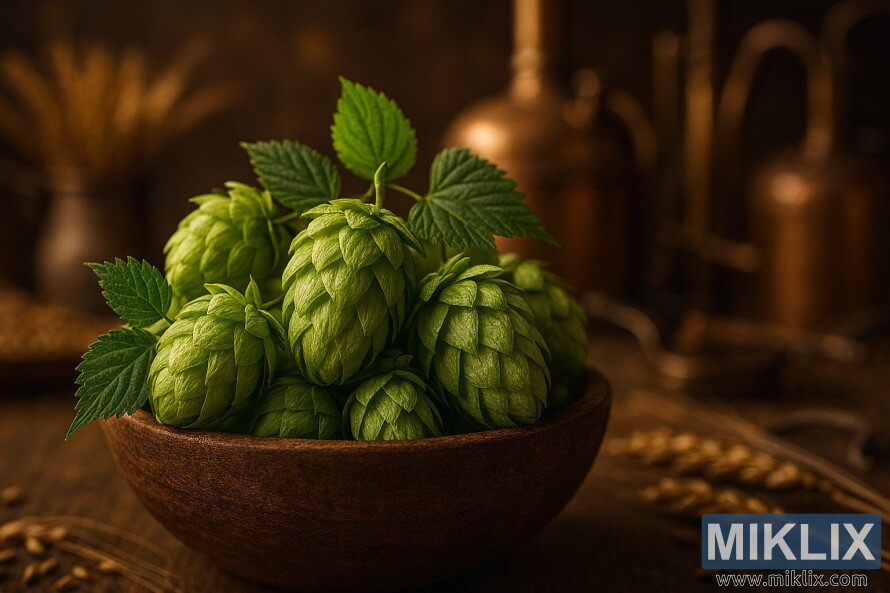
Click or tap the image for more information and higher resolutions.
Flavor and aroma profile of Summit hops
Summit aroma is known for its bold citrus character, a favorite among brewers. It starts with orange zest, followed by pink grapefruit and tangerine notes. These enhance the brightness of pale ales and IPAs.
When used in larger quantities, Summit reveals earthy undertones and a resinous dankness. However, careful dosing at whirlpool or dry hop can introduce lively citrus hop notes. This approach prevents the malt from being overpowered.
Some brewers also detect peppery hops qualities, adding a spicy lift that complements the citrus. Early boil additions of Summit contribute a smooth orange bitterness. This balances the beer's sweetness effectively.
However, brewers must be cautious of sulfurous traces that might manifest as garlic or onion. These off-aromas can occur if handling is not precise. Controlling contact time and maintaining lower whirlpool temperatures can mitigate these issues.
- Primary: orange zest, grapefruit, tangerine
- Secondary: earthy, resinous, incense-like
- Savory edge: peppery hops and light anise or incense notes
- Risk: occasional garlic/onion sulfur notes with poor handling
Blending Summit with cleaner aroma hops like Cascade or Citra can highlight citrus notes while reducing dank or sulfurous flavors. By adjusting timing and quantity, brewers can achieve a balanced Summit flavor profile. This versatility makes Summit suitable for a wide range of beer styles.
How to use Summit hops for bittering and aroma
Summit hops excel as primary bittering hops due to their high alpha acids. For full-volume brews, small amounts at long boil times deliver firm IBUs without the vegetal taste. Typical Summit bittering additions are effective at 60 to 90 minutes for stable bitterness.
For aroma, use conservative late additions to retain volatile oils. Summit late additions at 10–20 minutes enhance citrus and resin notes, provided you avoid extended vigorous boiling. The total oil content is delicate, so shorter heat exposure helps preserve more aroma.
Whirlpooling offers a middle ground between bittering and aroma. Add hops to a cooled wort whirlpool and rest at 160–180°F for 10–30 minutes. This method extracts flavor while limiting harshness. A modest Summit whirlpool charge provides pronounced top notes without overbitterness.
Dry hopping is the best method to showcase Summit’s aromatic profile. Cold-side contact captures the most volatile compounds, resulting in bright, fresh aromas. Many brewers blend small bittering additions with larger dry hop bills for balance.
- Example bittering plan for a 5.5-gallon batch: 0.25 oz at 90 min and 0.25 oz at 60 min to build IBUs without excess mass.
- Late additions example: 0.8 oz at 15 min and 0.5 oz at 10 min to add flavor and some aroma.
- Finishing touch: a combined whirlpool and dry hop of about 2.25 oz for 7 days to emphasize aroma and hop character.
When calculating totals, remember that Summit’s high-alpha nature means lower weight for the same IBU. Track additions carefully and taste at each stage where possible. This approach keeps bitterness clean and highlights the hop’s citrus-resin notes.
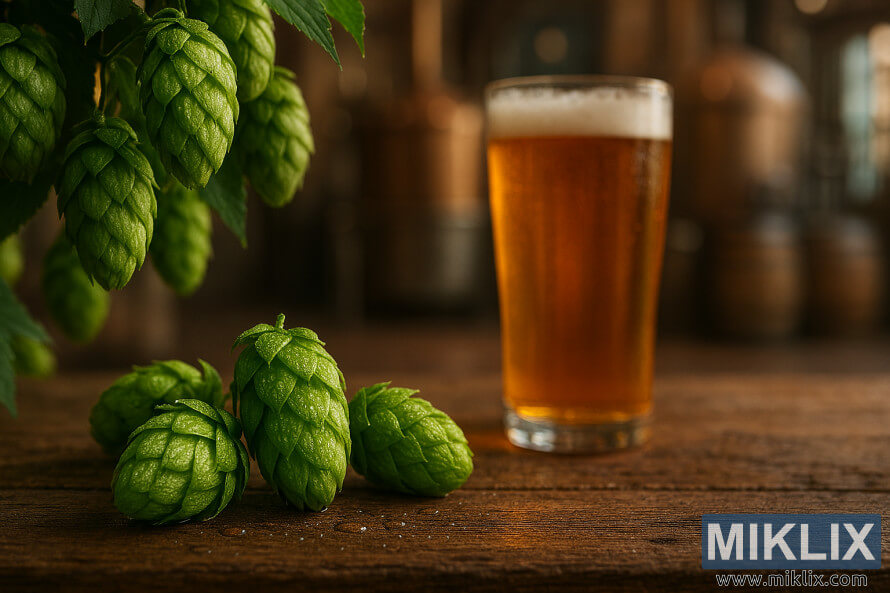
Click or tap the image for more information and higher resolutions.
Typical brewing values and oil composition
Summit hops boast a high bitterness potential, with alpha acids ranging from 15–17.5%. The average is around 16.3%. Beta acids vary from 4.0–6.5%, averaging 5.3%. The alpha-to-beta ratio is typically between 2:1 and 4:1, with an average of 3:1.
Cohumulone is a significant contributor to bitterness in Summit hops. It usually accounts for 26–33% of total alpha acids, averaging 29.5%. This high cohumulone content can result in a cleaner, firmer bitterness, influenced by mash and boil techniques.
Summit hops contain an average of 2.3 mL of essential oils per 100 g, ranging from 1.5–3.0 mL/100 g. The oil composition typically includes:
- Myrcene: roughly 30–40% (35% avg)
- Humulene: around 18–22% (20% avg)
- Caryophyllene: near 12–16% (14% avg)
- Farnesene: minimal, about 0–1% (0.5% avg)
- Other terpenes (β-pinene, linalool, geraniol, selinene): make up the remaining 21–40%
The oil proportions contribute to resinous, citrus, woody, spicy, peppery, and floral notes. These flavors evolve based on when the hops are added. Early additions emphasize bittering, while late additions and whirlpool hops enhance aroma and flavor.
Summit HSI values indicate good storage stability. Typical Summit HSI is near 0.15, showing a 15% loss after six months at 68°F. This rating places Summit HSI in a "great" category for shelf life and consistent performance.
Some sources mention varieties with higher alpha-to-beta ratios, up to 6:1, and elevated cohumulone. These variants offer more versatility for bitter-forward ales while still providing aromatic lift when added late in the boil.
Beer styles that suit Summit hops
Summit excels in beers with high bitterness and bold flavors, where citrus and pepper notes stand out against malt. It's a top choice for IPAs needing a strong hop presence. In IPAs, Summit contributes focused pine and grapefruit flavors, ideal for dry-hopped or high-IBU brews.
Pale ales benefit from Summit for a clean, sharp bitterness. It offers a tight citrus profile and a firm finish, perfect for light to moderate malt bills. Adding Summit late in the boil or as a whirlpool hop preserves aroma and controls bitterness.
Stronger, malt-forward styles also benefit from Summit when balance is key. Imperial IPA and barleywine showcase Summit's ability to counter rich malt and high alcohol. In stouts, a small amount of Summit can add a bright citrus edge, balancing roasted and chocolate notes.
- Common fits: IPA, Pale Ale, Imperial IPA, Barleywine, Stout.
- Lager use: breweries show Summit can succeed in lagers when grain and yeast balance bitterness.
- Pairing tip: use Summit for backbone bitterness and restrained late additions for aroma.
Creating an India Pale Lager with Summit as a lead hop is also noteworthy. Summit India Pale Lager examples highlight the hop's versatility with lager yeast and crisp grain bills. A well-planned hopping schedule ensures crisp citrus and pepper without obscuring the lager's clean character.
When planning a recipe, align Summit's intensity with the beer's structure. Use it as a primary bittering hop or a dominant flavor hop in styles that welcome bold bitterness and citrus clarity.
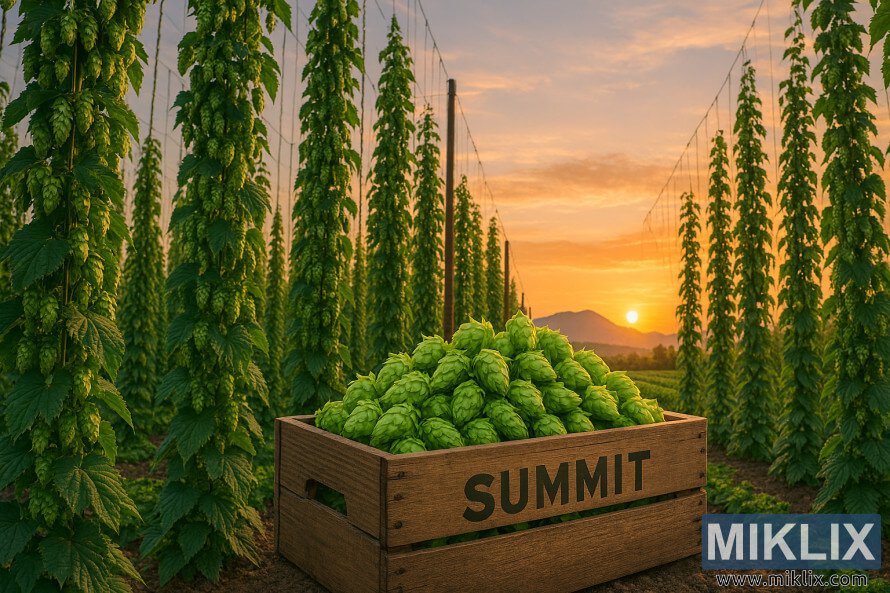
Click or tap the image for more information and higher resolutions.
Common hop combinations and pairings with Summit
Summit hop pairings often begin with bold, citrus-forward varieties. Citra and Amarillo enhance orange and grapefruit notes, complementing Summit's sharp citrus and pepper. Simcoe and Centennial add resin and pine, rounding out the top-end brightness.
Many brewers use Nugget or Chinook for bittering alongside Summit. These hops bring a firm backbone and spicy resin, allowing Summit's aroma to shine in late additions. Mid-boil Summit with Mt. Hood or Hersbrucker can tame intensity, adding a soft herbal balance.
- Citra — bright citrus, enhances fruitiness in Summit blend hops
- Amarillo — floral orange character that melds with Summit's pepper
- Simcoe — resinous pine and berry notes that contrast Summit
- Centennial — balanced citrus and floral lift for clean blends
- Chinook — firm spice and pine for bittering support
- Nugget — neutral bittering hop that anchors aroma-forward blends
For experimental ales, try creating Summit blend hops with one citrus hop and one herbal hop. This approach highlights the peppery bite while adding floral or herbal depth. Brewers often treat Summit as a substitute for Amarillo or Simcoe when a sharper citrus-pepper edge is desired.
When choosing hops that pair with Summit, think in layers. Use one hop for bittering, one for mid-boil balance, and a late or dry-hop addition for aroma. This method keeps clarity in the profile and boosts complexity without muddling the beer.
Substitutions and alternatives for Summit hops
When Summit is out of reach, there are reliable substitutes that match its high alpha acids and bold citrus-resin character. Brewers often turn to Columbus, Tomahawk, or Zeus as direct swaps for bittering and assertive aroma.
Use a Columbus substitute when you want similar bittering power and a peppery backbone. Tomahawk and Zeus are great in late additions for piney, dank notes that echo Summit’s intensity. The CTZ group (Columbus-Tomahawk-Zeus) provides a predictable alternative across bittering and aroma roles.
For aroma twists, consider Warrior or Millennium for cleaner bitterness with less citrus. Simcoe and Amarillo bring more pronounced fruity and citrus tones. Summit can sometimes replace Amarillo or Simcoe if you need more alpha acid strength, but lower the weight to balance bitterness.
- Columbus substitute: great for bittering and resinous spice.
- Zeus substitute: sharp pine and herbal lift in late additions.
- Warrior: neutral bittering with restrained aroma.
- Simcoe and Amarillo: use these when you want fruit-forward lift, reduce amount when swapping from Summit.
Note that lupulin powder versions like Cryo, LupuLN2, or Lupomax are not available for Summit from major suppliers such as Yakima Chief Hops, BarthHaas, or Hopsteiner. Plan your hops inventory accordingly if you rely on concentrated lupulin products for flavor clarity.
Test small batches when substituting to dial in IBUs and aroma balance. Adjust weights based on alpha values rather than replacing hop names one-for-one. This method keeps the beer close to the original intent while using accessible hops like Summit.
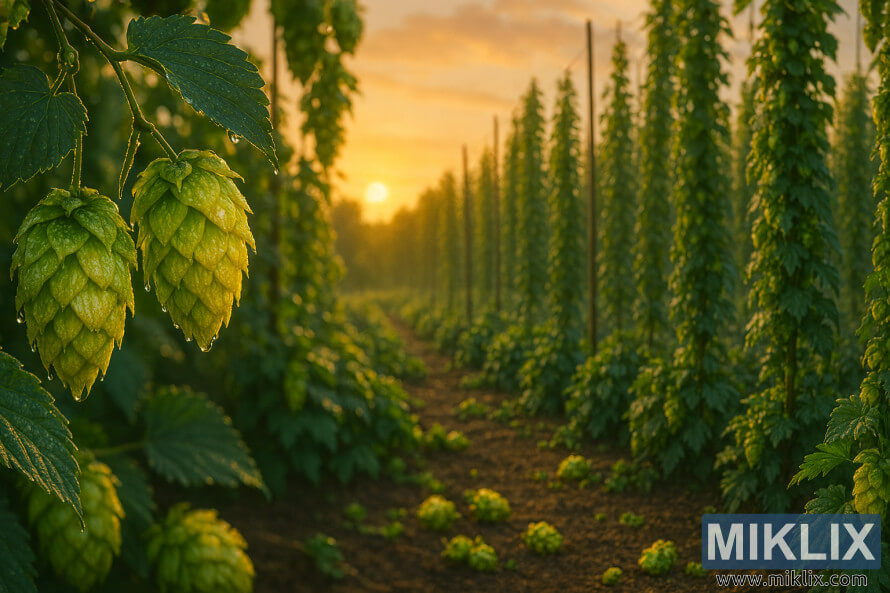
Click or tap the image for more information and higher resolutions.
Availability, forms, and storage recommendations
Summit hops are available from various suppliers across the United States. You can find them at specialty hop retailers, homebrew shops, and online platforms like Amazon. Prices and availability can fluctuate based on harvest year and lot size. It's essential to check current listings before planning your brew.
Both Summit hop pellets and whole-leaf forms are widely available. Many brewers opt for pellets due to their convenience and precise dosing. Pellets are more compact and easier to handle than whole cones, simplifying the brewing process.
Currently, concentrated lupulin products for Summit are scarce. Major processors like Yakima Chief Hops, BarthHaas, and Hopsteiner offer limited Cryo or Lupomax formats. Brewers should verify the availability of these products before making a purchase.
Proper storage is crucial to preserve the quality of Summit hops. An ideal storage condition has an HSI near 0.15, indicating stable storage potential. To maintain freshness, store hops in a vacuum-sealed container and keep them in a freezer.
Summit hop pellets can last for years when stored correctly. It's advisable to use older inventory first and store them in opaque, airtight bags. This prevents exposure to light and moisture. Ensure a consistent freezer temperature and avoid repeated thaw cycles.
Online hop retailers offer a range of payment options for convenience. You can use Visa, Mastercard, American Express, Discover, PayPal, Apple Pay, Google Pay, Diners Club, and more. Secure payment processors ensure that raw card details are not stored on merchant servers.
When purchasing Summit hops, compare suppliers based on price, harvest date, and quantity. Confirm whether the product is pellets or cones and inquire about packaging for optimal storage upon arrival.
Practical homebrew recipe ideas using Summit hops
When crafting a Summit homebrew recipe, begin with a solid plan. A 5.5-gallon full-grain base, using Rahr Premium Pilsner, Briess Caramel 40, Munich, Carapils, and Torrified Wheat, provides a balanced body. Mash at 148°F for 70 minutes, then sparge to collect about 7 gallons of wort.
Consider a Summit IPA recipe inspired by Morgan Street Brewery’s “Summit This, Summit That.” For the boil, add 0.25 oz Summit at 90 minutes and 0.25 oz at 60 minutes for gentle bittering. Add 0.8 oz at 15 minutes and 0.5 oz at 10 minutes to build hop flavor.
Include Irish moss at 10 minutes and whirlpool after flame-out to capture volatiles. For a Summit single-hop recipe, dry hop 2.25 oz of Summit pellets for seven days to showcase pine and citrus notes.
Ferment with White Labs Cry Havoc or a similar expressive ale yeast. Use a starter to ensure a healthy pitch, then follow a modest temperature profile to preserve hop clarity. Condition long enough to settle harsh esters while keeping hop aroma bright.
- Target carbonation of 2.75–3.0 volumes CO2 for a crisp mouthfeel.
- Serve cold at 38°F for a crisp finish or near 48°F to emphasize hop character.
- For hop timing tweaks, shift late additions slightly earlier to mute top-end aromas without losing bitterness.
Scaling Summit recipes requires careful planning. Use trusted brewing calculators like Beersmith or iBrewmaster to scale grain and hop amounts. Maintain hop utilization by adjusting bittering additions proportionally and keeping late additions on a weight-per-volume basis.
For substitutions, Summit performs well where Simcoe dominates. Swap Summit into Simcoe-heavy recipes to gain a darker, resinous pine character while preserving citrus lift. When scaling down, reduce late hop weights carefully to avoid overpowering smaller volumes.
Experiment with single-hop runs and small pilot batches to refine a Summit IPA recipe before committing to larger brews. Small, repeatable trials help dial in hop schedules, dry-hop quantities, and mash temps for consistent results in the homebrew kit.
Brewing techniques to maximize Summit’s strengths
Summit hops offer intense citrus and stone-fruit flavors when handled with precision. Late additions are key to highlighting volatile oils. High-temperature boils, however, can strip delicate aromas, emphasizing bitterness through alpha-acid isomerization.
Adjusting boil times is crucial to balance bitterness and aroma. Shorten the boil for late hops to five minutes or less for a brighter fruit character. Most Summit should be reserved for whirlpool and dry additions.
Run a cool whirlpool at 160–170°F to extract oils gently. This minimizes harshness. Let the wort rest for 15–30 minutes to enhance aroma adsorption into the beer. Lower whirlpool temperatures help preserve citrus esters.
Employ a gentle dry hop technique to enhance aroma. Use smaller hop masses over several days to avoid grassy or vegetal off-notes. Cold-side contact at 34–40°F is ideal for retaining Summit's aroma.
- Use small-weight high-alpha additions early for efficient bittering.
- Place most Summit in whirlpool or late additions for aroma.
- Stagger dry hops to avoid one large dose that can mute nuance.
Consider co-humulone and alpha-to-beta ratios when brewing. These impact perceived bitterness and mouthfeel. Adjust schedules and hop mass to balance sharp bitterness with fruit-forward aroma.
Store Summit hops in vacuum-sealed bags and refrigerated conditions to preserve oils. Fresh hops are essential for optimal aroma retention during whirlpool, hopstand, and dry hopping.
Industry insights and production statistics
Recent hop industry data reveals Summit's significant role in US hop production. By 2019, it ranked nineteenth in overall output, reflecting steady demand from commercial breweries.
Brewers prefer Summit for its high alpha acid content and efficient weight-per-IBU use. These characteristics reduce hop mass and freezer needs during large-scale brewing. This makes Summit hop production appealing for cost-conscious operations.
Growers appreciate Summit’s resistance to mold and fungus. This resilience lowers crop loss risks and boosts harvest reliability. It's a crucial factor in hop industry data on varietal adoption.
Summit hop statistics indicate stable demand tied to production efficiency. Commercial brewers and contract growers value predictable supply and handling benefits when planning annual sourcing.
Key points for stakeholders:
- Supply role: Summit supports portfolios where alpha efficiency matters in US hop production.
- Grower advantage: Resistance traits improve crop viability under varied conditions.
- Brewery impact: Reduced mass per IBU eases logistics and storage for high-volume breweries.
Keep an eye on trends in Summit hop statistics alongside broader hop industry data. This will help track shifts in acreage, yield, and commercial usage over time.
Common pitfalls and troubleshooting with Summit hops
Summit hop problems often stem from dosage issues. Summit hops have high alpha acids, leading to harsh bitterness if used excessively. To avoid this, reduce late-addition amounts by 20–40% when transitioning from milder varieties.
Overusing Summit hops can result in an overly concentrated hop character. This masks the yeast esters and malt nuances, making the beer taste one-dimensional. To soften the impact, consider reducing pellet mass or splitting late additions between whirlpool and dry hop.
Be cautious of Summit off-flavors that resemble garlic or onion. These sulfur notes can arise from interactions between hop compounds and hot-side enzymes or specific water chemistries. Enhancing sanitation and avoiding prolonged warm post-boil rest can help minimize their formation.
Boiling for extended periods can strip away the volatile oils responsible for Summit's citrus and resinous aroma. To preserve these oils, consider moving late additions to the whirlpool, using a hopstand at 170–180°F, or dry hopping. These techniques help retain the delicate oils and mitigate the risk of losing aromatic qualities.
Proper storage is crucial. Exposure to oxygen and heat can accelerate hop degradation and HSI, leading to dull or rubbery off-notes. To maintain freshness, vacuum-seal and freeze Summit pellets immediately after purchase. This approach helps reduce off-flavors over time.
- Reduce total hop mass to avoid Summit overuse.
- Shift late additions to whirlpool or hopstand to retain aroma.
- Keep post-boil exposure short and maintain good sanitation to prevent Summit sulfur notes.
- Store hops cold and oxygen-free to limit HSI and off-flavors.
When troubleshooting a batch, reproduce the beer at a smaller scale and change one variable at a time. Monitor hop weights, timing, and storage conditions closely. This method allows for pinpointing the cause of Summit hop problems and restoring balance effectively.
Conclusion
Summit hops summary: Summit is a high-alpha, semi-dwarf hop, ideal for efficient bittering. It also brings citrus, grapefruit, pepper, and resinous notes when used late or dry-hopped. With alpha acids between 15–17.5%, it allows brewers to reduce hop mass without losing flavor intensity. Its versatility makes it perfect for IPAs, pale ales, imperial IPAs, barleywines, stouts, and even single-hop lagers when balanced correctly.
For brewers looking to use Summit, it's best as a bittering hop. Reserve late additions or dry hops for aroma enhancement. Pairing it with Citra, Nugget, Chinook, Centennial, Amarillo, and Simcoe sharpens citrus and resin character. Herbal varieties can balance mid-boil. When Summit is not available, Columbus, Tomahawk, Zeus, Warrior, Millennium, Simcoe, Amarillo, and Cascade can be used as substitutes.
Summit brewing tips: store hops vacuum-sealed and frozen to preserve alpha acids and volatile oils. Summit is not yet common in lupulin powder from major processors. When buying online, expect secure payments like Apple Pay, PayPal, or major credit cards from reputable retailers. Used thoughtfully, Summit delivers concentrated bittering power with the option for expressive late-hop citrus and pepper notes.
Further Reading
If you enjoyed this post, you may also like these suggestions: