
A Guide to Growing Goji Berries in Your Home Garden
Published: December 1, 2025 at 8:54:29 PM UTC
Goji berries (Lycium barbarum) have gained popularity as a nutrient-packed superfood rich in antioxidants, vitamins, and minerals. These bright red berries not only offer impressive health benefits but also make an attractive and rewarding addition to your home garden. Whether you're a beginner or experienced gardener, growing goji berries can be a satisfying endeavor that provides years of nutritious harvests.

Click or tap the image for more information and higher resolutions.
This comprehensive guide will walk you through everything you need to know to successfully grow thriving goji berry plants right in your own backyard.
Health Benefits and Appeal of Homegrown Goji Berries
Before diving into growing techniques, it's worth understanding why goji berries have earned their "superfood" status. These small but mighty berries are packed with essential nutrients that support overall health:
- Rich in antioxidants that help fight free radicals
- Excellent source of vitamin A, supporting eye health
- Contains vitamin C, boosting immune function
- Provides essential minerals including iron, zinc, and selenium
- Contains all eight essential amino acids
Growing your own goji berries offers several advantages over store-bought options. Homegrown berries are fresher, free from commercial pesticides (when grown organically), and significantly more affordable than their often expensive store counterparts. Additionally, goji plants are visually attractive with their purple blossoms and bright red fruits, making them a beautiful addition to any garden landscape.

Click or tap the image for more information and higher resolutions.
Optimal Growing Conditions for Goji Berries
Climate and Hardiness Zones
Goji berry plants are remarkably adaptable and can thrive in a wide range of climates. They're recommended for USDA hardiness zones 3-10, making them suitable for most regions across the United States. These hardy plants can withstand temperatures as low as -15°F (-26°C) once established, though young plants may need protection during their first winter.
Sunlight Requirements
Goji berries perform best in full sun, requiring at least 6-8 hours of direct sunlight daily. While they can tolerate partial shade, especially in extremely hot climates where afternoon shade might be beneficial, insufficient sunlight will result in reduced flowering and fruit production.
Soil Preferences
One of the advantages of growing goji berries is their adaptability to various soil types. However, they do have some preferences:
- pH Level: Slightly alkaline soil with a pH between 6.8 and 8.1 is ideal (unlike many berries that prefer acidic soil)
- Soil Type: Well-draining, light loam soil works best
- Drainage: Good drainage is essential as goji plants don't tolerate waterlogged conditions
- Fertility: Moderate fertility is sufficient; overly rich soil can reduce fruit production
If your soil is heavy clay, consider amending it with organic matter or growing your goji berries in raised beds to improve drainage. For sandy soils, adding compost will help retain moisture and provide nutrients.
Step-by-Step Planting Instructions
Choosing Your Goji Berry Plants
You have three options for starting your goji berry journey:
Seeds
The most economical but slowest method. Goji seeds take 10-14 days to germinate and plants may not produce fruit for 2-3 years.

Click or tap the image for more information and higher resolutions.
Bare Root Plants
A good middle ground. These dormant plants establish quickly and typically produce fruit in their second year.

Click or tap the image for more information and higher resolutions.
Potted Plants
The fastest route to fruit production. Established potted plants may produce berries in their first year after transplanting.

Click or tap the image for more information and higher resolutions.
For named cultivars with reliable production, look for 'Crimson Star' (also known as Ningxia #1) or 'Phoenix Tears'. These varieties begin bearing fruit 1-2 years after planting and reach full production in 3-5 years.
Planting Process
- Timing: Plant in spring after all danger of frost has passed.
- Spacing: Space plants 2-4 feet apart within rows and 6-8 feet between rows.
- Hole preparation: Dig a hole twice as wide as the root ball but of equal depth.
- Planting depth: Set the plant at the same depth it was growing previously, with the crown at soil level.
- Backfilling: Fill in with soil, gently firming around the roots to eliminate air pockets.
- Watering: Water thoroughly after planting to help settle the soil.
- Mulching: Apply 2-3 inches of organic mulch around the base, keeping it away from the stem.

Click or tap the image for more information and higher resolutions.
Container Planting
Goji berries grow well in containers, making them suitable for patios, balconies, or small spaces:
- Choose a container at least 18 inches deep and wide with good drainage holes
- Use high-quality potting soil mixed with compost
- Position the container where it will receive at least 6 hours of sunlight
- Water more frequently than in-ground plants, as containers dry out faster
- Consider moving potted plants to a protected area during extreme winter conditions

Click or tap the image for more information and higher resolutions.
Care and Maintenance of Goji Berry Plants
Watering Schedule
Proper watering is crucial for goji berry success:
- Newly planted: Keep soil consistently moist but not soggy for the first few weeks
- Established plants: Water deeply once per week, providing approximately 1 inch of water
- During drought: Increase watering frequency, especially during fruit development
- Container plants: Check soil moisture daily during hot weather; water when the top inch feels dry
Goji berries are relatively drought-tolerant once established but produce better with consistent moisture. Avoid overhead watering which can promote fungal diseases; instead, water at the base of the plant.
Fertilization Needs
Goji berries don't require heavy fertilization and actually produce better with moderate fertility:
- Apply a balanced organic fertilizer (like 5-5-5) in early spring when growth begins
- Avoid high-nitrogen fertilizers which promote leafy growth at the expense of fruit production
- Consider a light application of compost around the base of plants annually
- For container plants, use a half-strength organic fertilizer every 4-6 weeks during the growing season

Click or tap the image for more information and higher resolutions.
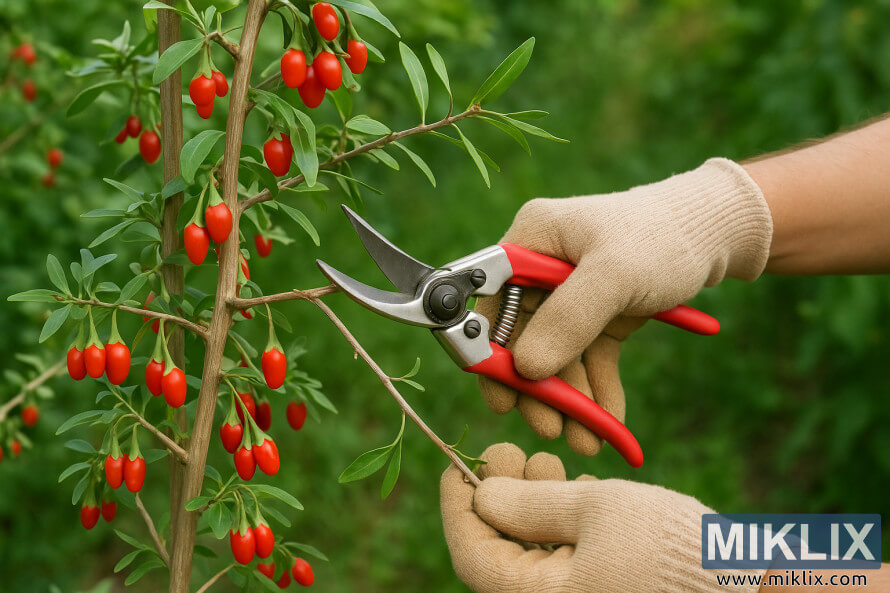
Pruning Techniques
Pruning is essential for maintaining plant health, encouraging new growth, and maximizing fruit production:
Year 1:
Minimal pruning needed. Allow the plant to establish its root system and gain strength.
Year 2:
- In late winter/early spring, select one strong central stem as the main trunk
- Remove competing stems and all branches within 15 inches of the ground
- When new growth reaches 24 inches, pinch the tips to encourage lateral branching
Year 3 and beyond:
- In late winter, remove dead, damaged, or crossing branches
- Thin out crowded areas to improve air circulation
- Shorten lateral branches by cutting back 6-18 inches from the tips
- Remove suckers that emerge from the base regularly
Click or tap the image for more information and higher resolutions.
Pest Management
Goji berries are relatively pest-resistant, but may occasionally face these challenges:
| Pest/Disease | Symptoms | Organic Control Methods |
| Aphids | Curled leaves, sticky residue, small green/black insects | Strong water spray, insecticidal soap, introduce ladybugs or lacewings |
| Spider Mites | Fine webbing, stippled yellowing leaves | Increase humidity, neem oil, insecticidal soap |
| Powdery Mildew | White powdery patches on leaves and stems | Improve air circulation, milk spray (1:10 ratio with water), organic fungicide |
| Goji Gall Mite | Small bead-like galls on leaves, yellow/green on bottom, reddish on top | Sulfur, insecticidal soap, horticultural oil (0.5% solution) |
Harvesting Your Goji Berries
Patience is key when growing goji berries. While some varieties may produce a small harvest in the first year, full production typically begins in years 2-3. Once established, a healthy plant can produce 2-6 pounds of berries annually.
When to Harvest
- Berries are ready to harvest when they reach full color (bright red) and are slightly soft to the touch
- This typically occurs about 35 days after flowering
- Harvest season runs from mid-summer through the first frost
- Berries do not ripen all at once, so expect to harvest continuously over several weeks
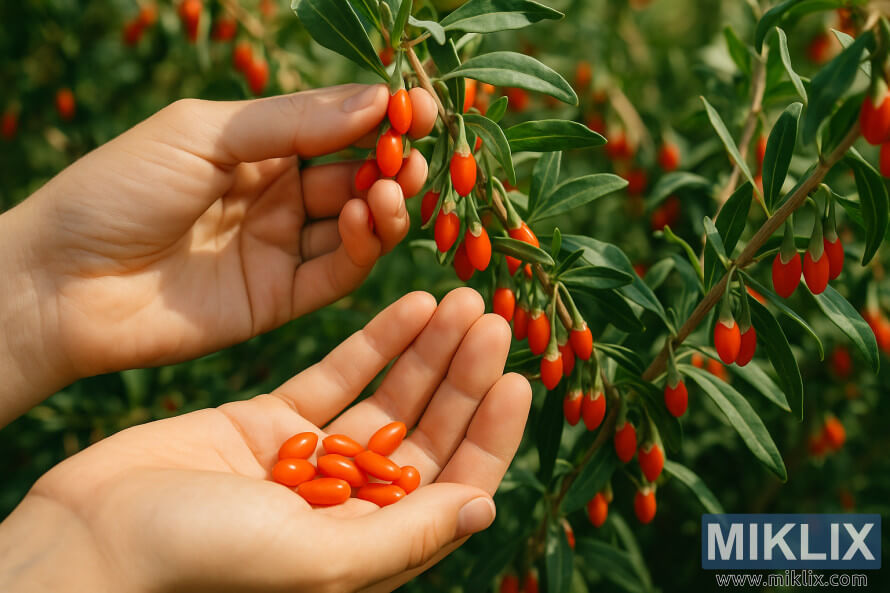
How to Harvest
Goji berries require gentle handling during harvest:
- Harvest in the morning when temperatures are cooler
- Gently pull berries to the side rather than straight up to minimize stem damage
- Place harvested berries in shallow containers to prevent crushing
- Refrigerate promptly if not using immediately
Fresh goji berries will keep for approximately 2 weeks in the refrigerator. For longer storage, consider drying, freezing, or juicing your harvest.
Click or tap the image for more information and higher resolutions.
Troubleshooting Common Problems
Plant Not Producing Fruit
- Problem: Insufficient sunlight
- Solution: Ensure plants receive at least 6 hours of direct sun daily
- Problem: Over-fertilization
- Solution: Reduce nitrogen fertilizer which promotes leafy growth at the expense of flowering
- Problem: Young plant (under 2 years)
- Solution: Be patient; full production begins in years 2-3
Yellowing Leaves
- Problem: Overwatering
- Solution: Reduce watering frequency and improve drainage
- Problem: Nutrient deficiency
- Solution: Apply balanced organic fertilizer
- Problem: Spider mites
- Solution: Treat with insecticidal soap or neem oil
Plant Becoming Unmanageable
- Problem: Excessive suckering
- Solution: Remove suckers regularly and implement annual pruning
- Problem: No structural pruning
- Solution: Establish a central leader and maintain open structure
Berries Turning Black
- Problem: Bruising during harvest
- Solution: Handle berries more gently
- Problem: Blossom end rot
- Solution: Maintain consistent soil moisture

Click or tap the image for more information and higher resolutions.
Storage and Usage Suggestions
Your goji berry harvest can be enjoyed in multiple ways:
Fresh Berries
- Store in refrigerator for up to 2 weeks
- Add to salads, yogurt, or eat as a snack
- Blend into smoothies

Click or tap the image for more information and higher resolutions.
Dried Berries
- Dry in dehydrator at 105°F for about 3 days
- Store in airtight container for up to 1 year
- Use in trail mix, baking, or rehydrate for tea

Click or tap the image for more information and higher resolutions.
Frozen Berries
- Freeze on tray then transfer to freezer bags
- Maintains color and flavor well
- Perfect for smoothies and cooking

Click or tap the image for more information and higher resolutions.
Creative Uses for Your Harvest
- Goji Berry Tea: Steep dried berries in hot water for an antioxidant-rich beverage
- Berry Sauce: Simmer with a little water and honey for a topping for desserts or breakfast
- Infused Vinegar: Add fresh berries to white wine vinegar for a flavorful salad dressing base
- Baked Goods: Add dried berries to cookies, muffins, and breads like you would raisins
- Homemade Energy Bars: Combine with nuts, seeds, and honey for nutritious snacks
Conclusion: Enjoying the Fruits of Your Labor
Growing goji berries at home is a rewarding experience that provides nutritional benefits while adding beauty to your garden. With proper care and maintenance, your goji berry plants can continue producing abundant harvests for 15-20 years. The key to success lies in providing adequate sunlight, proper pruning, and consistent but not excessive watering.
Remember that patience is important when growing goji berries. While you may see some fruit in the first year, the best harvests come in subsequent years as the plants mature. By following the guidelines in this comprehensive guide, you'll be well on your way to enjoying these nutritious berries straight from your garden.
Frequently Asked Questions
How long does it take for goji berries to produce fruit?
Goji berry plants may produce a small amount of fruit in their first year, but you can expect more substantial harvests beginning in the second year. Full production is typically reached in years 3-5.
Are goji berries difficult to grow?
Goji berries are relatively easy to grow compared to many other fruits. They're adaptable to various soil types, drought-tolerant once established, and resistant to many common pests and diseases. The main requirements are full sun and well-draining soil.
Can goji berries be grown in containers?
Yes, goji berries grow well in containers at least 18 inches deep and wide. Use high-quality potting soil, ensure good drainage, and be prepared to water more frequently than in-ground plants. Container-grown plants may also need winter protection in colder climates.
Further Reading
If you enjoyed this post, you may also like these suggestions:
- A Guide to Growing Celery in Your Own Garden
- A Complete Guide to Growing Peas in Your Own Garden
- How to Grow Watercress at Home: A Complete Beginner's Guide